SalesQL Pricing in 2026: One Credit Buys the Whole Contact, and the Table Got Smaller
SalesQL pricing checked on October 2, 2026: four plans from free to $119 a month, one credit per whole contact with phones included, a top plan that kept its price and dropped from 15 seats to 5, and the ten-rep arithmetic against Apollo, RocketReach and Clay.
SalesQL pricing in 2026 is four plans, Free with 50 credits a month, Basic at $39 a month, Professional at $79 and Premium at $119, 25% less on annual billing, where one credit reveals a prospect's emails, phones and company data and a search that finds nothing costs nothing.
A set menu is the friendliest page in a restaurant. One price for the table, every course included, no arithmetic over the starters. The catch, when there is one, is printed underneath the price, in the line that says how many people the table seats.
SalesQL pricing in 2026 is four plans, Free with 50 credits a month, Basic at $39 a month, Professional at $79 and Premium at $119, 25% less on annual billing, where one credit reveals a prospect’s emails, phones and company data and a search that finds nothing costs nothing (salesql.com/pricing, opened October 2, 2026). That makes SalesQL the set menu of contact data: one credit, the whole contact, phones included. It also makes it, at list, the cheapest contact on this site’s pricing pages by an order of magnitude. The line underneath changed this summer. The $119 plan kept its price and its credits, and the table shrank from 15 seats to 5.
The quick answer, three ways:
- SalesQL Basic, annual at $351. One rep or recruiter who prospects on LinkedIn and wants 24,000 whole contacts a year for about 1.5 cents each.
- SalesQL Professional plus seats. A small team that can share one credit pool: 3 seats included, extra seats at $45 a year each on annual billing.
- Supered Prospector, $540 a rep a year on your own Clay account. A team that already pays for Clay, where reps build lists from LinkedIn, a company site or the CRM record and the waterfall asks 200+ providers instead of one.
How much does SalesQL cost in 2026?
SalesQL publishes both billing cycles on its pricing page, so the table below needed no clicking. Annual plans are billed once a year, “$351 on Basic, $711 on Professional, $1,071 on Premium,” and “all your yearly credits are granted upfront.”
| SalesQL pricing (Oct 2, 2026) | Free | Basic | Professional | Premium |
|---|---|---|---|---|
| Monthly billing | $0 | $39 a month | $79 a month | $119 a month |
| Annual billing, per month | $0 | $29.25 | $59.25 | $89.25 |
| Billed for the year | $0 | $351 | $711 | $1,071 |
| Credits | 50 a month | 2,000 a month, 24,000 a year | 5,000 a month, 60,000 a year | 12,000 a month, 144,000 a year |
| Phones | Not included | In the same credit | In the same credit | In the same credit |
| Seats | 1 | 1, no extra seats | 3, add up to 100 at $5 a month | 5, add up to 100 at $5 a month |
| CSV enrichment | None | 1,000 rows a file | 5,000 rows a file | 50,000 rows a file |
| API and MCP | None | None | API (1,500 calls a day monthly, 5,000 annual) and MCP | API (4,000 and 20,000 a day) and MCP |
| Email verifier credits | 100 a month | 5,000 a month | 10,000 a month | 20,000 a month |
| Campaign recipients | 100 a month | 2,000 a month | 10,000 a month | 50,000 a month |
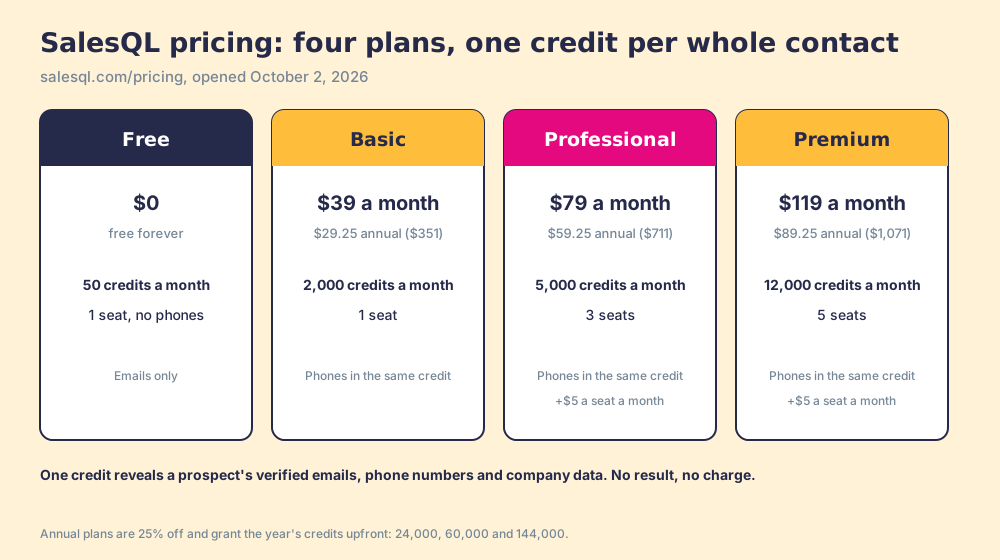
Two small print items. The API call limits carry an asterisk on the page: “Proposed daily limit, pending final validation.” In July 2026 the Professional plan showed 5,000 API calls a day on every billing cycle; on monthly billing it now shows 1,500. And SalesQL calls its own search screen “the Prospector,” as in “Select many contacts at once in the Prospector.” That is SalesQL’s feature. Supered Prospector, which appears later on this page, is a different product from a different company.
The page’s own numbers are SalesQL’s: “Loved by 800,000+ users,” a contact database of “200M+ professionals,” and “4.8, 917 reviews across 4 platforms.” The independent pieces check out close to that. The Chrome extension listing shows 100,000 users and 4.9 out of 5 from 649 ratings, updated September 22, 2026 (Chrome Web Store), and G2 shows 4.6 from 174 reviews (G2, SalesQL reviews), both checked October 2, 2026.
What does one SalesQL credit buy?
The whole course. The pricing page puts it in one line: “1 credit unlocks a prospect’s verified emails, phone numbers and company data. You’re only charged when we find results.” The credit table spells out the rest: a reveal is 1 credit, “No email found” is 0, CSV, API or MCP enrichment is 1 credit per enriched row or call, and verifying an address you already have uses a separate pool of verifier credits.
Most of SalesQL’s competitors price by the ingredient instead. Apollo charges 1 credit for an email and 8 for a phone, so 9 for both (apollo.io/pricing, October 2, 2026). Lusha charges 1 and 5, so 6. RocketReach meters the export, one per contact that leaves for a CSV or CRM. UpLead, like SalesQL, charges 1 credit per whole contact. Work each down to one email-and-phone contact at list, plan used in full:
| One email-and-phone contact, at list | Plan | Credits | Works out to |
|---|---|---|---|
| SalesQL Premium, annual | $1,071 for 144,000 | 1 | about 0.74 cents |
| SalesQL Professional, annual | $711 for 60,000 | 1 | about 1.2 cents |
| SalesQL Basic, annual | $351 for 24,000 | 1 | about 1.5 cents |
| SalesQL Basic, monthly | $39 for 2,000 | 1 | about 2 cents |
| Apollo Basic | $588 for 30,000 | 9 | about 18 cents |
| RocketReach Pro | $899 for 3,600 exports | 1 export | 25 cents |
| UpLead Plus, annual | $1,788 for 4,800 | 1 | about 37 cents |
| Lusha Starter | $449.10 for 4,800 | 6 | about 56 cents |
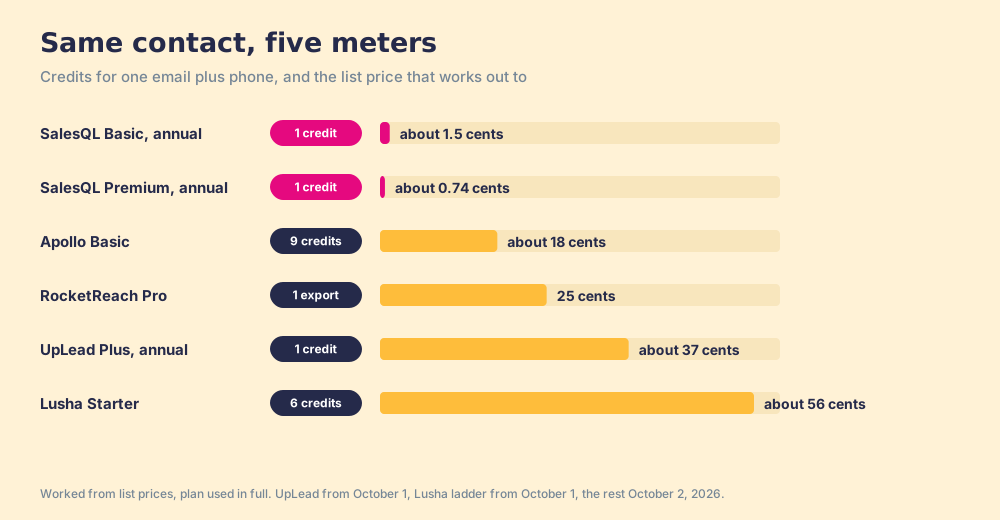
A twelve-fold gap with Apollo deserves suspicion before it deserves a purchase order, so think it through. A list price per credit says what a reveal costs when the reveal works. It says nothing about how often it works. SalesQL serves from one database, its own 200 million plus professionals, and charges only on a find, so the price of a contact it does not have is zero, and so is the contact. G2’s reviewers are split on the hit rate: they praise “accurate contact data” and also report email accuracy that varies from review to review. RocketReach, by contrast, publishes a claim of 85% or better fill for emails and 60% for direct phones; SalesQL publishes no fill rate on its pricing page.
The other word worth reading twice is “today.” The FAQ says “Phone numbers don’t cost extra credits today,” and the credit table repeats it. A vendor that writes “today” into its price list is telling you the phone may get its own price later. On an annual plan you are protected for the year you bought. Plan the renewal as if the phone might cost more.
So the set menu is a real bargain on paper. The test that turns it into a bargain on your list costs nothing: the free plan’s 50 credits a month reveal emails only, so start a Basic month at $39, run 100 contacts from your own won deals through it, and count the phones that connect.
What changed on the SalesQL pricing page in 2026?
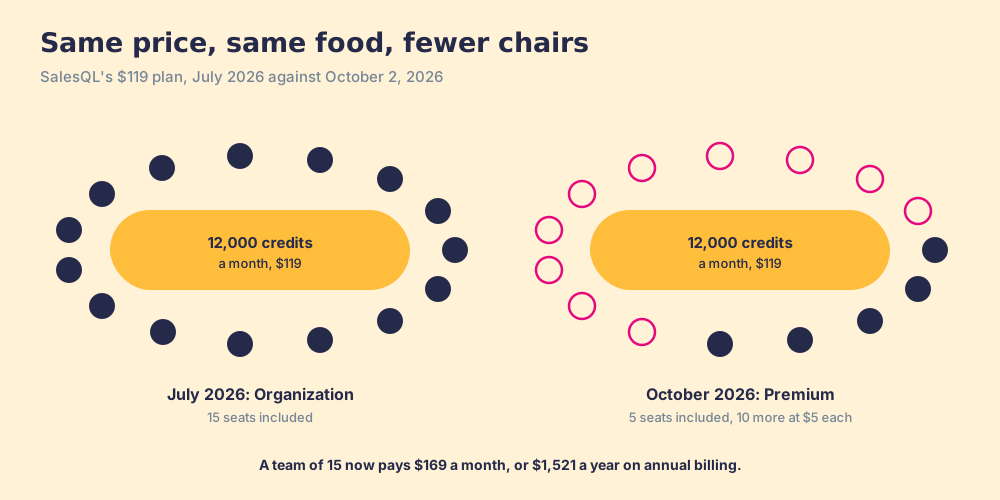
The menu kept its prices and moved its chairs. A Wayback Machine capture from July 10, 2026 shows three paid plans at $39, $79 and $119 a month with 2,000, 5,000 and 12,000 credits, the same as today. The top plan was called Organization, and it said “15 seats are included.” On October 2, 2026 the $119 plan is called Premium and includes 5 seats; seats beyond that cost $5 a month each, or $45 a year on annual billing.
For a team of five or fewer, nothing moved. For a team of fifteen, the monthly bill went from $119 to $169, because ten extra chairs at $5 each add $50 a month. Over twelve monthly payments that is $2,028 against $1,428, about 42% more for the same 144,000 credits a year. On annual billing, fifteen seats cost $1,071 plus ten extra seats at $45, so $1,521 a year.
Two older changes sit behind that one. An October 2025 capture showed a free plan with 100 credits and a semiannual billing option at $187.20 for six months of Basic; the free plan now gives 50 credits and the semiannual option is gone. And the site itself was mid-move on October 2, 2026: the changelog and two legal pages linked from the footer returned “We couldn’t find that page. The route may have changed during the migration.” None of this is sinister. Prices are the vendor’s to set, and a $5 seat is still cheap. It does mean a team-size buyer should price SalesQL from the current page, not from a review written last year, and should read the seat count before the credit count.
Is SalesQL cheaper on monthly or annual billing?
Annual, by 25% on every plan, and the annual buyer gets the credits on day one. Twelve months of Basic on monthly billing cost $468 against $351 annual, a saving of $117. Professional costs $948 against $711, saving $237. Premium costs $1,428 against $1,071, saving $357. The page’s own badges say the same: “Save $117/yr,” “Save $237/yr,” “Save $357/yr.”
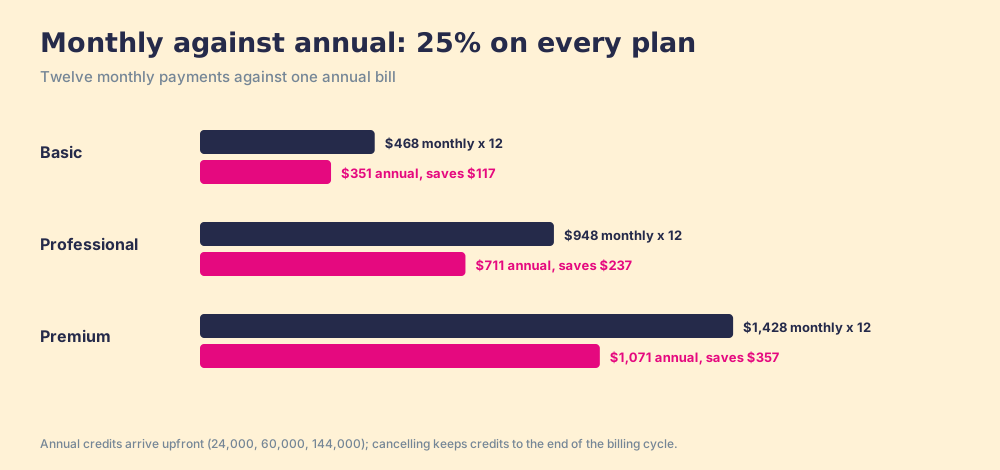
The exit terms are plain. “Your membership renews automatically at the end of each billing period,” and you “can cancel at any time. Once canceled, you can keep using the remaining credits until the current billing cycle ends.” The upfront grant cuts both ways: a rep can spend half the year’s credits in a busy March, and nothing comes back for the credits left at renewal. For anyone testing whether LinkedIn prospecting works for their market, one month at $39 is the cheaper experiment. For anyone who already knows, the monthly column is a 25% fee for flexibility.
What does SalesQL cost for a team of ten?
Less than almost anything else on this site, if the team can share a pool. Basic is a single seat with no extras, so ten reps on Basic means ten separate accounts: $3,510 a year on annual billing, 24,000 credits each, none of them shared. The cheaper route is one Professional plan with seven extra seats, $711 plus $315, so $1,026 a year for 60,000 pooled credits. That is about 6,000 contacts a rep a year, or 24 a working day across 250 days. Premium with five extra seats costs $1,071 plus $225, so $1,296 a year for 144,000 pooled credits.
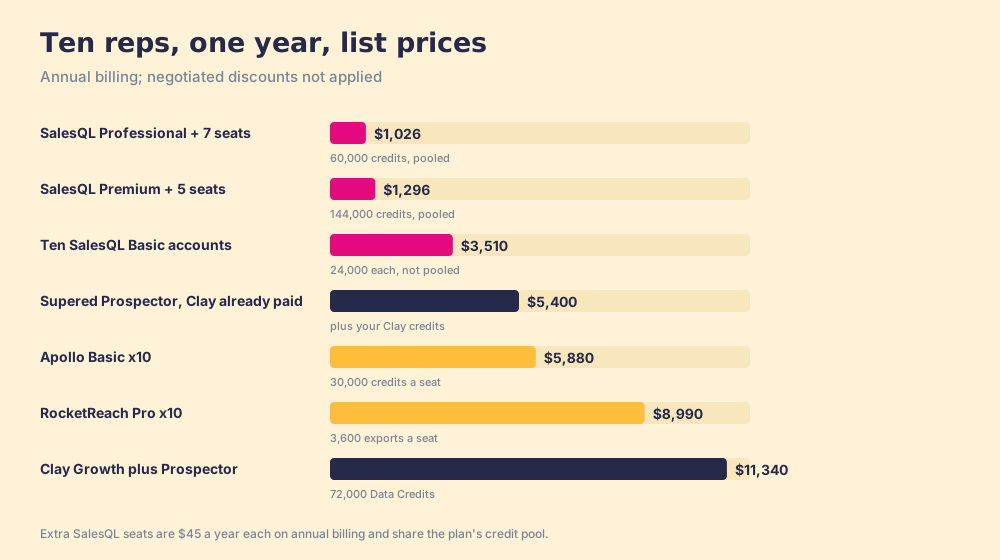
Against that, ten Apollo Basic seats list at $5,880 and ten RocketReach Pro seats at $8,990. On list price, SalesQL wins the ten-rep comparison outright, and it is not close. Two things narrow the gap in a real team. The first is the hit rate, covered above. The second is the CRM. SalesQL’s integrations page lists HubSpot, Zoho and Mailchimp as native, and Salesforce, Pipedrive, Salesloft and Outreach through Zapier (SalesQL integrations, October 2, 2026). A Salesforce or Pipedrive team pays for Zapier tasks and owns the mapping, which is cheap in dollars and dear in the hours someone spends fixing a broken zap.
Why do teams leave SalesQL?
Fair first. A 4.6 on G2 from 174 reviews, a 4.9 Chrome extension and a list price this low make SalesQL a sound purchase for one person prospecting on LinkedIn. A mid-market reviewer on G2 in March 2026 summed up its appeal: “I appreciate that I don’t need any technical experience to access contact details.”
The complaints gather in four places, and each is a buying criterion:
- The free tier. “The free version doesn’t provide many credits,” a small-business project manager wrote on G2 in October 2025. Fifty credits a month, emails only, is a sample, not a plan.
- Accuracy that varies. G2’s reviewers report email accuracy that swings from review to review, and SalesQL publishes no fill rate. One database has the contacts it has.
- Seats for growing teams. Past five people, the $119 plan now charges by the chair, and Basic cannot add a second seat at all.
- CRM depth. HubSpot is native; Salesforce and Pipedrive go through Zapier.
One more worry shows up in G2’s review summaries: LinkedIn account restrictions. SalesQL’s extension works on LinkedIn.com, Sales Navigator and Recruiter. This page makes no ruling on any vendor’s compliance. The fair test for any tool that touches a LinkedIn page, ours included, is three questions: what does it read from the page, where does the contact data come from, and is anything copied in bulk. Ask SalesQL, and ask us.
Why should you trust this breakdown?
We sell no contact data. Supered has no database of its own, on purpose; Prospector runs on Clay, our only data provider. So we gain nothing from whether you buy SalesQL, Apollo or RocketReach. Our stake is what reps do with a contact once it lands in the CRM.
Supered started inside RevPartners, the HubSpot partner I founded, which sold roughly twice as much Sales Hub as any other partner and reached HubSpot’s Elite tier in 13 months. Supered is the #1 sales enablement app on the HubSpot marketplace, with 6,000+ installs and a 5.0 rating from 122 reviews there, and on G2 it held a 4.9 out of 5 from 81 reviews on October 1, 2026 (G2, Supered reviews). Each SalesQL figure on this page links to the page it came from, opened today, and the July comparison comes from the Wayback Machine.
Which SalesQL plan, or which alternative, fits your team?
The grades use the five weights from our RocketReach pricing and UpLead pricing pages: coverage of the contact you need (x3), delivery where the rep already works (x2), price structure for a mid-market team (x2), what happens to the list after the export (x2), and bundled outreach (x1), out of 50. The weights serve one job, a team of five to fifty reps building its own lists. Flip the lens to “lowest price per contact” and SalesQL ranks first.
| Rank | Option | Grade | Best fit | CRM integration | Setup effort | Pricing (plan with the feature) | Reason to switch |
|---|---|---|---|---|---|---|---|
| 1 | Supered Prospector | A (44) | Teams already paying for Clay | Native: HubSpot, Salesforce, Pipedrive | Demo, then live in under a week on your own Clay account | $45 a rep a month, billed annually, plus your Clay plan | Clay’s waterfall across 200+ providers from the rep’s own screen; see which lists get worked and close |
| 2 | Apollo | A- (36) | Small teams wanting data plus sequencing | Native | Self-serve | Basic $49 a seat a month, annual | Sequences and a dialer in the same seat; G2 8.2 for contact accuracy |
| ref | SalesQL | B+ (31) | LinkedIn-first reps and small teams on one pool | HubSpot native; Salesforce and Pipedrive via Zapier | Self-serve, minutes | Basic $29.25 a month annual; Professional $59.25 plus $45 a seat a year | The cheapest whole contact at list, phones included |
| 3 | Lusha | B+ (29) | Low-commitment LinkedIn reps | Native HubSpot and Salesforce | Self-serve | Starter $449.10 a year | Free tier of 40 credits a month; Data Waterfall on every paid plan |
| 4 | RocketReach | B- (23) | Small teams that dial | Native from Pro | Self-serve | Pro $899 a seat a year | A posted export count with phones; misses refunded |
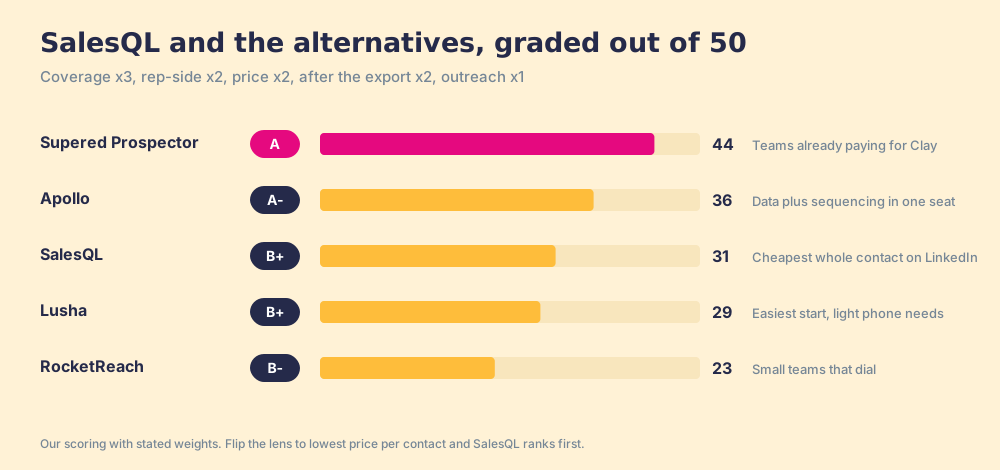
SalesQL’s 31 breaks down as coverage 3, rep-side delivery 4, price 5, what the leader sees 1, outreach 2. The price 5 is the easiest score on the page. The coverage 3 is one database with no published fill rate. The outreach 2 is for the new Campaigns feature, which sends to a monthly recipient quota without spending credits.
How does Supered Prospector compare to SalesQL pricing?
Go back to the restaurant. SalesQL is one good kitchen with a set menu: when the dish you ordered is not in the pantry, the bill is zero and so is the plate. Clay is the food hall next door: 200+ data and AI vendors under one contract (clay.com, checked October 2, 2026), and a waterfall that walks the order from stall to stall until one of them serves it. “If an enrichment returns no result, you’re not charged Data Credits or Actions” (clay.com/pricing). A set menu refunds the missing course. A food hall finds it somewhere else.
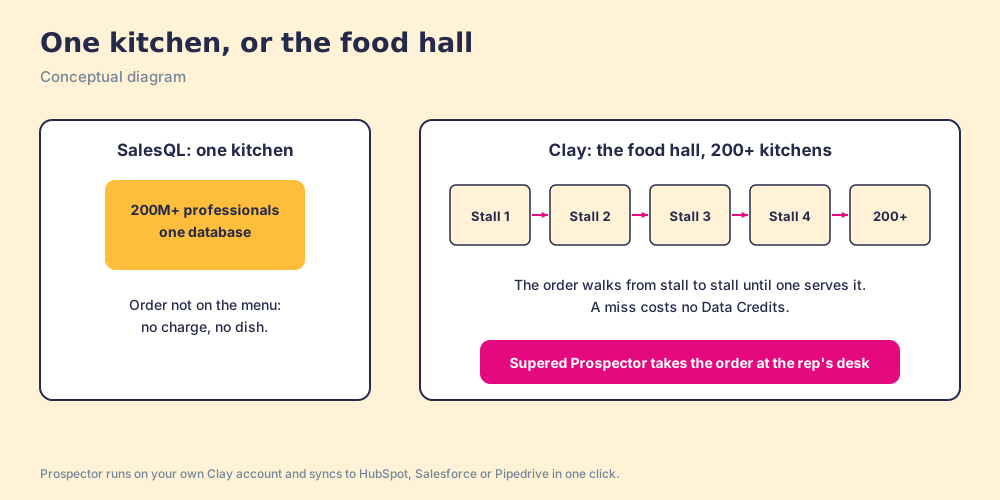
Prospector does not bring its own database. It brings Clay’s waterfall, which is every database, routed. The food hall has had one weakness: the GTM engineer builds the stalls and the order, and reps rarely walk in. Prospector puts what the GTM engineer built in the rep’s hands, where the rep already works:
- Where the rep already is. A LinkedIn profile, a Sales Navigator list, a company’s website, or a HubSpot, Salesforce or Pipedrive record. One click runs the waterfall, and reps never log in to Clay. Prospector runs inside the Supered Chrome extension, works within LinkedIn’s terms and does not copy search results in bulk.
- A check before the duplicate. On a LinkedIn profile, the rep sees whether the person already has a matching record in the CRM, who owns it, and whether the prospect was worked in the past.
- The GTM engineer’s tables, on a button. Any custom Clay workflow runs from Prospector, a whole list can go into a Clay workflow, and the buying-committee lookup is tuned by title, department and seniority.
- The list after the export. The contact arrives in the CRM with the team’s process applied, and the manager sees which lists get worked and which ones close, then coaches from what is converting.
Prospector is $45 per rep per month, billed annually, from one user (Prospector, Supered pricing). It runs on your Clay account and your Clay credits. Ten reps on a Clay account you already pay for add $5,400 a year; ten reps plus Clay Growth at its $495 monthly rate, with 72,000 Data Credits a year, cost $11,340. Both are more than SalesQL’s $1,026 for ten pooled seats, and this page will not pretend otherwise. The case for the food hall is the miss: when one kitchen does not have the phone, a waterfall asks the next provider, and the leader can see which lists turned into pipeline. The sourcing use case walks the rep’s side.
Choose something else if any of these is true:
- No Clay account. Prospector needs one. One person or a small team without Clay is better served by SalesQL on Basic or Professional.
- No waterfall owner. Someone decides which providers sit in which order. If no one on the team owns that, a single database with a posted price is less work.
- Outreach from the same vendor. If you want data, sequencing and a dialer in one seat, Apollo’s pricing bundles them.
How does SalesQL pricing compare with Lusha, Apollo and RocketReach?
The SalesQL alternatives below all sell contacts; the useful question is which one fits the job.
- Lusha. The closest in audience: a LinkedIn extension for individuals. Lusha charges 1 credit for an email and 5 for a phone, so Starter’s 4,800 credits a year at $449.10 cover about 800 email-and-phone contacts. SalesQL Basic annual covers 24,000 for $351. Lusha’s case is its free tier of 40 credits a month and a fallback to third-party providers on every paid plan. Lusha pricing has the ladder.
- Apollo. A different product: data plus sequences, a dialer and a pooled credit balance, Basic at $49 a seat a month on annual billing. Per contact, Apollo costs about twelve times as much at list. Per workflow, it replaces a sequencer you would otherwise buy. Apollo pricing walks the meter.
- RocketReach. Pro is $899 a seat a year for 3,600 exports with phones and unlimited annual lookups. RocketReach publishes fill-rate claims and refunds misses; SalesQL charges nothing for a miss and publishes no fill rate. RocketReach pricing explains its export meter, and RocketReach vs Apollo prices the two meters against each other.
- UpLead. The other one-credit, whole-contact menu, at about 37 cents a contact on Plus annual and single-user seats on its self-serve plans. UpLead pricing covers its trial default.
What we recommend
Three ways forward, and our view on each.
- One rep, LinkedIn-first. Buy SalesQL Basic for one month at $39, run 100 contacts from your own won deals through it, and count the phones that connect. If the hit rate holds, move to annual at $351 and take the 24,000 credits upfront.
- A team of three to ten without Clay. Buy one Professional plan and add seats at $45 a year each, so the whole team draws on one pool. Read the seat count before you sign, and if you run Salesforce or Pipedrive, price the Zapier work before you call it cheap.
- A team with Clay. Skip the second database and run Clay’s waterfall from where reps already work with Supered Prospector, at $540 a rep a year, where a miss sends the request to the next provider instead of back to the rep.
A set menu is the friendliest page in a restaurant, and SalesQL’s is close to the friendliest in contact data: one credit, the whole contact, a free plan and a posted price for every seat. Read the line underneath anyway. The chairs moved this summer, the phone is free “today,” and the cheapest contact is only cheap if it rings. For a team on Clay, a Prospector demo shows the food hall running on your own account.
Frequently asked questions
How much does SalesQL cost in 2026?+
What does one SalesQL credit buy?+
Is SalesQL free?+
How many users can share a SalesQL plan?+
Is SalesQL cheaper than Apollo or RocketReach?+
What are the best SalesQL alternatives?+
Everything we have written on SalesQL
More on SalesQL
Looking past SalesQL? See Supered Prospector on your own Clay accountYour Clay waterfall, where reps already work.