Dropcontact Alternatives in 2026: The Locksmith, the Key Cabinet, and the Ring
Dropcontact checks business emails with its own algorithms on EU servers instead of a database.
Dropcontact alternatives graded for a sales team, Dropcontact pricing per found email, two benchmarks with two winners, and why a Clay team can keep it as a step.
Dropcontact alternatives are the tools teams weigh against Dropcontact, a French email finder that checks addresses with its own algorithms on EU servers instead of a database: finders like Findymail, waterfalls like FullEnrich, phone databases like Kaspr, or Clay's waterfall.
Dropcontact alternatives come up for two kinds of team. One is a sales team that bought Dropcontact for clean, GDPR-careful emails and found its reps still need a mobile number, on a LinkedIn profile, today. The other already pays for Clay and has started to wonder why it also pays for a separate email finder. The short answer, graded in full below:
- Supered Prospector. For teams that already run Clay: Clay’s waterfall across 200+ providers, Dropcontact among them if you want it, run by reps from a LinkedIn profile, a company website or the CRM record, at $45 per rep per month billed annually.
- Findymail. A French-built finder with phones outside the EU, a credit refund if bounces pass 5%, and a Chrome extension, from $99 a month for the whole team.
- Kaspr. European mobile numbers from LinkedIn, part of Cognism, from $49 a user a month on annual billing.
Dropcontact alternatives are the tools teams weigh against Dropcontact, a French email finder that checks addresses with its own algorithms on EU servers instead of a database: finders like Findymail, waterfalls like FullEnrich, phone databases like Kaspr, or Clay’s waterfall. Dropcontact’s own pricing page carries a headline aimed straight at that last group: “The Email Finder that Outperforms Waterfalls” (dropcontact.com/pricing, opened October 2, 2026). This page works Dropcontact pricing out to the cost of one found email, checks that headline against a second benchmark, and grades the field. One point the other lists skip: Dropcontact is a step inside Clay, so for a Clay team, the best Dropcontact alternative can contain Dropcontact.
What is Dropcontact, and why does it say it beats waterfalls?
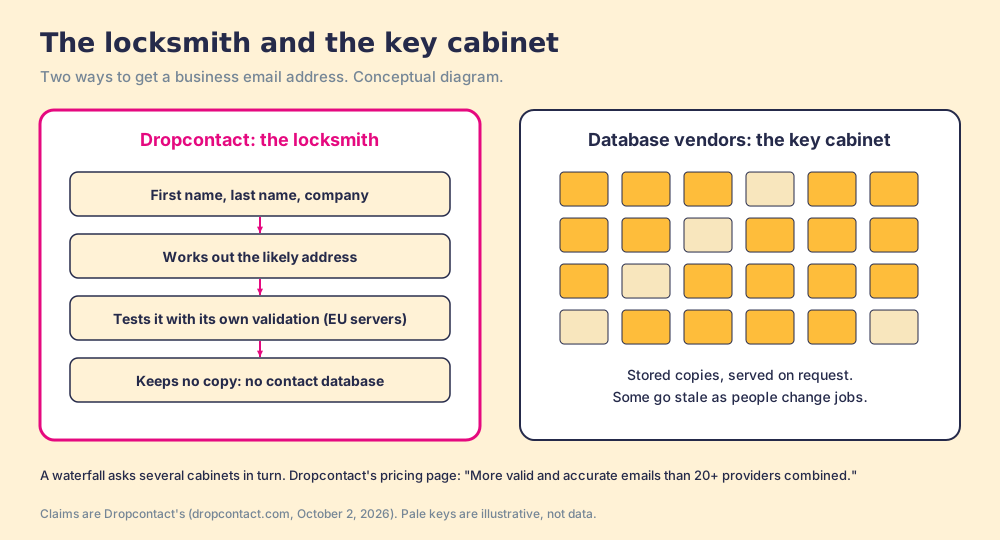
A locksmith and a key cabinet both get you through a locked door. The key cabinet holds copies: someone cut them once, hung them on hooks, and hands you the one labeled with your door, if it is there and if the lock has not been changed since. The locksmith carries no copies. He looks at the lock, works out the pattern, cuts a key, and tries it in the door before he hands it over.
Most contact-data vendors are key cabinets. Dropcontact sells itself as the locksmith. Its pricing FAQ says: “Unlike waterfall enrichment tools, which aim to collect as many email addresses as possible, Dropcontact operates exclusively with algorithms and does not use any contact databases. We also have our own email address verification and validation solution to guarantee 99% validity of the data provided.” Its homepage adds that “A website, a first name, and a last name are all it takes,” that it “uses proprietary algorithms and test servers to find, verify, and validate all data,” and that “No personal information is stored or resold” (dropcontact.com, October 2, 2026). The validation, it says, runs “exclusively by our own native algorithms on EU-based servers.”
The European part of the story is unusually well documented. Dropcontact publishes the letter in which the president of the CNIL, France’s data protection authority, notified it on November 6, 2020 that investigation no. 2019-168C was closed, after an online inspection and an on-site hearing in 2019, and it says the CNIL’s January 27, 2022 recommendation on opt-out suppression lists describes a hashing method Dropcontact had used since 2018 (Dropcontact benchmark page). For a data protection officer, that paper trail is worth more than a badge.
A locksmith needs a lock in front of him: a name and a company. He does not carry phone numbers, and he does not stand next to the rep on LinkedIn. The alternatives start where his trade stops.
What does Dropcontact cost in 2026?
Dropcontact pricing is two Email Finder plans priced by credit volume, plus an Enterprise tier and a separate CRM enrichment subscription. The page shows prices in euros and loads the ladder in its structured data, which we read on October 2, 2026.
| Credits a month | Starter, monthly | Starter, annual (per month) | Growth, monthly | Growth, annual (per month) | Starter per email, monthly |
|---|---|---|---|---|---|
| 500 | €29 | €24 | €35 | €29 | about 5.8 euro cents |
| 1,500 | €59 | €49 | €72 | €60 | about 3.9 euro cents |
| 4,000 | €79 | €66 | €120 | €100 | about 2.0 euro cents |
| 11,000 | €199 | €166 | €303 | €253 | about 1.8 euro cents |
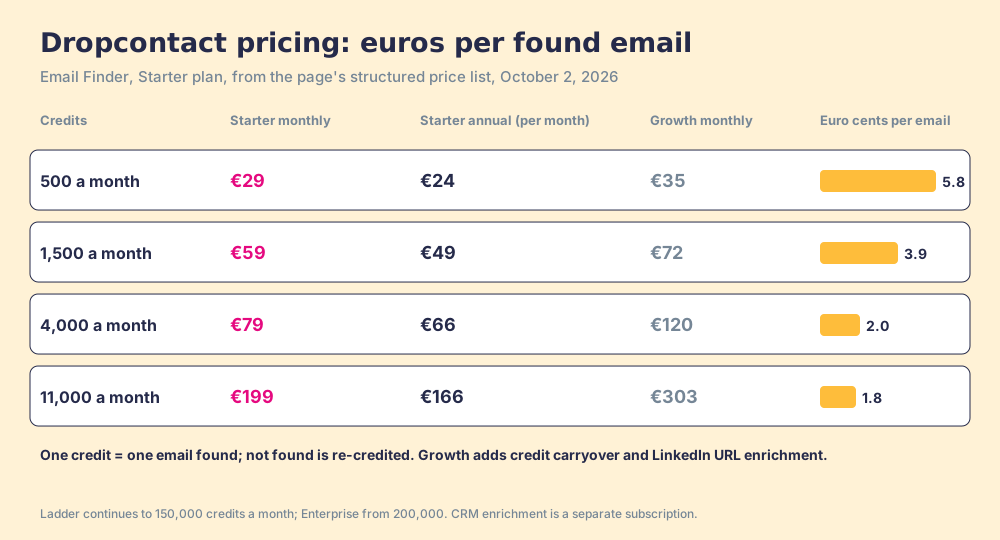
The meter is simple and fair. “Pay on success”: one credit per email found, and “In case an email is not found by Dropcontact, it will be re-credited to you.” The ladder runs to 150,000 credits a month, and Enterprise starts “From 200,000 credits / month.” New accounts get “50 free credits.” Starter includes email validation, catch-all verification, file enrichment, the API and MCP access, and a Google Sheets add-on. Growth adds “Credits carry over,” “LinkedIn enrichment, no login required,” LinkedIn URL enrichment, job cleaning, company change detection and company data.
Three lines change the arithmetic.
- Two separate wallets. “The Email Finder subscription and the CRM enrichment subscription are two differents plans. You can not use your Email Finder credits to enrich your CRM.” A team that wants both finder lookups and enrichment inside HubSpot, Pipedrive or Salesforce buys twice.
- The annual discount. The toggle says “-20%.” On the structured price list it ranges from about 16% (€79 to €66 at 4,000 credits) to about 17% (€29 to €24 at 500). Close enough, but check it.
- No commitment on monthly. “Dropcontact works on a monthly subscription with no commitment required.” Subscribe for one file, cancel, and keep access to the end of the billing period.
A Dropcontact email at 4,000 credits a month costs about 2 euro cents. The neighbors, at list: Findymail about 2 cents ($99 for 5,000 credits), Icypeas about 1 cent ($39 for 4,000 found emails), Hunter about 1.7 cents on its yearly Starter plan, FullEnrich about 5.5 cents ($55 for 1,000 credits). Dropcontact sits in the middle of the email-only market on price. Its argument is quality, which is where the benchmarks come in.
Does Dropcontact find more emails than a waterfall?
Dropcontact says yes, with a study behind it. In its Email Finder benchmark, updated February 2026, it sent the same file of 20,000 real contacts (9,800 US, 9,700 European, 500 elsewhere), with only first name, last name and company name, to 15 tools; sent a live email to every address found to count real hard bounces; and checked every company domain by double data entry (Dropcontact, Email Finder Benchmark). It subtracted bounces and wrong domains from the raw find rate to get a “real enrichment rate.”
On that measure Dropcontact ranked first at 54.9% usable, ahead of FullEnrich at 48.3%, Enrow at 40.9%, Findymail at 39.9% and BetterContact at 37.2%; Hunter scored 32.5%. On raw finds the order shifts: FullEnrich, a waterfall, found addresses for 57.0% of contacts against Dropcontact’s 55.9%, then lost points to a 3.6% hard bounce rate and 11.7% wrong domains. Dropcontact’s own error rate was 1.9%. The study discloses its author in its own words: “Yes, the author of this study is also the CEO of one of the tools tested.”
Clay runs a different test. Its North American work-email benchmark, last run October 22, 2025, scored 13 providers on coverage and quality, and ranked Findymail first at 90.26% coverage, then FullEnrich at 83.17%, BetterContact at 81.66% and Dropcontact at 75.45%, with a quality score of 91.81 for Dropcontact (Clay data test). Clay scores validity with five verifiers, one of which is Findymail, and Clay discloses that too.
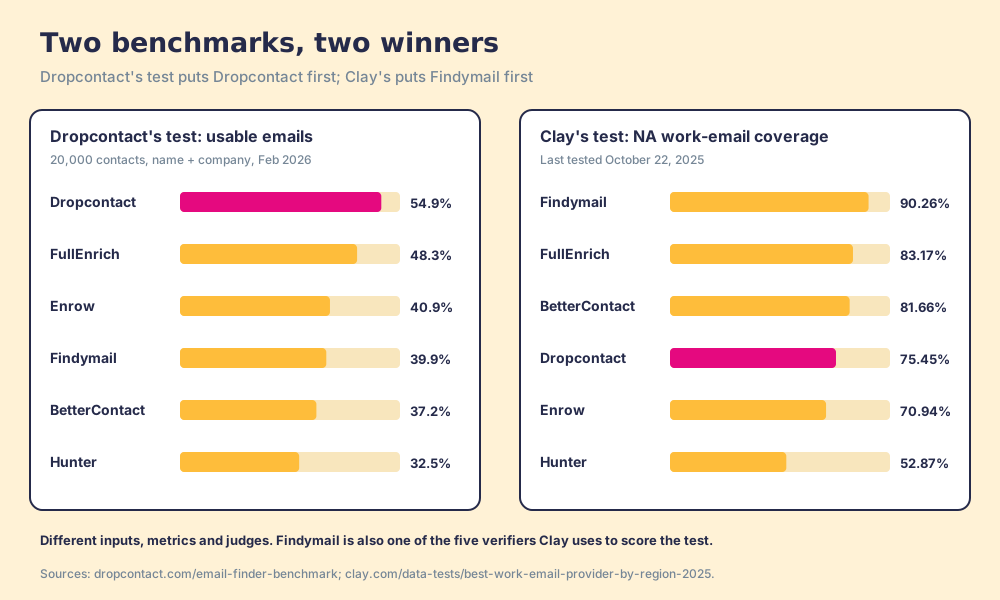
Both tests are serious, and they measure different things with different judges. Dropcontact’s test starts from the hardest input a finder sees, a name and a company with no website, and punishes wrong domains, which favors a tool that works out the domain carefully. Clay’s coverage figures come from a different input set and a verifier panel. FullEnrich places second in both, a point for waterfalls.
So the useful lesson for a buyer sits one level up from either ranking. A benchmark run by a vendor is a vendor’s argument, written down with its method attached, and both of these publish the method, which makes them possible to check. The test that settles your purchase is the one you run: 200 contacts from deals you already won, in the countries you sell into, entered the way your reps enter them, through the two or three tools on your shortlist in the same week, with bounces and wrong domains counted by hand. Waterfall enrichment explains why the order of providers changes the answer.
Why do teams look for Dropcontact alternatives?
Dropcontact is well regarded. It held 4.5 out of 5 from 50 reviews on G2 on October 2, 2026, newest dated September 29 (G2, Dropcontact reviews), and an owner of a small business wrote in February 2026 that its email data “is very accurate.” The reasons teams look elsewhere are mostly about jobs Dropcontact does not try to do.
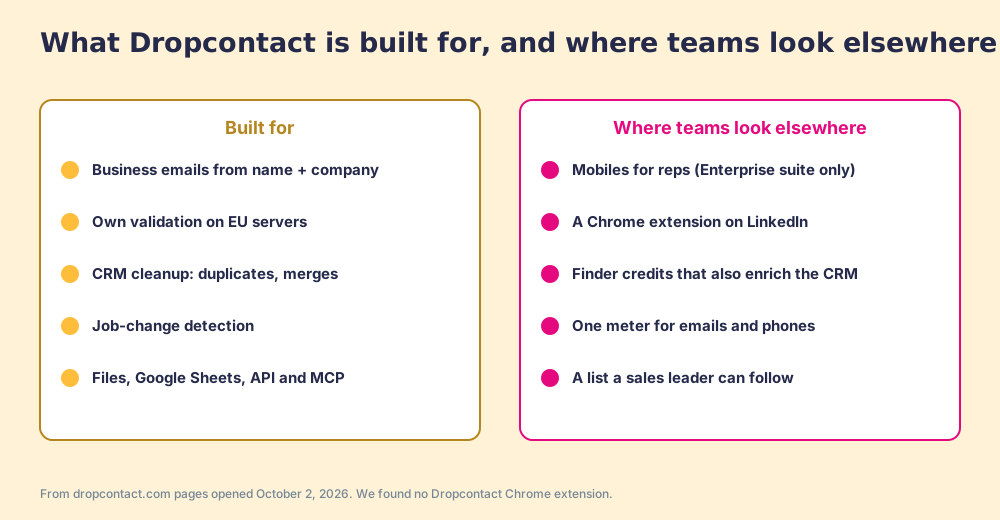
- Phones for reps. The Email Finder plans are priced per email. Mobile numbers appear in Dropcontact’s Enterprise CRM suite, “sourced from signature extraction within internal email flows,” and in job-change updates. A rep who wants to dial a prospect from LinkedIn today needs another source.
- No rep surface on LinkedIn. We found no Dropcontact Chrome extension. Growth adds LinkedIn URL enrichment, and Dropcontact’s site pages pair it with LinkedIn tools such as Evaboot and Dux-Soup. The rep in Sales Navigator works through a file or a partner tool.
- Two wallets. Email Finder credits cannot enrich the CRM, so finder and CRM enrichment are two subscriptions.
- Credit surprises. One G2 reviewer in May 2026 wrote that they had “enriched 235 emails via API but was charged ~500 credits.”
- CRM wording. The pricing page lists native HubSpot, Pipedrive and Salesforce integrations; the homepage, the same day, says Dropcontact “natively integrates with Pipedrive, HubSpot, and soon Salesforce and Zoho CRM.” Salesforce teams should ask which is current.
Why trust this comparison?
I started RevPartners, a HubSpot partner that did only sales implementations, sold roughly twice as much Sales Hub as any other partner, and reached Elite tier in 13 months. Supered came out of that work and is the #1 sales enablement app on the HubSpot marketplace. That is also the disclosure: we make Supered Prospector, and it sits first on this page for teams that have Clay. Supered holds 4.9 out of 5 from 81 reviews on G2 and 5.0 from 122 on the HubSpot App Marketplace (both checked October 1, 2026), and Supered is SOC 2 Type II and GDPR compliant. The grading below states its weights so you can flip them, and the flip for a European CRM cleanup job puts Dropcontact on top.
The Dropcontact alternatives, graded
The lens is a mid-market or SMB sales team, ten to fifty reps, that needs verified emails and mobiles reps will use where they already work, and a leader who can see which lists turn into pipeline. Each criterion is scored 1 to 5 and multiplied by its weight, for a maximum of 50. The per-vendor scores match the FullEnrich alternatives page and the Kaspr alternatives page, so the pages read together.
| Criterion | Weight | What it rewards |
|---|---|---|
| Coverage of the contact you need | 30% (x3) | Verified emails and mobiles when the first source misses |
| Rep-side delivery | 20% (x2) | Works on the profile, the company site, the CRM record; no new tab or file |
| Price structure for a team | 20% (x2) | Published, per-result, buyable for the whole team |
| What the leader sees after the export | 20% (x2) | Which sourced lists were worked and which closed |
| Bundled outreach | 10% (x1) | Sequencing, dialer, drafting in the same plan |
| Rank | Tool | Grade | Score | Best fit | CRM integration | Setup effort | Pricing (plan with the feature) | Reason to switch from Dropcontact |
|---|---|---|---|---|---|---|---|---|
| ref | Dropcontact | B- | 24 | EU-first email finding and CRM cleanup | HubSpot, Pipedrive; Salesforce listed on pricing, “soon” on homepage | Minutes for files; under 5 minutes for CRM, per Dropcontact | Starter from €29 a month for 500 emails | Stay for a DPO-led cleanup job |
| 1 | Supered Prospector | A | 44 | Teams that already have Clay | Native (HubSpot, Salesforce, Pipedrive) | Under a week on an existing Clay account | $45 per rep per month, billed annually, plus your Clay plan | 200+ providers in an order you set, Dropcontact among them if you choose, plus phones, run from LinkedIn and the CRM record |
| 2 | Findymail | B+ | 29 | Emails plus non-EU mobiles, one pool | Native (HubSpot, Salesforce, Pipedrive, Clay) | Minutes | Starter $99 a month for the team | Phones at 10 credits, a Chrome extension, a bounce refund |
| 3 | FullEnrich | B | 27 | A ready-made waterfall for a team with no Clay | HubSpot native; others via Zapier, Make, API | Minutes | Pro from $29 a month, $55 for 1,000 credits; unlimited users | 25+ providers, mobiles at 10 credits |
| 4 | Cognism | B | 26 | EMEA phones at enterprise prices | Native | Sales-led contract | Quote; Vendr median $32,750 a year | Phone-verified European mobiles and do-not-call screening |
| 5 | Kaspr | B- | 25 | European phones from LinkedIn | Native (HubSpot, Salesforce, Pipedrive) | Minutes | Starter $49 a user a month, annual | Unlimited B2B emails, 100 phone credits a month, a LinkedIn extension |
| 6 | Icypeas | B- | 23 | The cheapest found email | Make, Zapier, n8n, API, MCP | Minutes | Basic $19 a month for 1,000 found emails | About 1 cent an email at volume, credits roll over |
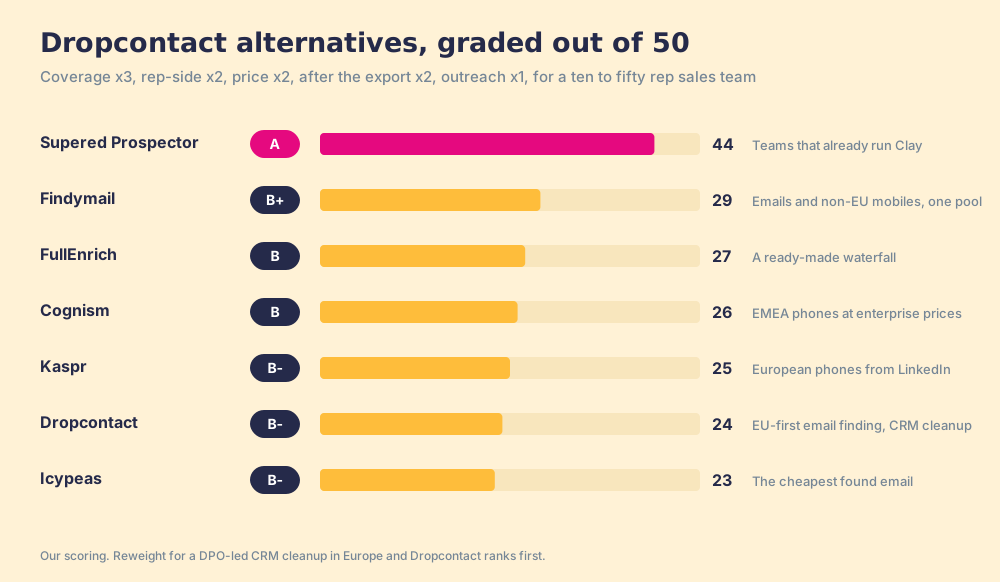
Dropcontact’s 24 breaks down as coverage 3, rep-side delivery 2, price structure 4, what the leader sees 1, outreach 1. The coverage 3 is strong email quality held back by the missing rep-facing phone. The price 4 is pay-on-success with no commitment, losing a point for the second wallet. The rep-side 2 is the missing LinkedIn surface. Prospector’s coverage score is Clay’s waterfall coverage, credited to Clay, and its outreach score is the lowest on the card on purpose: no sequencer, dialer or drafting.
Corporate status, checked October 2, 2026. Dropcontact is independent, led by founder and CEO Denis Cohen; a news search found no 2026 acquisition or funding round. Kaspr is “part of Cognism” and joined it in 2022. FullEnrich raised a €1.9 million seed round in February 2025 and a search found no 2026 deal. A search found no 2026 acquisition of Findymail or Icypeas.
Where does Supered Prospector fit?
Back to the locksmith. A master key ring holds the locksmith’s best keys and the cabinet’s, in an order someone chose, and it hangs on the belt of the person standing at the door. Clay is the ring: 200+ data and AI vendors under one contract (clay.com, checked October 2, 2026), with a waterfall that tries each provider in the order your GTM engineer sets and stops at the first verified result. “If an enrichment returns no result, you’re not charged Data Credits or Actions” (clay.com/pricing). Dropcontact is already on the ring. Clay’s Dropcontact page shows it joined on July 1, 2023, with “Enrich Person with Dropcontact” and “Find Work Email with Dropcontact,” each paid with “Clay Credits or Bring Your Own Account” (Clay, Dropcontact); in Clay’s North American test it cost 1 Clay credit per lookup.
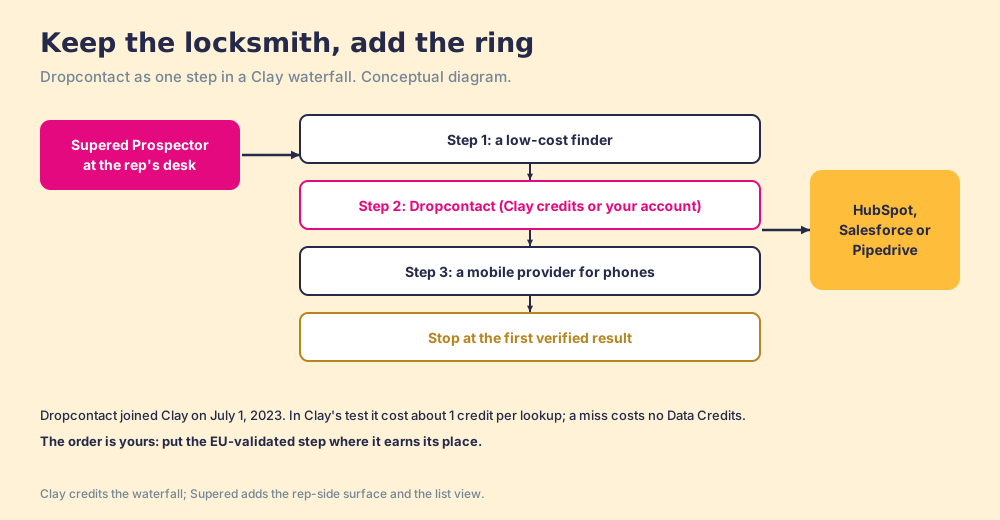
Prospector does not bring its own database. It brings Clay’s waterfall, which is every database, routed, the locksmith included if you want him. We chose Clay as our only data provider for that reason. Clay governs the data. Supered governs the motion.
What a rep gets from Prospector, on the team’s own Clay account and with no Clay login:
- Lookups from the page they are on. A LinkedIn profile, a Sales Navigator list, a company’s website with company research alongside, or a HubSpot, Salesforce or Pipedrive record. Prospector runs inside the Supered Chrome extension, works within LinkedIn’s terms and does not copy search results in bulk; the contact data comes from Clay’s waterfall on your Clay account. Ask any vendor what it reads from a LinkedIn page, ours included.
- Emails and phones in one pass. The waterfall fills the email in the order the GTM engineer set, Dropcontact included if it earns its place, and a mobile step behind it, so the rep gets both without a second tool.
- Context before the first touch. On a LinkedIn profile, the rep sees the matching CRM record, who owns it, and whether the prospect was already worked.
- One click to the CRM, or into a workflow. Field mapping is set once; a contact syncs to HubSpot, Salesforce or Pipedrive in one click, and a whole list can be pushed into any custom Clay workflow.
- Lists the leader can follow. The team’s process applies to worked prospects, so the manager sees which sourced lists were worked and which closed, and coaches from what is converting.
The arithmetic for ten reps. Prospector is $45 per rep per month billed annually, from one rep (Prospector), so ten reps on a Clay account you already pay for add $5,400 a year. If you are buying Clay for this, Clay Growth at its $495 monthly rate is $5,940 a year with 72,000 Data Credits, so the total is $11,340. Dropcontact’s 11,000-credit Starter plan costs €199 a month on monthly billing, about €2,388 a year, for emails only. The Clay row is not the cheapest line. Its case rests on three things the locksmith alone cannot sell: the phone behind the email, the rep’s own surface on LinkedIn and in the CRM, and a list a leader can follow to closed.
Choose something else if any of these is true:
- No Clay account. Prospector runs on the customer’s Clay account and does nothing without one. Pick from the branches below.
- A DPO-led cleanup job. If the work is deduplicating and refreshing a European CRM, with every enrichment step documented for your data protection officer, Dropcontact’s CNIL paper trail and EU-hosted validation are the reason to stay.
- No waterfall owner. Someone decides which providers sit in which order. Without that person, a single finder or a ready-made waterfall is less work.
- A field or mobile-first team. Supered runs at the computer and has no mobile product.
How do the other Dropcontact competitors compare?
Each was priced from the vendor’s page on October 1 or 2, 2026.
- Findymail. A single finder from France, $99 a month for 5,000 finder credits shared by the team, an email at 1 credit and a phone at 10, credits that roll over up to twice the allowance, and “If your bounce rate exceeds 5% with emails from Findymail, we refund your credits.” Its mobile finder is non-EU only. Chrome extension, native HubSpot, Salesforce, Pipedrive and Clay. G2: 4.9 from 57 reviews. Findymail alternatives grades it in full.
- FullEnrich. A ready-made waterfall across 25+ providers, Pro from $29 a month for 500 credits, a work email at 1 credit and a mobile at 10, unlimited users, HubSpot as its native CRM. It found the most raw emails in Dropcontact’s own test. G2: 4.8 from roughly 239 reviews. FullEnrich alternatives prices it per mobile.
- Kaspr. Part of Cognism, built for European reps on LinkedIn: Starter at $49 a user a month on annual billing with unlimited B2B email credits and 100 phone credits a month, and a claim of “200 million + European B2B contacts.” G2: 4.4 from more than 830 reviews. Kaspr alternatives covers the field.
- Cognism. The enterprise EMEA option, quote-only, with a Vendr median of $32,750 a year across 94 purchases and phone-verified mobiles on its top package. G2: 4.5 from 1,370 reviews. Cognism has no Clay integration page. Cognism pricing decodes the contract.
- Icypeas. Another French email finder and the cheapest per email here: Basic $19 a month for 1,000 found emails, $39 for 4,000, $89 for 10,000, or $190 a year for 12,000, with catch-all verification, credits that roll over, and Make, Zapier, n8n, API and MCP access. G2 lists one review. In Dropcontact’s test it scored 31.6% usable; Dropcontact’s own cost estimate for it was €8.13 per 1,000 usable emails, against €20.00 for Dropcontact.
For the email-only job by domain, Hunter.io alternatives goes deeper.
Which Dropcontact alternative should you choose?
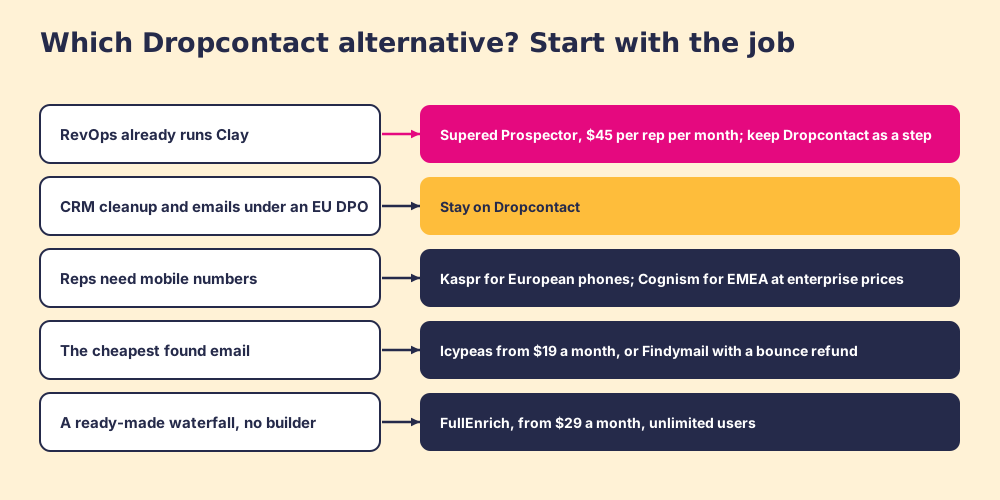
The choice resolves once you name the job. The ways forward:
- Dropcontact itself. The pick for CRM cleanup and email finding under a European data protection officer, where EU-hosted validation and a closed CNIL investigation matter more than phones.
- Findymail. The pick when emails plus non-EU phones from one pool, a bounce refund and a Chrome extension decide it.
- Kaspr or Cognism. The pick when reps need European mobile numbers: Kaspr for individual reps on LinkedIn, Cognism for an enterprise contract.
- Icypeas. The pick when the job is the cheapest found email in bulk.
- FullEnrich. The pick for a team with no Clay and no builder that wants a ready-made waterfall with unlimited users.
- Supered Prospector. The pick when the team already has Clay: Clay’s waterfall in the order your GTM engineer sets, Dropcontact as a step if it earns one, a mobile step behind it, in every rep’s hands on LinkedIn, the company site and the CRM record.
What we recommend depends on whether you have a ring. If you do not, keep the locksmith for the job he does best, clean European emails, and add one phone source your reps can reach from LinkedIn; do not replace a careful email finder with a cheaper one on the strength of a vendor’s benchmark, theirs or Dropcontact’s. If you have Clay and a GTM engineer, put Dropcontact on the ring where your own 200-contact test says it belongs, put a mobile step behind it, and put the ring on every rep’s belt. Clay prospecting shows how a rep-run list differs from an Ops-built one, AeroLeads pricing shows what a pay-on-find meter charges for a bounced email, and a Prospector demo on your own Clay account is where you can watch Dropcontact run as one step.
Frequently asked questions
What are the best Dropcontact alternatives in 2026?+
How much does Dropcontact cost in 2026?+
Does Dropcontact use a database?+
Is Dropcontact better than a waterfall?+
Does Dropcontact find phone numbers?+
Can I use Dropcontact inside Clay?+
Everything we have written on Dropcontact
More on Dropcontact
Looking past Dropcontact? See Supered Prospector on your own Clay accountYour Clay waterfall, where reps already work.