Hunter.io Pricing in 2026: A Family Data Plan With No Minutes
Hunter.io pricing checked on October 2, 2026: Free, Starter, Growth and Scale, what a credit buys, why unlimited users make Hunter cheaper the bigger the team, what credit packs cost, and when a Clay team should keep Hunter as step one.
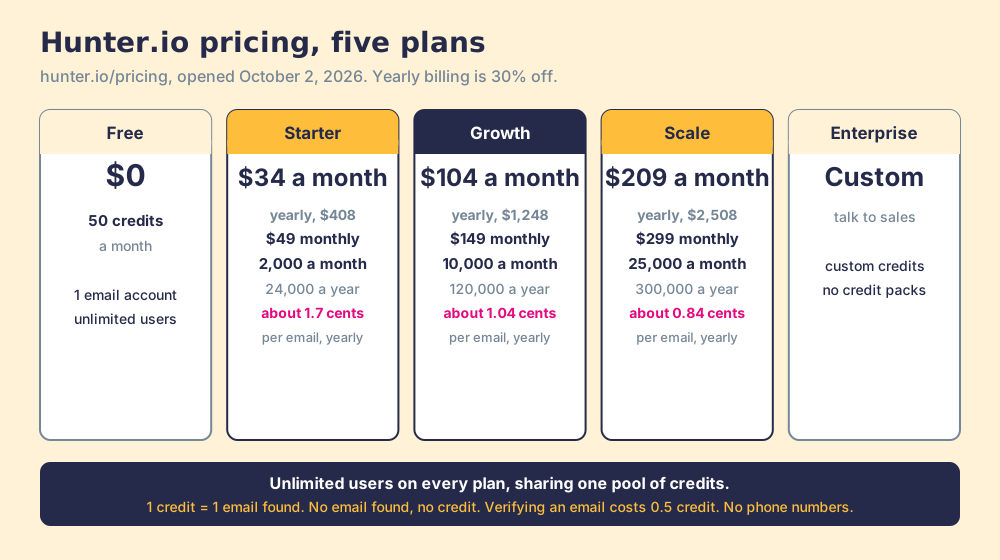
Hunter.io pricing in 2026 is five plans with unlimited users: Free with 50 credits a month, Starter at $49 a month or $34 billed yearly, Growth at $149 or $104, Scale at $299 or $209, and Enterprise, where one credit buys one found email and a miss is free.
A family data plan has one generous habit and one blind spot. The habit: one bucket of data, and you add as many phones to the line as you like, so the fourth teenager costs nothing extra. The blind spot shows up on the bill of the family member who wanted to make a call, because the plan you picked was data only, with no minutes.
Hunter.io pricing in 2026 is five plans with unlimited users: Free with 50 credits a month, Starter at $49 a month or $34 billed yearly, Growth at $149 or $104, Scale at $299 or $209, and Enterprise, where one credit buys one found email and a miss is free (hunter.io/pricing, opened October 2, 2026). The unlimited users are the generous habit. The missing minutes are phone numbers, which Hunter does not sell. Whether Hunter is cheap or expensive for your team depends on which of those two facts touches your reps more.
The quick answer, three ways:
- Hunter Growth, yearly at $1,248. A team of any size that writes to work emails and rarely dials: 120,000 found emails a year in one shared pool, about a cent each.
- Hunter Starter, monthly at $49. One person testing whether Hunter’s coverage holds in their market, with the right to leave after a month.
- Supered Prospector, $540 a rep a year on your own Clay account. A team that already pays for Clay and needs phones too, where reps build lists from LinkedIn, a company site or the CRM record, and Hunter can stay in the waterfall as step one.
How much does Hunter.io cost in 2026?
Hunter publishes both billing cycles in the page source. The figures below come from the pricing page or Hunter’s help center, opened today.
| Hunter.io pricing (Oct 2, 2026) | Free | Starter | Growth | Scale | Enterprise |
|---|---|---|---|---|---|
| Monthly billing | $0 | $49 a month | $149 a month | $299 a month | Custom |
| Yearly billing, per month | $0 | $34 | $104 | $209 | Custom |
| Billed for the year | $0 | $408 | $1,248 | $2,508 | Custom |
| Credits | 50 a month | 2,000 a month, or 24,000 a year | 10,000 a month, or 120,000 a year | 25,000 a month, or 300,000 a year | Custom |
| Price per found email | free | 2.45 cents monthly, 1.7 yearly | 1.49 cents monthly, about 1.04 yearly | 1.2 cents monthly, about 0.84 yearly | Quoted |
| Users | Unlimited | Unlimited | Unlimited | Unlimited | Unlimited |
| Connected email accounts | 1 | 3 | 10 | 20 | Custom |
| Recipients per sequence | 500 | 2,500 | 5,000 | 15,000 | Custom |
| Credit packs | No | Yes | Yes | Yes | No |
Hunter now sells itself as an “All-in-one outreach platform”: the paid tiers add connected inboxes and its Sequences cold-email tool beside the email finder. A separate API-only product, the Data Platform, is priced by credit volume on a calculator. One naming note before we go on. Salesforce launched an outbound sales agent this year that it also calls Hunter, with Apollo announced as its data partner on September 15, 2026 (Apollo newsroom). That product has nothing to do with hunter.io, which remains independent; we found no acquisition, funding round or rebrand in a news search on October 1.
What does one Hunter credit buy?
One email that Hunter found. The FAQ on the pricing page spells out the meter: “1 credit = 1 email found via Domain Search, Email Finder, or Bulk Email Finder,” “1 credit = up to 10 emails found via Bulk Domain Search,” and “0.5 credit = 1 email verified via Email Verifier or Bulk Email Verifier.” Then two lines that keep the bill fair: “If the email address can’t be found, it’s free,” and “The same email searches or verifications are counted once per billing period.”
How Hunter finds the address matters for what the credit buys. Its Email Finder page says it first looks for a match “in our extensive database of email addresses found publicly on the web,” and if there is none, it considers “the likely permutations of the person’s name on that domain” and checks the guess (hunter.io/email-finder). Hunter’s data page says it crawls “30M Web pages” a day and has indexed “150M Professional email addresses,” and that the Email Finder labels whether a result “is a guess or if it has public sources” (hunter.io/our-data). So a credit buys a found email that is either published somewhere or a verified best guess, and Hunter tells you which.
Now the family plan. Hunter’s FAQ: “You can invite as many team members as you’d like at no extra cost. Everyone added will share the same pool of credits included in your plan.” One bucket, unlimited lines.
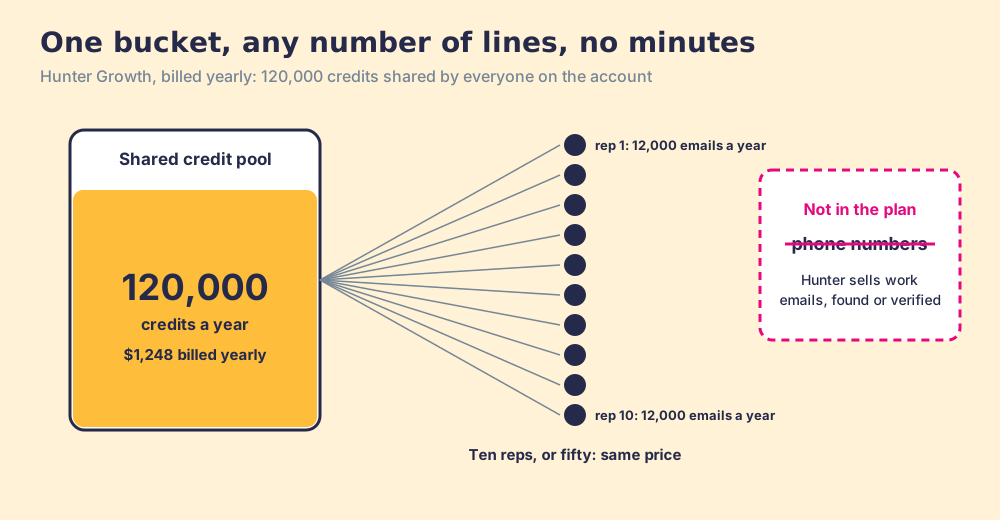
The minutes are the gap. No phone product or phone credit appears on Hunter’s pricing page. Its help center says Domain Search returns “Phone numbers (only for personal emails)” (Hunter help center), and a saved lead may include a phone “when available.” A rep who dials gets an inbox address from Hunter and a blank where the direct dial goes. The Bridge Group’s 2025 SDR report, 351 companies, puts the median SDR at 44 dials a day (Bridge Group, 2025), so for a calling team the second vendor is a certainty, and the price of Hunter is the price of half the job.
Is Hunter cheaper on monthly or yearly billing?
Yearly, by 30%, and the credits arrive differently. Twelve months of Starter on monthly billing cost $588 against $408 yearly; Growth $1,788 against $1,248; Scale $3,588 against $2,508. The page’s own toggle reads “Pay yearly -30%.”
The shape of the credits changes with the cycle, and Hunter’s help center documents it plainly (Hunter help center):
- Monthly plans. “Credits reset at the end of each monthly billing cycle,” and “Unused credits do not carry over.” A slow month is credits lost.
- Yearly plans. “Credits are valid for 12 months.” Hunter removed the monthly reset on yearly plans in May 2024, so the whole year’s credits sit in the bucket from day one (Hunter blog). A team with a heavy launch month and a slow summer loses nothing.
- Plan changes. On an upgrade, downgrade or switch, “All remaining credits from your current plan are automatically rolled over as an extra credit pack.” Cancelling, pausing or dropping to Free is the exception: “unused subscription credits will not roll over.”
For a team that prospects in bursts, the yearly plan is both cheaper and more forgiving. The monthly plan earns its premium of about 43% (the other side of 30% off) only for a buyer who wants the exit.
What do Hunter credit packs cost?
More per credit than the plan, by two to six times. When the bucket runs dry, Starter, Growth and Scale can buy credit packs; Free, Enterprise and Data Platform plans cannot. Hunter’s help article lists the prices (Hunter help center): 100 credits cost $10 on Starter, $7.50 on Growth and $5 on Scale; 1,000 cost $70, $52.50 and $35; 10,000 cost $400, $300 and $200. Packs are “valid for 3 months from the date of purchase,” and an auto-purchase setting with a monthly cap can buy them for you at zero balance.
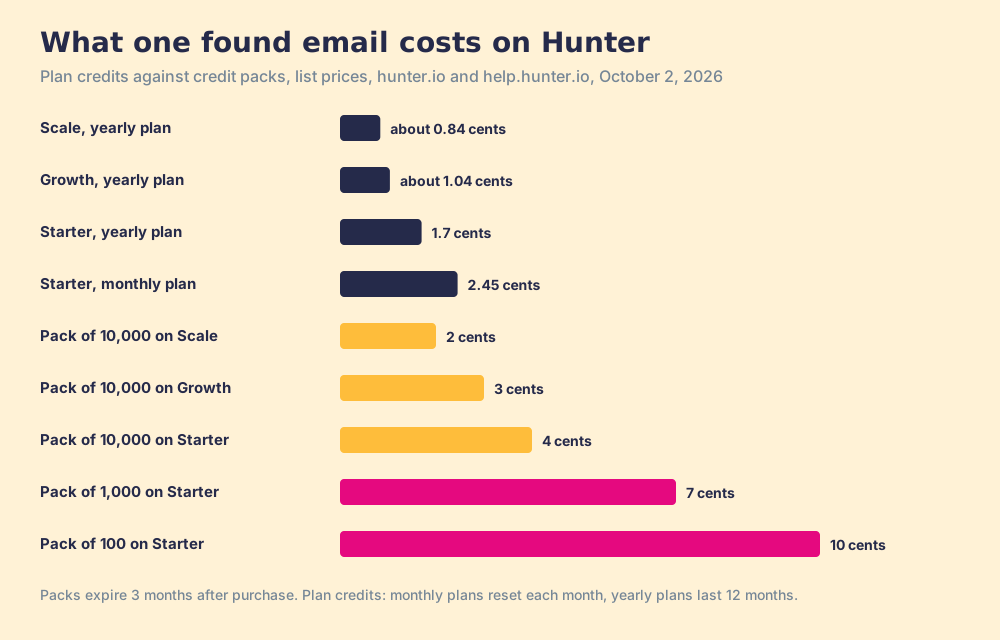
The arithmetic points one way. A Starter team that buys 10,000 extra credits pays $400, which is almost exactly what the whole Starter year costs ($408 for 24,000). Two such refills and Growth yearly ($1,248 for 120,000) would have been cheaper than Starter plus packs. A second help article lists the $10 minimum pack as 300 credits on Growth, so read the price at checkout. Packs are for the surprise month. A second surprise month is a sign to move up a tier.
Why do teams leave Hunter?
Fair first. Hunter is one of the most installed tools in contact data: its Chrome extension had 600,000 users and a 4.7 out of 5 from 12.5K ratings on October 1, 2026 (Chrome Web Store), its pricing page says it is “Trusted by 7 million + users,” and on G2 it held a 4.4 out of 5 from 657 reviews (G2, Hunter reviews). In Clay’s own test of 13 work-email providers on North American contacts, Hunter’s results earned the top quality score, 97.15 (Clay data tests, last tested October 22, 2025). When Hunter returns an email, it tends to be right.
The reasons to leave are written in Hunter’s own documentation:
- Coverage. In that same Clay test, Hunter found 52.87% of the emails, against 90.26% for the leader, Findymail. High quality and lower coverage are two sides of one method: an index of what the public web shows, checked carefully.
- Phones. No phone product, as above. A team that dials buys a second tool.
- LinkedIn. Hunter’s help center says it “cannot be integrated with LinkedIn” and that it replaced the LinkedIn integration with the Email Finder (Hunter help center, dated November 22, 2024). The extension works on company websites, finding “all the email addresses related to the website you’re visiting.” A rep who lives in Sales Navigator copies a name and a domain into another screen.
The third reason is the one a bigger plan cannot fix, and it decides most of what follows.
Why should you trust this breakdown?
We sell no contact data. Supered has no database of its own, on purpose; Supered Prospector runs on Clay, our only data provider, and Clay can run Hunter as one of its steps. So we gain nothing from whether you buy Hunter, Findymail or Apollo directly. Our stake is what reps do with a contact once it lands in the CRM.
Supered started inside RevPartners, the HubSpot partner I founded, which sold roughly twice as much Sales Hub as any other partner and reached HubSpot’s Elite tier in 13 months. Supered is the #1 sales enablement app on the HubSpot marketplace, with 6,000+ installs and a 5.0 rating from 122 reviews there, and on G2 it held a 4.9 out of 5 from 81 reviews on October 1, 2026 (G2, Supered reviews). People search this topic as “hunter io pricing” and as “hunter pricing”; both lead to the same page, and every Hunter figure here links to the page it came from.
Which Hunter plan, or which alternative, fits your team?
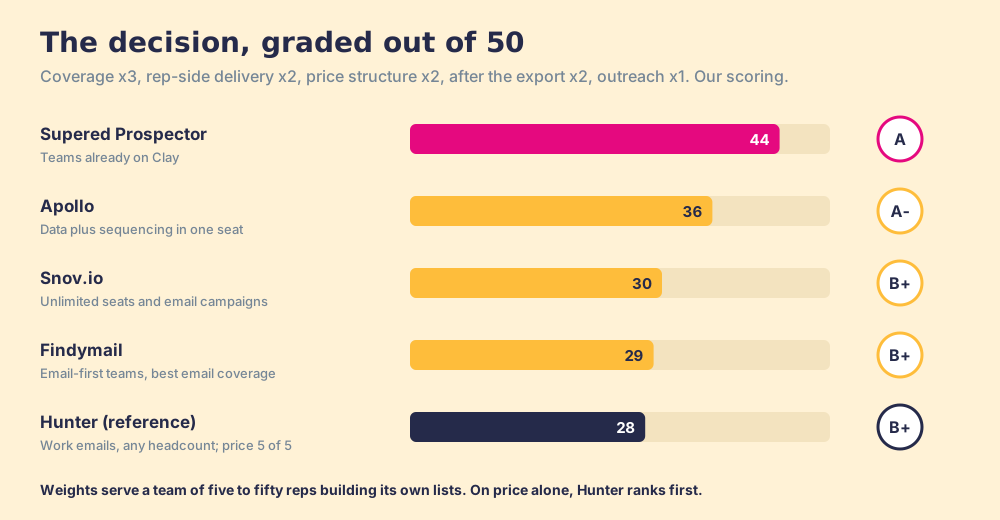
The grades reuse the five weights from our Hunter.io alternatives page: coverage of the contact you need (x3), delivery where the rep already works (x2), price structure for a mid-market team (x2), what happens to the list after the export (x2), and bundled outreach (x1), out of 50. The weights serve one job, a team of five to fifty reps building its own lists. Flip the lens to “cheapest verified email for any headcount” and Hunter moves to the top.
| Rank | Option | Grade | Best fit | CRM integration | Setup effort | Pricing (plan with the feature) | Reason to switch |
|---|---|---|---|---|---|---|---|
| 1 | Supered Prospector | A (44) | Teams already paying for Clay | Native: HubSpot, Salesforce, Pipedrive | Demo, then live in under a week on your own Clay account | $45 a rep a month, billed annually, plus your Clay plan | Clay’s waterfall across 200+ vendors, phones included, from LinkedIn, the company site or the CRM record |
| 2 | Apollo | A- (36) | Small teams wanting data plus sequencing | Native | Self-serve | Basic $49 a seat a month, annual | Phones and emails in one seat; about 2 cents per email |
| 3 | Snov.io | B+ (30) | Budget teams wanting unlimited seats and outreach | Native: HubSpot, Pipedrive | Self-serve | Starter $39 a month | LinkedIn prospect finder and email campaigns |
| 4 | Findymail | B+ (29) | Email-first teams that want the best coverage | Native: HubSpot, Salesforce, Pipedrive | Self-serve | Starter $99 a month, shared team credits | Clay’s test ranks it first for North American work emails |
| ref | Hunter | B+ (28) | Any headcount writing to work emails | Native: HubSpot, Salesforce, Pipedrive, Zoho | Self-serve, minutes | Growth $104 a month, billed yearly | The reference: unlimited users, one pool, about a cent an email |
Sources for the rows: Apollo’s pricing page (Basic $49 a seat a month annual, 30,000 credits a year, captured September 25, 2026), Snov.io’s pricing (October 1), Findymail’s pricing (October 2), and Hunter’s integrations page. The scores are our scoring, not vendor data. Hunter scores 5 on price structure, the top mark, and 2 on coverage because it sells no phones.
What does Hunter cost for a team of ten?
Less than any per-seat tool in contact data, because the seat count does not move the price. Ten reps on Growth billed yearly pay $1,248, and the same plan costs the same for fifty. Per rep, that is $124.80 a year for about 12,000 found emails each, if they share evenly. Shared pools rarely split evenly, and one rep’s bulk domain search can drain the week, so the team owner should watch the usage page.
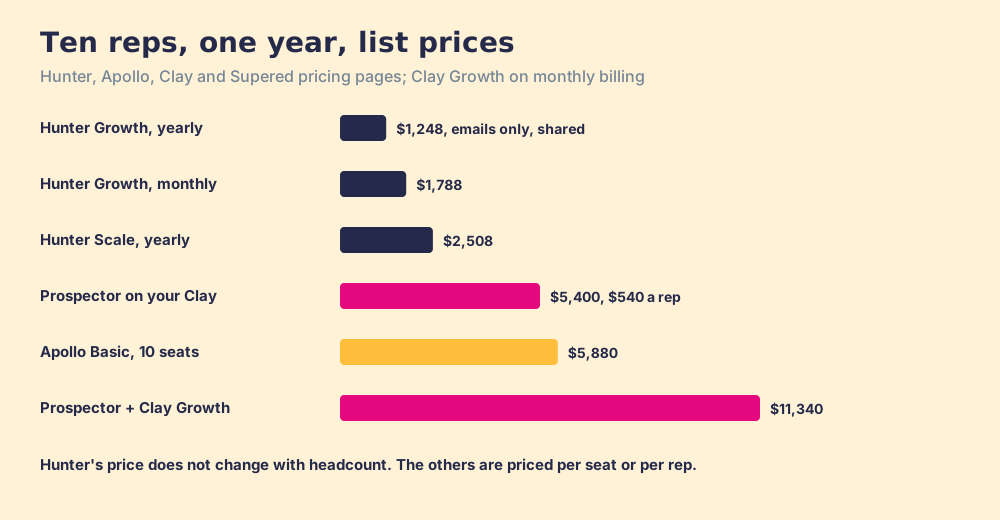
Read the chart both ways. On emails alone, nothing here touches Hunter: $1,248 for ten reps against $5,400 for Prospector on an existing Clay account and $11,340 with Clay Growth ($495 a month on monthly billing, $5,940 a year, from clay.com/pricing). If your reps write and never call, buy Hunter and stop reading. The chart changes the moment the job includes a phone. Hunter’s line then needs a second vendor added to it, and Apollo Basic at $5,880 for ten seats is the cheapest one-tool answer that carries phones. With Clay already paid for, Prospector at $540 a rep puts every provider in the waterfall, phones included, behind one button.
How does Supered Prospector compare to Hunter.io pricing?
Go back to the family plan. Hunter sells a strong data-only plan: one bucket, every line free, about a cent a gigabyte. Clay is the carrier that sells minutes too, from 200+ data and AI vendors under one contract (clay.com, September 25, 2026), and its waterfall asks provider after provider until one returns a verified email or phone. “If an enrichment returns no result, you’re not charged Data Credits or Actions” (clay.com/pricing).
The two do not have to compete. Clay lists Hunter’s Find Work Email, Find Emails by Company and Verify Email actions as “Clay Credits or Bring Your Own Account” (Clay, Hunter integration, opened October 2, 2026), and Clay’s pricing page says your own API keys skip Data Credits. Run through Clay’s managed account, Hunter costs more: Clay’s data test lists 0.4 credits per lookup and Clay University’s integration docs list 2 credits per enriched cell, which is 2 to 10 cents at the entry rate of $0.05 a credit, so test ten rows and read the meter. With your own Hunter key, the find costs what your Hunter plan costs.
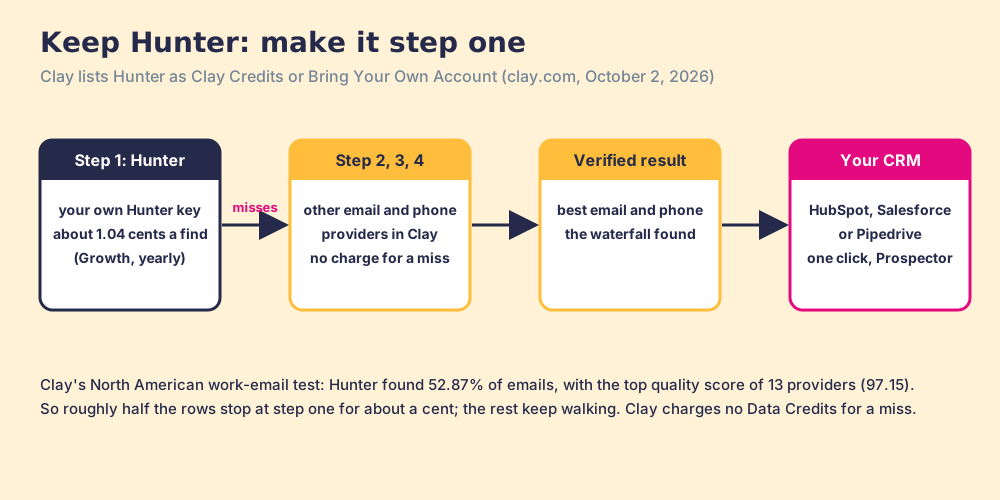
The weakness of the carrier has been the handset. Clay was built for the GTM engineer, who designs the tables. Prospector puts what the GTM engineer built in the rep’s hands, where the rep already works:
- Where the rep already is. A LinkedIn profile, a Sales Navigator list, a company’s website, or a HubSpot, Salesforce or Pipedrive record. One click runs the waterfall, and reps never log in to Clay.
- A check before the duplicate. On a LinkedIn profile, the rep sees whether the person already has a matching record in the CRM and whether the prospect was worked in the past.
- The GTM engineer’s tables, on a button. Any custom Clay workflow runs from Prospector, a list can go into a Clay workflow, and the buying-committee lookup is tuned by title, department and seniority.
- The list after the export. The contact lands in the CRM with the team’s process applied, and the manager sees which lists get worked and how each lead ends: Qualified, Recycled or Disqualified.
Prospector is $45 per rep per month, billed annually, from one user, runs inside the Supered Chrome extension, and is live in under a week with implementation included (Prospector, Supered pricing). It runs on your Clay account and your Clay credits. Clay governs the data. Supered governs the motion. Ask every vendor what it reads from LinkedIn, ours included. The sourcing use case walks the rep’s side, and the Clay email finder guide shows the email steps inside Clay.
Choose something else if any of these is true:
- Email-only outreach. If your reps write and never dial, Hunter Growth at $1,248 a year for the whole team is the better buy, by a wide margin.
- No Clay account. Prospector needs one. Without Clay, Hunter for email plus a phone source, or Apollo alone, costs less.
- No waterfall owner. Someone decides which providers sit in which order. If no one on the team owns that, Hunter’s single price is less work.
What are the best Hunter.io alternatives?
Our Hunter.io alternatives page grades the full field; the short version by job:
- Findymail, for email coverage. First in Clay’s North American work-email test at 90.26%, with credits that only charge for verified results. Findymail pricing works out its email and phone meters.
- Apollo, for one seat with phones and sequences. Basic is $49 a seat a month on annual billing with 30,000 credits a year; a phone costs 8 credits. Apollo pricing walks the meter.
- Prospeo and LeadMagic, for cheap credits. Prospeo starts at $37 a user a month billed yearly (Prospeo pricing); LeadMagic sells one credit pool across every endpoint (LeadMagic pricing).
- Snov.io, for unlimited seats with campaigns. Starter at $39 a month with unlimited team seats (Snov.io pricing).
For the rule that decides an email finder’s bill, who pays for the address no server will confirm, see email finder tools.
What we recommend
Three ways forward, and our view on each.
- One person, testing. Use the Free plan’s 50 credits on people you already know, then one month of Starter at $49. If Hunter’s coverage holds in your market, move to yearly and save 30%.
- A team that writes and does not dial. Growth billed yearly at $1,248, for the whole team. It is the cheapest verified-email bucket in this market for a team of ten, and it gets cheaper per rep with every hire. Watch the shared pool, and move up a tier instead of buying a second pack.
- A team that dials, especially one with Clay. Do not buy Hunter and a phone vendor and hope reps open both. Put your Hunter key into Clay as the first email step and run the waterfall from where reps already work with Supered Prospector, at $540 a rep a year.
A family data plan is a fine plan for a family that texts. Before you sign, ask who on the account needs to make a call, and price the minutes too. If that is your whole sales floor, the Clay pricing page shows what the carrier costs, and waterfall enrichment shows how the order is built.
Frequently asked questions
How much does Hunter.io cost in 2026?+
What does one Hunter credit buy?+
Is Hunter.io free?+
Does Hunter charge per user?+
Does Hunter.io include phone numbers?+
Should a Clay team still pay for Hunter?+
Everything we have written on Hunter
More on Hunter
Looking past Hunter? See Supered Prospector on your own Clay accountYour Clay waterfall, where reps already work.