Hunter.io Review 2026: A Careful Grocer With Half a Shelf
Hunter scored the highest email quality and found barely half the emails in Clay's North America test.
A Hunter.io review checked October 2, 2026: each module graded, the Chrome extension, the ratings, and who should buy it.
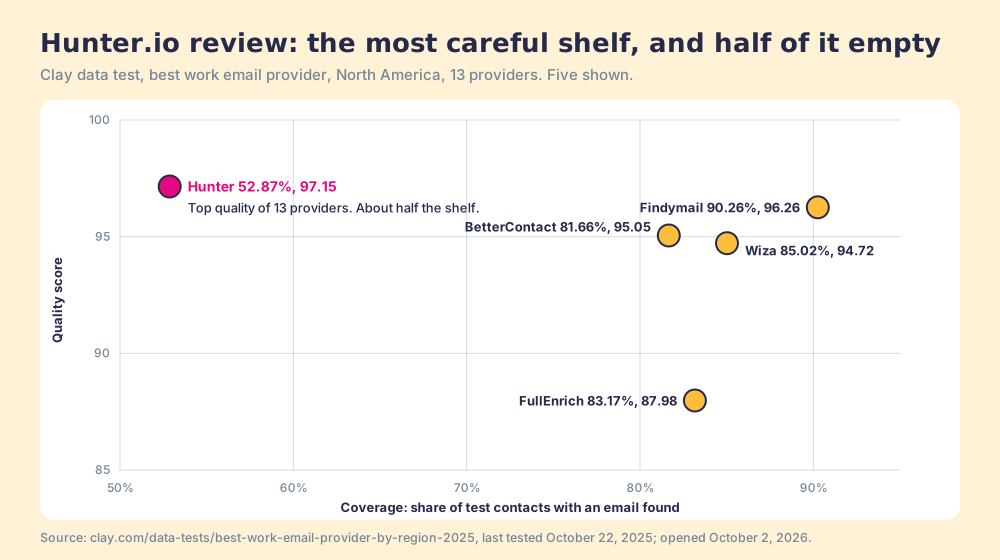
This Hunter.io review grades Hunter, the public-web email finder from Hunter Web Services, module by module (Domain Search, Email Finder, Email Verifier, Discover, Sequences and the Chrome extension) on accuracy, reach, and fit for a sales team.
A good corner grocer stocks only what he has tasted. Nothing on his shelf is spoiled, and he will tell you which apples came in this morning. Ask for something he has not tasted and the shelf has a gap where it would be. You leave with half your list, and all of it good. Hunter is that grocer for work emails. In Clay’s North America test of 13 work-email providers, Hunter posted the highest quality score, 97.15, and found an email for 52.87% of the contacts (Clay data test, last tested October 22, 2025).
The quick answer, checked October 2, 2026:
- Hunter itself. The pick for founders and email-first teams who work from company websites: the careful answer, a posted price, and unlimited users on every plan.
- Supered Prospector. The pick for a team that already pays for Clay: Hunter becomes one step in Clay’s waterfall across 200+ vendors, run from a LinkedIn profile, a company site or the CRM record, at $45 per rep per month billed annually.
- Findymail. The pick without Clay when you need the other half of the list and a phone: 90.26% coverage in the same test.
This Hunter.io review grades Hunter, the public-web email finder from Hunter Web Services, module by module (Domain Search, Email Finder, Email Verifier, Discover, Sequences and the Chrome extension) on accuracy, reach, and fit for a sales team. The short version: everything Hunter hands you is good, and it hands you about half.
Is Hunter.io accurate?
Yes, and the reason is how it finds an address. Hunter’s crawlers visit 30 million pages a day and index 150 million professional emails from 650 million public sources (hunter.io/our-data). The Email Finder looks there first. If the person never published an address, it reads the company’s pattern (first.last@, say) from the colleagues who did, guesses, and sends the guess through a verification check (hunter.io/email-finder). Hunter tells you which kind you got: the result says “if the result is a guess or if it has public sources.” And it drops contact data that “no longer has public sources” after six months, so the shelf gets cleared of stale stock.
Two limits keep the grade below perfect.
- The doorman domains. Some mail servers sign for any name, real or not. Hunter calls these accept-all domains and says “no verification tool, including Hunter, can fully confirm deliverability on these domains,” naming hubspot.com as one (Hunter help center, dated September 1, 2026). Its advice is to keep results with a confidence score of 85% or more. In Clay’s catch-all verifier test, Hunter returned a verdict on 30.62% to 43.89% of accept-all addresses, against 100% for Findymail (Clay data test, last tested August 31, 2025).
- The young and the small. A crawler finds what has been published, and a twelve-person startup has published little. “Limited data coverage especially for small and new companies in the market,” a GTM manager wrote on G2 in February 2026.
What do Hunter.io reviews say?
Buyers rate Hunter 4.4 out of 5 from 656 reviews on G2 and 4.2 from 345 on Trustpilot, both checked October 2, 2026. The praise is about ease and trust: “You can query a company and contact name and instantly get a working email,” a small-business sales lead wrote in August 2026. The complaints cluster:
- The credit meter. “The credit system can feel limiting, especially when working on larger prospecting campaigns” (G2, February 2026). Hunter’s credits are shared by every user on the plan, generous for three people and tight for thirty.
- The missing phone. A mid-market recruiter wrote in September 2026 that Hunter “doesn’t provide the phone numbers for prospects,” sending them to Apollo or ZoomInfo.
- The add-on bill. A Trustpilot reviewer in September 2026 found “a hidden fee for email warmup.” The warm-up service, Inbox Protection, is $7.50 a month per inbox, listed in the help center.
- The aging platform. An accounting-firm reviewer on G2 wrote that Hunter “feels outdated now compared to Apollo,” in November 2025.
The reviews agree with the test. None of these complaints says the emails were wrong. They write about what Hunter does not hold, and what it charges around the edges.
How good is each Hunter module?
Our grades, for a sales team of five to fifty reps, from Hunter’s own feature pages and plan table (hunter.io/pricing):
| Module | What it does | Our grade | Why |
|---|---|---|---|
| Domain Search | All indexed emails for a company domain, with sources and the email pattern | A | The best version of this job on the market; a miss costs nothing |
| Email Finder | Name plus domain returns one address with a confidence score | A- | Highest quality in Clay’s test, half the coverage |
| Email Verifier | Checks a mailbox for 0.5 credit; Unknown results are free | B+ | Careful, and candid that accept-all domains cannot be confirmed |
| Discover | Hunter’s B2B company database with filters and an AI assistant | B- | 10 to 300 AI searches a month by plan; useful for account lists, thin on people |
| Sequences | Cold email from 1 to 20 connected inboxes by plan | B | Solid sender with A/B tests; warm-up and extra inboxes cost extra |
| Integrations | HubSpot, Salesforce, Pipedrive and Zoho native; Clay; Google Sheets; MCP | A- | Connects to the CRMs a mid-market team runs |
| Phones | None sold | F | No credit buys a mobile number on any plan |
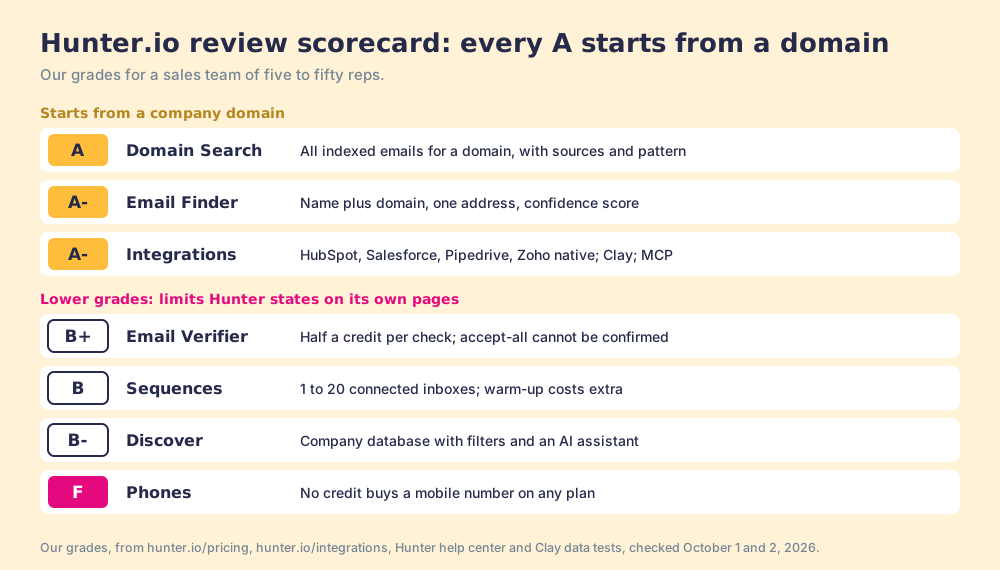
The pattern in the grades is the grocer again. Anything that starts from a company’s domain, where colleagues have published their addresses for years, earns an A. Anything that needs a person’s private data, a mobile number, or a fresh hire at a young company drops fast.
How does the Hunter.io Chrome extension work?
The Hunter.io Chrome extension has 600,000 users and a 4.7 from 12.5K ratings, version 3.2.0, updated September 12, 2026 (Chrome Web Store, checked October 2, 2026). Click the icon on a company’s website and it lists “all the email addresses related to the website you’re visiting,” with the company’s most common pattern, department filters, and the public sources for each address. Type a name and it runs the Email Finder. Saved leads go to a list, then to Sequences or to Salesforce, HubSpot, Pipedrive or Zoho. Credits count the same as in the web app, and the free account includes 50 a month.
The extension reads the address on the door, never the papers on the desk. Hunter’s own FAQ is explicit: “the extension will never save data from the content of the pages you visit. The email addresses displayed are exclusively email addresses our own crawlers found public on the web” (hunter.io/chrome). The website you are on is only a key: Hunter takes the domain and opens its own index for that company. That design is why it is fast, why it is careful, and why it has nothing to say on a LinkedIn profile, where the domain belongs to LinkedIn.
On LinkedIn, Hunter does not run at all. Its help center says “Hunter cannot be integrated with LinkedIn as we need to comply with LinkedIn’s Terms of Use that prohibits the use of any extension on its website,” and sends users to the Email Finder instead (Hunter help center). A rep who prospects from LinkedIn copies a name and company into Hunter by hand. The LinkedIn email finder extensions page compares the tools built for that starting point.
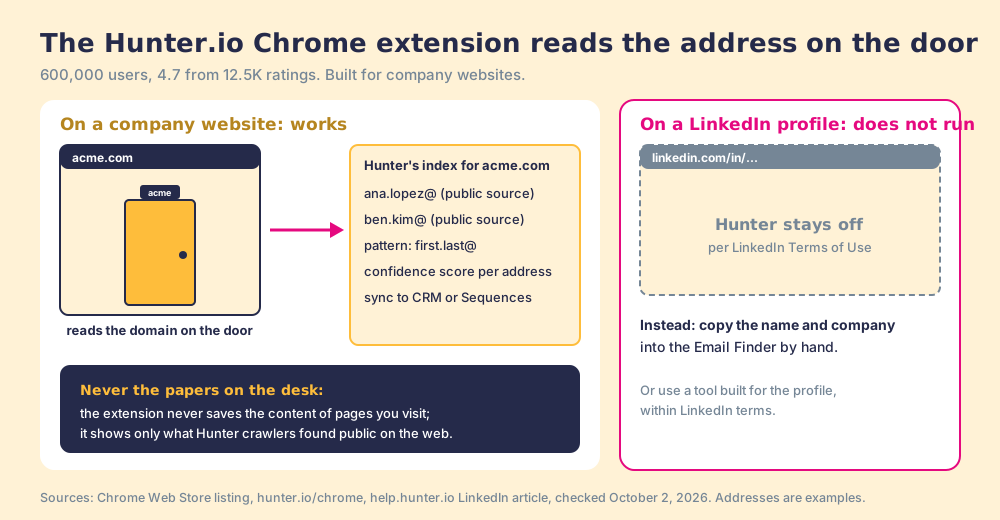
Grade for the extension: A for company-site research, which is its job, and no grade for LinkedIn, which it declines to do.
Why trust this review?
I started RevPartners, a HubSpot partner that did only sales implementations, sold roughly twice as much Sales Hub as any other partner, and reached Elite tier in 13 months. Supered came out of that work and is the #1 sales enablement app on the HubSpot marketplace, rated 4.9 from 81 reviews on G2 (checked October 1, 2026). The disclosure: we make Supered Prospector, which can run Hunter as one step in a Clay waterfall, and it ranks first below only for teams that have Clay.
How does Hunter.io compare with the alternatives?
The lens is a team of ten to fifty reps who email and dial. Scores are 1 to 5 on coverage (x3), rep-side delivery (x2), price structure (x2), what the leader sees after the export (x2), and bundled outreach (x1), out of 50, matching the Hunter.io alternatives page.
| Rank | Tool | Grade | Score | Best fit | CRM integration | Setup effort | Pricing | Reason to switch from Hunter |
|---|---|---|---|---|---|---|---|---|
| ref | Hunter | B+ | 28 | Email-first teams working from company sites | Native (HubSpot, Salesforce, Pipedrive, Zoho) | Minutes | $34 to $209 a month billed yearly, unlimited users | Stay if your reps do not dial |
| 1 | Supered Prospector | A | 44 | Teams that already pay for Clay | Native (HubSpot, Salesforce, Pipedrive) | Under a week on an existing Clay account | $45 per rep per month, billed annually, plus your Clay plan | Hunter plus every other provider per lookup, starting from LinkedIn too |
| 2 | Apollo | A- | 36 | Data, phones and sequences in one seat | Native (HubSpot, Salesforce) | A day | $49 a seat a month, billed annually | Phones at 8 credits and a dialer |
| 3 | Snov.io | B+ | 30 | Small teams wanting outreach at Hunter’s price | Native (HubSpot, Pipedrive) | A day | Starter $39 a month, unlimited seats | LinkedIn automation and outreach |
| 4 | Findymail | B+ | 29 | Like-for-like finder that adds phones | Native (HubSpot, Salesforce, Pipedrive) | Minutes | $99 a month for the team | 90.26% coverage in Clay’s test, phones at 10 credits |
Hunter’s 28 is coverage 2, rep-side 3, price 5, leader view 1, outreach 4. Prices are from the Hunter.io pricing breakdown and the alternatives page, checked October 1 and 2, 2026.
Where does Supered Prospector fit?
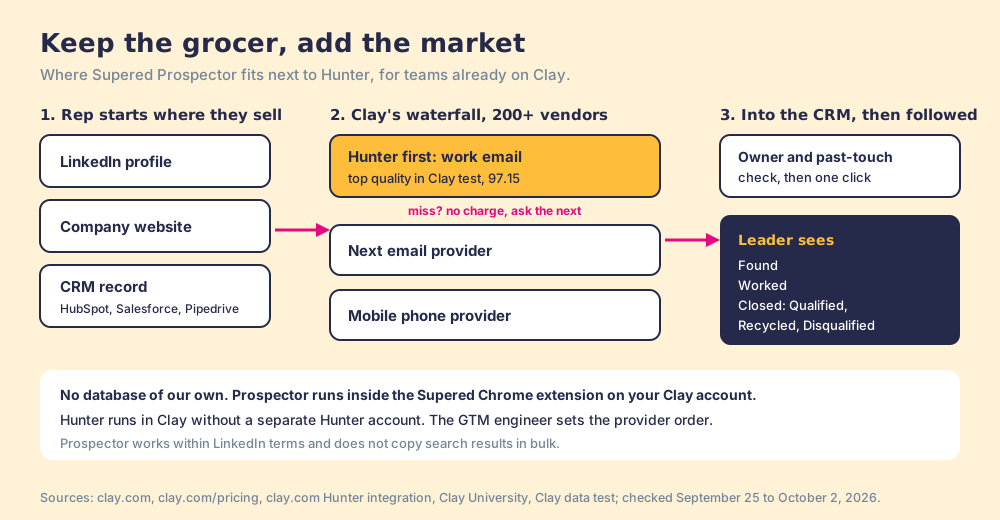
Hunter’s best quality is precision, and its gap is reach. A waterfall keeps the first and fills the second. Clay’s waterfall across 200+ data and AI vendors asks provider after provider until one returns a verified email or phone (clay.com, September 25, 2026), charges nothing when an enrichment returns no result (clay.com/pricing), and has listed Hunter as a provider since October 1, 2022 (Clay, Hunter integration). Clay’s docs say its Hunter action runs “without any need to create a Hunter account” (Clay University). So Hunter can answer first, at 97.15 quality, and the next provider answers when the grocer’s shelf is empty.
Prospector brings no database of its own. It runs inside the Supered Chrome extension, on the team’s own Clay account, and hands reps the Clay tables the GTM engineer built, as a button where they already sell:
- The rep. The table on a LinkedIn profile, a company website, or a HubSpot, Salesforce or Pipedrive record, with a check before pushing: who owns the record, and whether it was prospected before. One click to the CRM.
- The GTM engineer. Flows built once, each a Clay table or function with a destination, picked from a Push menu. Hunter sits in the waterfall wherever you put it.
- The leader. Found, Worked, Closed: which lists reps found, who is working theirs, and how each lead ended the way your process says, Qualified, Recycled or Disqualified.
Prospector works within LinkedIn’s terms and does not copy search results in bulk; the contact data comes from Clay’s waterfall on the customer’s Clay account.
The arithmetic at list: Clay Growth is $495 a month, $5,940 a year, and Prospector is $45 per rep per month billed annually, from one rep (Prospector). Ten reps come to $11,340 a year, against $1,248 for Hunter Growth. For email alone Hunter is far cheaper. The extra buys the other half of the shelf, the phone, the LinkedIn starting point, and lists you can follow to closed.
Choose something else if you do not have Clay: Prospector runs on the customer’s Clay account and does nothing without one, and someone has to build the tables. Choose something else, too, if your team only emails from company research. Hunter Growth for the whole team is the better buy for that job. The sourcing use case shows the setup for teams that dial.
Is Hunter.io worth it?
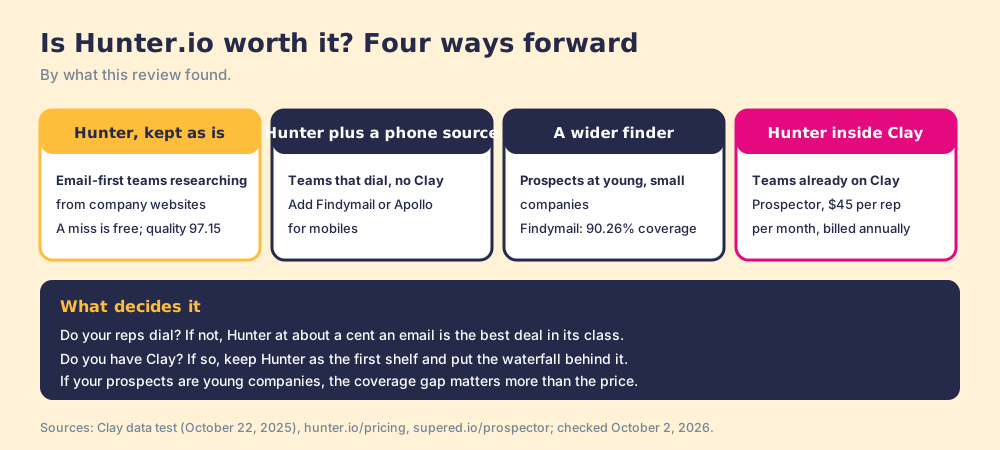
The ways forward, by what this review found:
- Hunter, kept as is. Founders, agencies and email-first teams that research from company websites. The quality is the best in its class and a miss is free.
- Hunter plus a phone source. Teams that dial and do not have Clay. Keep Hunter for email; add Findymail or Apollo for mobiles.
- A wider finder in place of Hunter. Teams whose prospects are young, small companies, where the coverage gap hurts most. Findymail found 90.26% in the same test.
- Hunter inside Clay, through Prospector. Teams that already pay for Clay and prospect from LinkedIn and the CRM. Hunter answers first; the waterfall fills the gaps.
My recommendation: buy Hunter for what it is, the highest-quality work-email source in Clay’s test, and stop asking it to be a phone book. If half the list is enough, Hunter at about a cent an email is the best deal in the category. If you need the whole list and the phone, keep Hunter as the first shelf and put a market behind it. The Hunter.io pricing breakdown shows which plan to buy, and the Hunter.io alternatives page grades the shops next door.
Frequently asked questions
Is Hunter.io legit?+
Is Hunter.io accurate?+
Does the Hunter.io Chrome extension work on LinkedIn?+
Is Hunter.io free?+
Is Hunter.io legal to use?+
Does Hunter.io find phone numbers?+
Everything we have written on Hunter
More on Hunter
Looking past Hunter? See Supered Prospector on your own Clay accountYour Clay waterfall, where reps already work.