Clearbit Alternatives in 2026: HubSpot Kept Two Blades of the Pocketknife
HubSpot bought Clearbit, kept enrichment and visitor reveal, and switched off Connect and the Logo API. The Clearbit alternative you need depends on which blade you used. Seven options, graded and priced.
Clearbit alternatives are the tools teams use to replace what Clearbit did before HubSpot folded it into its own product: record and form enrichment, website-visitor reveal, and finding a person's email and phone.
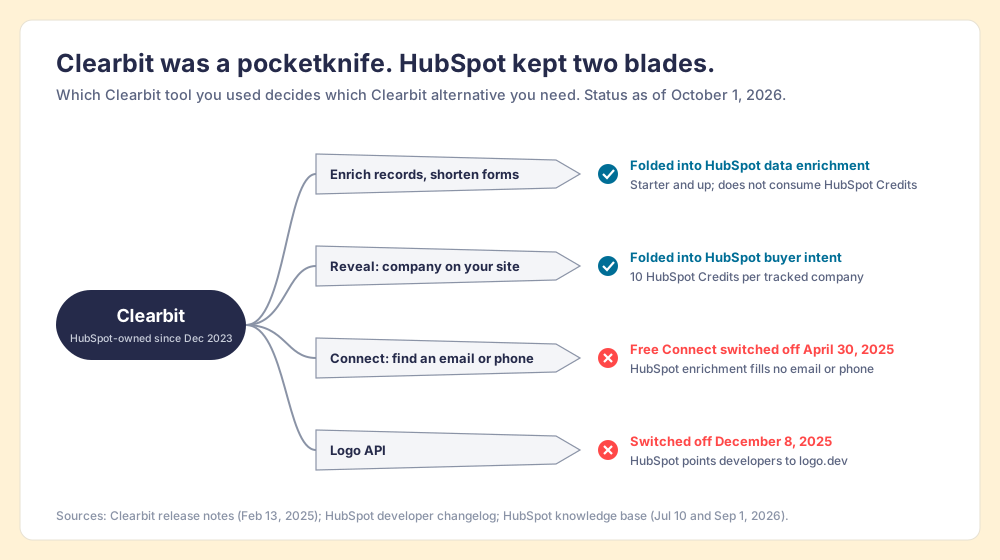
Clearbit was a pocketknife. HubSpot bought the knife in December 2023, kept two blades for its own drawer, and folded the rest away, so the Clearbit alternative you need depends on which blade you used. The short answer:
- HubSpot’s own data enrichment. For HubSpot teams that used Clearbit to fill company fields and shorten forms. Included from Starter, and it “does not consume HubSpot Credits.”
- Supered Prospector on Clay. For reps who found emails and phones with Clearbit: Clay’s waterfall across 200+ vendors, inside LinkedIn and the CRM record, $45 a rep a month.
- Apollo. For a team without Clay that wants one database, an extension, and a posted price from $49 a seat.
Clearbit alternatives are the tools teams use to replace what Clearbit did before HubSpot folded it into its own product: record and form enrichment, website-visitor reveal, and finding a person’s email and phone. Below, seven of them are graded for a team of 10 to 50 reps and priced for a team of ten. The argument underneath the grades is short. HubSpot already handed its own customers the enrichment blade, at no extra cost. What it did not keep is the blade that put a person’s email and phone in front of a rep, and that is the one worth shopping for. And by Clearbit’s own description, that blade was never one database in the first place.
What happened to Clearbit after HubSpot bought it?
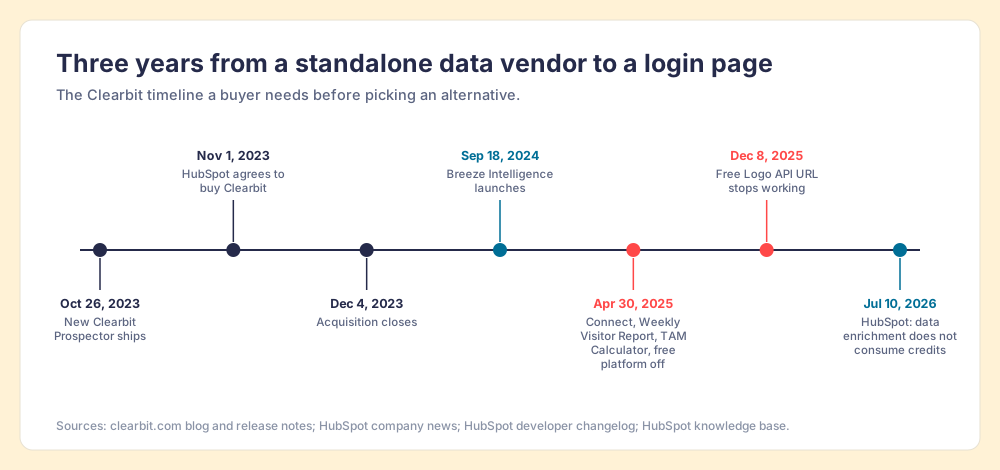
HubSpot announced the deal on November 1, 2023. CEO Yamini Rangan’s memo described what HubSpot was buying: “Clearbit’s data for more than 20M companies and 500M decision makers comes from a lot of sources: 250+ public and private data sources including social profiles, company websites, legal filings and crowdsourcing,” and promised that “Clearbit will remain available as a standalone product once the acquisition is complete” (HubSpot, November 2023). The deal closed on December 4, 2023 (HubSpot).
On September 18, 2024, HubSpot launched Breeze Intelligence, “powered by a dataset of over 200 million company and buyer profiles,” with three parts: data enrichment, buyer intent, and form shortening (HubSpot, September 2024). Five months after that, the Clearbit team posted the announcement that sent a lot of people to this search. On April 30, 2025, it switched off the “Free Clearbit Platform, Weekly Visitor Report, Clearbit Connect, TAM Calculator, and Clearbit free Slack integration,” because “sunsetting our free tools allows us to develop more integrated and innovative solutions together, such as Breeze Intelligence” (Clearbit release notes, February 13, 2025). The free Logo API followed: HubSpot’s developer changelog set the shutdown for December 8, 2025 and recommended logo.dev, “a free and high-quality logo-fetching service based on domain names” (HubSpot developer changelog).
Where it stands on October 1, 2026: clearbit.com reads “Clearbit has joined HubSpot!” above a customer login and nothing to buy, and the old clearbit.com/pricing address redirects to the homepage. HubSpot’s knowledge base no longer uses the Breeze Intelligence name in its enrichment articles; the features are called data enrichment and buyer intent.
So take the knife apart, one blade at a time.
- Record enrichment and form shortening. Kept. It lives inside HubSpot as data enrichment, from Starter up, and “Data enrichment does not consume HubSpot Credits” (HubSpot knowledge base, July 10, 2026).
- Reveal, the name of the company on your website. Kept, as HubSpot buyer intent. “Tracking a company costs 10 credits,” and tracking “continues to be charged monthly” (HubSpot knowledge base, September 1, 2026).
- Connect, the free Gmail sidebar that found a person’s email. Gone since April 30, 2025, and HubSpot’s enrichment does not fill a contact’s email or phone.
- The Logo API. Gone since December 2025, with logo.dev as HubSpot’s named replacement.
Why are teams looking for Clearbit alternatives now?
Three groups of buyers land on this search, and the Clearbit competitors that suit each are different.
- HubSpot teams that lost Connect. The rep who opened an email thread and saw the sender’s title and company, or looked up a stranger’s address, lost that sidebar in April 2025. HubSpot’s enrichable contact properties are City, Country, Employment Role, Seniority, Sub Role, First Name, Job Title, Last Name, LinkedIn URL, and State; there is no email and no phone on the list, and “Contacts must have a business email address” before they can be enriched at all (HubSpot knowledge base, July 20, 2026). A Reddit thread titled “Alternatives to Clearbit Connect?” ranks on the first page of Google for this search today.
- Teams outside HubSpot. A Salesforce shop that bought Clearbit for routing and scoring was told in 2023 that the product would stay available on its own. Three years later there is a customer login and a Clearbit staffer’s assurance in the HubSpot Community that “Clearbit is still supporting our current customers, business as usual” (HubSpot Community). Supported is a long way from purchasable, and a renewal is a bad moment to discover the difference.
- Developers who called the free endpoints. The logo URLs in your app stopped resolving after December 8, 2025.
The customers who stayed are not unhappy. Clearbit still holds 4.4 out of 5 from 633 reviews on G2 (October 1, 2026), and the recurring complaints there are price for small teams and contacts who had already left their jobs. It also had real pricing weight: one Cognism buyer on Vendr records winning a 32% discount “by leveraging competition with Clearbit enrichment” (Vendr, Cognism). The search is about access more than disappointment.
Why trust this comparison?
I started RevPartners, a HubSpot partner that did only sales implementations, sold roughly twice as much Sales Hub as any other partner, and reached Elite tier in 13 months. Supered came out of that work. It is the #1 sales enablement app on the HubSpot marketplace and a HubSpot Premier Tech Partner, with 5.0 stars from 122 reviews and 6,000 installs on its marketplace listing and 4.9 out of 5 from 81 reviews on G2, both checked October 1, 2026. The disclosure runs two ways. We make Supered Prospector, and it ranks first below. We are also a HubSpot partner grading a HubSpot product, and our verdict on HubSpot’s own enrichment is favorable: for a HubSpot customer who used Clearbit to fill company fields, it is the right replacement and it costs nothing extra. The weights are printed so you can flip them.
How do the Clearbit alternatives compare?
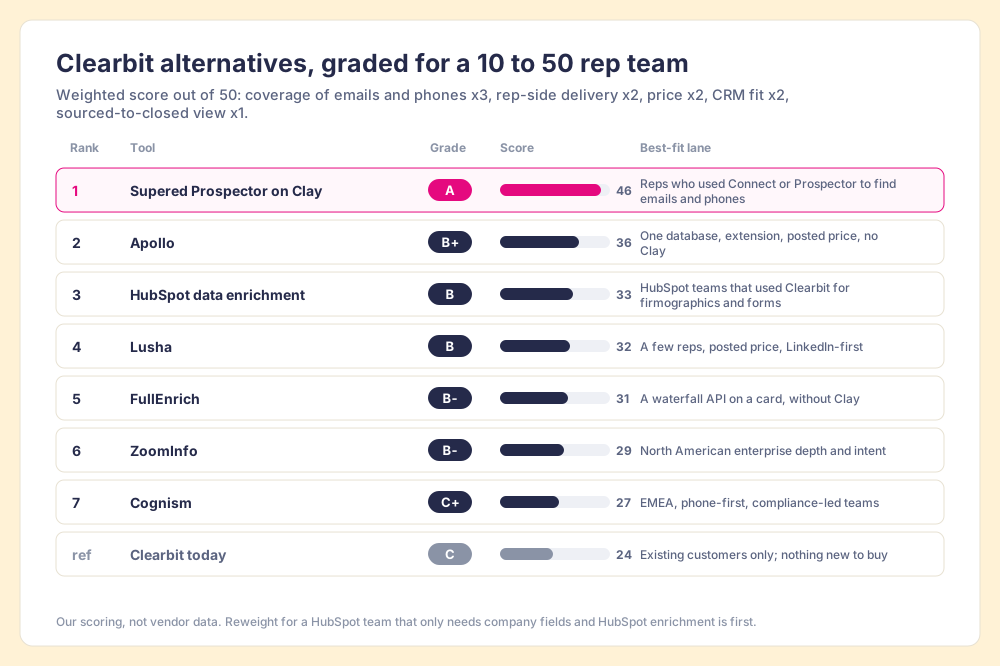
The lens is a mid-market or SMB team of 10 to 50 reps whose reps need contacts they can call and email. Weighted that way, coverage of emails and phones counts most.
| Rank | Tool | Grade | Best fit | CRM integration | Setup effort | Pricing (plan with the feature) | Reason to switch |
|---|---|---|---|---|---|---|---|
| 1 | Supered Prospector on Clay | A | Teams with Clay whose reps used Connect or Clearbit Prospector | One-click sync to HubSpot, Salesforce or Pipedrive | Admin connects Clay inside Supered; live in under a week | $45/rep/mo billed annually, plus your Clay plan (Growth $495/mo list) | Clay’s waterfall across 200+ vendors in LinkedIn and the CRM record, no Clay login |
| 2 | Apollo | B+ | Teams without Clay wanting one database plus outreach | HubSpot and Salesforce integrations | Self-serve | $49 / $79 / $119 per seat/mo, annual | Posted price, extension, sequencer, Waterfall Enrichment |
| 3 | HubSpot data enrichment | B (A in its lane) | HubSpot teams that used Clearbit for company fields and forms | Native, HubSpot only | A settings change | Included from Starter; no HubSpot Credits; buyer intent 10 credits per tracked company | You already pay for it |
| 4 | Lusha | B | A few reps, LinkedIn-first, card-paid | Extension, API from Pro | Self-serve | Premium $299.95/mo billed yearly for 5 seats | Published ladder, 1 credit per email, 5 per phone |
| 5 | FullEnrich | B- | A waterfall API without Clay | HubSpot integration, API | Self-serve | Pro $55/mo for 1,000 credits | Pays only for found data across 25+ sources |
| 6 | ZoomInfo | B- | North American enterprise | Salesforce, HubSpot, Dynamics typically included | Sales-led annual contract | No list price; Vendr median $33,500/yr | Deepest single database and intent |
| 7 | Cognism | C+ | EMEA, phone-first, compliance-led | Two-way HubSpot sync (2026) | Sales-led, 5 seats included | No list price; Vendr median $32,750/yr | Phone-verified mobiles, DNC screening |
| ref | Clearbit today | C | Existing customers | Native in HubSpot | Not open to new buyers | Not sold; enrichment now inside HubSpot | Stay only if your contract still covers you |
The grades come from five weighted criteria, each scored 1 to 5, for a maximum of 50. Our scoring, not vendor data.
| Criterion | Weight | What it rewards |
|---|---|---|
| Coverage of emails and phones | x3 | A verified contact when the first source misses |
| Rep-side delivery | x2 | Works where the rep is: the profile, the company site, the CRM record |
| Price for a 10 to 50 rep team | x2 | Published, per result or per seat, no platform fee |
| CRM fit | x2 | Native to HubSpot or Salesforce |
| Sourced-to-closed view | x1 | The manager sees which sourced contacts were worked and closed |
| Tool | Coverage (x3) | Rep-side (x2) | Price (x2) | CRM (x2) | Sourced-to-closed (x1) | Total |
|---|---|---|---|---|---|---|
| Supered Prospector on Clay | 5 | 5 | 4 | 4 | 5 | 46 |
| Apollo | 4 | 4 | 4 | 3 | 2 | 36 |
| HubSpot data enrichment | 1 | 4 | 5 | 5 | 2 | 33 |
| Lusha | 3 | 4 | 4 | 3 | 1 | 32 |
| FullEnrich | 4 | 2 | 4 | 3 | 1 | 31 |
| ZoomInfo | 4 | 3 | 1 | 4 | 1 | 29 |
| Cognism | 4 | 3 | 1 | 3 | 1 | 27 |
| Clearbit today (reference) | 3 | 1 | 2 | 4 | 1 | 24 |
Letter bands: A 42 and up, B+ 35 to 41, B 32 to 34, B- 29 to 31, C+ 25 to 28, C 20 to 24. Flip the weights for a HubSpot team that only ever used Clearbit to fill company fields, drop coverage of emails and phones to zero, and HubSpot data enrichment goes first, which is the lane where it earns its A.
Is HubSpot’s own data enrichment a Clearbit alternative?
For the blade most Clearbit customers used, yes, and it is the best one. Be fair to it first. It runs three ways, automatic (fills blanks and never overwrites), manual from a record’s Intelligence tab, and continuous, plus bulk enrichment from an index page, a segment, an import, or a workflow action. It fills the company record generously: annual revenue, employee range, industry, phone number, web technologies, year founded, LinkedIn page. Form shortening shows a visitor only “the fields that can’t be enriched.” Its sources are “HubSpot’s commercial dataset, third-party providers, and publicly available information from across the internet,” and on any paid plan from Starter up it “does not consume HubSpot Credits.” For a HubSpot team that bought Clearbit to score and route inbound leads, the job is done and the invoice is gone.
Two things to know before you switch it on. First, the trade: when HubSpot verifies a record, “limited business contact data from that enrichment may also be contributed back to the commercial dataset,” while “If you’re only using continuous enrichment, no data is added to HubSpot’s commercial dataset.” Your legal team will want to read that line. Second, the gap. Treat the enriched contact card as a form with six lines. HubSpot fills the first four, job title, seniority, LinkedIn URL, and location, in neat handwriting. The last two, the mobile phone and an email for someone you do not already have an email for, stay blank, because they are not on HubSpot’s list of enrichable contact properties and enrichment starts from a business email you already hold.
Those two blank lines are the job Connect did. They are also the job no single database does well alone. A courier with one person to find walks a street of doors: knock on the first, an empty house, try the next, and stop at the door where someone answers. A waterfall is that courier. It asks one provider, then the next, in the order your GTM engineer set, and stops at the first verified result. Clay runs that route across “200+ providers” and says on its pricing page, “If an enrichment returns no result, you’re not charged Data Credits or Actions” (clay.com/pricing, October 1, 2026). An empty house costs nothing.
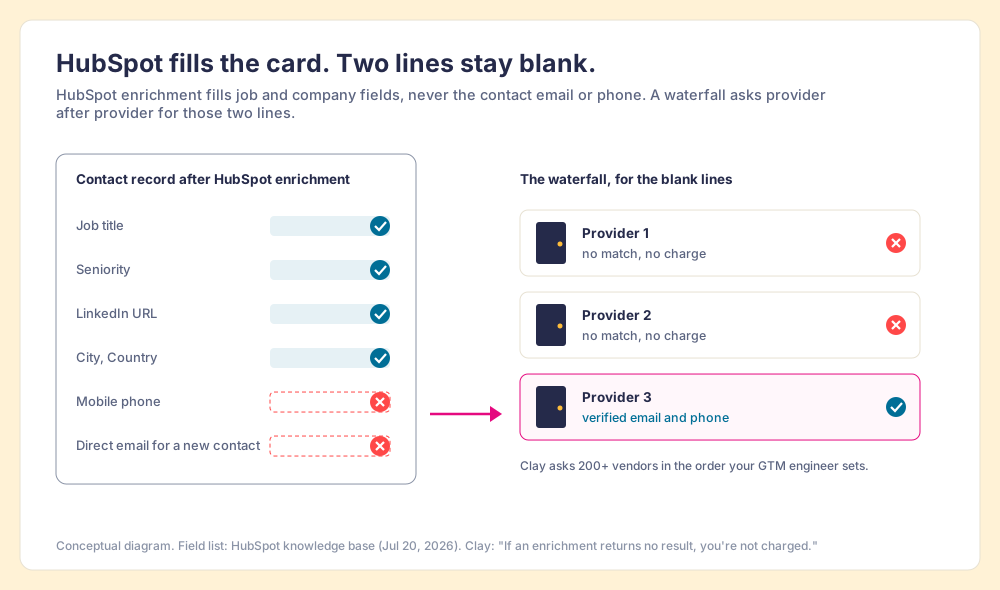
The courier has a limit. A courier only finds people who live on the street, and a waterfall only finds what its providers hold; a contact no provider holds stays unfound. The courier’s advantage is the length of the street, nothing more magical.
Which Clearbit alternative finds emails and phone numbers?
Go back to HubSpot’s 2023 memo for a moment. Clearbit’s data came from “250+ public and private data sources.” Clearbit was a waterfall wearing one brand. The closest thing to what you lost is another waterfall, and the question is only where it runs and who gets to use it.
Supered Prospector does not bring its own database. It brings Clay’s waterfall, which is every database, routed. We chose Clay as our only data provider for that reason, and it is why Clay is not a row in the table above: Clay is the row that contains the other rows. It even contains Clearbit. Clay’s integration directory still lists a “Clay-built Integration” for Clearbit, joined May 17, 2022, with actions to enrich a company, enrich a person and company from a work email, and reveal a company from an IP address (Clay, Clearbit integration, October 1, 2026). Whether each action still returns data for your account after HubSpot’s changes is worth one test row in your own table, but the idea holds: the blade you liked can stay on the route as one door among many.
What the rep sees, from Supered’s shipped Prospecting work:
- Start points where reps already are. A LinkedIn profile, a Sales Navigator list, a company’s website (with company research while the rep is on the site), or a HubSpot, Salesforce or Pipedrive record. The enrichment is one click from the screen, with no Clay login.
- A CRM check before the add. On a LinkedIn profile the rep sees the matching CRM record, and whether the prospect was already worked in the past, before creating a duplicate or stepping on a teammate.
- The buying committee, tuned per team. Titles, departments, and seniority set as parameters, so the committee lookup matches how your team sells.
- Lists that go to work. Push a whole list into a custom Clay workflow your GTM engineer built, or sync contacts to HubSpot or Salesforce in one click with field mapping set once.
- The process, applied to worked prospects. Once the contact is in the CRM, the next step your team expects reaches the rep in the flow of work, and the manager sees which sourced lists were worked and which closed, so coaching starts from what is converting.
Prospector costs $45 per rep per month, billed annually, from one user, on its own plan separate from Supered’s other products (Supered pricing). The sourcing use case walks the rep loop end to end. It runs on your Clay account and your Clay credits, and an admin enables Clay inside Supered without engineering. On list prices, Clay Growth ($495 a month, $5,940 a year, with 6,000 data credits a month and CRM auto-sync) plus Prospector for 10 reps ($5,400) is $11,340 a year, and for 20 reps ($10,800) it is $16,740. Customers typically go live in under a week.
Choose something else in four cases. If you used Clearbit only for company fields and you are on HubSpot, HubSpot’s enrichment does the job for free. If you do not have Clay and do not want a GTM engineer building tables, Apollo or Lusha is simpler. If your reps found contacts from inside Gmail, know that Prospector’s start points are LinkedIn, Sales Navigator, company sites, and the CRM record. And if your team sells from a phone in the field, Supered has no mobile product.
What does a Clearbit alternative cost a ten-rep team?
Prices on two bases, labelled: list price for ten seats where the vendor publishes one, Vendr’s median contract where it does not.
| Option | Basis | Annual cost |
|---|---|---|
| HubSpot data enrichment | Included from Starter; no email or phone | $0 extra |
| Apollo Professional | 10 seats x $79 x 12, list (apollo.io, September 25, 2026) | $9,480 |
| Clay Growth + Supered Prospector | $5,940 + 10 x $540, list | $11,340 |
| Lusha | Vendr median, 147 purchases | $15,999 |
| Cognism | Vendr median, 94 purchases | $32,750 |
| ZoomInfo | Vendr median, 1,574 purchases | $33,500 |
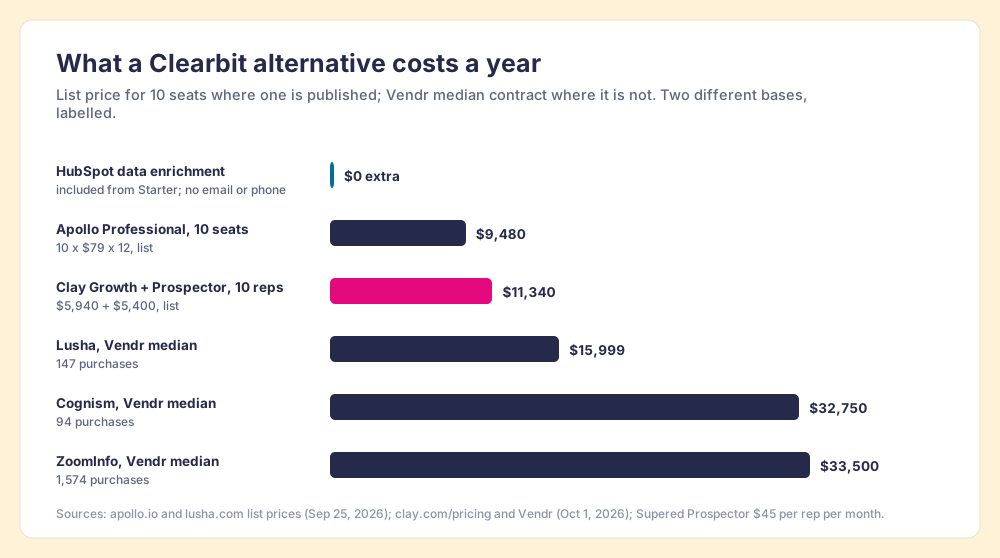
Apollo is the cheapest bar that finds phones, and it carries its own meter: 8 credits a phone. The Clay bar buys 72,000 data credits a year across 200+ vendors, with a miss costing nothing. The two Vendr medians at the top are platform-fee databases priced for a bigger buyer than this page has in mind.
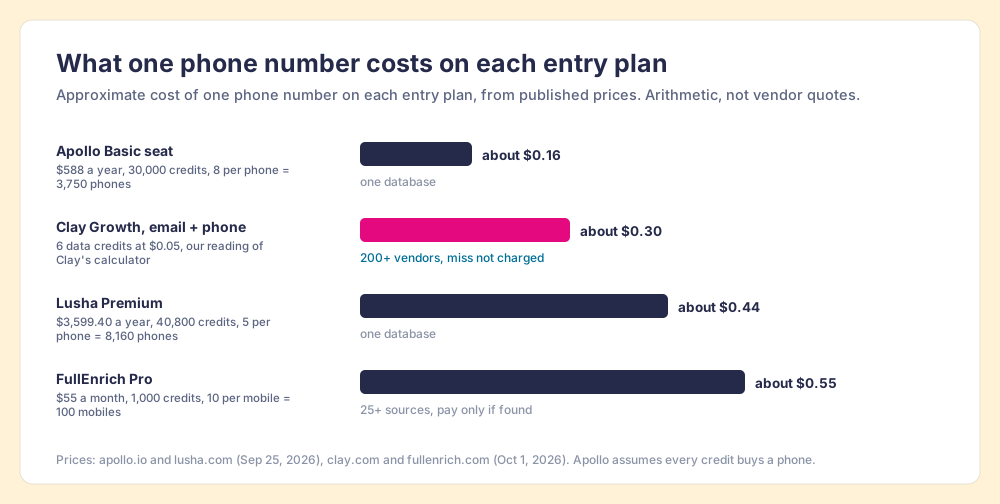
Seat prices hide the number a phone-first team cares about, so do the division. An Apollo Basic seat is $588 a year for 30,000 credits; at 8 credits a phone that is 3,750 phones, about 16 cents each, if every credit goes to phones. Lusha Premium is $3,599.40 a year for 40,800 credits; at 5 a phone that is 8,160 phones, about 44 cents each. FullEnrich Pro is $55 a month for 1,000 credits; at 10 a mobile that is 100 mobiles, about 55 cents each, charged only when found. On Clay, our reading of its pricing calculator (the Clay pricing page shows the working) is that a work email plus a phone costs roughly six data credits, about 30 cents at the $0.05 starting rate, across 200+ vendors with misses free. The cheapest phone on paper is Apollo’s, from one database; the widest net per dollar is the waterfall.
The other Clearbit alternatives, one at a time
- Apollo. The default for a team without Clay, compared in full on the Apollo alternatives page: Basic $49, Professional $79, Organization $119 per user per month on annual billing, a free tier, 1 credit per email and 8 per phone, and a Waterfall Enrichment feature that “fills each record with Apollo data first, then lets 20+ partners fill in the rest” (Apollo Waterfall). G2 4.7 from 9,690 reviews on apollo.io (September 25, 2026). Vendr’s median Apollo contract is $19,000. Independent; Matt Curl became CEO in February 2026.
- Lusha. The closest thing to Connect’s lightness: a posted ladder from free (40 credits a month) to Premium at $299.95 a month billed yearly for 5 seats and 40,800 credits, 1 credit per email and 5 per phone (lusha.com/pricing, September 25, 2026). Since March 10, 2026, Lusha is also a step in Clay’s waterfall, which the Lusha alternatives page prices out. Independent.
- FullEnrich. A waterfall sold as a product: “Only Pay For Data You Actually Find. Verified, Or It’s Free.” Pro is $55 a month for 1,000 credits, 1 credit per work email and 10 per mobile, across 25+ sources, with a HubSpot integration and an API (fullenrich.com/pricing, October 1, 2026). The best pick for a developer replacing Clearbit’s enrichment API without Clay. Independent, seed-funded (€1.9 million, February 2025).
- ZoomInfo. The deepest single database, “more than 100 million companies, 500 million contacts” by its August 2026 filing, quote-only, Vendr median $33,500 across 1,574 purchases with 22% average savings (Vendr). Public (Nasdaq: GTM), and in May 2026 it approved cutting about 600 roles to accelerate its move upmarket (SEC Form 8-K).
- Cognism. The EMEA, phone-first database: DNC screening in twelve named countries, two packages with 5 seats included and no published price, a Vendr median of $32,750 across 94 purchases, and a native two-way HubSpot sync launched in 2026. Private; owns Kaspr.
- The visitor-reveal and logo jobs. Off HubSpot, the Reveal job goes to website visitor-identification tools such as RB2B and Leadfeeder, both named on RB2B’s own Clearbit alternatives list; we did not score them, because they do not find a rep a contact. The logo job goes to logo.dev.
Corporate status for every vendor above was checked between September 25 and October 1, 2026.
Which Clearbit alternative should you choose?
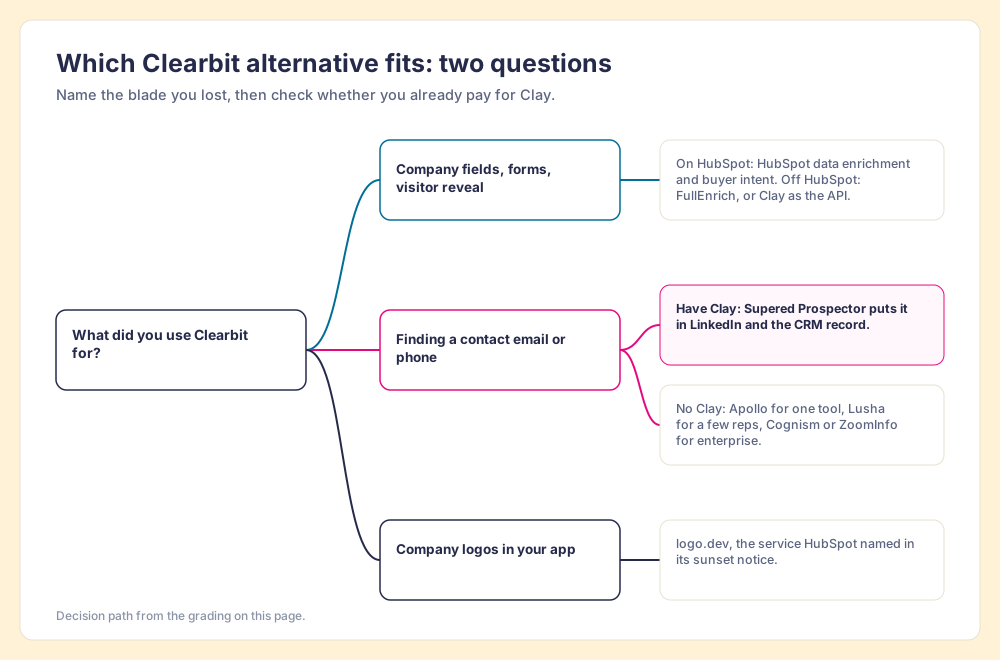
Name the blade, then the answer comes quickly.
- Company fields and forms, on HubSpot. HubSpot data enrichment, switched on today, with buyer intent at 10 credits per tracked company for the old Reveal. Do not buy a replacement for something you already own.
- Company fields through an API, off HubSpot. FullEnrich for a card-paid waterfall, or Clay itself run by your GTM engineer.
- Emails and phones for reps, with Clay. Supered Prospector, so the waterfall lives in LinkedIn, Sales Navigator, the company site, and the CRM record, and the manager sees which sourced lists get worked and closed.
- Emails and phones for reps, without Clay. Apollo for one tool with outreach bundled, Lusha for a few reps on a posted price, Cognism or ZoomInfo when you are the EMEA or enterprise buyer their contracts describe.
- Logos. logo.dev.
Our recommendation follows from the knife. If you are on HubSpot, turn on HubSpot’s enrichment first and see how much of your Clearbit habit it covers, at no extra cost. Then look at what is left. If what is left is reps who need a phone number and an email for the person on their screen, do not rebuild Clearbit as one more single database. Clearbit itself was 250+ sources behind one brand, and the version of that idea you can buy today is a waterfall: Clay’s 200+ vendors, Clearbit’s own step still on the route, run from the rep’s tab and synced to the CRM in a click. The waterfall enrichment explainer shows how the route is built, HubSpot data enrichment covers the native side in depth, and the wider field of data enrichment tools sorts the rest by job. When you are ready to see the waterfall on your own Clay account, Prospector is the place to start.
Frequently asked questions
Is Clearbit still available in 2026?+
What replaced Clearbit Connect?+
How much does Breeze Intelligence cost now?+
What is the best free Clearbit alternative?+
Clearbit vs Apollo: which should a sales team use?+
Is Supered Prospector related to Clearbit Prospector?+
Your process, running itself.