SignalHire Alternatives in 2026: Unlimited Users, One Bottle
SignalHire sells unlimited users and one shared pool of credits.
Here are the SignalHire alternatives graded for a sales team, SignalHire pricing verified live, the evidence on whether SignalHire is legit, and where a Clay team fits.
SignalHire alternatives are the contact-data tools sales teams weigh against SignalHire, the finder sold with unlimited users and one shared credit pool: single databases like Apollo and Lusha, or Clay's waterfall across 200+ vendors run from Supered Prospector.
SignalHire alternatives come up when a team outgrows a shared pool of credits, or when someone types “is SignalHire legit” after reading the reviews. The short answer, graded in full below:
- Supered Prospector. For sales teams that already have Clay: Clay’s waterfall across 200+ vendors, run from a LinkedIn profile, a Sales Navigator prospect list, a company website, or the CRM record, at $45 per rep per month billed annually.
- Apollo. For a small team that wants data, sequences, and a dialer in one plan, from $49 a seat on annual billing.
- Lusha. The like-for-like extension with a posted team ladder and a fallback to third-party data on every paid plan, from $449.10 a year.
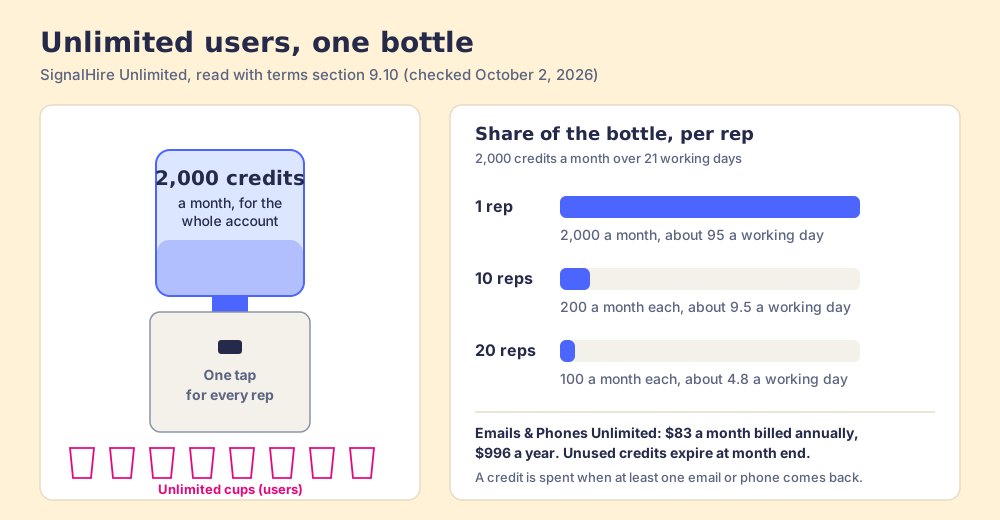
An office water cooler works on a simple deal. Anyone in the building can take a cup, and the cups go uncounted, but there is one bottle on top, and when the bottle is empty the whole floor is thirsty until the delivery truck comes. SignalHire is priced like that cooler. Every plan on its pricing page, opened October 2, 2026, says “UNLIMITED users” (signalhire.com/pricing), and its FAQ adds “we do not charge per seat” and “all the contacts are shared between the team.” The bottle is the credit pool. On the Unlimited plans, section 9.10 of the terms sets it at 2,000 credits a month for the account, “aggregate for all” its users (signalhire.com/terms, last updated August 31, 2026).
SignalHire alternatives are the contact-data tools sales teams weigh against SignalHire, the email and phone finder sold with unlimited users and one shared credit pool. They are either other single databases sold by the seat or the credit (Apollo, Lusha, ContactOut, RocketReach, Kaspr, ZoomInfo), or Clay’s waterfall across 200+ data and AI vendors (clay.com, October 2, 2026), which a rep can run from Supered Prospector on the team’s own Clay account. This page works SignalHire pricing out to the cost of one contact, lays out the evidence for the “is it legit” question, grades the field, and ends on a point the other lists leave out: SignalHire is cheaper per contact than anything else on this page, and for a sales team that dials, that is less of a verdict than it looks.
What does SignalHire cost in 2026?
SignalHire pricing is published, short, and built around one idea: you buy credits, not seats. The page below was captured October 2, 2026, for a US visitor (signalhire.com/pricing):
| Plan | Billed monthly | Billed annually | Credits | Cost per credit at full use |
|---|---|---|---|---|
| Free | $0 | $0 | 5, or 10 a month with the extension | Free |
| Emails | $69 a month, 1,000 credits | $57 a month ($684 a year) | 12,000 a year | 5.7 cents |
| Phones, or Emails & Phones | $69 a month, 435 credits | $57 a month ($684 a year) | 5,400 a year | 12.7 cents |
| Emails Unlimited | $79 a month | $63 a month ($756 a year) | 2,000 a month cap | 3.2 cents |
| Phones or Emails & Phones Unlimited | $99 a month | $83 a month ($996 a year) | 2,000 a month cap | 4.2 cents |
| Scale | Let’s talk | Let’s talk | Bulk license | Quote |
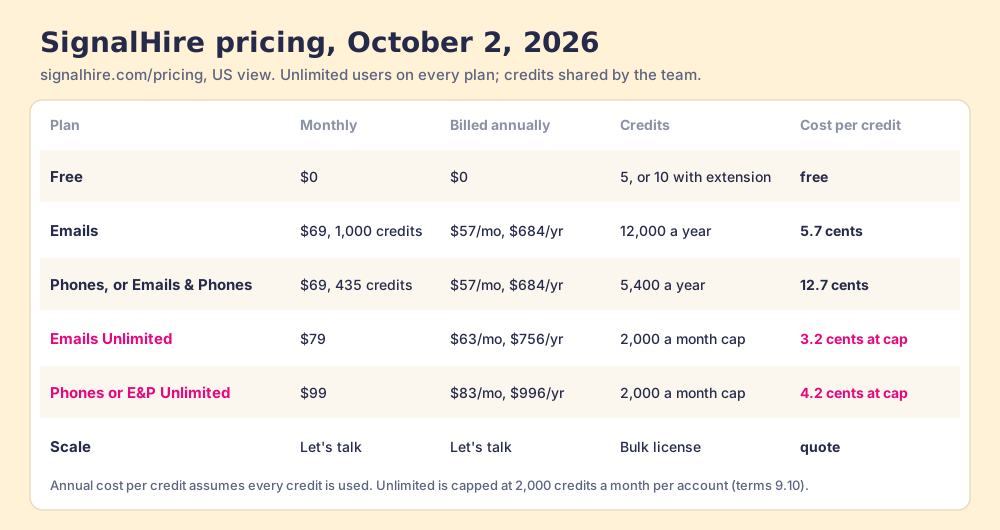
Each price sits beside a struck-through one with a “Save” badge. Five lines in the fine print change the arithmetic.
- The shared pool. Unlimited users is real, and so is the pool. “Unlimited users” means each account may add unlimited users, “provided that Monthly limit shall be aggregate for all of them” (terms 9.10). The headcount grows; the bottle does not.
- The cap behind “unlimited.” The Unlimited packages “operate under a fair usage policy,” with spending “limited to 2,000 credits per month.” The same clause says these packages are for users “who purchased annual subscription,” while the pricing page also shows Unlimited prices on monthly billing. Ask which applies before you buy monthly.
- Credits that lapse. Unused Unlimited credits “shall not be forwarded for the following month and shall expire at the end of such month.” A G2 reviewer on a monthly plan wrote in 2023: “I paid for 1 month which gives me (100 credits). Once my month was up, I still had about 60 credits and I lost them” (G2).
- The hit rule. “Clicking the button subtracts 1 contact if at least 1 email address or phone number is returned” (pricing FAQ), and the homepage says one credit “is only charged on success.” A success means something came back, so on the Emails & Phones plan a rep who wanted a mobile and got only an email has still spent the credit.
- No refunds, automatic renewal. “We do not offer any refunds” (terms 9.9), and plans renew “at the same rate that you signed up for” unless cancelled (terms 9.3).
The plan is cheap, too, and the arithmetic shows it. Emails & Phones Unlimited at $996 a year, used to its cap of 24,000 contacts, is about 4.2 cents a contact for an entire team. The Bridge Group’s 2025 SDR report, 351 companies, puts the median SDR at 44 dials a day (Bridge Group, 2025), and one rep on SignalHire Unlimited can pull about 95 new contacts a working day. The squeeze arrives with the second, the tenth, and the twentieth rep at the cooler.
Is SignalHire legit?
Yes. SignalHire is a registered company that sells a working product to a large base of users, and it is also a vendor whose public record has two marks a buyer should see before paying. Both columns, checked October 2, 2026:
- A registered company. The terms name the contracting entity as SignalHire Sp. z o.o., with a registered office on Złota Street in Warsaw, and set English law for disputes. The Chrome Web Store lists the same company as a trader under EU rules, with D-U-N-S number 849516897 and a Ukrainian support phone line.
- A large, rated extension. “SignalHire - find email or phone number” has 400,000 users and a 4.6 rating from 582 ratings, carries the Featured badge, and was updated September 20, 2026. The store says “The publisher has a good record with no history of violations” (Chrome Web Store).
- Middling marks from reviewers. 4.0 out of 5 from 72 reviews on G2 and 4.3 from 35 on Capterra. Both are below ContactOut’s 4.5 on G2 and Apollo’s 4.7 (October 1, 2026).
- A suspended Trustpilot rating. Trustpilot shows “This company’s rating is unavailable due to a breach of our guidelines” and “We’ve removed a number of fake reviews for this company.” Of the 61 reviews left, 59% are one-star, and the profile is unclaimed (Trustpilot).
- People who never signed up. The terms say the Prospects Database holds data “sourced from publicly available web data, third party sources, or Users,” and that SignalHire may build a profile of a professional who is not a customer (terms 1.9). The contact-data category runs on the same model, and SignalHire publishes an opt-out page for deletion. Several one-star Trustpilot reviews come from people who found themselves listed. A news search on October 2, 2026 found no published regulator decision against SignalHire.
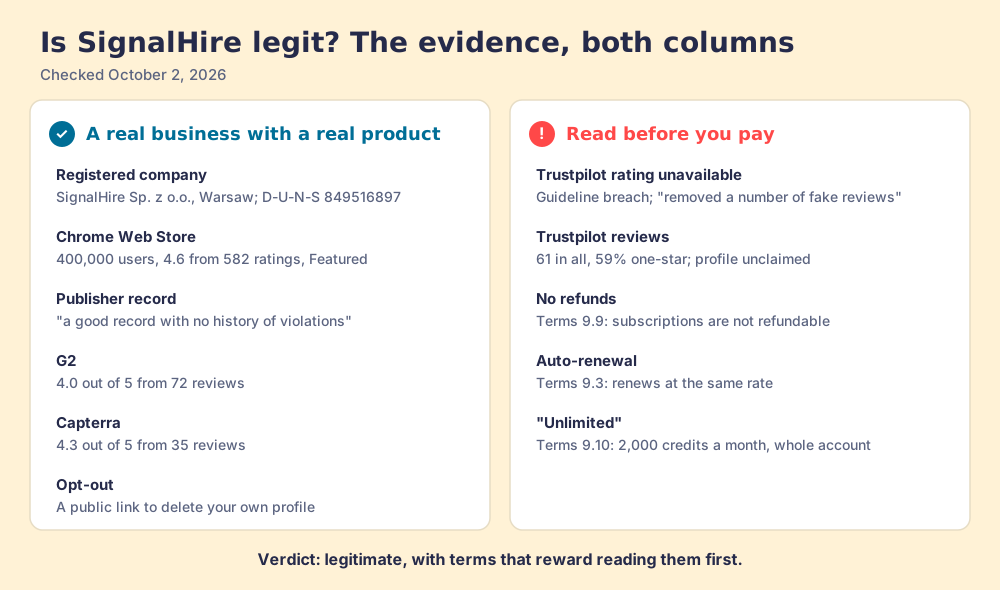
Trustpilot removed reviews it judged fake and suspended the score; it did not say who wrote them. The SignalHire review worth weighing comes with a name, a role and a date, and those are on G2 and Capterra.
Why do teams look for SignalHire alternatives?
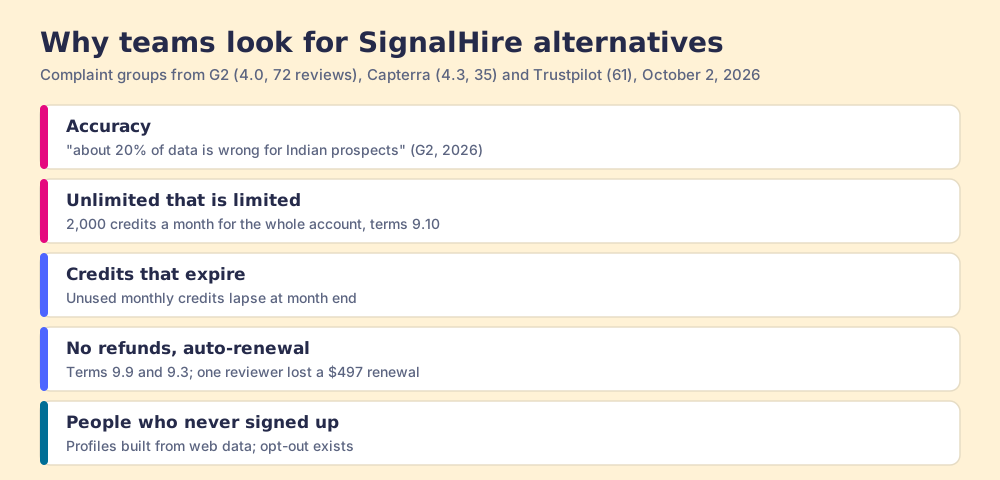
The complaints across the SignalHire reviews on G2, Capterra and Trustpilot fall into five groups, each with a reviewer saying it in their own words (all fetched October 2, 2026).
- Accuracy. “The accuracy is so low it’s unbelievable. Most of the time you get dead/fake or guessed emails,” a small-business reviewer wrote on G2 in September 2023. A founding SDR wrote in April 2026 that “about 20% of data is wrong for Indian prospects.” A marketing director on Capterra reported that 30% of the emails she sent came back as failed deliveries.
- The cap behind “unlimited.” A staffing CEO wrote on Capterra in August 2026: “Unlimited means limited,” adding that the plan “fails to tell you your limit.” Terms 9.10 does tell you: 2,000 a month, across the account.
- Credits that expire. The pool resets monthly, and leftovers go with it.
- Billing. A research analyst on Capterra wrote in May 2025 that SignalHire was “unable to refund the $497 annual renewal fee.” With 9.9 and 9.3 in the terms, put the renewal date in a calendar the day you buy.
- Privacy. “They publish profiles about people without consent,” a Trustpilot reviewer wrote in late September 2026. For a buyer it matters because the terms make the customer the data controller for any personal data it uses (terms 4.5).
There is a sixth reason that shows up in the integrations list rather than the reviews. SignalHire’s integrations page, opened October 2, 2026, lists 25 tools: 18 are recruiting and applicant-tracking systems, and the sales tools are Salesforce, Pipedrive, Zoho CRM, ActiveCampaign, Salesloft and Reply (signalhire.com/integrations). HubSpot is not on it. The Chrome Web Store copy names “Recruitment professionals” first in its “WHO IS IT FOR?” list. SignalHire sells to sales teams, and its integration shelf was stocked for recruiters.
Why trust this comparison?
I started RevPartners, a HubSpot partner that did only sales implementations, sold roughly twice as much Sales Hub as any other partner, and reached Elite tier in 13 months. Supered came out of that work and is the #1 sales enablement app on the HubSpot marketplace. That is also the disclosure. We make Supered Prospector, and it sits first on this page for teams that have Clay. Supered holds 4.9 out of 5 from 81 reviews on G2 and 5.0 from 122 on the HubSpot App Marketplace (both checked October 1, 2026). The grading below states its weights so you can flip them, and the flip for price per contact puts SignalHire first.
The SignalHire alternatives, graded
A ranking that hides its math is an advertisement. The lens is a mid-market or SMB sales team, ten to fifty reps, that needs contact data reps will use where they already work and a leader who can see which lists turn into pipeline. Each criterion is scored 1 to 5 and multiplied by its weight, for a maximum of 50. The per-vendor scores match the ContactOut alternatives page and the Kaspr alternatives page, so the pages read together.
| Criterion | Weight | What it rewards |
|---|---|---|
| Coverage of the contact you need | 30% (x3) | Verified emails and mobiles when the first source misses |
| Rep-side delivery | 20% (x2) | Works on the profile, the company site, the CRM record; no new tab or login |
| Price structure for a team | 20% (x2) | Published, buyable for the whole team without a platform fee |
| What the leader sees after the export | 20% (x2) | Which sourced lists were worked and which closed, by your definitions |
| Bundled outreach | 10% (x1) | Sequencing, dialer, drafting in the same plan |
| Rank | Tool | Grade | Score | Best fit | CRM integration | Setup effort | Pricing (plan with the feature) | Reason to switch from SignalHire |
|---|---|---|---|---|---|---|---|---|
| ref | SignalHire | B+ | 29 | Recruiters and price-first teams sharing one pool | Native (Salesforce, Pipedrive, Zoho), ATS; no HubSpot listed | Minutes | $83 a month billed annually for Emails & Phones Unlimited, whole team | Stay if price per contact is the job |
| 1 | Supered Prospector | A | 44 | Teams that already have Clay | Native (HubSpot, Salesforce, Pipedrive) | Under a week on an existing Clay account | $45 per rep per month, billed annually, plus your Clay plan | 200+ vendors per lookup, lists you can follow to closed |
| 2 | Apollo | A- | 36 | Small teams wanting data plus outreach in one | Native (HubSpot, Salesforce) | A day | $49 / $79 per seat per month, billed annually | A larger single database, sequencer and dialer in the plan |
| 3 | Lusha | B+ | 29 | Like-for-like extension for a team of up to 5 | Native (HubSpot, Salesforce) | Minutes | Premium $3,599.10 a year, 5 seats | Data Waterfall on every paid plan, HubSpot native |
| 4 | ContactOut | B | 28 | One rep or recruiter who wants personal emails | Native (Salesforce, HubSpot, ATS) | Minutes | $79 a month billed annually, 1 user | A separate phone allowance, stronger G2 marks |
| 5 | ZoomInfo | B | 28 | North American enterprise depth and intent | Native (HubSpot, Salesforce, Dynamics) | Weeks | Quote only; Vendr median $33,500 a year | US depth, for teams with the budget for a platform |
| 6 | Kaspr | B- | 25 | Email-first reps on LinkedIn, European data | Native (HubSpot, Salesforce, Pipedrive, Zoho) | Minutes | $49 or $79 per user per month, billed annually | Per-seat phone allowances, European coverage |
| 7 | RocketReach | B- | 23 | Individuals and small teams wanting published seats | Native from Pro | Minutes | Pro $899 a year; teams from $6K | Unlimited lookups on annual plans, multi-seat checkout |
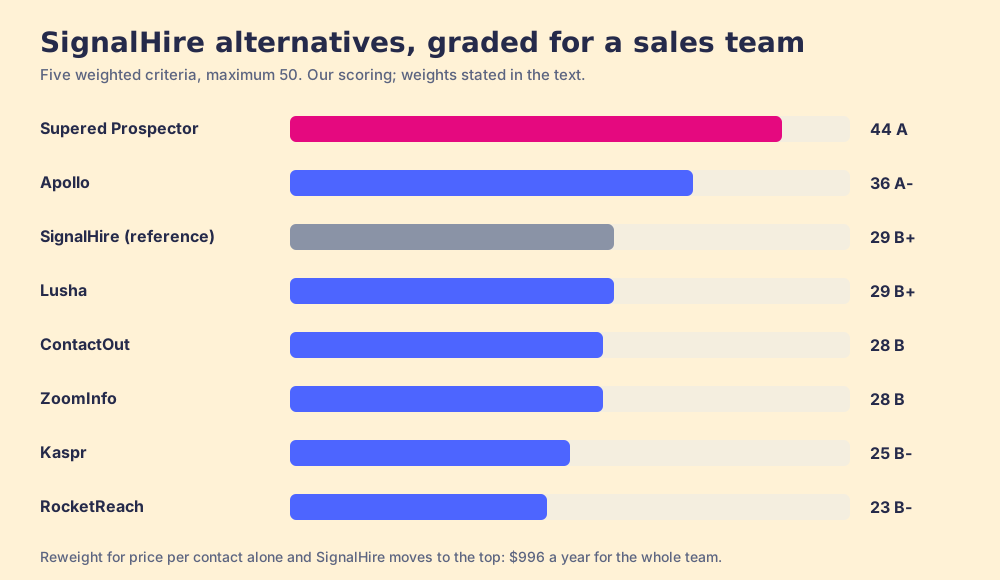
SignalHire’s 29 breaks down as coverage 2, rep-side delivery 4, price structure 5, what the leader sees 1, outreach 3. The 5 is earned: no tool on this page sells a whole team a published plan for less, and unlimited users means no rep waits for a seat. The rep-side 4 is earned too. The extension works on LinkedIn, Facebook, GitHub, X and Meetup profiles, bulk-finds up to 1,000 profiles at a time, and pushes to the CRMs and ATS tools it lists. Outreach scores 3 because SignalHire now ships email sequences from your own mailbox. The coverage 2 is the weakest mark on the card, set by the reviewer accuracy reports, the lower G2 average, and the hit rule that charges for an email when you came for a phone. Prospector’s coverage score is Clay’s waterfall coverage, credited to Clay, and its outreach score is the lowest on the card on purpose: no sequencer, dialer, or drafting.
Corporate status, checked October 1 and 2, 2026, because a comparison is wrong the day one of its vendors is bought. SignalHire is independent and privately held; a news search found no 2026 acquisition, funding round, or rebrand. Apollo acquired Pocus in March 2026 (TNW). Lusha is independent and cut about 8% of staff in December 2025 (Calcalist). Kaspr is part of Cognism, which acquired it in 2022. ZoomInfo is public (Nasdaq: GTM) and in May 2026 approved a restructuring of about 600 roles (SEC Form 8-K). ContactOut and RocketReach are independent.
Where does Supered Prospector fit?
Back to the cooler. One bottle is fine until the office grows, and the problem with a single bottle is never only its size. When it runs dry, or when the water tastes off, there is no second source in the room. A building with plumbing works differently. Water comes from more than one main, a valve opens the next line when the first one drops, and the tap at each desk does not care which main answered.
Clay’s waterfall is the plumbing. The GTM engineer writes down the order: ask this provider first, then that one, stop when a verified email or phone comes back. “Clay’s signature data waterfalls check multiple providers to return the most verified emails (lower bounce rate) and phone numbers (higher connect rate),” across 200+ data and AI vendors under one contract (Clay, rep prospecting). A miss is free: “If an enrichment returns no result, you’re not charged Data Credits or Actions” (clay.com/pricing). Compare that with SignalHire’s hit rule. The waterfall asks for a phone and keeps asking until a phone comes back, or no provider has one; the single bottle charges for whatever came out of the tap.
SignalHire can be one of the mains. Clay’s SignalHire page lists it as a data provider that joined on July 1, 2023, “Included in All Plans,” with one native action, “Search for a Candidate with SignalHire,” marked “Bring Your Own Account Required” (Clay, SignalHire integration, October 2, 2026). Clay’s waterfall page does not name SignalHire among its default providers, so whether it earns a place in your order is your GTM engineer’s call, run on your own SignalHire account. The pooled-credit plan suits that job well: one API key, one account, one bottle feeding one line in the building. The comparison stops somewhere: plumbing reaches only the mains someone connected, and a team that has never built a waterfall needs the person who builds it.
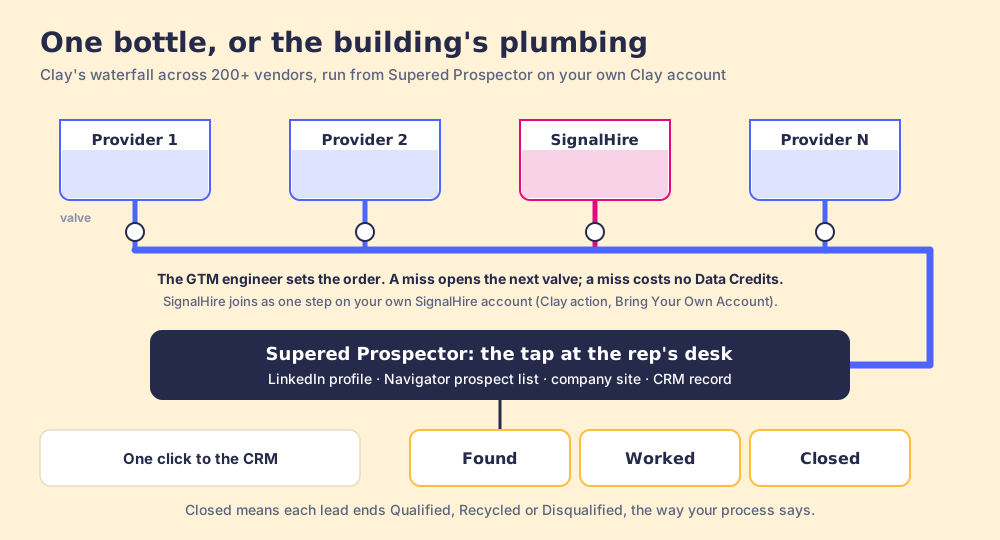
Prospector does not bring its own database. It brings Clay’s waterfall, which is every database, routed. We chose Clay as our only data provider for that reason, and it is why Clay is not a row in the tables above: Clay is the row that contains the other rows. Clay plus Supered is the best way for a sales team to prospect: GTM engineers build in Clay, reps never open Clay. Prospector runs inside the Supered Chrome extension, on the team’s own Clay account, and three people get something different from it.
- The GTM engineer, off the list desk. You built great Clay tables, and reps still Slack you for every list. With Prospector you build named flows once (person enrichment, a buying committee, a campaign) and reps pick them from a Push menu. Your waterfalls, tiers, tags and sequence variables stay yours. Start from the Supered Clay template or bring your own tables. Clay workflows covers the building side.
- The rep, with the table as a button. On a LinkedIn profile, a company’s website, or the HubSpot, Salesforce or Pipedrive record already open, the rep runs the flow in one click. From Sales Navigator, the rep adds leads to a prospect list and pushes the list to a Clay table. Before pushing, the rep sees the matching CRM record, who owns it, and whether someone already prospected this person, so two reps do not call the same buyer.
- The leader, watching lists become pipeline. Each list shows as Found, Worked and Closed: which leads reps found with your tables, who is working their list and who is not, and how each lead ended, Qualified, Recycled or Disqualified, the way your process says. The Clay budget grows on that evidence.
On LinkedIn, the same rule applies to us as to SignalHire’s extension, and it is worth asking any vendor what its extension reads. LinkedIn’s User Agreement, section 8.2, rules out software and browser add-ons that scrape or copy the service (LinkedIn User Agreement). Prospector works within LinkedIn’s terms and does not copy search results in bulk; the contact data comes from Clay’s waterfall on the customer’s Clay account.
The arithmetic, because SignalHire is cheaper than any slogan. Clay’s Growth plan lists at $495 a month, $5,940 a year, with CRM sync (clay.com/pricing). Prospector is $45 per rep per month, billed annually, from one rep (Prospector). Ten reps come to $11,340 a year. SignalHire Emails & Phones Unlimited is $996 a year for all ten, with 200 contacts a rep a month. On our reading of Clay’s pricing calculator, a work email plus a phone costs roughly six data credits, so Growth works out to about 50 cents a fully enriched contact, a supposition since Clay does not publish the calculator’s rates (the Clay pricing page shows the working). SignalHire at its cap is about 4.2 cents. On price per contact, SignalHire wins by a factor of ten.
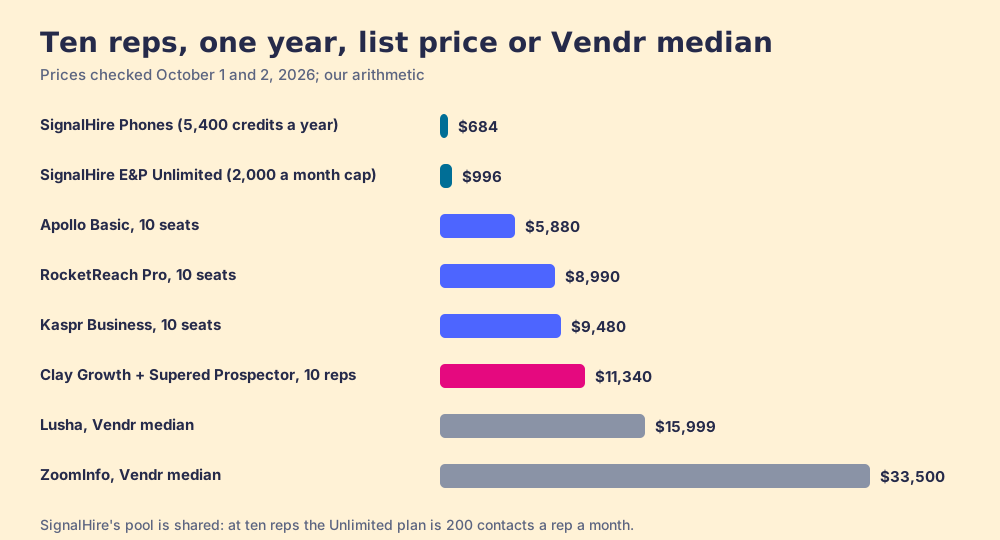
So the case for the Clay line rests on what a cheap contact costs after it is bought. A wrong mobile costs a dial and a rep’s minute; a bounced email costs sender reputation, which the Capterra reviewer with the 30% failure rate called the reason it was “not worth it.” The waterfall answers with a second and a third source when the first one misses. And the leader can see whether the contacts became meetings, which no credit counter records.
Choose something else if you do not have Clay. Prospector runs on the customer’s Clay account and does nothing without one, and someone has to build the tables; Clay’s homepage says “GTM engineers build on Clay.” Choose something else, too, if your team is two recruiters or three founders who need emails at the lowest possible price, because SignalHire’s $684 Emails plan is hard to argue with for that job. And Prospector does not send email; it hands the contact to your CRM or your sales engagement tool. The mechanics from the rep’s chair are on the Clay Chrome extension page, and sourcing on Clay walks through the full loop from profile to closed.
How do the other SignalHire competitors compare?
Each of these is a single bottle of its own, priced and checked on October 1, 2026 unless another date is given.
- Apollo. Seats for the whole team at $49 a month on annual billing with 30,000 credits per seat per year, a sequencer and dialer included, and a meter that charges 1 credit for an email and 8 for a phone (apollo.io/pricing). G2: 4.7 from 9,778 reviews. A bigger bottle with outreach attached; Apollo vs Lusha sets the two side by side.
- Lusha. Starter at $449.10 a year for 4,800 credits and Premium at $3,599.10 a year for 40,800 credits and 5 seats, with an email at 1 credit and a phone at 5 (lusha.com/pricing). Since September 23, 2026, Lusha’s Data Waterfall falls back to third-party providers on every paid plan (Lusha changelog), which answers SignalHire’s coverage complaint inside one vendor. G2: 4.3 from 1,665 reviews. The Lusha review weighs it in full.
- ContactOut. The recruiter’s other favorite, with a separate meter for phones: Email + Phone at $79 a month billed annually ($948 a year), unlimited under a fair-use cap of 2,000 emails and 1,000 phones a month, and one user per company on self-serve (contactout.com/pricing). G2: 4.5 from 113 reviews. It is the mirror image of SignalHire: one cup, a bigger bottle. ContactOut pricing works it to the export.
- RocketReach. Pro at $899 a year for unlimited lookups under fair use and 3,600 exports, team plans “start at $6K annually” (rocketreach.co/pricing). G2: 4.4 from 1,385 reviews. The RocketReach alternatives page grades its field.
- Kaspr. Business at $948 a year with 2,400 phone credits and “200 million + European B2B contacts” (kaspr.io/our-data). Owned by Cognism.
- ZoomInfo and Cognism. The quote-only platforms, at Vendr medians of $33,500 and $32,750 a year (Vendr, ZoomInfo).
For the email-only job, the email finder tools roundup goes deeper, and direct dials covers what makes a mobile number worth paying for.
Which SignalHire alternative should you choose?
The choice resolves once you name two things: how many people will drink from the bottle, and whether you already run Clay. The ways forward:
- SignalHire itself. The pick for a recruiter, a founder, or a small team where price per contact decides it and someone checks a sample before the list goes out. Buy annually, read terms 9.9, 9.3 and 9.10 once, and put the renewal date in a calendar.
- Apollo. The pick when the job is data plus sequences and a dialer in one tool, with a seat and a credit allowance for every rep. Size the credits before the seats: a phone costs 8.
- Lusha. The pick for a HubSpot team of up to five that wants the same extension workflow with a fallback to third-party data built in.
- ContactOut, RocketReach or Kaspr. The pick when you want per-person allowances instead of a shared pool: ContactOut for one rep’s personal emails, RocketReach for US exports, Kaspr for European data.
- ZoomInfo or Cognism. The pick for enterprise depth or EMEA phone coverage, if the budget makes a platform contract sensible.
- Supered Prospector. The pick when the team already has Clay: Clay’s waterfall, SignalHire among the mains if your GTM engineer wants it, in every rep’s hands on LinkedIn, the company site and the CRM record, and a view of which lists get worked and closed.
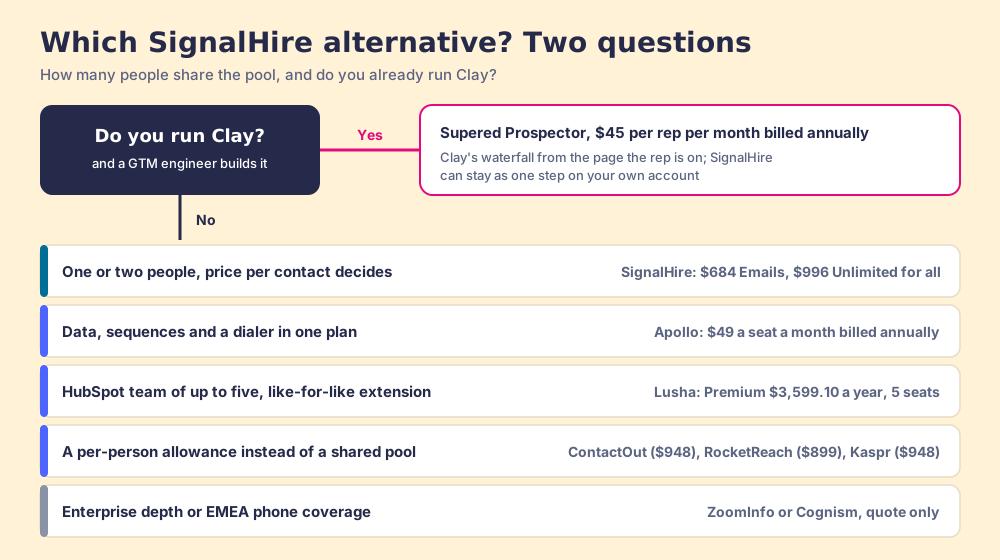
What we recommend depends on how many people stand at the cooler. One or two, and SignalHire is a bargain with fine print you can live with. A team without Clay that dials for a living should pay more per contact for a source with better reviewer marks on phones and a HubSpot connector if that is your CRM: Lusha or Apollo for most US mid-market teams, Kaspr or Cognism if your buyers are in Europe. A team with Clay should stop shopping for a better bottle. Plumb the building, keep SignalHire as a main if its hit rate holds up in the order, and follow each list your reps build from the profile to closed. The ContactOut alternatives page covers the per-seat side of this same market, and a Prospector demo on your own Clay account is where you can watch the first list go from a LinkedIn tab into the CRM and on to closed.
Frequently asked questions
What are the best SignalHire alternatives in 2026?+
How much does SignalHire cost in 2026?+
Is SignalHire legit?+
Is SignalHire's unlimited plan really unlimited?+
Why is my profile on SignalHire, and how do I remove it?+
Do I need a Clay account to use Supered Prospector?+
Everything we have written on SignalHire
More on SignalHire
Looking past SignalHire? See Supered Prospector on your own Clay accountYour Clay waterfall, where reps already work.