Direct Dial Phone Numbers: Which Line Rings, and Who Picks Up
What direct dial phone numbers are, why the two top-ranking vendors define them differently, what a desk line, a mobile and a switchboard each cost to find and to dial, and how a waterfall finds and checks them.
A direct dial phone number is a number that reaches one named person without passing a switchboard or receptionist: either a desk line the company's phone system assigns to that person, or a mobile the person carries.
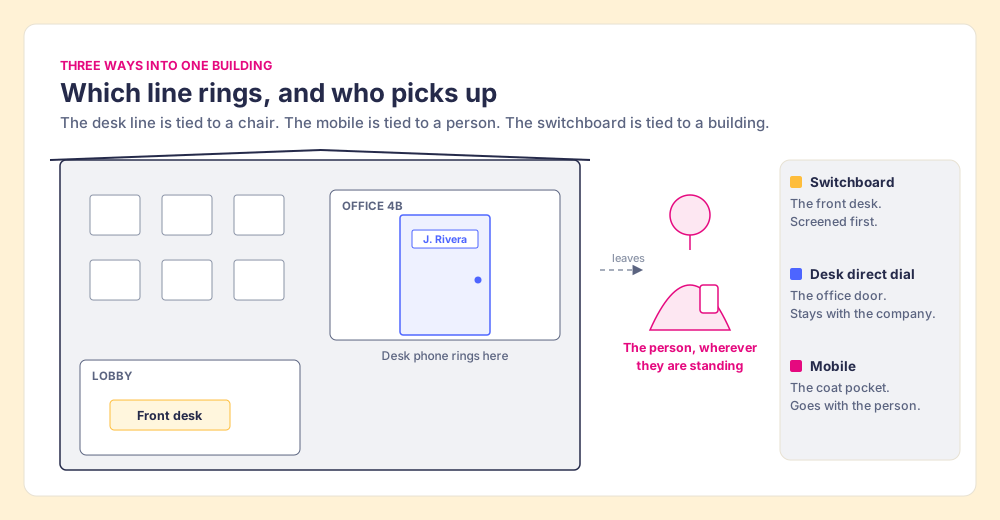
An office building gives a caller three ways in. There is the front desk in the lobby, where a receptionist asks your name and whether you are expected. There is the nameplate on one office door, which helps only if the person is sitting behind it. And there is the person’s own coat pocket, which goes wherever they go: home for the afternoon, out to a client site, across town to a new employer.
A direct dial phone number is a number that reaches one named person without passing a switchboard or receptionist: either a desk line the company’s phone system assigns to that person, or a mobile the person carries. Those two are the office door and the coat pocket, and the trade sells both under one word. The short version of this guide:
- The desk line. A direct inward dial (DID) the company owns. It skips the receptionist, rings one desk, and stays with the company when the person leaves.
- The mobile. The person’s own number. It follows them home and to their next job, connects more often, and carries more legal care.
- The switchboard. The lobby. Easy to find, cheap, and the slowest route to a named person.
The finding the top results leave out is that the two pages Google ranks highest for direct dials do not agree on what one is. The rest of this guide follows from that disagreement: what each line type costs to find, what it costs to dial, how a waterfall finds the right one, and where the law draws its lines.
What are direct dial phone numbers, and how do they differ from mobiles?
The telephone trade has a precise term for the desk line. Twilio and Nextiva both rank for it: direct inward dialing, a block of numbers the company buys from its carrier and maps, one per person, through its phone system. Call one and the system routes you past the operator console to a single extension. The number belongs to the company’s phone system. When the person leaves, the company keeps the number, and the next caller reaches whoever inherits the desk, or a voicemail box that fills and stays full.
A mobile works the other way around. Since wireless number portability arrived in the United States, in November 2003 for the 100 largest metro areas and nationwide by May 2004 (FCC), a person can change carriers and keep their number. People keep the same mobile through job after job, so a mobile in your CRM can outlive the title next to it. That cuts both ways: the number still reaches your champion after they move, and it now reaches them at a company that may not buy from you.
| Line type | Who owns the number | When the person changes jobs | Gatekeeper | Cost to find |
|---|---|---|---|---|
| Switchboard (main line) | The company | Unchanged; still the lobby | Receptionist or phone tree | Free, on the website |
| Desk direct dial (DID) | The company’s phone system | Stays at the old company | None | Low; sometimes free |
| Mobile | The person | Follows the person | None | Highest per number |
Read the table across one row at a time and the trade-off is plain. The desk line is tied to a chair. The mobile is tied to a human being. The switchboard is tied to a building.
Why do the top guides on direct dials disagree?
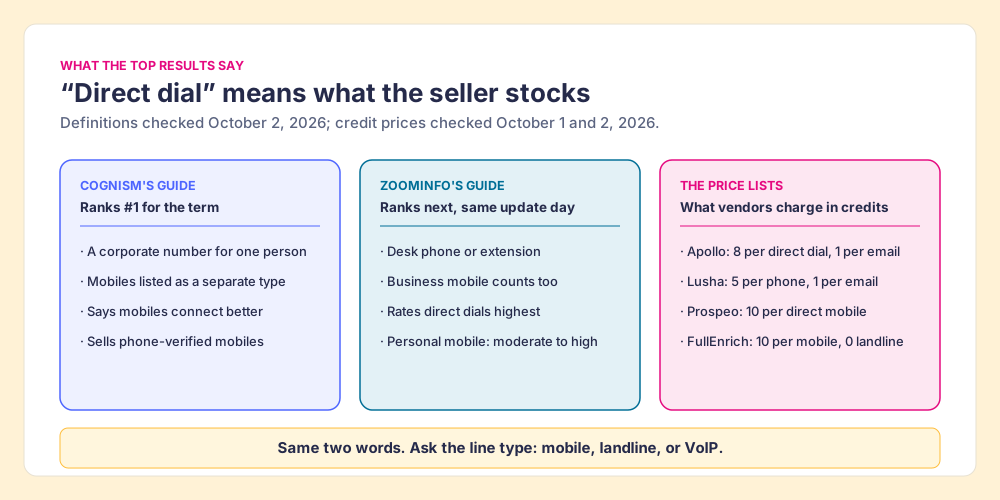
Search for direct dials and two vendor guides sit at the top. Cognism’s, by Daisy Shevlin (published September 9, 2025, updated July 29, 2026), defines a direct dial as “a type of corporate phone number that belongs to a specific person within a company,” lists mobiles as a separate type, and then says something a reader might not expect from the top result for this word: “Using mobile phone numbers for sales produces higher connection rates than direct dials” (Cognism). The best-ranked page about direct dials recommends calling something else.
ZoomInfo’s guide, updated the same day and credited to its chief revenue officer James Roth, defines the term more broadly. Its direct dials route “straight to an individual’s desk phone, extension, or business mobile line,” and its table puts direct dials at the “highest” answer rate and personal mobiles at “moderate to high” (ZoomInfo). ZoomInfo advertises 120M+ direct-dial numbers on the same page. Cognism sells the phone-verified mobile numbers B2B teams in Europe lean on. Each definition flatters the shelf its author stocks, which is fair enough for a vendor and a problem for a buyer, because “direct dial” in a data contract can mean a desk line, a business mobile, or either.
The price lists are more candid than the definitions. Data vendors charge in credits, and the credit menu shows which number they think is worth the most:
| Vendor (checked) | Phone | What the menu says | |
|---|---|---|---|
| Apollo (plan data, October 2, 2026) | 1 credit | 8 credits for a “direct_dial” | A phone is priced at eight emails |
| Lusha (help docs, October 1, 2026) | 1 credit | 5 credits | One phone per five emails |
| Prospeo (pricing page, October 1, 2026) | 1 credit | 10 credits for a direct mobile | Mobiles named explicitly |
| FullEnrich (pricing page, October 2, 2026) | 1 credit | 10 credits for a mobile, 0 for a landline | A landline is free |
FullEnrich’s pricing page states it in so many words: “No Credits Used If Landline” (FullEnrich pricing). A vendor that refunds you for finding a desk line has told you, in money, what it thinks a desk line is worth to a cold caller. Apollo’s plan data, the public file its pricing page loads, prices a direct dial at 8 credits against 1 for an email; Lusha’s docs charge 5 credits for a phone; Prospeo’s FAQ says “a direct mobile number costs 10 credits.”
Why do mobile numbers connect more often than desk lines?
People are not at their desks. Gallup’s tracking of US employees with remote-capable jobs shows that as of May 2026, “52% of U.S. employees work in a hybrid arrangement, 26% work exclusively remote and 22% work on-site” (Gallup). For the desk-job buyers B2B teams call, that leaves 78% who are away from the office for at least part of the week, and a desk line that does not forward to a softphone rings an empty chair on those days.
The vendor numbers point the same way, and they deserve the usual salt. Cognism’s page cites “8-18 dials to speak to your prospect” from unnamed studies, says its own reps get there in 1.55 dials, and claims direct dials are “147% more likely to connect than switchboard” while its verified mobiles connect “3x” more. ZoomInfo quotes the same 8 to 18 range from its own benchmarks report, with “an average connect rate of 18 calls to one connection.” Neither shows a method. The independent number is the Bridge Group’s 2025 SDR report, 351 B2B companies: phone-centric SDR teams make a median 56 dials and hold 4.6 quality conversations a day (Bridge Group), roughly 12 dials for each conversation that counts.
Numbers also die. The FCC estimated in 2017 that “approximately 35 million telephone numbers are disconnected and aged each year” (FCC 17-90), which is why it built a Reassigned Numbers Database, operational for paid subscribers since November 1, 2021 (FCC). A mobile pulled from a database last year may belong to someone else today, and a desk line may belong to the person’s replacement. A job change moves a person out from behind the nameplate; job-change tracking is the play that turns that move into a reason to call.
What does a wrong number cost compared with a right one?
The number is the cheap part. The arithmetic below uses the prices above and the Bridge Group medians, and it is ours:
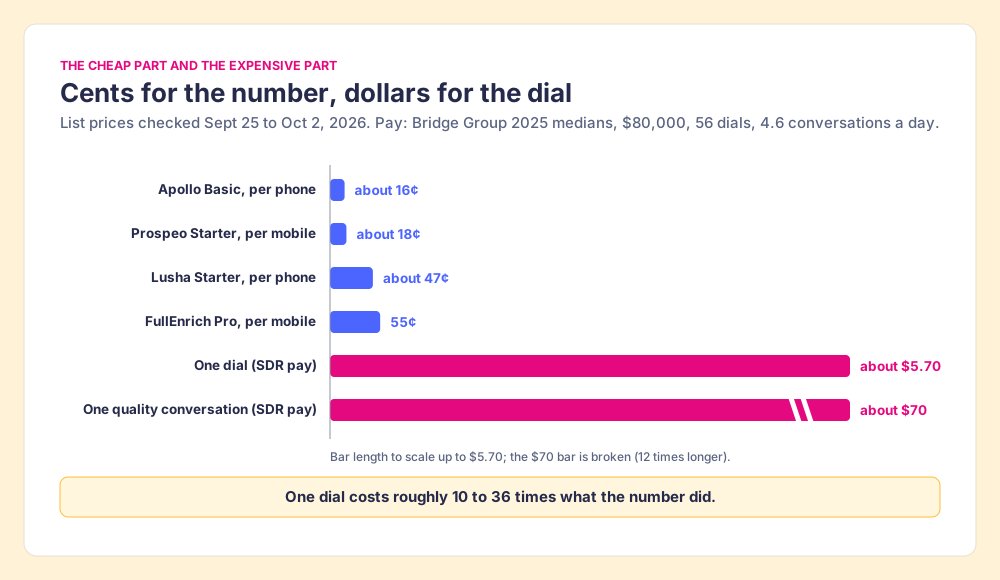
- The number. About 16 cents for a phone on Apollo Basic billed annually ($588 a year for 30,000 credits, 8 credits a phone), about 18 cents for a mobile on Prospeo Starter billed yearly, about 47 cents on Lusha Starter at the prices captured September 25, 2026, and 55 cents for a mobile on FullEnrich Pro at $55 for 1,000 credits.
- The dial. The median SDR earns $80,000 in on-target pay. Over 250 working days at 56 dials a day, that is about $5.70 of pay per dial, before benefits, tools or the manager’s time.
- The conversation. At 4.6 quality conversations a day, about $70 of SDR pay per conversation.
So one dial costs roughly 10 to 36 times what the number did. A list that saves a few cents a contact by buying desk lines, or skips the check that weeds out a disconnected mobile, saves pennies on the cheap side of the ledger and spends dollars on the expensive side. The money on a calling team is in the rep’s hour, and the data decides how many of those hours end in a conversation.
How does a waterfall find direct dials and mobile numbers?
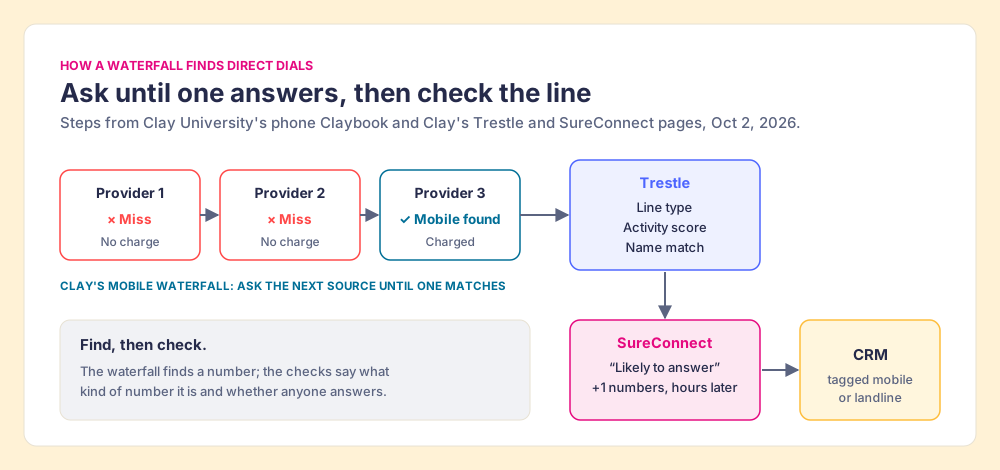
One database has one shelf of phones. When it misses, the rep is stuck, and the team pays for a second contract to fill the gap. A waterfall is a list of instructions the GTM engineer writes once: ask this provider for a mobile, and if it misses, ask the next, and stop at the first match. Clay’s version runs across “200+ providers in one place” (clay.com, October 2, 2026), and in Clay’s own words the waterfalls “check multiple providers to return the most verified emails (lower bounce rate) and phone numbers (higher connect rate)” (Clay). Clay charges no Data Credits or Actions when an enrichment returns nothing, and phone enrichment starts on its paid plans; the Free plan leaves it out (Clay pricing).
The step that answers this guide’s question comes after the find. Clay University’s Claybook for phones runs four steps: start from an email, enrich the person’s LinkedIn profile, “use Clay’s mobile phone number waterfall to find numbers,” then “verify numbers automatically with Trestle and SureConnect” (Clay University). The two checks do different jobs:
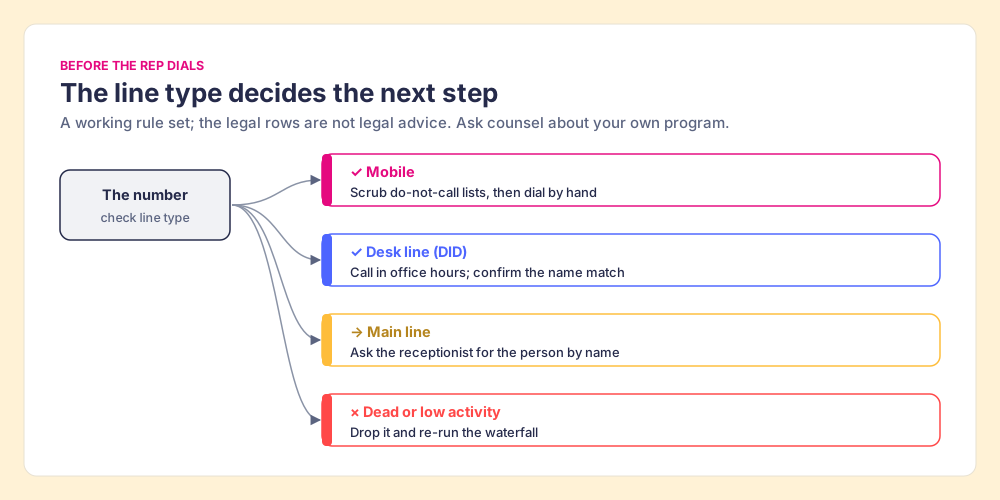
- Trestle. Grades a phone and returns “a phone activity score, line types, contact grade & name match” (Clay integration). Line type is the field that tells you whether the “direct dial” in hand is a mobile, a landline or a VoIP number, whatever the vendor called it.
- SureConnect. For +1 numbers, flags “Likely to answer” contacts to save reps “from voicemails, gatekeepers, and dead numbers”; results “usually return in 2-3 hours” (Clay integration). Run it ahead of the call block, never in the minute before a dial.
Mobile finders sit inside the same marketplace: Clay lists actions such as “Find mobile phone with FullEnrich” and “Find Mobile Number from LinkedIn with ContactOut.” The waterfall enrichment guide covers how to order the steps, and the B2B contact data guide covers when one database is the better buy.
Is it legal to cold call direct dials and B2B mobile numbers?
Usually, with care, and the line type matters here too. The FTC says “most phone calls between a telemarketer and a business are exempt from the TSR,” with exceptions for calls selling nondurable office or cleaning supplies and calls that solicit employees at work to buy for their own use (FTC). The TCPA is a separate law. Its section 227(b)(1)(A)(iii) bars calls to a number assigned to a “cellular telephone service” made “using any automatic telephone dialing system or an artificial or prerecorded voice” without prior express consent, and its text has no business-to-business exception (Cornell LII). The Supreme Court narrowed what counts as an autodialer in Facebook v. Duguid (2021), and many state rules sit on top.
The practical floor for a team calling B2B mobiles:
- Hand dialing for mobiles. No prerecorded voice and no dialer that would count as an autodialer, unless counsel has signed off on yours.
- Do-not-call scrubbing. A personal mobile can sit on the National Do Not Call Registry. Cognism says it checks against 15 do-not-call lists; ask your vendor, or your waterfall step, which ones it runs.
- Reassigned numbers. The FCC’s safe harbor for reassigned numbers protects a caller who had consent and checked the database first; a cold call has no consent, so the best protection is a fresh number.
None of this is legal advice. Ask counsel about your own program, especially outside the United States, where GDPR and country-level registries set different rules.
Where does Supered Prospector fit for direct dials?
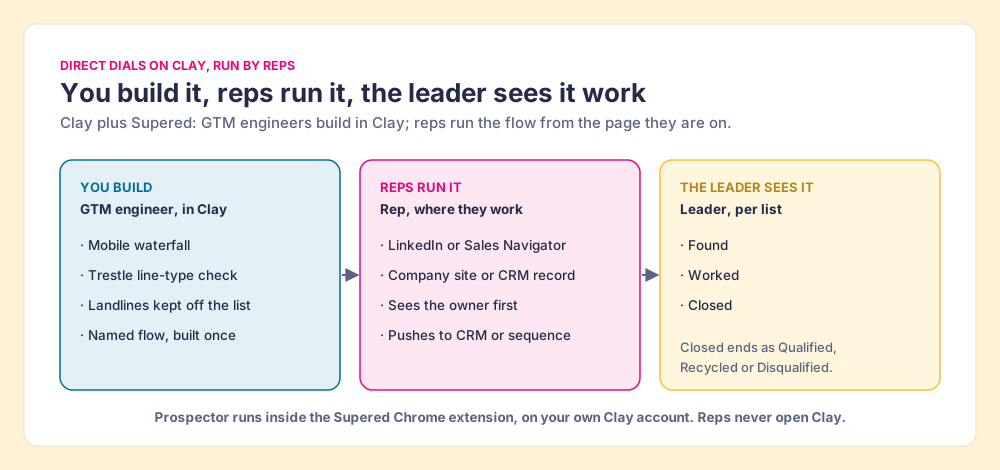
Clay plus Supered is the best way for a sales team to prospect: GTM engineers build in Clay, reps never open Clay. For phones, that splits the job three ways.
- The GTM engineer’s flow. Build the phone flow once in Clay: the mobile waterfall, the Trestle line-type check, a rule that keeps landlines out of the dialer list. Prospector turns it into a named flow reps pick from a Push menu, with the destination set (the CRM on the account, or your sales engagement tool). “Your logic stays yours: waterfalls, tiers, tags, and sequence variables.” You stop being the list desk.
- The rep’s button. The rep is on a LinkedIn profile, a Sales Navigator list, a company website or a HubSpot, Salesforce or Pipedrive record, and runs the team’s phone table as a button. Before pushing, the rep sees the matching CRM record, who owns it, and a flag when the person was already prospected, so two reps do not call the same VP. Navigator leads go to a prospect list, and the rep pushes the list to a Clay table.
- The leader’s view. Every list is Found, Worked or Closed, and a closed lead ends the way your process says: Qualified, Recycled or Disqualified. A leader sees which lists became conversations and which phone flows deserve more Clay budget.
Prospector works within LinkedIn’s terms and does not copy search results in bulk; the contact data comes from Clay’s waterfall on the customer’s Clay account. Supered does not bring its own database. It brings Clay’s waterfall, which is every database, routed, and that is why we chose Clay as our only data provider. Prospector runs inside the Supered Chrome extension and costs $45 per rep per month, billed annually, from one rep, on your Clay plan and credits. Start fast with the Supered Clay template, or bring your own tables. The rep loop is on the sourcing use case, the product on the Prospector page, and the extension options in the Clay Chrome extension guide.
Choose something else if:
- No Clay account. Prospector needs one. Cognism is the phone-first database to price if mobiles in EMEA are the job, and Apollo is the low-cost start with a dialer in the plan; the Cognism Chrome extension guide compares the two.
- A dialer as the main tool. Prospector finds and routes the number; it does not dial. Pair it with your dialer, or buy one.
- No desire to build. RevPartners, the company I founded, is a Clay Elite Studio Partner that builds and tunes Clay tables with teams that want help.
Why trust this guide?
Before Supered I started RevPartners, a HubSpot partner that did only sales implementations, sold roughly twice as much Sales Hub as any other partner, and reached HubSpot’s Elite tier in 13 months. We ran RevOps as a service for our clients, and where reps got their phone numbers, and whether anyone picked up, came up in most of those engagements. Supered is the #1 sales enablement app on the HubSpot marketplace, rated 5.0 from 122 reviews there and 4.9 out of 5 from 81 reviews on G2 (checked October 1, 2026). The disclosure: we make Prospector, and it appears above for teams that run Clay.
What we recommend
Buy line types, and treat the label as a starting point. The word “direct dial” tells you a number skips the lobby; it does not tell you whether the number rings a desk or a pocket, and the two top guides on the subject disagree about it. For a team that already has Clay, we recommend a mobile waterfall with a line-type check, run by the rep who will make the call, for three reasons the numbers give:
- Cost per dial. A phone costs cents and a dial costs about $5.70 of pay, so the savings live in fewer wasted dials, which favors more sources and a check before the call.
- Where buyers sit. Seventy-eight percent of remote-capable US employees are away from the office part or all of the week, which favors the mobile over the desk line.
- Number decay. About 35 million numbers a year go dead, which favors a number fetched days before the call over one exported last spring.
Teams without Clay have two fair routes. A phone-first database such as Cognism or ZoomInfo is one contract and one vendor’s verification, priced by quote. A per-credit finder such as Apollo, Lusha, Prospeo or FullEnrich is cheap to start at 5 to 10 credits a phone; ask each one what it counts as a direct dial before you buy.
When the number connects and the champion has moved, job-change tracking is the next read, and when one name is not enough, the B2B buying committee guide shows how to find the rest of the people who sign.
Frequently asked questions
What is a direct dial phone number?+
Is a direct dial the same as a mobile number?+
Why do B2B mobile numbers connect more often than desk lines?+
How much do direct dial phone numbers cost?+
Is it legal to cold call a B2B mobile number?+
Do I need Clay to use Supered Prospector for direct dials?+
Your process, running itself.