Sales Prospecting Tools in 2026: Four Jobs, Three Handoffs, and Where the Leads Get Dropped
Sales prospecting tools do four jobs: find the person, fill in the email and phone, time the touch, send it. Most stacks buy one tool per job and lose leads at the handoffs. Ten tools graded for a mid-market team, priced October 2, 2026.
Sales prospecting tools are the software a sales team uses to find the right people, get a verified email or phone for them, learn when to reach out, and send the first touch, and a typical stack buys a separate tool for each of those four jobs.
Sales prospecting tools do four jobs, and the order you buy them in matters less than what happens between them. The short answer, graded in full below:
- Supered Prospector. For teams that already have Clay: the GTM engineer’s Clay tables become a button reps press in Sales Navigator, on a company website or in the CRM record, at $45 per rep per month billed annually.
- Apollo. For a small team without Clay that wants search, contact data, sequences and a dialer in one plan, from $49 a seat per month on annual billing.
- LinkedIn Sales Navigator. For finding the right person, which it does better than anything else here, from $119.99 a month. It sells no emails or phones, so it never works alone.
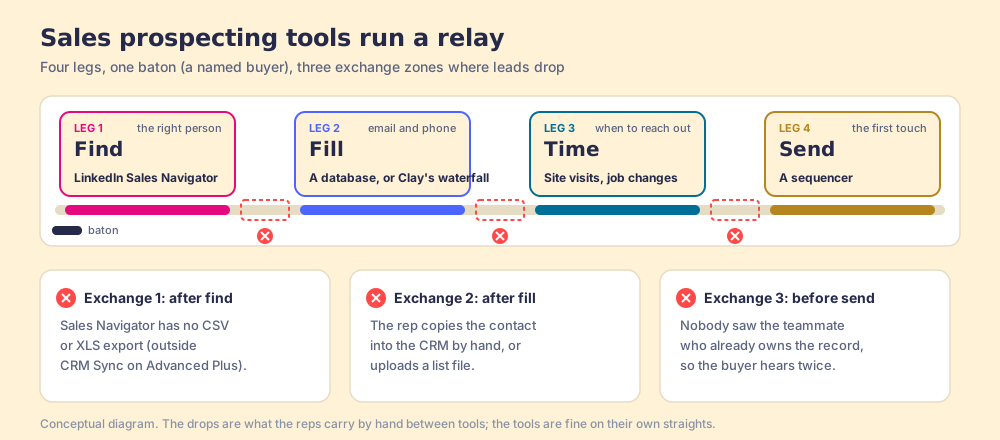
A 4x100 relay is four sprinters and one baton. Fans watch the straights, where the runners are fast and the race looks like it is being decided. Coaches watch the exchange zones, the short boxes where one runner has to put the baton into the hand of the next at full speed, because a fast team that fumbles one pass finishes last. A prospecting stack is a relay. One tool finds the person, a second fills in the email and phone, a third says when to reach out, a fourth sends the first touch, and the baton, a single named buyer, has to cross three exchanges in the hands of a rep who also has a quota.
Sales prospecting tools are the software a sales team uses to find the right people, get a verified email or phone for them, learn when to reach out, and send the first touch, and a typical stack buys a separate tool for each of those four jobs. Salesforce’s State of Sales survey of 7,775 sales professionals found sales teams “use an average of 10 tools to close deals,” and 66% of reps said they were overwhelmed by the number (Salesforce, December 2022). The lists that rank for this term grade the runners. This page grades the runners too, and then the exchanges.
What did the top-ranking lists of sales prospecting tools leave out?
I read the eight organic results Google showed in the US for “sales prospecting tools” on October 2, 2026 (Ahrefs SERP overview). Six are lists of the best sales prospecting tools written by a vendor about its own category. One is a Reddit thread and one is a Salesloft guide with no ranked list. The six lists, read the same day:
| Publisher (position) | Tools listed | Publisher’s own rank | Apollo | Sales Navigator | Clay | Waterfall enrichment |
|---|---|---|---|---|---|---|
| ZoomInfo (2) | 10 | 1st | 3rd | 2nd | Absent | Absent |
| Salesgenie (3) | 17 | 1st | 4th | 3rd | 14th | Absent |
| Salesforce (6) | 5 | 1st | 3rd | 4th | Absent | Absent |
| Leadfeeder (7) | 20 | 1st | 4th | 2nd | Absent | Absent |
| Pipedrive (8) | 15 | 1st | 3rd | 2nd | Absent | Absent |
| Overloop (10) | 8 | 1st | 3rd | 2nd | Absent | Absent |
Six lists, six self-appointed winners. That part is ordinary; every vendor is entitled to its own blog, and Overloop at least prints its disclosure. The useful finding is in the other columns. Apollo and Sales Navigator made all six lists, which tells you the field agrees on who runs leg one and who sells the most popular shelf for leg two. Clay made one list, at 14th of 17, and not one of the six mentions waterfall enrichment, the method Clay sells: “One contract to buy data from 200+ data and AI vendors” (clay.com, checked September 25, 2026). The lists compare the shelves and skip the shopper who visits all of them.
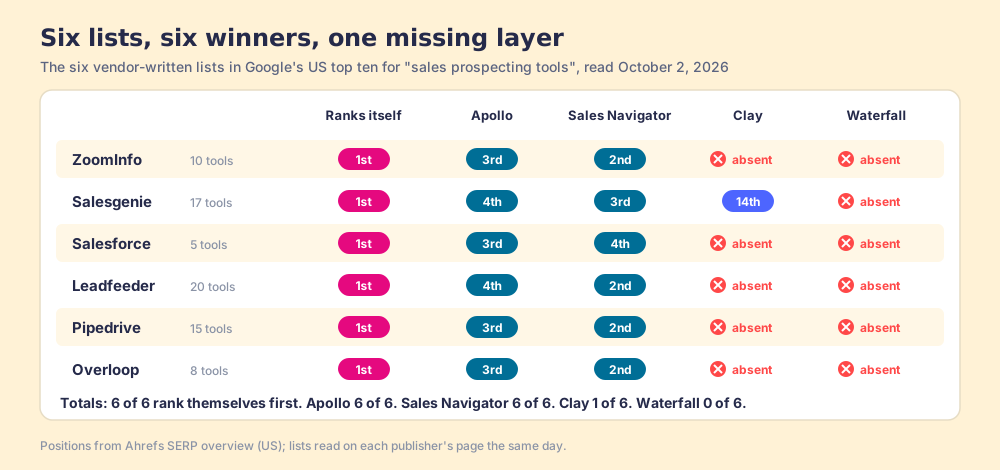
None of the six counts the exchanges either. They grade each runner alone, on its own straight, which is the one place a runner never drops the baton.
Why do teams switch sales prospecting tools?
The switching reasons show up in survey data and in the vendors’ own pricing pages, and almost all of them are exchange problems.
- Too many tools for one rep. Gartner surveyed 1,026 B2B sellers in early 2024: 50% said they were overwhelmed by the amount of technology the job needs, and overwhelmed sellers were 45% less likely to attain quota (Gartner, September 16, 2024). Adding a fifth runner to a relay adds a fourth exchange.
- The empty shelf. Apollo’s pricing page runs a credit calculator whose built-in assumptions are an 88% match rate on emails and 81% on phones, read October 2, 2026 (apollo.io/pricing). Those are Apollo’s planning numbers, not an audit, and they mean the most-listed database expects about 19 phone lookups in 100 to come back empty. The usual fix is a second database contract.
- The export that does not exist. “LinkedIn currently doesn’t offer the option to export account and lead information from Sales Navigator into a CSV or XLS file,” LinkedIn’s help center says, except through CRM Sync on Advanced Plus (LinkedIn Help). The first exchange in most stacks has no handle on it.
- The contract that outgrows the team. ZoomInfo publishes no prices; Vendr’s median buyer pays $33,500 a year across 1,574 purchases, and Outreach’s median is $45,600 across 917 (Vendr, ZoomInfo; Vendr, Outreach, October 2, 2026).
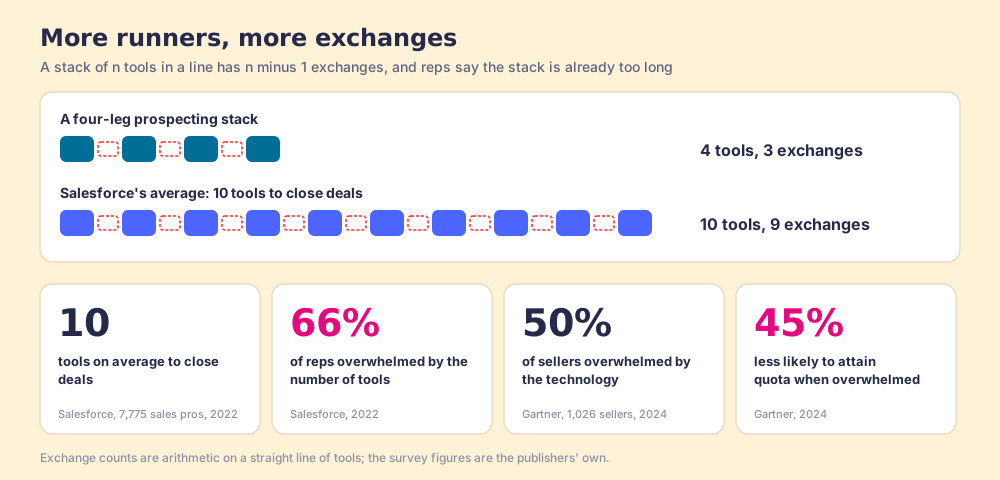
Those four reasons are the grading criteria below, plus one the vendor lists leave off: how many exchanges a tool removes.
Why trust this ranking?
I started RevPartners, a HubSpot partner that did only sales implementations, sold roughly twice as much Sales Hub as any other partner, and reached Elite tier in 13 months. I spent those years at the CRM end of the relay, where the baton either arrives or does not. Supered came out of that work, and it holds 4.9 out of 5 from 81 reviews on G2 and 5.0 from 122 on the HubSpot App Marketplace (checked October 1, 2026). That is also the disclosure: we make Supered Prospector, and it ranks first below for teams that have Clay. The weights are printed so you can flip them. Flip them for a team without Clay and Apollo is first, which is a fair result.
Which sales prospecting tools are graded highest?
The lens is a mid-market or SMB team, ten to fifty reps, already on a CRM, that wants reps building and working their own lists and a leader who can see which lists turn into pipeline. Each criterion is scored 1 to 5 and multiplied by its weight, for a maximum of 50.
| Criterion | Weight | What it rewards |
|---|---|---|
| Does its own job well | 30% (x3) | Best in its leg: search, contact data, signals or sending |
| Works where the rep already is | 20% (x2) | On the profile, the company site, the CRM record; no new tab or login |
| Exchanges it removes | 20% (x2) | Fewer copy-pastes, exports and duplicate records between jobs |
| Price structure for mid-market | 20% (x2) | Published, per seat or per result, no platform contract |
| What the leader sees after the list | 10% (x1) | Which lists were worked and how they ended |
| Rank | Tool | Job | Grade | Score | Best fit | CRM integration | Setup effort | Pricing (plan with the feature) | Why it ranks here |
|---|---|---|---|---|---|---|---|---|---|
| 1 | Supered Prospector | Fill + rep layer, on Clay | A | 46 | Teams that already have Clay | Native (HubSpot, Salesforce, Pipedrive) | Under a week on an existing Clay account | $45 per rep per month, billed annually, plus your Clay plan | Clay’s waterfall from any page the rep is on; three exchanges collapse into one button |
| 2 | Apollo | Find + fill + send | A- | 40 | Small teams wanting one tool | Native (HubSpot, Salesforce) | A day | $49 / $79 / $119 per seat per month, billed annually | Fewest exchanges of any single vendor; one shelf |
| 3 | HubSpot Sales Hub Pro | Send, from the CRM | B+ | 35 | HubSpot teams sequencing from the record | It is the CRM | Days, $1,500 onboarding | $90 per seat per month, billed annually | Sends where the record already lives; no contact data |
| 4 | ZoomInfo | Fill + signals | B+ | 34 | North American depth, intent | Native (HubSpot, Salesforce, Dynamics) | Weeks | Quote only; Vendr median $33,500 a year | Deepest US shelf; contract built for upmarket |
| 5 | LinkedIn Sales Navigator | Find | B | 32 | Finding the right person | CRM Sync on Advanced Plus | Minutes | Core $119.99 a month, $1,079.88 a year | Best search here; no email, phone or export |
| 5 | Outreach | Send | B | 32 | Large teams running governed sequences | Native | Weeks | Request pricing; Vendr median $45,600 a year | Strong sequencing, priced for big teams |
| 5 | Lusha | Fill | B | 32 | Self-serve extension with a posted price | Native (HubSpot, Salesforce) | Minutes | From $37.45 a month, billed yearly | Low entry, one shelf |
| 8 | Instantly | Send (cold email) | B | 31 | High-volume cold email | Integrations | A day | Growth $47 a month, $37.60 billed annually | Cheap volume, a separate app from the CRM |
| 9 | Leadfeeder | Signals (site visits) | B | 30 | Knowing which companies visited | CRM push | A day | Free tier; Discover from €79 a month, annual | Good timing signal, no person attached until a paid plan |
| 10 | Cognism | Fill | B- | 27 | EMEA, phone-first outbound | Native | Weeks | Quote only; Vendr median $32,750 a year | Verified mobiles, enterprise contract |
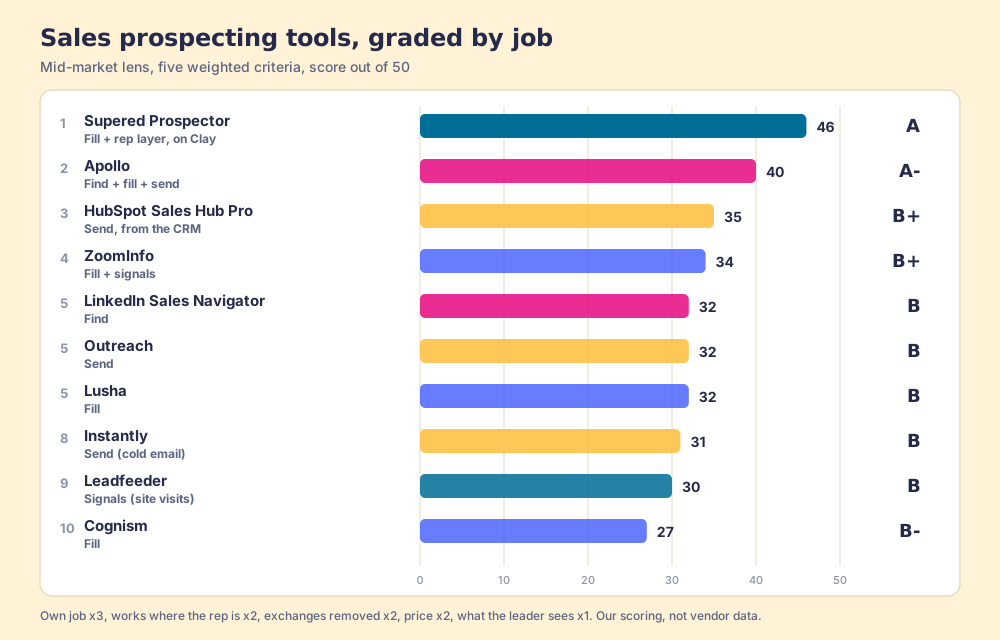
The scores, criterion by criterion, so the math is checkable. Letter bands: A 44+, A- 38-43, B+ 34-37, B 30-33, B- 26-29.
| Tool | Own job (x3) | Where the rep is (x2) | Exchanges removed (x2) | Price (x2) | Leader sees (x1) | Total |
|---|---|---|---|---|---|---|
| Supered Prospector | 5 | 5 | 4 | 4 | 5 | 46 |
| Apollo | 4 | 4 | 5 | 4 | 2 | 40 |
| HubSpot Sales Hub Pro | 4 | 4 | 3 | 3 | 3 | 35 |
| ZoomInfo | 5 | 4 | 3 | 2 | 1 | 34 |
| Sales Navigator Core | 5 | 4 | 1 | 3 | 1 | 32 |
| Outreach | 5 | 3 | 3 | 1 | 3 | 32 |
| Lusha | 3 | 4 | 3 | 4 | 1 | 32 |
| Instantly | 4 | 2 | 2 | 5 | 1 | 31 |
| Leadfeeder | 4 | 2 | 2 | 4 | 2 | 30 |
| Cognism | 4 | 3 | 2 | 2 | 1 | 27 |
Prospector’s own-job 5 is Clay’s waterfall coverage, credited to Clay. Its exchanges score is 4, not 5, because it does not send: the sequence runs in your CRM or your sales engagement tool. Apollo takes the only 5 on exchanges, since one vendor running search, data and sequences has the fewest hand-offs of anyone here. If one tool for everything decides it for you, Apollo wins this page.
Corporate status, checked October 2, 2026. ZoomInfo is public (Nasdaq: GTM). Cognism has owned Kaspr since April 2022. Salesloft and Clari merged in December 2025 and now operate as Salesloft. Dealfront became Leadfeeder on March 24, 2026 (Leadfeeder). Outreach now runs on outreach.ai. Apollo, Lusha, Instantly and Clay are independent.
Where does Supered Prospector fit among sales prospecting tools?
Prospector does not bring its own database. It brings Clay’s waterfall, which is every database, routed. We chose Clay as our only data provider for that reason, and it is why Clay is not a row in the tables above: Clay is the row that contains the other rows. Clay plus Supered is the best way for a sales team to prospect: GTM engineers build in Clay, reps never open Clay.
Start with the person who built the tables. A GTM engineer at a Clay shop has usually written better prospecting logic than any vendor list on page one, with waterfalls, tiers and tags tuned to the team’s market, and then becomes the list desk. Reps take a ticket, the way you take a number at a deli counter, and wait for a list. The counter is the bottleneck, and it is staffed by the most expensive builder on the team. Prospector turns the counter into self-serve. Three people, three changes:
- The GTM engineer. Builds named flows once, each pointing at a Clay table or function (person enrichment, buying committee) and a destination (the CRM on the account, or a sequence). “Your logic stays yours: waterfalls, tiers, tags, and sequence variables.” Start from the Supered Clay template, or bring your own tables.
- The rep. Gets the table as a button in Sales Navigator, on a company website and in the HubSpot, Salesforce or Pipedrive record, and picks a flow from a Push menu. Navigator leads go onto a prospect list, and the rep pushes the list to a Clay table. Before pushing, the rep sees whether the person is already in the CRM, who owns them, and whether they were prospected before, so the rep does not step on a teammate’s account.
- The leader. Sees every list found, worked and closed. Found: reps use your tables with no duplicate work. Worked: who is working their list, and who isn’t. Closed: every lead ends the way your process says, as Qualified, Recycled or Disqualified. The Clay budget grows on that view, because the VP sees what the tables produced.
The plays the flows run are the plays a team already wants: research an account and pull the buying committee you defined, start new logos from any lead, find the rest of the team at a customer for expansion, push a past champion who changed jobs into a sequence with their new team, and add the economic buyer and two peers to a stalled deal before the forecast call.
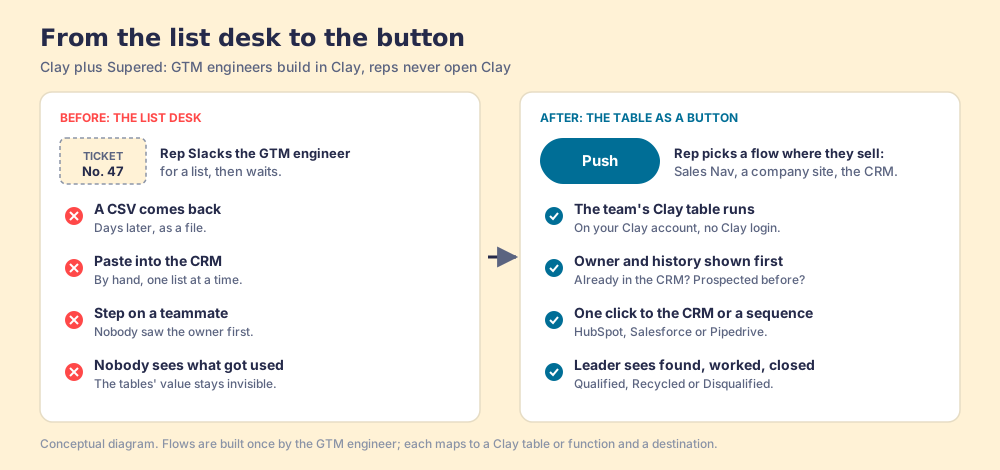
Prospector runs inside the Supered Chrome extension, on your Clay account, and reps never log into Clay. Prospector works within LinkedIn’s terms and does not copy search results in bulk; the contact data comes from Clay’s waterfall on the customer’s Clay account. Ask every vendor on this page what its extension reads on LinkedIn, ours included. Reps who ask for Apollo seats to build their own lists are asking for a fifth runner; skip the extra seats and get more out of the Clay you already pay for. Prospector, Prospector for reps, Prospector for GTM engineers and the sourcing use case show the whole loop.
Choose something else if you do not have Clay, because Prospector runs on the customer’s Clay account and does nothing without one. RevPartners, a Clay Elite Studio Partner and the company I founded, builds and tunes the tables for teams that want to start. Choose something else, too, if you want sequencing, a dialer and the data in one bill: Apollo does that and Prospector does not.
Which prospecting tools find the right people?
Leg one is search, and LinkedIn Sales Navigator runs it for most B2B teams. Core is $119.99 a month or $1,079.88 a year per seat, Advanced $159.99 or $1,799.88 (LinkedIn compare plans, October 2, 2026), with “50+ advanced search filters,” and G2 lists it at 4.4 from 2,178 reviews. The Bridge Group’s 2025 report of 351 companies puts 19 of the median SDR’s 112 daily activities on LinkedIn (Bridge Group, 2025), so the first runner is the one reps already know.
Its limit is the handle on the baton. Navigator gives you no verified email, no mobile and no CSV export, and CRM Sync lives on Advanced Plus, whose price is quoted. So every stack pairs it with a leg-two tool, and the scrapers that promise an export appear in this market; LinkedIn’s prohibited-software page bans extensions that “scrape, modify the appearance of, or automate activity on LinkedIn’s website.” Export Sales Navigator leads covers the safe routes, and LinkedIn prospecting tools covers the extensions that live on the profile.
Which lead prospecting tools fill in the email and phone?
Leg two is where the money goes, and it comes in two shapes. A database is one company’s shelf, rented by the seat or the contract. A waterfall owns no shelf and walks from shop to shop until the item is in the bag.
- Apollo. The widest self-serve shelf with outreach built in: Basic $49 a seat per month billed annually ($65 monthly), Professional $79 ($99), Organization $119 with a 3-seat minimum, with an email at 1 credit and a phone at 8 (apollo.io/pricing, October 2, 2026). G2: 4.7 from 9,442 reviews. Apollo pricing works the credits out per phone.
- ZoomInfo. “More than 100 million companies, 500 million contacts,” by its August 2026 filing, with intent data, G2 4.5 from 8,923 reviews, and a Vendr median of $33,500 a year. ZoomInfo competitors grades it in its own lane.
- Lusha. A posted ladder for one rep at a time: Starter $37.45 a month billed yearly, Pro $52.45, 1 credit per email and 5 per phone (lusha.com/pricing, captured September 25, 2026). G2: 4.3 from 1,667.
- Cognism. Phone-verified mobiles for EMEA, quote only, Vendr median $32,750 a year across 94 purchases, G2 4.5 from 1,370. It owns Kaspr.
- Clay. The waterfall: “Buy data from 200+ providers in one place,” and “If an enrichment returns no result, you’re not charged Data Credits or Actions” (clay.com/pricing, October 2, 2026). Growth is $446 a month on annual billing, $495 monthly. ZoomInfo, Apollo, Lusha and LeadIQ each have a page in Clay’s integration directory with their contact steps marked “Bring Your Own Account Required,” so the shelf you already rent can be the first stop on the route.
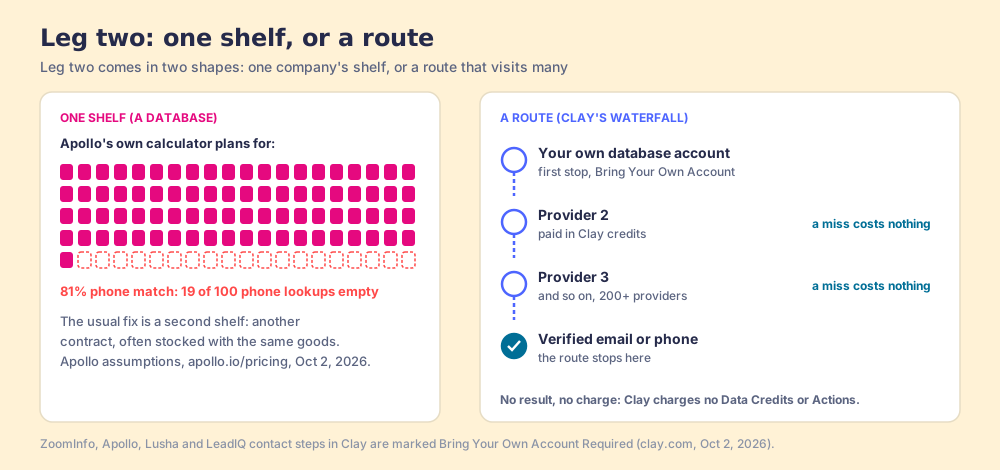
The second database contract, the one bought to cover the first one’s empty shelves, is the purchase a waterfall makes unnecessary. Waterfall enrichment explains the order of the route and who writes it, and the email finder tools page covers the single-purpose finders.
Which b2b prospecting tools tell you when to reach out?
Leg three is timing, and it is the leg vendor lists blur most, because every database now sells “intent.” Three signals hold up:
- Website visits. Leadfeeder identifies the companies on your site: a free Lite plan covers the last 7 days and up to 100 companies a month, Discover starts at €79 a month on annual billing (€113 monthly), and Activate, at €369, adds verified emails and phones (leadfeeder.com/pricing, October 2, 2026). A company is a timing signal; a person is still leg two’s job.
- Job changes. A champion who moves to a new company is the warmest cold lead there is. Clay’s job change signal needs “the contact’s LinkedIn URL as an identifier” and costs “1 action plus 0.2 data credits” a check (Clay University). Job change tracking compares the options.
- Buying-committee gaps. Gartner puts a B2B buying group at six to ten people (Gartner). A deal with one contact on it is a timing signal of its own, for the second and third threads. Multithreading in sales covers the play.
Which prospecting tools send the first touch?
Leg four is the sequencer, and the first question is whether it should live inside the CRM or beside it.
- HubSpot Sales Hub Professional. $90 a seat per month billed annually, $100 monthly, with a one-time $1,500 onboarding fee, and sequences that send from the same record the rep is working (hubspot.com/pricing/sales, October 2, 2026). No exchange between the record and the send.
- Outreach. Four Amplify packages priced by AI credits, every one marked “Request pricing” (outreach.ai/pricing); Vendr’s median buyer pays $45,600 a year across 917 purchases, range $8,620 to $214,450. Strong governance for large teams.
- Instantly. Cold email at volume with posted prices: Growth $47 a month for 5,000 emails ($37.60 billed annually), Hypergrowth $97 for 125,000 (instantly.ai/pricing, October 2, 2026). G2: 4.8 from 4,157 reviews. It is a separate app from the CRM, which is one more exchange. Instantly and Clay covers that pairing.
- Apollo. Sequences and a dialer in the same plan as the data, which is why it scores highest on exchanges removed.
Salesloft, merged with Clari since December 2025, sits beside Outreach and also quotes its prices.
What does a prospecting stack cost for ten reps?
The arithmetic for a ten-rep team, on list prices and Vendr medians checked October 2, 2026. The last column counts the places a rep works to take one buyer from search to first touch, by our reading of each vendor’s own workflow, with the CRM counted once. It is our count, not a measurement.
| Stack | Annual cost for ten reps | Places the rep works |
|---|---|---|
| Sales Navigator Core + ZoomInfo + Outreach | $89,898.80 ($10,798.80 + $33,500 median + $45,600 median) | 4: Navigator, ZoomInfo’s extension, CRM, Outreach |
| Apollo Professional alone | $9,480 (10 x $79 x 12) | 2: Apollo, CRM |
| Apollo Professional + Sales Navigator Core | $20,278.80 | 3: Navigator, Apollo’s extension, CRM |
| Sales Navigator Core + Clay Growth + Prospector | $21,550.80 ($10,798.80 + $5,352 + $5,400) | 2: Navigator with the Prospector button, CRM |
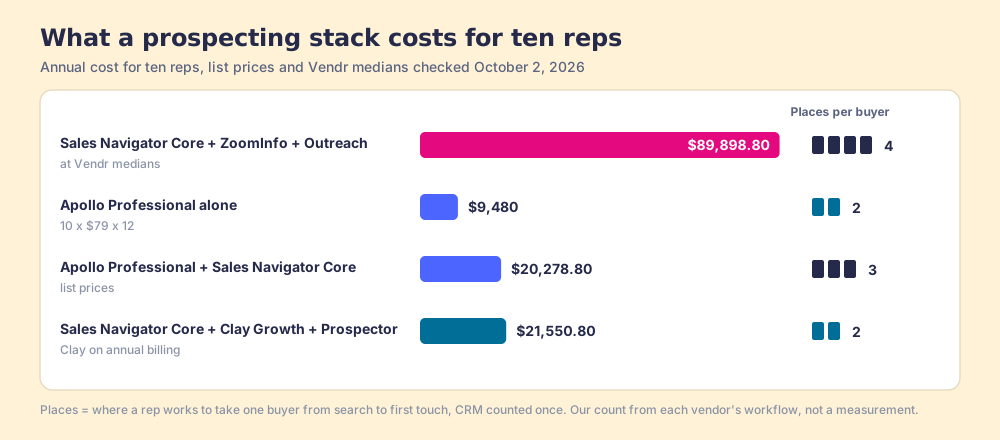
Apollo alone is the cheapest line and has the fewest places, and for a small team without Clay it is the right line. The Clay row costs $1,272 more than Apollo plus Navigator and asks 200+ providers instead of one, with no charge for a miss. The four-vendor relay costs about four times the Clay row and more than nine times Apollo alone, and the extra money buys depth on each straight and one more exchange. Clay’s monthly-billed Growth plan at $495 makes the Clay row $22,138.80.
Which sales prospecting tools should you choose?
The relay image stops being true at one point: in a stack, a dropped baton makes no sound. The Navigator lead that never reached the CRM and the list that went out twice leave no trace in any single tool’s report, so the last criterion on the card asks what the leader sees. The ways forward:
- A team with Clay. Supered Prospector: the GTM engineer builds the flows once, reps run them from Sales Navigator, the company site or the CRM record, and the leader sees each list found, worked and closed.
- A small team without Clay that wants one bill. Apollo, from $49 a seat on annual billing. Size the credits before the seats, since a phone costs 8.
- North American enterprise depth. ZoomInfo, with the escalator negotiated.
- EMEA phone-first outbound. Cognism.
- A self-serve extension for a few reps. Lusha, from $37.45 a month billed yearly.
- Timing from your own website. Leadfeeder, starting on the free plan.
- Sending. From the CRM’s own sequences if you can, Outreach for a large governed team, Instantly for cold email at volume.
- Finding the person. Sales Navigator, in every branch.
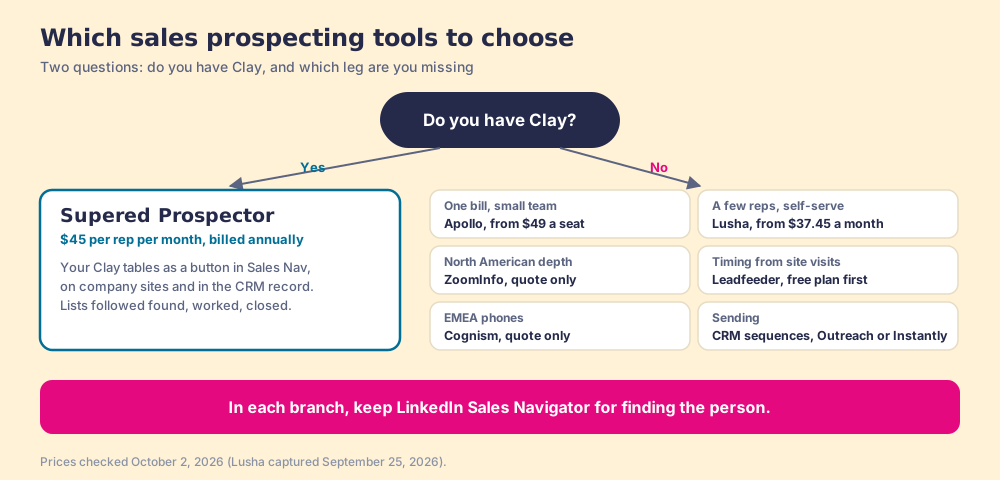
What I recommend depends on one fact about your stack. If you do not have Clay, buy Apollo and Sales Navigator, send from your CRM’s sequences, and add a database only when Apollo’s own calculator tells you how often its phone shelf is empty for your market. If you have Clay, do not buy a second shelf or a fifth runner. The GTM engineer has already written the route; put it in the rep’s hand on the page where they find the buyer, and count the leads that cross the exchanges instead of the seats. The sales prospecting guide walks the motion from list to meeting, the Clay Chrome extension page explains the rep-side category, and a Prospector demo on your own Clay account shows the baton arriving.
Frequently asked questions
What are the best sales prospecting tools in 2026?+
What is the difference between a prospecting database and a prospecting tool?+
How much does a prospecting stack cost for ten reps?+
Do I need Clay to use Supered Prospector?+
Which prospecting tools are safe to use on LinkedIn?+
Why do vendor lists of prospecting tools disagree?+
Your process, running itself.