Seamless AI Pricing in 2026: Market Price on the Board, a Yearly Lease Behind It
Seamless AI pricing is now a two-question form with no plan cards and no dollar figure. What the page showed, what Vendr says buyers pay, how the credits and the yearly lease work, and the per-result path for a team that already has Clay.
Seamless AI pricing in 2026 is quote-only: the pricing page shows no dollar figure for any paid plan, asks how many contacts you need a month and how big your company is, and sells annual subscriptions that renew for 12 months unless cancelled 60 days before the anniversary.
Seamless AI pricing in 2026 is quote-only: the pricing page shows no dollar figure for any paid plan, asks how many contacts you need a month and how big your company is, and sells annual subscriptions that renew for 12 months unless cancelled 60 days before the anniversary. The quick answer, by job:
- Seamless itself. Right for a high-volume team that wants real-time contact search, a dialer and email in one contract, and will negotiate. Vendr’s median Seamless.AI contract is $8,350 a year.
- Apollo. Right for a small team that wants a published price: $49 to $119 a seat a month on annual billing, with outreach bundled.
- Supered Prospector. Right for a team that already has Clay: $45 per rep per month, billed annually, for Clay’s waterfall across 200+ vendors from the rep’s own screen, paid per result.
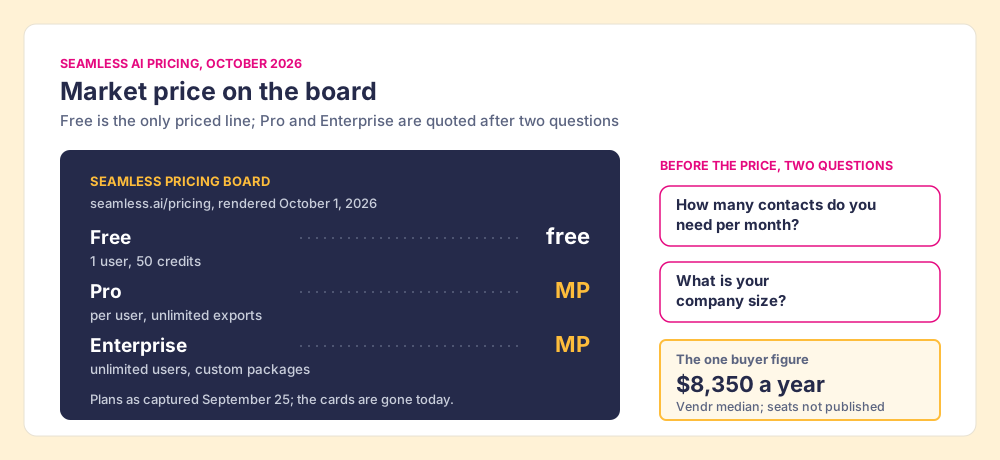
A seafood shack does not print the price of lobster. The chalkboard says “MP,” market price, and the waiter answers the question with two of his own: how hungry are you, and how many in your party. Seamless’s pricing page, rendered on October 1, 2026, has become that chalkboard. The headline still reads “Perfect Pricing for Startups to the Fortune 500,” and below it, where Free, Pro and Enterprise cards stood a week earlier, a form titled “Get pricing and promos” asks two things: “How many contacts do you need per month?” and “What is your company size?” (seamless.ai/pricing). Google’s search result still shows the old Free, Pro and Enterprise sitelinks, which tells you how recent the change is. This page prints what the board showed, what buyers pay, how the credits and the yearly lease work, and the way to buy the same contact by the result.
| Seamless AI pricing at a glance | What the sources say (dates as shown) |
|---|---|
| Pricing page, October 1, 2026 | No plan cards, no dollar figures; a “Get pricing and promos” form asking contacts per month and company size |
| Plans, as captured September 25, 2026 | Free (1 user, 50 credits); Pro (per user, unlimited exports, annual credit packages, contact sales); Enterprise (unlimited users, custom packages, contact sales) |
| Credits | ”A credit is used when Seamless.AI researches a contact”; Pro “start[s] off at 10,000 annual credits” (FAQ, September 25) |
| Bulk Credits | One pool across Search, Enrich, AI Assistant, Autopilot and API; per-user limits; credits “automatically return for invalid emails or bad data” |
| Buyer median | $8,350 a year (Vendr, comparison block on its RocketReach listing; seat count and term not published) |
| Promotions | ”Switch and Save”: discounts or credits “matching remaining contract value, up to 50%”; “No setup fees” |
| Term | Annual, with monthly or annual billing; renews for 12 months unless cancelled more than 60 days before renewal; all sales final (Terms, section 6) |
| G2 | 4.4 out of 5 from 5,407 reviews (October 1, 2026) |
How much does Seamless AI cost in 2026?
There is no list price to quote, so the answer comes in three pieces, each with its source and date.
- The page. On October 1, 2026 the pricing page carries three promises and a form. “Only pay for features or licenses you need. Get volume discounts. Top CRM integrations included. No setup fees.” Then “Switch and Save. Switch from a competitor and get discounts or credits matching remaining contract value, up to 50%.” Then the two questions. The subhead names what the quote can include: “unlimited users, bulk credits, prospector, job changes, buyer intent, and enrichment.”
- The Seamless AI pricing plans the page used to show. Our September 25 capture recorded Free (1 user, 50 credits), Pro (“Per User,” “Unlimited Exports,” “Annual Credit Packages,” “Contact sales,” marked most popular) and Enterprise (“Unlimited Users,” “Custom Packages,” “Contact sales”), with an FAQ line that Pro plans “start off at 10,000 annual credits” and that “the prices shown on this page reflect this annual discount,” on a page that showed no prices.
- What buyers pay. Vendr’s own listing for Seamless.AI pricing, last updated September 23, 2025, still publishes no median (Vendr, Seamless.AI). The figure lives one page over: the comparison block on Vendr’s RocketReach listing, opened today, prints “Median Contract Value” of $8,350 for Seamless.AI against $6,750 for RocketReach (Vendr, RocketReach). Vendr does not say how many seats or which term sits behind the $8,350, so treat it as the middle of the market and expect your quote to land somewhere around it.
Third-party guides print monthly per-seat estimates for Seamless. Neither Seamless nor Vendr prints one, so this page does not.
One naming note, because it will confuse a buyer comparing tabs. Seamless sells a product it calls Prospector (“Find and close leads,” in its navigation). Supered’s sourcing product is also named Prospector. On this page, Prospector without a qualifier means Supered Prospector, which runs on Clay and has no database of its own.
Why does the Seamless AI pricing page ask questions instead of showing prices?
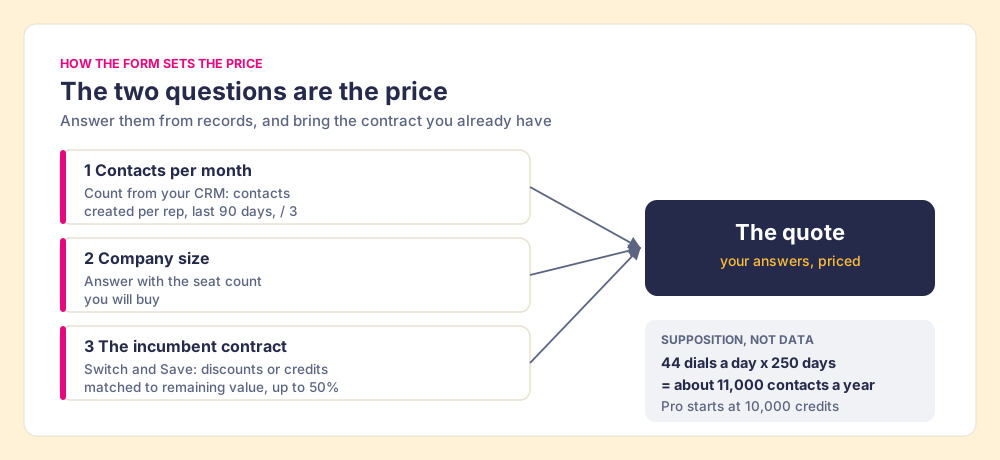
The page asks because your answers set the price. The waiter’s two questions are the inputs to the number he is about to say. A vendor that quotes instead of posting can charge a five-rep startup and a 500-rep sales floor different amounts for the same credit, and the form is how it sorts you before the call. Economists call this price discrimination: the same service sold at different prices to buyers the seller places in different segments (price discrimination). The two questions are the segmenting.
So walk in with the answers already counted from your own records.
- Contacts per month. Pull the number of contacts each rep created or enriched in your CRM over the last 90 days and divide by three. The Bridge Group’s 2025 SDR report, 351 companies, puts the median SDR at 112 activities a day, 44 of them phone dials (Bridge Group, 2025). Suppose, for the arithmetic only, that each dial needed a freshly researched contact: 44 dials a day over 250 working days is about 11,000 contacts a year, slightly more than Pro’s 10,000-credit starting package for one seat. Reps redial the same people, so your real number is lower, and the form rewards you for knowing by how much.
- Company size. Answer with the number of seats you will buy; total headcount inflates the quote. The quote follows the answer.
- The incumbent contract. Switch and Save is sized to “remaining contract value, up to 50%.” Bring the other vendor’s order form and its renewal date. The cheapest Seamless quote goes to the buyer who arrives with someone else’s contract in hand.
How do Seamless AI credits work?
A credit is a research fee. The September 25 FAQ put it plainly: “A credit is used when Seamless.AI researches a contact to find their emails, phone numbers and insights.” Ten thousand annual credits is about 833 a month, and the meter runs at the research step, which is the step Seamless is built around: it describes itself as a real-time search engine that looks the person up when you ask, rather than serving a stored record.
The credit has grown since. Seamless now sells Bulk Credits, “one pool for every Seamless feature,” spent across “Search, Enrich, AI Assistant, Autopilot, and API workflows,” with admins choosing “open distribution or set per-user limits” (Seamless, Bulk Credits). Give it its due: the page says “credits automatically return for invalid emails or bad data,” which is a better promise than a plain reveal fee, and a pooled credit lets a manager move volume from an idle rep to a busy one.
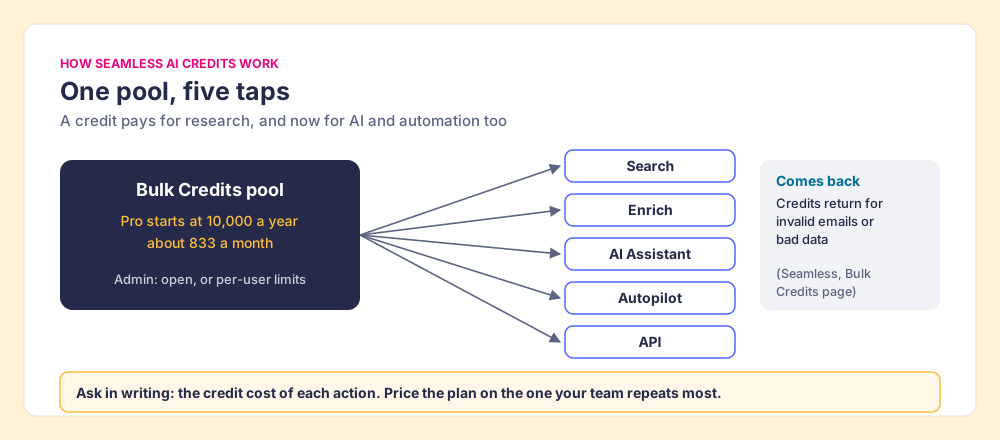
The trade is legibility. When one pool pays for research, AI drafting and automation, the line “10,000 credits” no longer tells you how many people you can reach. Ask the rep on the call for the credit cost of each action you will use, in writing, and price the plan on the action your team repeats most, usually a mobile number.
What contract terms come with Seamless AI pricing?
Seamless sells a yearly lease paid as monthly rent. The tenant who pays by the month still signed for twelve, and the landlord’s office wants notice in writing before a date you set a reminder for a year ago. Seamless’s Terms of Use, re-opened on October 1, 2026 (last updated July 12, 2024), say it in section 6: “All subscriptions for the Services are annual with monthly or annual billing cycles.” Monthly billing changes when you pay. It does not change how long you are bound (Seamless Terms of Use).
- The renewal. “If the subscription is not modified or cancelled under these Terms more than 60 days before the renewal, the annual contract will automatically renew for an additional 12 months.”
- The exit. The help center: “At least 60 days prior to your subscription renewal date, an admin and/or owner must submit the appropriate account modification request form and meet with your Customer Success Representative” (Seamless help center). A form and a meeting, both done before day 305 of a 365-day term.
- The rest of page three. “All sales are final once you elect to purchase a subscription.” A fee change is “effective immediately upon notice.” Late payment carries a 2% fee. Section 18 caps Seamless’s aggregate liability to you at $100.
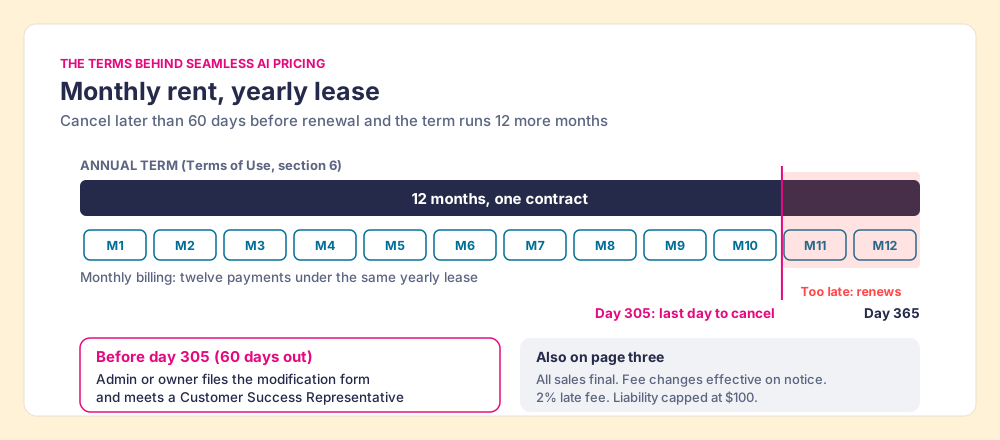
None of this is hidden; it sits in numbered sections on a public page, and annual auto-renewal is common in this market. The point is narrower. A buyer comparing a Seamless quote with Apollo’s or Lusha’s monthly plans is comparing a lease with a hotel room, and the monthly figure on each looks alike. The full exit-terms table for eight vendors lives on our Seamless AI alternatives page.
Why trust this breakdown?
We show our sources, and we name our bias. I co-founded Supered after starting RevPartners, a HubSpot partner that did only sales implementations, sold roughly twice as much Sales Hub as any other partner, and reached Elite tier in 13 months. That work put me inside a great many HubSpot portals where a data contract was renewing and the leader signing it could not say what it had produced. Supered is the #1 sales enablement app on the HubSpot marketplace, with a 5.0 rating from 122 reviews and 6,000 installs, and holds 4.9 out of 5 from 81 reviews on G2 (October 1, 2026). The disclosure: we sell Supered Prospector, and it appears below as an alternative, after the Seamless numbers. Seamless holds 4.4 out of 5 from 5,407 reviews on G2 the same day, a large and mostly happy base that the grades below take seriously.
How does Seamless AI pricing compare with the alternatives?
The lens is a mid-market or SMB team of five to fifty reps that wants contact data reps will use and a manager who can see what it produced. Each tool is scored 1 to 5 on five jobs, weighted, out of 50: coverage of the contact you need (x3), rep-side delivery without a new tab (x2), price structure for mid-market (x2), what happens after the export (x2), and bundled outreach (x1). The scores are the ones used on our Seamless AI alternatives page and the Lusha alternatives page, so the pages read together. Weight it for a high-volume dialing floor that wants search, email and calls in one contract, and Seamless climbs.
| Rank | Tool | Grade (of 50) | Best fit | CRM integration | Setup effort | Pricing (plan with the job) | Reason to switch from Seamless |
|---|---|---|---|---|---|---|---|
| 1 | Supered Prospector (on Clay) | A (44) | Teams that already have Clay | Native in HubSpot and Salesforce; enrich and sync from the record | A demo, your Clay account, field mapping set once | $45 per rep per month, billed annually, plus your Clay plan (Growth from $495 a month) | 200+ sources per lookup, no charge for a miss, and a view of which contacts were worked and closed |
| 2 | Apollo | A- (36) | Small teams wanting data and outreach in one | Native (Salesforce, HubSpot, Outreach, Salesloft, per apollo.io) | Self-serve | Basic $49, Professional $79, Organization $119 a seat a month, annual | A posted price and outreach in the same seat |
| 3 | Lusha | B+ (29) | LinkedIn-first teams under about ten seats | Native (HubSpot, Salesforce) | Self-serve | Premium $299.95 a month billed yearly, 5 seats | Cancel from settings at the end of the cycle |
| 4 | RocketReach | B- (23) | Individuals and two-person teams | Native from Pro (Salesforce, HubSpot, Outreach, Salesloft, Bullhorn) | Self-serve | Pro $899 a year per user | The cheapest posted seat with phones |
| ref | Seamless | C+ (21) | High-volume search plus dialer and email, with counsel on the order form | Native (“Top CRM integrations included”) | Sales call and order form | Quote only; Vendr median $8,350 a year | (the incumbent) |
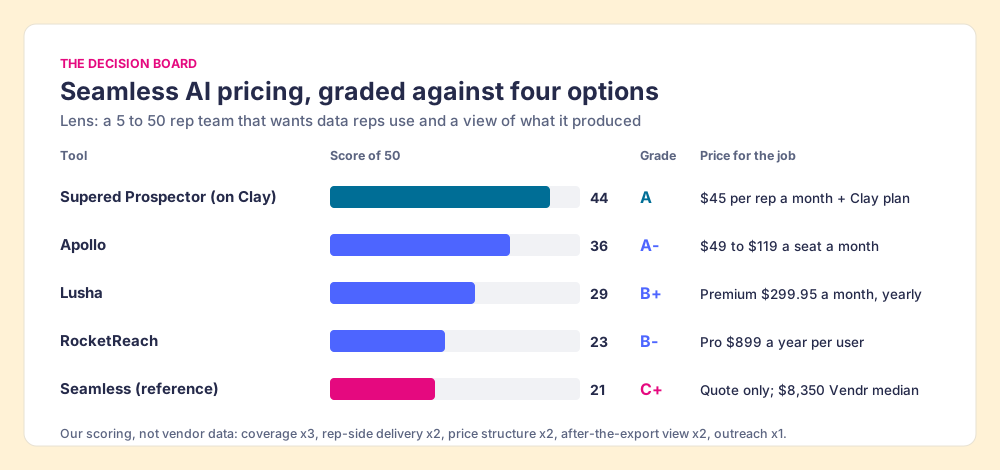
Seamless’s 21 is a lane score for this team; a dialing floor would grade it higher. It loses points on price structure, because nothing is posted and the term is a lease, and on the after-the-export column, which no single database scores well on. It holds its own on coverage and on bundled outreach, where its Connect, dialer and email modules sit in the same contract.
Is there a cheaper way than Seamless AI pricing if you already have Clay?
At five reps the totals land within 3% of each other; at ten, the Clay path costs more and buys a different meter. Supered Prospector does not bring its own database. It brings Clay’s waterfall, which is every database, routed: Clay asks provider after provider across 200+ data and AI vendors under one contract (clay.com), and its pricing page states the rule that changes the bill: “If an enrichment returns no result, you’re not charged Data Credits or Actions” (clay.com/pricing, opened October 1, 2026). A Seamless credit pays for the research. A Clay data credit pays for the result.
The rep never opens Clay. On a LinkedIn profile, a Sales Navigator list, a company’s website, or a HubSpot, Salesforce or Pipedrive record, Supered Prospector runs the waterfall your GTM engineer built, shows whether the person is already in the CRM or was worked before, and syncs the contact in one click with field mapping set once. Then the contact enters your process: the next expected step reaches the rep in the flow of the work, and the manager watches each list become pipeline (sourced, worked, closed, by your own definitions) and coaches from what is converting. Clay governs the data. Supered governs the motion.
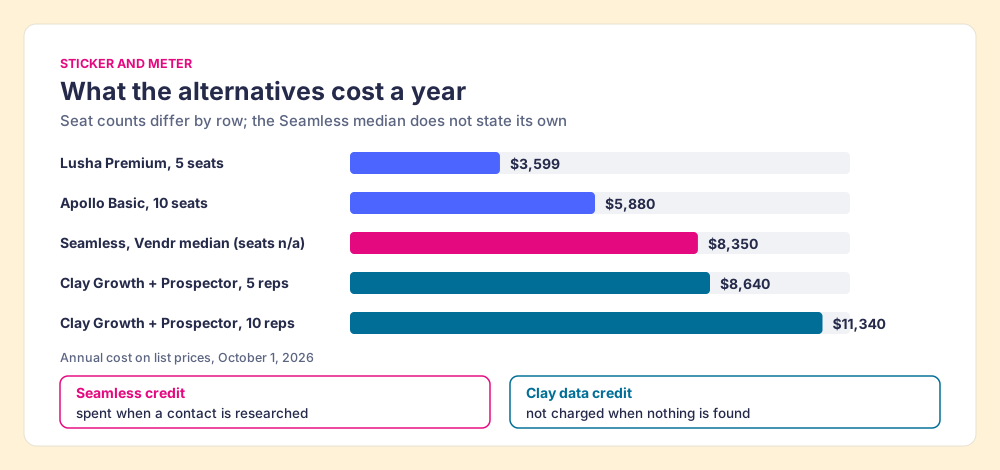
Now the arithmetic, on list prices, with the seat counts stated because the Seamless median does not state its own.
- Five reps. Clay Growth at $495 a month is $5,940 a year; Supered Prospector for five reps is $2,700; together $8,640, about 3% above Vendr’s $8,350 Seamless median.
- Ten reps. Prospector rises to $5,400 and the total to $11,340, above the median. At ten reps the sticker is higher, and the reason to switch is coverage and the per-result meter.
- For scale. Apollo Basic for ten seats on annual billing is $5,880 a year; Lusha Premium is $3,599.40 for five seats; RocketReach Pro is $899 per user.
Supered Prospector costs $45 per rep per month, billed annually, with no seat minimum, on its own plan (Prospector pricing). It runs on your Clay account and your Clay credits.
Choose something else if:
- No Clay account, and no plan for one. Supered Prospector only works on Clay, and someone on your team has to build the waterfall. Without that person, Apollo’s posted seat or Lusha’s ladder is the simpler buy.
- A dialing floor that lives inside one tool. If your reps want search, a dialer and email in one login and the Seamless quote lands near the median, Seamless’s bundle is a defensible choice, provided someone diarizes the date 60 days before renewal.
- One or two seats. RocketReach Pro at $899 a year per user is cheaper than any platform path here; our RocketReach pricing breakdown covers its lookup caps.
How do Apollo, Lusha and RocketReach pricing differ from Seamless?
Each posts a number, which is the first difference, and each puts the meter somewhere different.
- Apollo. Basic $49, Professional $79, Organization $119 a seat a month on annual billing, with credits per seat and a phone number costing 8 credits. The strength is the bundle: data, sequencing and a dialer at a posted price. The tradeoff is the phone meter, which sets the real bill for a dial-heavy team. Full breakdown: Apollo pricing.
- Lusha. A five-plan ladder from Free to a custom Scale plan, 1 credit per email and 5 per phone, Premium at $299.95 a month billed yearly with 5 seats, and cancellation from account settings at the end of the cycle. The strength is a short commitment; the tradeoff is an annual credit jar that resets on the anniversary. Full breakdown: Lusha pricing.
- RocketReach. Essentials $399, Pro $899 and Ultimate $1,699 a year per user on annual billing, with phones from Pro and CRM integrations from Pro. The strength is the lowest posted seat with mobiles; the tradeoff is a single library and thin team tooling. Full breakdown: RocketReach pricing.
- Seamless. No posted number, real-time search, a bundled engagement suite, pooled Bulk Credits, and a yearly lease. The strength is volume in one contract; the tradeoff is that the price depends on how well you answer two questions.
What we recommend
Three ways forward, and our view on each.
- A Seamless quote, negotiated as a lease. If the bundle is what you want, answer the form from your CRM numbers, bring an incumbent contract for Switch and Save, get the credit cost per action in writing, and put the renewal date minus 60 days in two calendars before you sign. Budget against the $8,350 median and hold the first number on the call up against it.
- A posted seat. If you have no Clay account and fewer than about ten reps, Apollo’s $49 seat or Lusha’s ladder gives you a price you can read today and a shorter way out.
- The per-result path, with the list worked to your standard. If you already have Clay, put the waterfall in front of your reps with Supered Prospector, pay for the contacts Clay finds and nothing for the misses, and watch which lists turn into pipeline. The chalkboard was always going to tell you the price of the lobster after it asked how hungry you were. The better question to bring to the table is how many of last year’s contacts anyone called. See Supered Prospector, read what is Clay for how the waterfall works, and book a Prospector demo with your Clay account open.
Frequently asked questions
How much does Seamless AI cost in 2026?+
What plans does Seamless AI offer?+
How do Seamless AI credits work?+
Can you cancel Seamless AI at any time?+
Is Seamless AI cheaper than Apollo or RocketReach?+
Is there a way to buy contact data per result instead of per seat?+
Your process, running itself.