Seamless AI Alternatives in 2026: The Storage Unit That Renews Itself, and the Courier Who Charges Per Parcel
Seamless.AI publishes no paid prices, and its Terms make every subscription annual, renewing for 12 months unless you cancel 60 days early. The Seamless AI alternatives graded for a mid-market team, every vendor's exit terms side by side, and the per-result path out.
Seamless AI alternatives are the contact-data tools buyers weigh against Seamless.AI's unpublished, auto-renewing annual seats: single databases like Apollo, Lusha, ZoomInfo, and Cognism, or Clay's waterfall across 200+ vendors, paid per result and run from Supered.
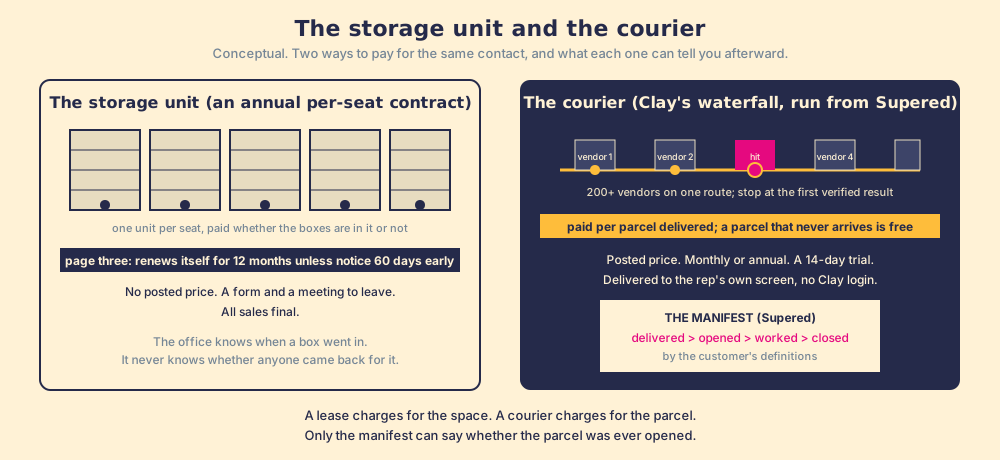
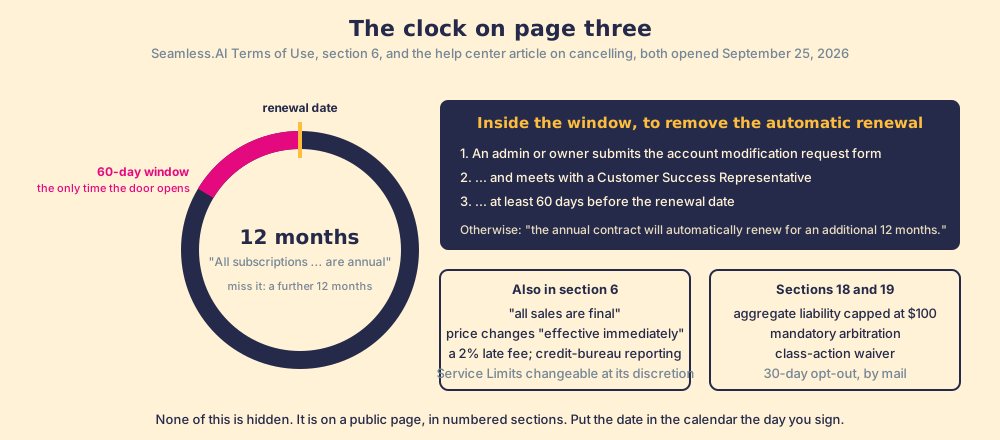
A storage unit is the easiest lease you will ever sign. There is no viewing, no deposit to argue over, and you bring your own padlock. The part you did not read is on page three: the twelve months roll over by themselves unless you gave notice before a date you have already forgotten, in writing, and the office would like a word before it processes the form. Seamless.AI sells contact data the way a storage company sells space. Its pricing page, opened September 25, 2026, lists a Free plan, a Pro plan “per user” with “annual credit packages” behind a contact-sales button, and an Enterprise plan, with no dollar figure for either paid tier (seamless.ai/pricing). Its Terms of Use, opened the same day, supply page three: “All subscriptions for the Services are annual with monthly or annual billing cycles,” “all sales are final once you elect to purchase a subscription,” and “if the subscription is not modified or cancelled under these Terms more than 60 days before the renewal, the annual contract will automatically renew for an additional 12 months” (Seamless.AI Terms of Use, section 6).
Seamless AI alternatives are the contact-data tools buyers weigh against Seamless.AI’s unpublished, auto-renewing annual seats, and in 2026 they split into single databases sold by the seat or the credit (Apollo, Lusha, ZoomInfo, Cognism, Kaspr, LeadIQ, RocketReach) and Clay’s waterfall across 200+ vendors (clay.com, September 25, 2026), paid per result, which a rep can run from Supered without a data contract of its own. The buyer typing this search is usually not asking about data quality. They are asking about the door. So this page grades the field on the same jobs as the Apollo alternatives page and the ZoomInfo competitors page, then does something the other pages do not: it puts every vendor’s exit terms side by side, from the vendor’s own page where one exists, and it makes the argument the search is circling. You do not need a bigger unit. You need a courier who charges per parcel, and a manifest that records whether the parcel was opened.
Why are teams searching for Seamless AI alternatives in 2026?
Three causes, and the first two are on page three.
- The door that opens once a year. The renewal clause above is the reason this search exists. Seamless.AI’s own help center spells out the exit: “At least 60 days prior to your subscription renewal date, an admin and/or owner must submit the appropriate account modification request form and meet with your Customer Success Representative to process the removal of your account’s contracted automatic renewal” (Seamless.AI help center). A form, a meeting, and a window that closes 60 days before a date on a contract you signed a year ago. Miss it by a day and the unit is yours for twelve more months.
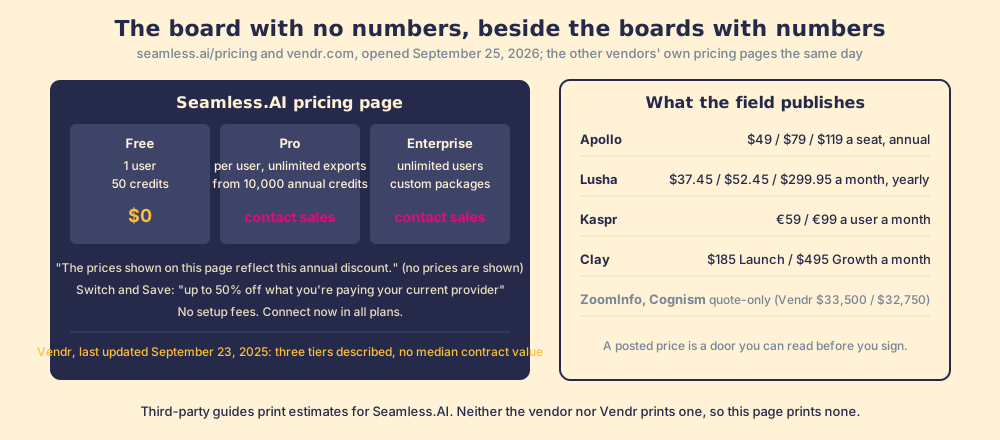
- The price you cannot see. Neither paid tier carries a number. The FAQ says Pro plans “start off at 10,000 annual credits,” that “the prices shown on this page reflect this annual discount,” and, on exceeding a limit, “upgrade today and never have to worry about credit usage again.” Vendr’s marketplace listing for Seamless.AI, last updated September 23, 2025, describes the same three tiers and publishes no median contract value, which for Vendr is unusual: its ZoomInfo page carries 1,573 purchases and its Apollo page 101 (Vendr, Seamless.AI). Third-party pricing guides print estimates; neither the vendor nor Vendr prints one, so this page prints none.
- The empty unit. The cause a better contract never fixes. A credit “is used when Seamless.AI researches a contact,” and after that the vendor’s meter is dark. The leader signing the renewal cannot say how many of last year’s 10,000 researched contacts were dialed, and no vendor on this page fixes that by having a friendlier lease.
What is Seamless.AI best at?
Be fair to the unit first. Seamless.AI describes itself as a real-time search engine rather than a static database, which is a real architectural difference: it researches the contact when you ask rather than serving a record it stored last quarter, and for a team that needs volume on fresh titles that is the pitch. The pricing page, opened September 25, 2026, adds the things a buyer can hold onto: a Free plan of 50 credits for one user, “unlimited exports” on Pro, “no setup fees,” a free admin seat, a Connect module (“Email, Call, and Manage Tasks Inside Seamless”) that the page says is now in every plan, and a “Switch and Save” program offering “up to 50% off what you’re paying your current provider” to eligible prospects. Vendr lists it beside Apollo, Clearbit, LeadIQ, and Lusha as similar products, which is the right shelf. If your job is high-volume, real-time contact discovery and you have counsel to read the order form, it is a defensible buy.
The rest of the Terms deserve their full force too, because a buyer should read them the way the vendor wrote them. Section 6 lets Seamless.AI change subscription fees “by providing you notice,” with the change “effective immediately upon notice,” lets it charge a 2% late fee and report unpaid amounts to business credit bureaus, and reserves the right to modify Service Limits “at any time in our sole discretion.” Section 18 caps Seamless.AI’s aggregate liability at $100. Section 19 is a mandatory arbitration clause with a class-action waiver and a 30-day opt-out by mail. None of that is hidden; it is on a public page, in numbered sections. The company behind it is Seamless Contacts, Inc., doing business as Seamless.AI, of Dublin, Ohio, private and founder-led (Brandon Bornancin is CEO per its Crunchbase profile); a September 25, 2026 news check turned up no acquisition or funding round, and one 2026 review site describes a rebrand to “Seamless” in February 2026 while the pricing page and Terms still trade as Seamless.AI.
How we graded the Seamless AI alternatives
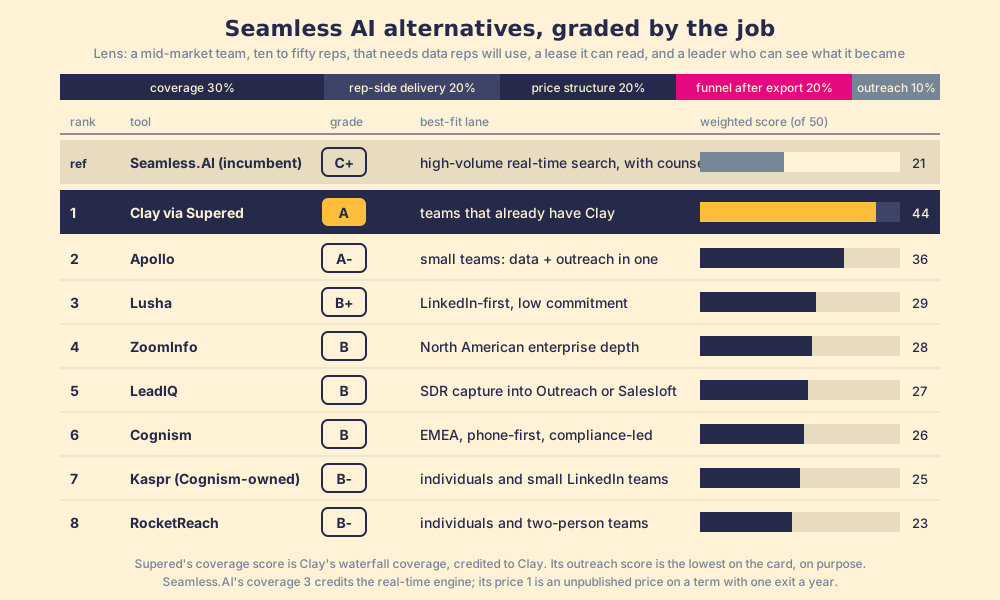
A ranking that hides its math is an advertisement. The lens is a mid-market or SMB team, ten to fifty reps, that needs prospecting data reps will use and a leader who can tell whether it worked. Weight it that way and per-result pricing, published terms, and rep-side delivery rise. Weight it for a high-volume outbound shop that wants real-time search and has counsel on the order form, and Seamless.AI climbs. Each criterion is scored 1 to 5 and multiplied by its weight, for a maximum of 50; the per-vendor scores are the same ones used on the Apollo, ZoomInfo, Cognism, and Lusha pages, so the five read together.
| Criterion | Weight | What it rewards |
|---|---|---|
| Coverage of the contact you need | 30% (x3) | Verified emails and mobiles when the first source misses |
| Rep-side delivery | 20% (x2) | Works on the profile, the company site, the CRM record; no new tab or login |
| Price structure for mid-market | 20% (x2) | Published, per-result or per-seat without a platform fee, no auto-escalator, a plain exit |
| The funnel after the export | 20% (x2) | Sourced, worked, closed, by your definitions, visible to the manager |
| Bundled outreach | 10% (x1) | Sequencing, dialer, drafting in the same plan |
The last row is where Supered scores worst, on purpose: no sequencer, no dialer, no drafting, because drafting is cheap and the unsolved job is whether the rep runs the motion. If bundled outreach decides it for you, Apollo wins this page outright, and Seamless.AI’s Connect module earns its 2 here.
| Rank | Tool | Grade | Score (of 50) | Best-fit lane | Why it ranks here |
|---|---|---|---|---|---|
| ref | Seamless.AI (the incumbent) | C+ | 21 | High-volume real-time search with counsel on the order form | Real-time search and unlimited exports on Pro; no published paid prices, an annual term that renews for 12 months on a 60-day notice window |
| 1 | Clay via Supered | A | 44 | Teams that already have Clay | Coverage is 200+ vendors, the rep never leaves LinkedIn or the CRM, credits are charged per result, and the export starts a measured process |
| 2 | Apollo | A- | 36 | Small teams wanting data plus outreach in one | Published seats from $49, G2 4.7 from 9,690 reviews, the best bundle; cancellations take effect at term end |
| 3 | Lusha | B+ | 29 | LinkedIn-first individuals and teams under about ten seats | Published ladder from free, 1 credit per email and 5 per phone, cancel from settings |
| 4 | ZoomInfo | B | 28 | North American enterprise teams buying depth and intent | The deepest single database and a Forrester Leader; no published price, a $33,500 Vendr median, a stated move upmarket |
| 5 | LeadIQ | B | 27 | SDR teams on Outreach or Salesloft | Capture-to-sequencer workflow, a public MCP server since early 2026; narrower data |
| 6 | Cognism | B | 26 | EMEA, phone-first, compliance-led outbound | Phone-verified mobiles and a notified database; quote-only, 5-seat platform, $32,750 Vendr median |
| 7 | Kaspr | B- | 25 | Individuals and small teams on LinkedIn | Published euro seats, unlimited B2B emails from the first paid tier, monthly renewal; owned by Cognism |
| 8 | RocketReach | B- | 23 | Individuals and two-person teams | Cheap published seats and broad individual coverage; thin on team workflow and measurement |
Supered’s coverage score is Clay’s waterfall coverage, credited to Clay. Its funnel score rests on the sourced-worked-closed model described further down and marked for confirmation before this ships. Seamless.AI’s coverage 3 credits the real-time engine; its rep-side 3 credits the extension; its funnel 1 is the same 1 as every database on the card.
Current corporate status, because a comparison that does not say who owns whom is wrong the moment a deal closes: Seamless.AI is private, as above. Apollo is independent and venture-backed, with Matt Curl as CEO since February 2026. Lusha is independent and cut about 8% of its staff in December 2025 (Calcalist). ZoomInfo is public (Nasdaq: GTM), owns Chorus, and in May 2026 approved a restructuring of about 600 roles, roughly 20% of headcount, to fund a move upmarket (SEC Form 8-K, May 2026). Cognism is private, London-based, and has owned Kaspr since April 2022. RocketReach and LeadIQ are independent as of September 25, 2026. Surfe is not scored here.
The Seamless AI competitors, one at a time
- Apollo. The alternative buyers land on, because everything Seamless.AI hides is on Apollo’s page: Basic $49, Professional $79, Organization $119 per user per month on annual billing, monthly billing on the first two, a free tier, credit rates of 1 per email and 8 per phone, and the line “cancellations take effect at the end of the current term” (apollo.io/pricing, September 25, 2026). G2 4.7 from 9,690 reviews. Vendr’s median on Apollo’s listing is $19,000 across 101 purchases. Still one database, and a contact “in a cadence” for six weeks is not a contact that was worked.
- Lusha. The lowest-commitment entry on the page: five published plans from a Free tier of 40 credits a month, Starter at $37.45 a month billed yearly, Premium at $299.95 for 5 seats, and a FAQ that says “you can cancel your plan at any time,” effective at the end of the cycle, from account settings (lusha.com/pricing, September 25, 2026). Five credits a phone is the wall you hit later; the Lusha pricing page does that arithmetic.
- ZoomInfo. The deepest single database: “more than 100 million companies, 500 million contacts” by its August 2026 filing, a Forrester Leader in the Q1 2026 Wave, quote-only, a Vendr median of $33,500 across 1,573 purchases. On terms, Vendr’s page describes contracts of one to three years, notice periods “typically 30-90 days,” and auto-renewal clauses that often carry a 5 to 10% annual escalation (Vendr, ZoomInfo). A unit with a better office and a bigger lease.
- Cognism. The notified, phone-verified European database, two packages with 5 seats included and no published price, a Vendr median of $32,750 across 94 purchases. On terms, one Vendr buyer note reads, in full, “They will not compromise if you miss the notice date by a 1-3 days!” and another reports “they require 24 month term length at this time” at a renewal (Vendr, Cognism).
- Kaspr. Cognism’s LinkedIn extension: Starter at €59 per user per month with unlimited B2B email credits, Business at €99, a Free plan, and subscriptions that “automatically renew monthly” (kaspr.io/pricing, September 25, 2026). Monthly is the shortest lease among the databases here.
- LeadIQ. Built for the SDR who captures on LinkedIn and pushes straight into Outreach or Salesloft; a public MCP server since early 2026 runs the same capture inside an AI chat on the customer’s existing credits (LeadIQ MCP). Narrower data; its contract terms were not opened for this page.
- RocketReach. Published per-seat tiers and broad coverage of individuals; the tool a founder buys before there is a team. Thin team workflow, no measurement past the export; terms not opened for this page.
- Clay via Supered. Coverage is Clay’s waterfall, credited to Clay every time. Delivery is the rep’s own screen: a LinkedIn profile, a Sales Navigator list, a company’s website, or a HubSpot or Salesforce record, one click to enrich and one to sync, no Clay login. Price is Clay’s per-result credits on the customer’s own Clay account, on Clay’s terms. The funnel after the export is the part the other rows leave blank.
Which Seamless.AI alternatives let you leave?
Put the doors side by side. This is the table the search is asking for, and it is built only from pages opened on September 25, 2026; where a vendor’s terms were not opened, the row says so.
| Vendor | Published paid price? | Term and renewal, per the vendor or Vendr | The exit |
|---|---|---|---|
| Seamless.AI | No | All subscriptions annual; renews 12 months unless cancelled more than 60 days before renewal; all sales final (Terms, s.6) | Account modification form plus a meeting with a Customer Success Representative, at least 60 days before the renewal date (help center) |
| Apollo | Yes ($49 / $79 / $119 annual; monthly on Basic and Professional) | Annual or monthly billing | Cancellations take effect at the end of the current term; no mid-term refund on downgrades (apollo.io) |
| Lusha | Yes ($37.45 / $52.45 / $299.95 yearly; $49.90 / $69.90 / $399.90 monthly) | Monthly or yearly; renews automatically | Cancel any time from account settings, effective at the end of the plan cycle (Lusha FAQ) |
| Kaspr | Yes (€59 / €99) | Renews monthly | End of the monthly cycle (kaspr.io FAQ) |
| ZoomInfo | No (Vendr median $33,500) | 1 to 3 years; auto-renewal with 5 to 10% escalators common | Notice typically 30 to 90 days; Vendr advises negotiating 90 to 120 (Vendr) |
| Cognism | No (Vendr median $32,750) | Annual; a 24-month term reported at one renewal | Notice date enforced to the day, per a Vendr buyer note (Vendr) |
| LeadIQ, RocketReach | Yes (per-seat tiers) | Not opened for this page | Not opened for this page |
| Clay (the data side of a Supered team) | Yes ($185 Launch / $495 Growth monthly; annual saves 10%) | Monthly or annual; 14-day trial on paid plans | Per-result data credits; “If an enrichment returns no result, you’re not charged” (clay.com/pricing) |
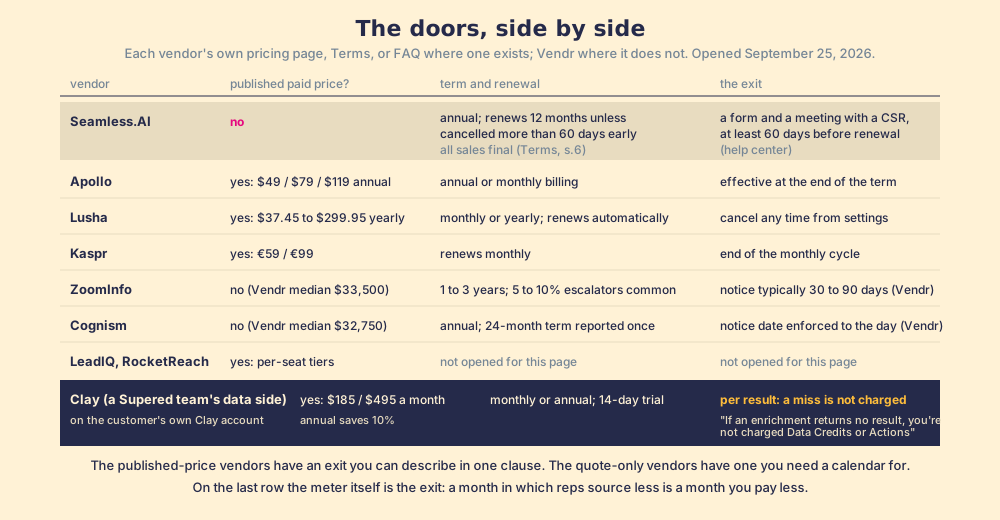
Two things stand out once the doors are in a row. The published-price vendors all have an exit you can describe in one clause, and the quote-only vendors all have one you need a calendar for. And the only row where the meter itself is the exit is the last one: on Clay, a contact that returns nothing costs nothing, so a month in which reps source less is a month you pay less, without anyone submitting a form.
Can you pay per result instead of per seat?
Look closely at what a waterfall is. It is a list of instructions the GTM engineer wrote down: ask this provider first, then that one, stop when a verified email or phone comes back, and charge for the result. “Clay’s signature data waterfalls check multiple providers to return the most verified emails (lower bounce rate) and phone numbers (higher connect rate),” across 200+ data and AI vendors under one contract (clay.com, September 25, 2026). The rule that makes it a courier rather than a landlord is on Clay’s pricing page: “If an enrichment returns no result, you’re not charged Data Credits or Actions,” with data credits from $0.05 each (clay.com/pricing). A storage unit charges for the space whether the boxes are in it or not. A courier charges for the parcel that arrived.
Supered does not bring its own database. It brings Clay’s waterfall, which is every database, routed. That is the reason we chose Clay as our only data provider, and it is why Clay is not a row in the grade table above. Clay is the row that contains the other rows.
The arithmetic, done on the numbers that are published, since Seamless.AI’s are not. Clay’s Growth plan lists at $495 a month, or $5,940 a year, with 6,000 data credits a month (72,000 a year), 40,000 actions, and CRM sync built in; Launch is $185 a month; the annual toggle saves 10%, and the monthly view is the price above (the Clay pricing page walks the ladder). Now take Seamless.AI’s own FAQ figure, “Pro plans start off at 10,000 annual credits” per user, with a credit spent each time a contact is researched. A ten-seat Pro team therefore holds 100,000 researched contacts a year at a price it cannot see, on a term it can leave once. On Clay, our reading of the pricing calculator is that a work email plus a phone costs roughly six data credits, so Growth’s 72,000 credits is roughly 12,000 fully enriched contacts a year; call that a supposition, since the calculator’s internal rates are not published. The Bridge Group’s 2025 SDR report, 351 companies, puts the median SDR at 44 dials a day (Bridge Group, 2025), which is about 11,000 a year; a rep does not need a freshly researched contact for every dial, so a 10,000-credit seat is sized for a rep who never redials, and the credits a rep does not use are the part of the unit that stays empty. Per-result pricing has no empty part.
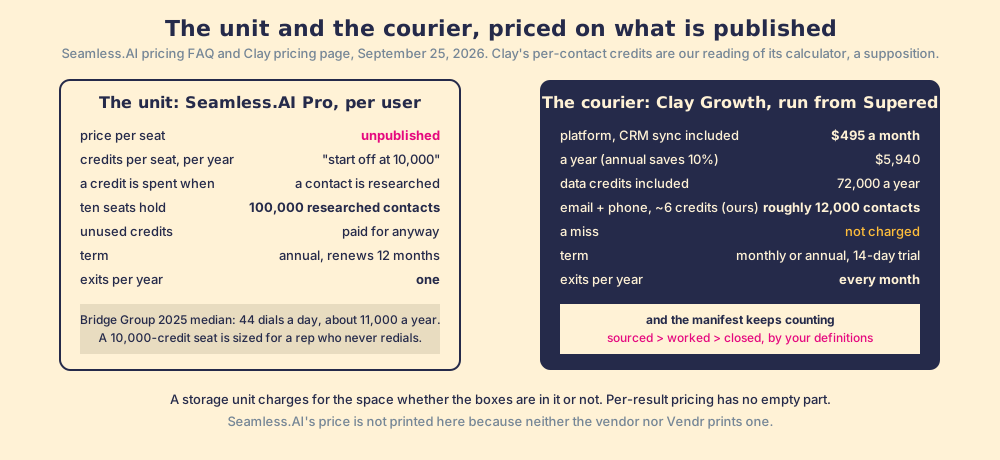
Two cautions, so the picture does not overreach. A team that has never set up Clay needs someone to build the tables and the waterfall; Clay itself says “GTM engineers build on Clay,” and that person is real overhead. And Supered’s sourcing is only for teams that have Clay. If you are not a Clay customer, the next best door on this page is Apollo’s, and the shortest lease is Kaspr’s.
What happens after the export?
Look at where each vendor’s meter sits. Seamless.AI: a credit “is used when Seamless.AI researches a contact.” Apollo: eight credits “whenever you export a contact outside of Apollo.” ZoomInfo: “Each export costs one credit.” Lusha: five credits at the reveal. Four vendors, four meters, all bolted to the same spot, which is the moment the contact leaves the vendor. Whether anyone dialed it, and what the buyer said, the meter never learns. The storage office knows when a box went in. It has no idea whether anyone ever came back for it.
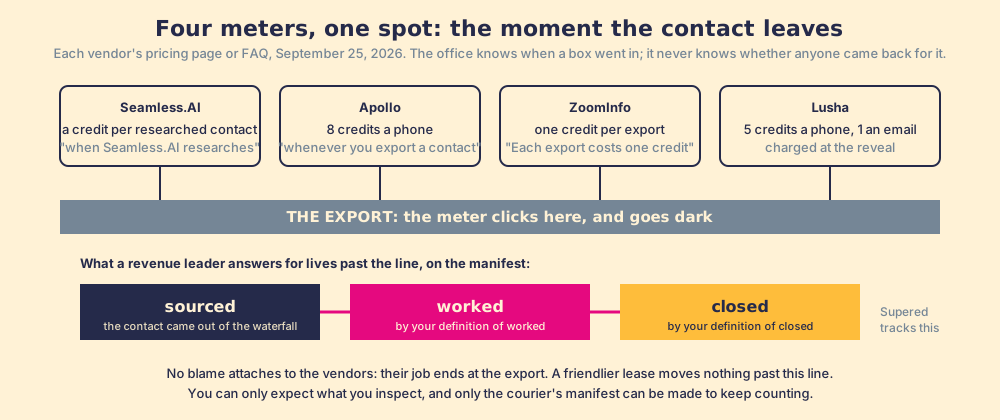
No blame attaches to the vendors for that; their job ends at the export. A revenue leader’s job starts there. Across 198 sales teams in The State of Sales Enablement, 89% had a defined sales process and 36% saw reps run it as designed, and the teams that inspected adherence consistently hit quota at 6.3 times the rate of those that did not. Sourcing a contact is step one of that process. The Bridge Group’s 2025 report shows how much motion follows it: a median of 112 activities a day, 44 of them phone, and $3.78 million in raw pipeline sourced per SDR a year, “not forecast or closed-won revenue.” A researched contact is bought before the first of those 44 dials. If the export is the only step anyone measures, you get a CRM full of researched contacts, a credit allotment draining, and no answer to “is the prospecting engine working?”
You can only expect what you inspect. So the layer worth paying for after Clay is the one that treats the sourced contact as the start of a motion with an expectation attached: was it worked, by your definition of worked; did it advance; did it close, by your definition of closed. Supered is that layer. Clay governs the data. Supered governs the motion. The rep gets the next expected action in the flow of the work, the way a sales cadence is meant to reach them, and the manager sees sourced, worked, and closed per rep against the standard they set, so the coaching conversation starts from the signal instead of a hunch. In the same study, quota attainment ran 49% when process guidance reached reps in the flow of work versus 15% when it lived in documents; the reasoning sits in the sales process guide, and the call itself, once the number is in hand, in cold calling tips.
Which Seamless AI alternative should you choose?
The choice resolves once you name the job. Here are the ways forward, then what we recommend.
- Seamless.AI itself. The pick when the job is high-volume, real-time contact discovery, you want Connect in the plan, and counsel has read section 6. Put the renewal date and the 60-day window in the contract calendar the day you sign, and ask for the account modification form in writing before you need it.
- Apollo. The pick when the job is data plus outreach in one tool with a published price and an exit you can describe in a clause. Size the credits before the seats: a phone costs 8.
- Lusha or Kaspr. The pick when the job is a handful of reps on LinkedIn with the least commitment: Lusha cancels from settings, Kaspr renews monthly.
- ZoomInfo or Cognism. The pick when you are the North American enterprise or the EMEA compliance-led team their pricing describes and you have the seats to make a platform fee sensible. Cap the escalator and diarise the notice date; Cognism’s buyers say it holds you to the day.
- LeadIQ or RocketReach. The pick when the job is SDR capture straight into a sequencer, or a founder prospecting alone. Open the terms yourself; this page did not.
- Clay via Supered. The pick when you already have Clay and your reps never open it, or when what you want from a Seamless AI alternative is a meter that runs only when a result comes back and a lease that ends when you stop. The data side carries Clay’s terms; the export becomes the first step of a measured process.
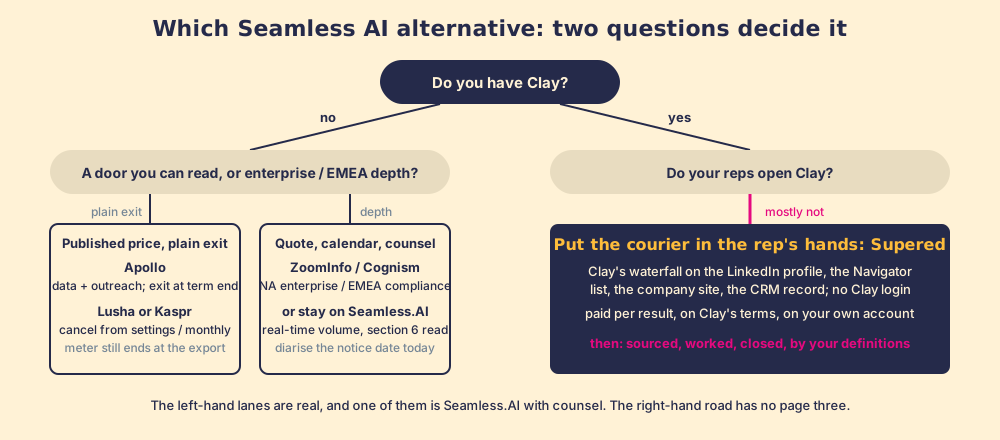
So here is what we recommend. If you do not have Clay, buy from the row whose exit you can read on the vendor’s own page, which today means Apollo for a team and Lusha or Kaspr for a few people, and treat any vendor that will not print a price as a vendor that wants the door to be theirs. If you are staying on Seamless.AI, that is a legitimate choice for the real-time job; put the 60-day window in the calendar today, because the Terms say the unit is yours for another year the morning after. If you have Clay, do not rent another unit at all. Put the courier in your reps’ hands where they already work, pay for the parcels that arrive, and measure what happens to every contact they pull, because a lease was never the problem. The problem was that no office in this category can tell you whether the boxes were ever opened, and the demo is where you can watch a manifest that can, on your own Clay account.
Frequently asked questions
What are the best Seamless AI alternatives in 2026?+
How much does Seamless.AI cost?+
Does Seamless.AI auto-renew?+
Who are Seamless AI competitors?+
Is there a data tool with no annual contract?+
Why does Supered use Clay instead of its own database?+
Your process, running itself.