Sales Enablement Myths: Adobe's William Libert on the AI Content Reps Never Read
William Libert runs sales skills enablement for about 60 reps in an Adobe business unit. He thinks AI content made for its own sake is a fad, and he bets on shared language, manager coaching and AI that speeds reps up.
Sales enablement myths are beliefs about what makes reps better that do not hold up in the field; William Libert of Adobe names the loudest one today: that generating more content and adding more tools, with AI, makes sellers more capable.
A few years after William Libert left his first enablement job, a rep he had coached found him on Facebook Messenger. She had finished a job interview that included a role play. “Hey, I just had the best interview,” she wrote. “I had a role play. The feedback was fantastic.” She listed what she had done in the room and thanked him. They had not been in touch for years.
William told Caleb King that story on Enablement for Real, then spent most of the episode on the sales enablement myths he no longer believes, starting with the idea that more AI-made content helps reps.
He runs sales skills enablement for Adobe, based in London by way of Sydney, with about 60 reps in his business unit across EMEA. He sold for years before he moved into enablement, and he says that is how he learned what reps find useful and what is noise. “I was as demanding as other sellers. I was as rebellious as other sellers as well.”
What does William Libert count as enablement success?
“I can give you a standard answer or I can give you a personal answer,” William said. Caleb chose personal.
William gave the standard one first anyway. Ramp time to first deal, deal velocity and the percentage of reps at quota are, in his words, the “unspoken expectations for enablement professionals.” If an enablement lead does not know the business metrics, “it’s on you.”
The personal answer was the Messenger note. He had coached that rep in his first enablement role, at CEB, the company behind The Challenger Sale, now part of Gartner. The job was mostly one-on-one and small-group coaching. CEB also gave him an idea he still works from, enterprise contribution, which judges people partly by how they help the people around them get work done. “It changed the way I coach,” he said.
He wants to see, years later, that “people grow and they carry some of the teaching, some of the lessons with them.” Of the rep who wrote to him, he said, “That is my personal measure.”
Why does William Libert think AI content for its own sake is a fad?
He started with a disclaimer. “I’m not a pessimist,” he said, and he uses AI every day. His doubts are about one use of it, generating content because generating content now costs almost nothing.
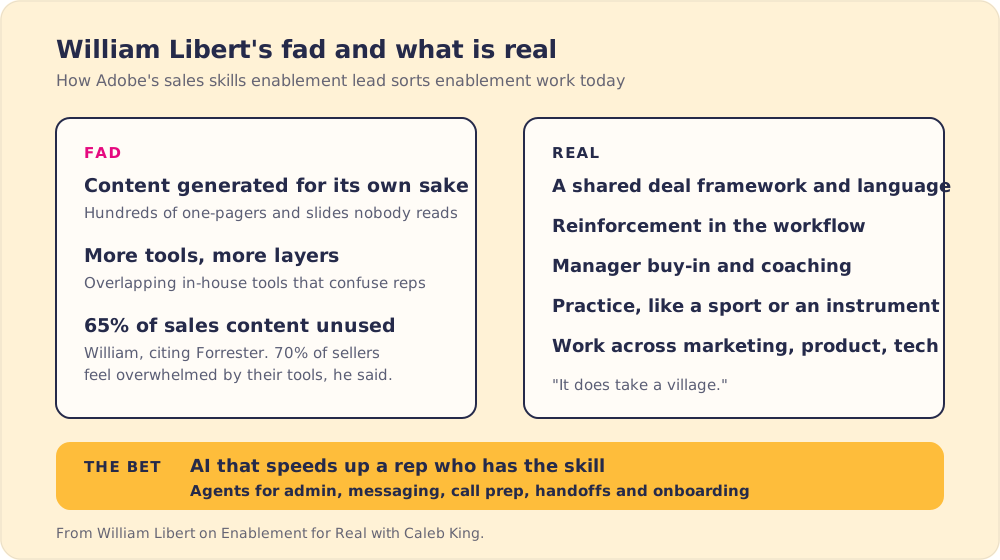
“These days we can spin up hundreds of one pages, documents, slides, presentations and whatnot that nobody reads, right?” He remembers his own seller years. “I never read anything back then. People just want to sell.”
He cited Forrester for the claim that 65% of sales content goes unused, and said 70% of sellers feel overwhelmed by the tech they are handed. Forrester’s post on the SiriusDecisions research puts unused content at 60% to 70% of what B2B marketing organizations produce, with some clients above 80% (Forrester). I could not trace the 70% figure to a source. Gartner’s survey of 501 sellers found 77% struggle to complete their assigned tasks efficiently, even with budgets set aside for sales technology, training and enablement (Gartner, 2023).
He does not blame the documents or the software themselves. “It’s about the findability and the use in the moment of selling,” he said. With so many layers and tools, reps are “confused.” Then came the line he repeated at the end of the episode: “a fool with a tool is still a fool.” With generative AI, he said, a team can pile up agents and “scale it into the graveyard.” Tools “don’t replace fundamental skills, training and sound judgment.”
Caleb agreed that “generative content is not necessarily substantive.”
William had seen the overload up close the week before, at a tech fest he ran for his group. Tools his team assumed were basics “landed as mind blowing” for reps, because in-house tools from different product owners overlap. He expects the building era in AI to give way to a consolidating one, “where judgment would kick in” and people start asking which tools they need.
Our State of Sales Enablement 2026 survey found 64% of teams already use AI for content creation. When respondents named why tools end up as shelfware, the top answers were that reps do not see the value (55%), managers do not reinforce them (51%) and the tool sits outside the workflow (48%) (The State of Sales Enablement 2026). Our post on sales enablement content covers how to judge an asset by whether reps use it, and our look at sales enablement tools covers what a bigger stack costs.
Which sales enablement myths does William Libert reject?
Across the episode, William argued against four beliefs.
- More content, better reps. Hundreds of AI-made one-pagers go onto the pile reps already skip. He wants reps to find the one they need in the moment of selling.
- A new tool for a skill gap. “A fool with a tool is still a fool.” A tool does not supply the skill or the judgment behind it.
- One classroom session. William sees selling “like a sport or a language that you’re learning or an instrument that you’re practicing.” A single session does not build a skill. “But you do need to practice.”
- Enablement coaching alone. He told Caleb he could not get the impact without the manager’s support. “It does take a village.”
What does William Libert say is real in sales enablement?
Caleb’s next question was what works. William’s answer was “more on process and people.” The first piece is a common deal framework and a shared language, so “everyone follows the same process, speaks the same language.” Then, to be clear: “I’m not talking about German, French, Italian. We’re talking about the same sales language here.”
The second is reinforcement inside the workflow, through coaching, deal coaching and QBRs. The third is manager buy-in, which he called big for him. The fourth is work across teams, with marketing, product and technical staff.
He credited Gartner with a figure of up to 2.4 times more commercial growth when sales works with marketing and service. I could not find that exact number. Gartner’s survey of 412 marketing and sales leaders does point the same way: commercial teams that share buyer journey insights are 1.6 times more likely to exceed revenue growth expectations and 2.3 times more likely to see higher sales conversion rates. The same survey found marketing and sales typically collaborate on only three of 15 commercial activities (Gartner, 2024).
If you want to try his version, write down the deal framework your best reps already run and the words your team uses for stages, pains and next steps. If two managers describe the same deal in different words, the language is not shared yet.
How does William Libert coach reps without taking over the manager’s job?
Caleb wanted tactics. William works through the managers first, for scale. He also knows managers differ. A good manager who is also a good coach means “you’re lucky,” he said, and then asked what happens when someone is “a good manager but not a good coach.”
So he offers extra one-on-one coaching when a manager asks, and does more of it with new managers. He draws one hard line. When a struggling rep is a performance problem, he stays out: “that’s your job that’s you and HR that’s not enablement job.”
When he does coach, he starts by isolating the skill. Is it discovery, product knowledge, presentation, the value proposition or messaging? Sometimes it is process, meaning what the rep does before and after the call. He reviews recorded calls and joins live ones, and before he joins he asks the rep what his role should be. “Do you want to lead the call and I’ll just be a fly on the wall or should we co-lead it?” The third option is that William leads and the rep sits back.
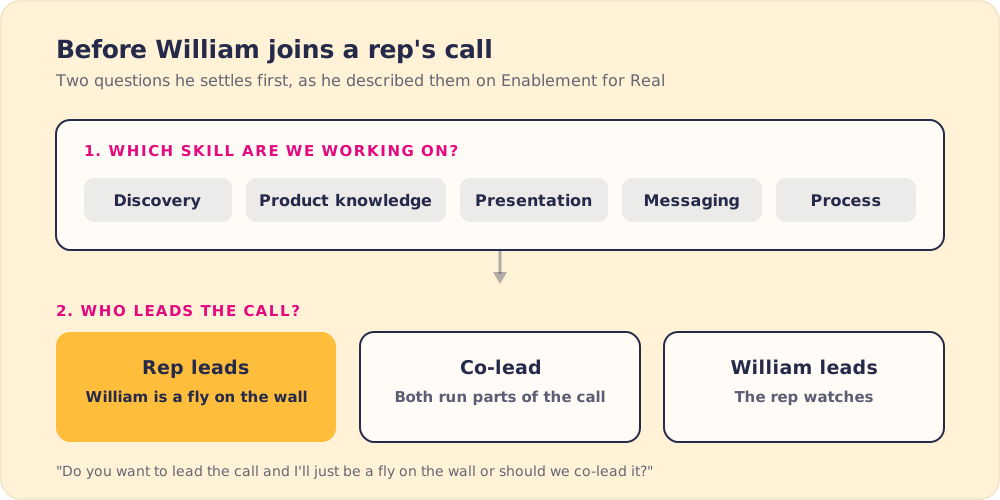
Which option he picks depends on the rep. Our sales coaching guide covers how managers protect time for this work.
Where does William Libert think AI is headed in enablement?
William admitted the bet question had given him trouble, since his fad was one side of AI. “My bet is the other side of the coin,” he said. He believes AI will speed up much of the work, and he was frank about the limits of anyone’s forecast: “we don’t know what we don’t know.”
For sellers, he is testing agentic tools that cut admin, tailor messaging, prepare reps for sales calls and hand opportunities to other teams more cleanly. For his own work, there were moments “I surprised myself that I was able to redesign an entire workflow” with AI. He built an onboarding coach, an agent for new reps, and recently turned a prompt into a two-minute video. His advice to the rest of the field: “we just need to have an open mind, be curious, explore.”
Gartner’s 2026 survey of 210 sales leaders found AI saves sellers an average of 4.8 hours a week, and 72% of sales organizations report low reinvestment of that time in high-value work. Dan Gottlieb, a VP analyst there, said “AI is not the hero of this story; AI is the accelerant” (Gartner, 2026). Our AI sales enablement guide covers what to measure once the agents are live.

What William Libert has learned about enablement
- A personal measure of success. Ramp time, deal velocity and reps at quota are the baseline. William’s own test is whether a rep still uses the skill years later.
- Content judged by use. AI makes documents cheap. William cares whether a rep can find the right one in the moment of selling.
- A shared sales language. One deal framework and one vocabulary, so managers describe a deal the same way.
- Managers as the coaching engine. Enablement adds extra coaching when asked and stays out of performance management.
- AI as an accelerant. Agents for admin, messaging, call prep and onboarding, working for a rep who already has the skill.
What would William have an enablement leader do first?
Check what reps use before you make more. Pull last year’s assets, see which ones reps opened this month, and retire the rest. Write down the shared deal language. Put your coaching hours behind the managers, and offer the new ones extra help. Then point AI at the admin and call prep that eat sellers’ hours, and track whether the time saved goes back to buyers.
We built Supered around the first half of that list: the shared process, shown to reps inside the CRM while they work, with AI added once the process is running.
Frequently asked questions
What are the most common sales enablement myths?+
How much sales content goes unused?+
Does AI-generated content help sales reps?+
Should sales enablement or sales managers coach reps?+
Where is AI headed in sales enablement?+
Your process, running itself.
Turn the playbook into rep behavior.
More from Enablement for Real

RevOps Best Practices: Hope Edmiston on Bolt-On AI and the Classics That Still Work
Hope Edmiston
AI Sales Role Play: Peter Roccaforte on Rehearsal, Lazy Bots and Two Enablement Fads
Peter Roccaforte