Generative AI for Sales: Why More Output Isn't More Revenue
Generative AI drafts the email, summarizes the call, and writes the proposal in seconds. The productivity is real. Here is why it doesn't move the number on its own, and where it does.
Generative AI for sales is the use of LLMs to produce sales work, emails, summaries, proposals, research, scripts, and increasingly to act in the workflow; it makes the knowledge work of selling nearly free, so its value depends on whether it changes what reps do.
McKinsey estimates that generative AI could add between $2.6 and $4.4 trillion a year to the global economy, and that three-quarters of that value sits in four areas, with marketing and sales among them (McKinsey, 2023). Numbers like that have a gravity to them. They pull a sales leader toward a simple plan: buy the AI, point it at the team, watch the line bend. So a team does exactly that. Reps start drafting emails in seconds, every call gets summarized and scored, proposals write themselves, and the volume of sales work produced goes up and to the right. Then the quarter closes, and the win rate is sitting where it always sat.
That is the puzzle worth solving, because it is not a story about bad AI. The AI worked. It did everything it promised. The trouble is what it promised, which was to make the knowledge work of selling faster, and the knowledge work was never the part that decided deals.
Generative AI for sales is the use of large language models to produce sales work, emails, call summaries, proposals, research, and scripts, and increasingly to act in the workflow; it makes the knowledge work of selling nearly free, so its value depends on whether it changes what reps do, not how much it produces. Hold that distinction, between producing knowledge and changing behavior, and the whole category sorts itself out.
What is generative AI for sales?
It is software built on large language models that produces the artifacts and analysis of selling, and, in its newer agentic form, takes actions in the workflow. It is one of the most-bought categories of ai tools for sales, and the generative AI sales use cases that teams buy today cluster into a familiar list: drafting outbound emails and sequences, summarizing and scoring calls, researching accounts and buyers, generating pitches and objection scripts, running practice roleplay, and forecasting from historical patterns. Each is genuinely useful, and almost all of them share one trait. They produce an input, the knowledge a rep carries into the work, faster and cheaper than a human could.
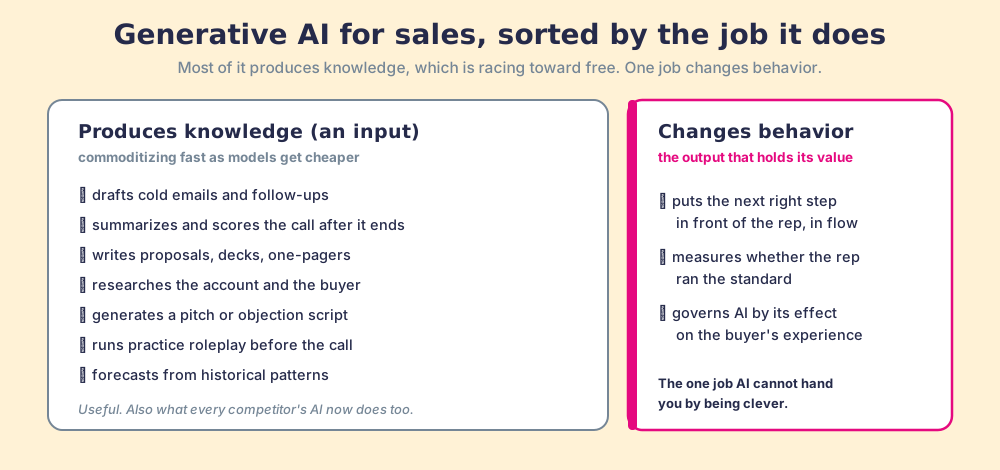
The reason the input jobs are a shaky place to build a moat is that their price is collapsing. A free notetaker now records and summarizes any call, and the conversation tools that built businesses on transcripts are watching that work turn into a commodity. When the thing a category produces becomes free, the category stops being a moat and becomes a feature. That is the direction every “generate it for you” use case is heading. The output job, did the rep run the standard, gets more valuable as the inputs get cheaper, because it is the one thing AI cannot hand you by being clever.
What does the data show?
It shows a real productivity lift, and a gap the productivity number hides. Gong’s State of Revenue AI report, built on 7.1 million sales opportunities and a survey of more than 3,000 revenue leaders, found that teams who deeply use AI generate 77% more revenue per rep (Gong, December 2025). McKinsey’s productivity estimates point the same way. So the upside is not in doubt.
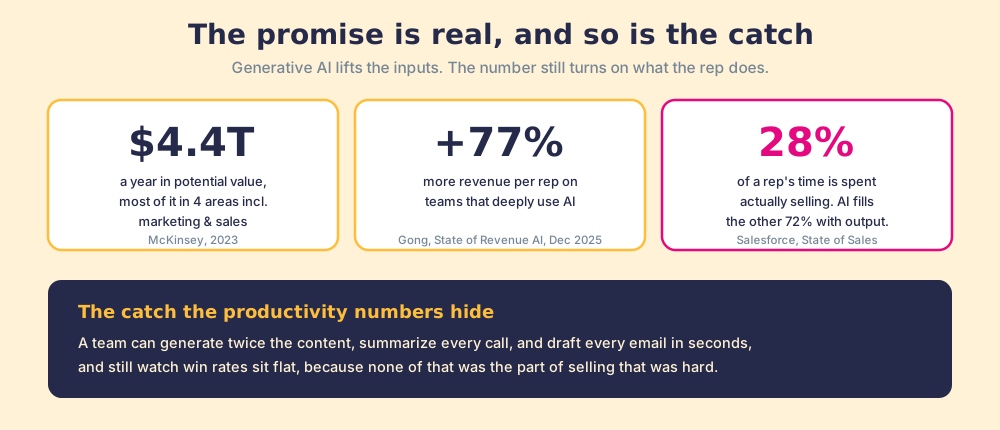
The catch hides inside the word “deeply.” The teams seeing the gains are not the ones generating the most content; they are the ones who changed how reps work. That distinction matters because of where a rep’s day goes. Salesforce’s State of Sales research has repeatedly found that reps spend under a third of their time selling, with the rest lost to admin, data entry, and internal meetings (Salesforce, State of Sales). Generative AI is brilliant at clearing that admin, and clearing it is worth real money. It is also not the same lever as making the selling time itself more effective, and a team that uses AI only to produce more output has pulled the first lever and left the second alone.
Why doesn’t more generated content close more deals?
Because the gap that loses deals was never made of missing knowledge. Pfeffer and Sutton named the underlying problem a generation ago in The Knowing-Doing Gap: the chronic distance between what an organization knows it should do and what it does (Pfeffer & Sutton, Harvard Business School Press, 2000). The firms that closed it did not win by knowing more. They won by changing what happened in the daily flow of the work. Generative AI is the most powerful knowing machine ever built. Pointed at a doing problem, it makes a cheap thing cheaper and leaves the expensive thing untouched.
Our own field research puts a number on the doing problem in sales. In The State of Sales Enablement 2026, 89% of teams had a defined sales process and only 36% saw reps follow it as designed, a 53-point sales execution gap that no amount of generated content closes. Behavioral science has measured the same distance under cleaner conditions: Sheeran and Webb’s review of the intention-behavior gap found that a sizable change in what people intend to do produces only a modest change in what they do (Sheeran & Webb, 2016). A rep who can now generate a flawless discovery plan in four seconds is a person with stronger intentions and the same weak follow-through. The plan was never the bottleneck.
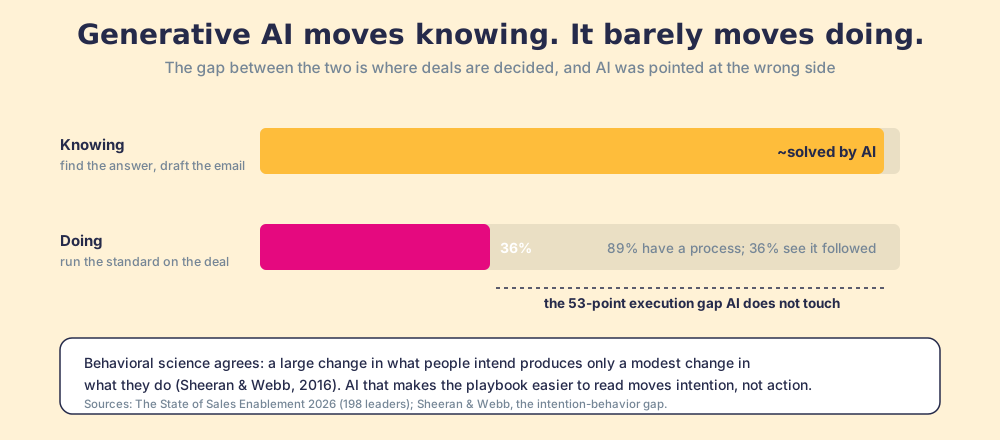
89% of teams have a defined sales process. 36% see reps follow it as designed. The 53-point gap between the two is a doing problem, and generative AI, the greatest knowing machine ever built, does not close it on its own.
Where does generative AI move the number?
In the places where it changes what the rep does, not what they know. There are three, and all of them are about doing.
- Equip in the moment. AI earns its keep when it puts the next right action in front of the rep the instant the question arises, in the flow of the work, so following the process is the path of least resistance instead of a tax on the rep’s memory.
- Lift the inspection burden. Someone has to check whether the process is being run. Done by hand, that inspection eats the hours a manager should spend coaching. AI can read every open deal against the standard and flag the drift, so the scarce human time goes to coaching, not chasing.
- Govern AI by its effect on behavior. When AI acts with a buyer, the test is not how clever the output was. The test is whether the buyer got the experience you designed, inspected at the level of the individual interaction.
Notice what these share. None of them is “produce more.” Each one points AI at the rep’s behavior in the moment of the work, which is the side the productivity numbers leave alone. This is the case for treating generative AI as a behavior tool rather than a content tool, and it is the same argument we make in full in AI sales enablement and demonstrate through AI sales coaching and the best AI sales tools.
How should you adopt generative AI for sales?
In an order, because the order decides the result. Generative AI is an amplifier, and an amplifier supplies no signal of its own; it multiplies whatever you feed it. Feed it an adopted process and it compounds, the standard motion running on more deals with less effort per deal. Feed it a process reps ignore and it scales the gap, every rep running a private version of the motion, now with machine speed behind the drift. AI without a working, adopted process amplifies failure, because the thing being multiplied is variance.
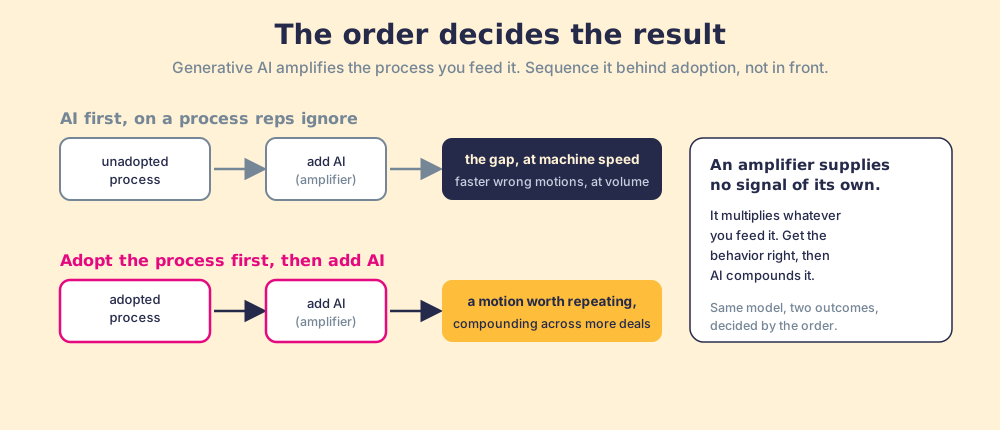
So the sequence is plain. First, make the process something reps run, not something they store: deliver it in the moment, and measure adherence in the moment, so drift gets caught while there is still time to change the outcome. This is sales process adoption, and it is the prerequisite, the way compliance becomes adoption only once it is measured and coached into a habit. Then add generative AI, pointed at the doing: to equip reps in the moment, to lift the inspection burden off managers, and always governed by its effect on the buyer’s experience. That version compounds. The reverse, AI bolted in front of a process nobody follows, buys a faster and more expensive copy of the gap you already have.
What we recommend
Two ways to buy generative AI for sales sit in front of every leader, and they look almost identical on a demo. You can buy it as a production engine: generate more emails, more summaries, more decks, more research, and measure success by how much the team produces. Or you can buy it as a behavior engine: use it to put the right action in front of the rep in the moment, to inspect whether the process ran, and to govern the experience the buyer gets.
We recommend the second, and the evidence is why. McKinsey and Gong say the upside is real, and Gong’s own data ties the gains to teams that changed how reps work, not the ones that produced the most. Pfeffer and Sutton, and Sheeran and Webb, say the constraint is doing, not knowing, and that more knowledge moves intention without moving action. Our own survey says the execution gap is 53 points wide and that AI in the flow of work, not in a separate tab, is what more than doubles quota outcomes. Those point one way: buy the productivity, by all means, but do not mistake it for the result. The result lives on the doing side, behind an adopted process, and that is where to point the most powerful knowing machine ever built.
From here: the fuller argument in AI sales enablement, the coaching version in AI sales coaching, the buyer’s guide in the best AI sales tools, and the adoption system underneath it all in sales process adoption.
Frequently asked questions
What is generative AI for sales?+
How is generative AI used in sales?+
Does generative AI increase sales?+
What are the risks of generative AI in sales?+
Your process, running itself.