Sales Performance Management: You Can't Manage the Result
Sales performance management usually means tracking quotas and outcomes.
But you cannot manage a result, only the behavior that drives it. Here is what SPM is and how to do the version that works.
Sales performance management is the discipline of improving how a sales team performs through goals, metrics, coaching, and incentives, and it works only when it manages the leading behaviors that drive results rather than the lagging results themselves.
A sales manager at the end of a quarter is, for a few painful days, a person staring at a number they can no longer touch. The deals are won or lost. The quota landed where it landed. They can review it, explain it, dress it for the board, but they cannot manage it, because the thing they would manage already happened. And yet the phrase over the whole exercise is sales performance management, as if the number were the object of the work. That misreading is the reason so many SPM programs report diligently and improve nothing.
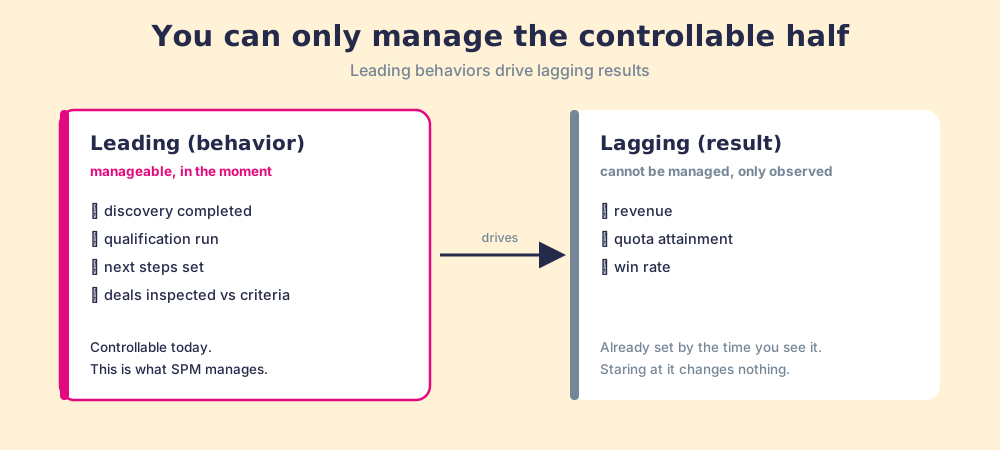
You cannot manage a result. Revenue, quota attainment, and win rate are events that have already occurred by the time you see them, and no amount of managing a figure that is already set will move it. The only thing a manager can manage is the behavior that produces the figure, while it is still being produced. That one distinction separates a sales performance management process that works from one that merely keeps score.
So, plainly: sales performance management is the discipline of improving how a sales team performs through goals, metrics, coaching, and incentives, and it works only when it manages the leading behaviors that drive results rather than the lagging results themselves. The whole discipline lives in that shift from the outcome to the behavior underneath it.
What is sales performance management?
It is the connected system that turns sales strategy into rep behavior and behavior into results. SPM spans the practices that, taken together, shape how a team performs: setting goals and quotas, tracking the metrics that matter, coaching reps against them, and aligning incentives so the behavior you want is the behavior you reward. As a software category, SPM often leans on the back office, quota and commission management, territory planning, but the discipline is wider than the tooling. At bottom it answers one question: how do you reliably get a team to perform better, not merely record that they did or did not.
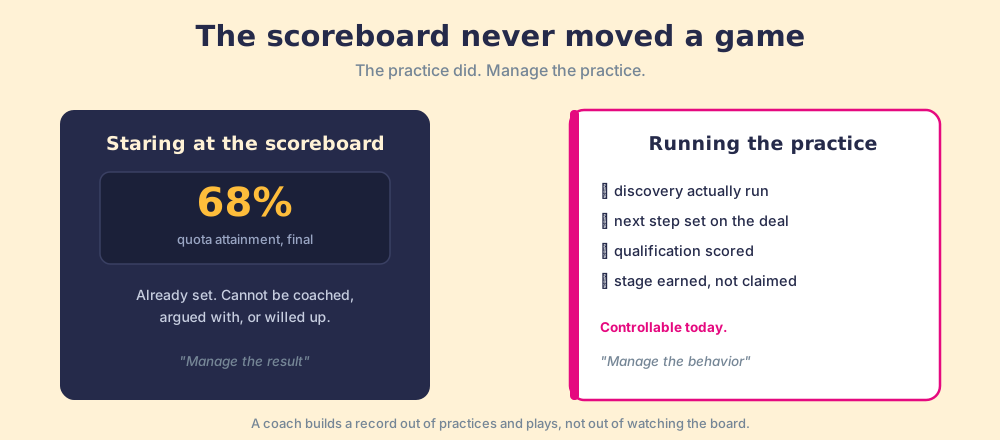
The mature version treats performance the way a coach does, as something built out of practices and plays. A coach who wants a better record does not stand and glare at the final score; the score is a readout, not a lever. The work is on the practice field, in the reps and the film and the corrected footwork, and the score follows from that. The immature version of SPM treats performance as the score itself, and then is puzzled that staring harder does not raise it.
What does sales performance management software do?
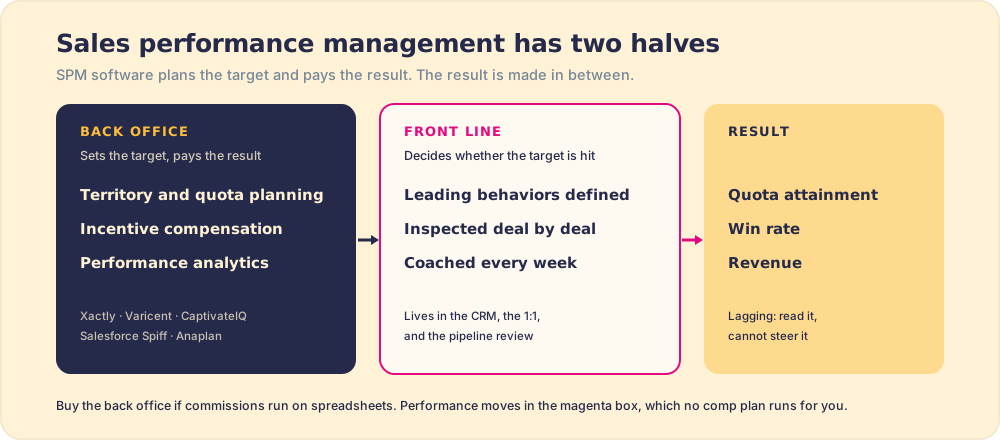
It runs the back office of sales performance: it plans the target and pays the result. Gartner’s SPM review pages use it that way, as do vendor sites such as Xactly’s and Anaplan’s, and if you searched the term with a budget in hand, this is the market you are shopping. The category usually covers three jobs:
| SPM software job | What it does | Typical vendors |
|---|---|---|
| Territory and quota planning | Carves accounts into territories, sets quotas, models capacity and ramp | Varicent, Anaplan, Xactly |
| Incentive compensation management | Calculates commissions and accelerators, shows reps their pay, handles disputes and clawbacks | Xactly, CaptivateIQ, Salesforce Spiff, Varicent |
| Performance analytics | Reports attainment, pay, and plan effectiveness by rep, team, and region | Most of the above, plus the CRM’s own reporting |
The vendor map has moved in the last few years. Salesforce bought Spiff and relaunched it inside Sales Cloud as Salesforce Spiff in April 2024 (Salesforce). Varicent left IBM when its founder and the private equity firms Great Hill Partners and Spectrum Equity bought it back on December 31, 2019, and now sells sales planning, incentives, and seller insights (Varicent). Xactly has been owned by Vista Equity Partners since 2017, and Thoma Bravo took Anaplan private in 2022. If commissions still run on a spreadsheet that one analyst understands, these tools pay for themselves in disputes avoided and plans changed without a fire drill.
The limit, stated fairly: SPM software sets the target and pays the result accurately; it does not make a single rep run discovery before the demo. The result is made in between, in the behaviors a rep runs on each deal and the coaching a manager does off them, and that half of sales performance management lives in the CRM, the one-on-one, and the pipeline review, not in the comp plan. Buy the back office for the back office.
It will not move the number by itself.
Why does managing results fail?
Because results are lagging, and lagging things can be observed but not managed. Jason Jordan and Michelle Vazzana made this case rigorously in Cracking the Sales Management Code, after sorting through hundreds of the sales metrics teams track. Their finding was uncomfortable and precise: business results like revenue are, in their word, “unmanageable.” You can no more direct revenue to rise than a captain can order the wind to blow. What a captain manages is the set of the sails and the heading of the ship, the things still in his hands; the wind he takes as it comes. In selling, the sails are the activities and the process that produce the result, the part still in motion and still in the rep’s grip.
So SPM built around the number, the quarterly review of who hit quota, hands managers nothing they can act on in time. By the time the quota is final, reviewing it is an autopsy: thorough, instructive, and far too late for the patient. The evidence that the controllable half is where performance gets made is consistent. Korn Ferry’s CSO Insights research found that teams running a formal, fully implemented coaching approach, coaching aimed at process behavior rather than pep talk, posted an average win rate of 55.2%, nearly nine points above the study average (Korn Ferry / CSO Insights). The lever was the behavior they managed on the way to the number, not the number.
There is a second trap waiting for teams that hear “manage behavior” and respond by picking one behavior to enforce. Goodhart’s Law: when a measure becomes a target, it stops being a good measure (on Goodhart’s Law). Make “calls logged” the target and you will get calls, hollow ones, dialed to register on the dashboard and hung up before they mean anything. So the job is narrower than “track results” and wider than “enforce one metric.” It is to manage the whole process behavior: the motion that genuinely produces the outcome, watched as a motion, not gamed as a number.
How do you do sales performance management that works?
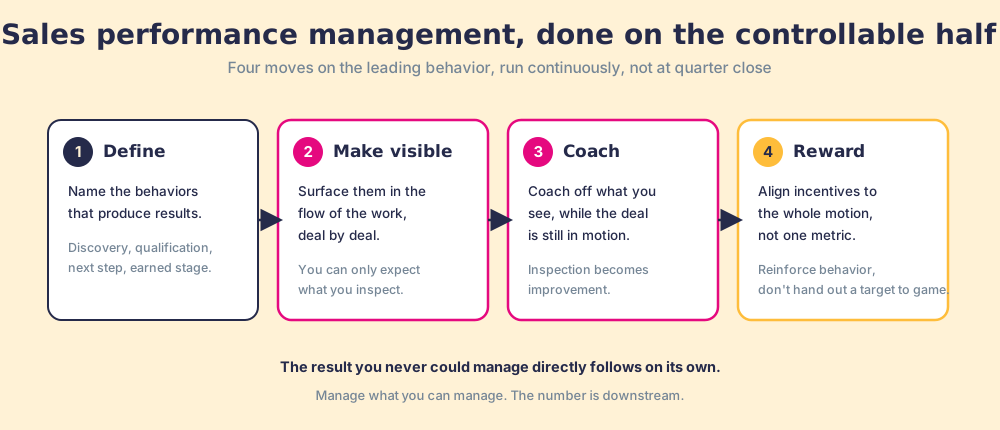
Manage the leading indicators, continuously, and coach off them. Leading indicators are the controllable process behaviors that predict results: discovery completed, qualification run, next steps set, deals that have genuinely earned their stage rather than being dragged into it. These are the moves a rep can make today that show up as revenue next quarter, which makes them the only fair object of management. The four moves fit together as a loop, run all quarter rather than sprung at the end of it.
- The behaviors that drive results. Name them, concretely, so performance management has something it can hold. “Sell better” is not manageable; “run discovery before the demo” is.
- Those behaviors made visible, deal by deal. You can only expect what you inspect, and a behavior you cannot see is a behavior you are merely hoping for.
- Coaching off what you see. When inspection feeds the conversation, it turns from judgment into improvement, the manager working on the motion while the deal is still live enough to change.
- Incentives aligned to the whole motion. Tie reward to the behavior, carefully, so you reinforce the full process instead of handing reps a single number to chase against the spirit of it.
The single number that makes this case better than any argument is about inspection. In The State of Sales Enablement 2026, teams that consistently inspect deals against a defined process hit quota at 6.3 times the rate of teams that rarely do, the largest single effect we measured. Read it the right way and it is sales performance management in one statistic: the teams managing a leading behavior, the act of inspection, outperformed the teams watching the lagging result by a multiple, not a margin.
The reason this so rarely happens by hand is that inspecting every deal against a process is tedious, and tedious work gets skipped under quota pressure. A business logic layer exists for that job. Supered makes the leading behaviors visible and inspectable in each deal’s deciding moments, inside HubSpot and Salesforce where reps already work, so the manager spends the quarter coaching the controllable part while it is still controllable instead of reconstructing it afterward. It pairs with the numbers you track in sales KPIs, the conversations in sales coaching, and the standard you hold in sales accountability.
How do you measure sales management performance?
Judge a sales manager by the shape of their team as well as its total. A manager whose team hits 102% on the back of one rep has a different problem from a manager whose team hits 95% with every rep between 85% and 110%, and only the second one has built something that will survive a resignation. Five measures cover it:
- Spread of attainment. The percent of reps at quota and the median rep’s attainment, next to the team total (the three readings in quota attainment).
- Ramp of new hires. Months to the first full-quota month for each hire the manager onboarded, against the 6.2-month AE average in The Bridge Group’s 2026 AE report (The Bridge Group).
- Behavior adherence. The share of the team’s deals where the standard behaviors happened: discovery before demo, a dated next step, stage criteria met.
- Coaching cadence. Whether each rep gets a weekly one-on-one that works deals and skills rather than reading status back (the questions are in one-on-one meeting questions).
- Forecast accuracy. How close the manager’s commit lands to the result, which is the clearest read on whether they know their deals.
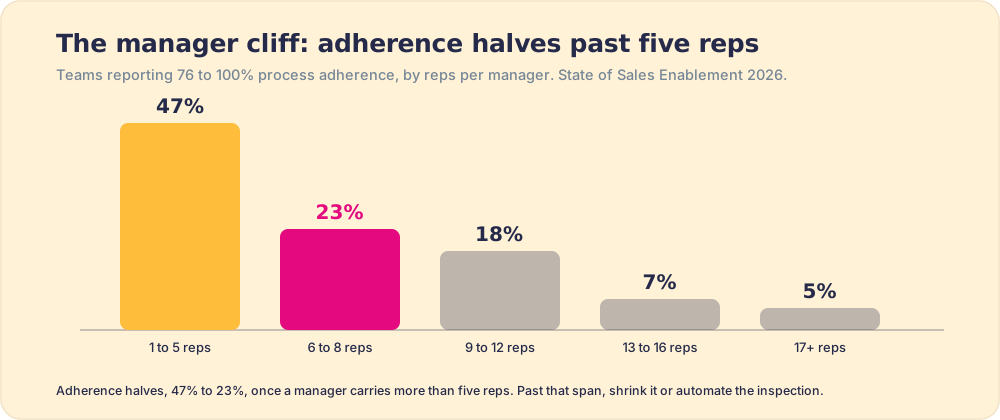
Span of control sits underneath all five. In The State of Sales Enablement 2026, 47% of teams with 1 to 5 reps per manager reported 76 to 100% process adherence. At 6 to 8 reps the rate fell to 23%, at 9 to 12 to 18%, at 13 to 16 to 7%, and at 17 or more to 5%. Among the 29% of respondents who named manager non-enforcement as the main reason reps skip the process, capacity came up as the cause more often than indifference (The State of Sales Enablement). A manager with eleven reps who inspects every deal by hand is not managing performance; they are out of hours. Either shrink the span or automate the inspection so the hours go to coaching.
What we recommend
Strip the topic back and a clean choice sits underneath it. You can run sales performance management as scorekeeping: track the results, review them after the quarter, and accept that by the time you are managing the number there is nothing left to manage. Or you can run it as behavior management: define the leading behaviors that produce your results, make them visible deal by deal, coach off what you see, and align incentives to the whole motion rather than a single gameable metric.
We recommend behavior management, without hedging, because of the evidence. Jordan and Vazzana’s metric work says the result is unmanageable by definition. Korn Ferry’s data says managing the coaching behavior moves the win rate by nine points. Goodhart’s Law says enforcing one metric breaks the metric. Our own survey says inspecting the process behavior multiplies quota attainment by six. All four land on the practice field, not the final score. Manage what you can manage, and the result, which you never could touch directly, arrives downstream on its own.
From here: the metrics worth tracking in sales KPIs, the coaching that improves the behavior in sales coaching, the standard that holds it in sales accountability, the conversation that carries it in one-on-one meeting questions, and the system underneath in sales process adoption.
Frequently asked questions
What is sales performance management?+
Why does sales performance management often fail?+
What is the difference between leading and lagging indicators in sales?+
How do you improve sales performance management?+
What does sales performance management software do?+
How do you measure sales management performance?+
Your process, running itself.