Sales Enablement Content: A Liability Until Reps Use It
Most teams treat sales enablement content as a production problem: make more decks, more battlecards, more one-pagers.
Here is why the library is a liability, and what turns it into an asset.
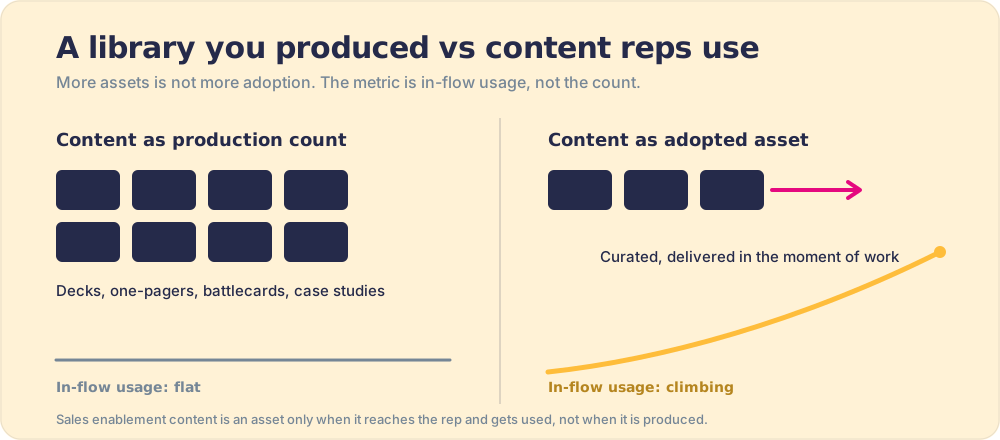
Sales enablement content is the collection of buyer-facing collateral and internal materials a revenue team builds to help reps sell; it becomes an asset only when it reaches the rep in the moment of work and gets used, and stays a depreciating liability until then.
Open a sales team’s content library and you often find a graveyard with good intentions. Nine hundred approved assets, a tagging scheme three managers argued over, version 4 of the pitch deck next to versions 1 through 3, all still live. It looks like wealth. Then watch a rep on a live call, asked a pricing question they have not handled before. They do not open the library. They guess, promise to follow up, and hang up. The team produced everything. The rep, in the only moment that mattered, reached for nothing.
The field mostly looks past that gap. The market treats sales enablement content as a production problem, make more decks, more battlecards, more one-pagers, as if the trouble were a shortage of assets (the split between who writes content and who gets it used is laid out in sales enablement vs product marketing). The trouble is the opposite. A document is a depreciating liability the moment the process it describes changes, and it becomes an asset only when it reaches the rep in the moment of work and gets used. The number to watch is not how many assets you produced. It is in-flow usage. A library reps skip mid-deal is not a content program. It is a shelf.
Sales enablement content is the collection of buyer-facing collateral and internal materials a revenue team builds to help reps sell. The behavioral version, the one that predicts whether the spend pays off, is this: that content is an asset only when it reaches the rep in the moment of work and gets used, and a depreciating liability until then. Knowledge is solved, any rep can find a doc and an AI can summarize it in seconds. What the rep does with it on a slipping deal is the unsolved problem.
What is sales enablement content, exactly?
Strip away the brand of the platform it sits in and sales enablement content is the material reps sell with. Some of it the buyer sees. Some of it only the rep sees. All of it exists to make the next conversation go better than it would have without it. Ordinary, useful, and worth defining before we argue about it.
The behavioral definition matters because the two readings lead to different decisions. Read content as a production target and every gap looks like a thing to make: no industry one-pager, write one; no competitive battlecard, build it. Read it as a behavior input and the question becomes whether the asset reaches the rep and changes what they do on a real deal. A case study no rep pulls into a live opportunity is not a case study. It is a file. The asset got produced and the behavior never arrived, and only one of those shows up in a content audit.
That distinction decides everything that follows.
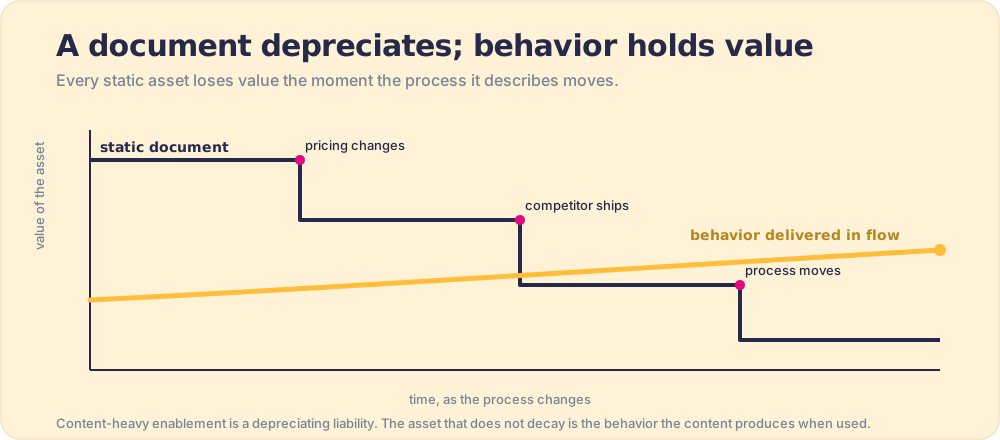
The liability part is not a metaphor. The day your pricing changes, half your one-pagers are wrong. The day a competitor ships a feature, your battlecard misleads. Documents and decks go stale the moment the process they describe moves, which is why a content-heavy program is a depreciating asset on the books, losing value every quarter unless someone keeps repainting it. The asset that does not depreciate is the behavior the content produces when it reaches the rep in the moment and gets used. The move worth making runs from a library you maintain to a delivery you measure.
What are the main types of sales enablement content?
Most lists of content types run to twenty bullets and teach nothing, because the categories overlap and the labels drift. There is a cleaner cut, and it is a single question: does the buyer see this, or only the rep? Sort every asset by that line and the whole inventory snaps into two families with different jobs.
- Buyer-facing collateral. The content a prospect sees: pitch decks, one-pagers and product sheets, case studies and references, proposals and quotes, ROI calculators, demo follow-ups. Its job is to move a specific buyer one step closer, so its test is whether it lands in the buyer’s hands at the right moment, not whether it exists in a folder.
- Internal content. The material only the rep sees: battlecards, playbooks and process steps, talk tracks, objection-handling guides, discovery question sets, competitive and pricing briefs. Its job is to change what the rep does in the conversation, so its test is whether the rep can reach it the instant the question arises, mid-call, without leaving the work.
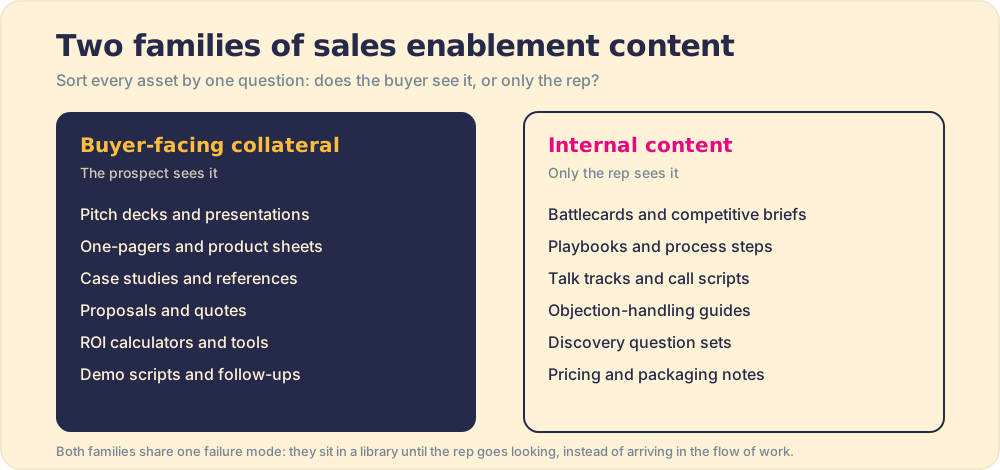
The two families look different and fail the same way. Buyer-facing collateral that lives in a tool the rep forgets under pressure never reaches the buyer. Internal content parked in a wiki the rep would have to open in a fourth tab never changes the call. The format is not the variable. The distance between the asset and the moment the rep needs it is the variable, and most sales enablement collateral is filed exactly one tab too far from the work to ever get used.
Why does most sales enablement content go unused?
Not because the wrong assets got built. Because the right assets live somewhere the rep has to leave the deal to reach, and under pressure they will not make the trip. The math of attention is unforgiving: the more places there are to look, the less likely the right look happens in the moment it matters.
The evidence is blunt. The Sales Enablement Collective’s 2025 Impact of Enablement report found that 79.7% of enablement leaders say their reps leave at least 40% of a stand-alone tool’s features untouched (SEC). The same friction governs the content inside those tools. An asset that lives in a separate library, away from the deal, sits at the same distance as an unused feature, and gets adopted at about the same rate, which is to say barely. That is not a discipline failure on the rep’s part. It is structural. Following the process by going somewhere else to find the asset costs a tab switch, and friction wins.
It compounds with how little of a rep’s day is free to begin with. Sellers spend only about 25% to 40% of their time selling, the SEC reports; the rest goes to prep, admin, and hunting for information (SEC). An asset that demands its own search, its own tab, its own moment of context-switching is taxing the smallest and most valuable slice of the week. Build a one-pager to save a rep time, file it in a library they have to go find, and you can easily spend more of their attention than you save.
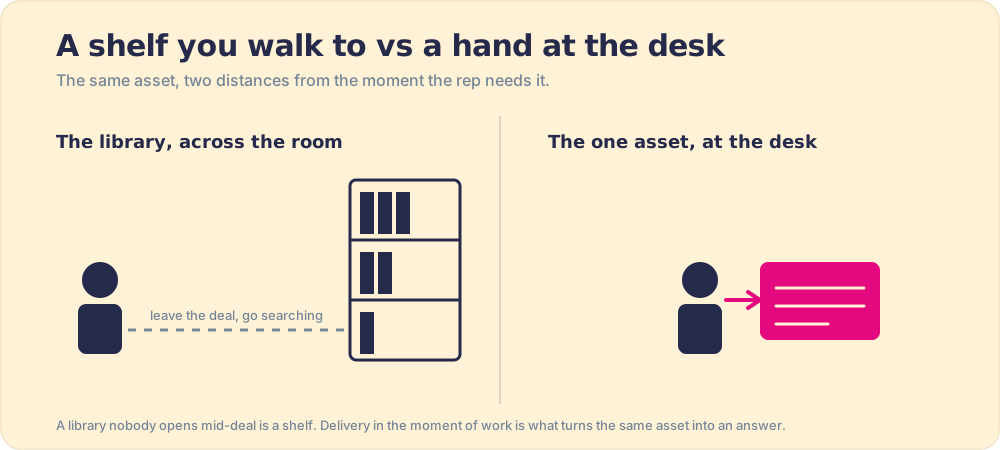
Think of it as a library across the room. A rep mid-deal is not going to stand up, walk to the far shelf, scan the spines, find the right binder, and walk back while the buyer waits on the line. They will use what is at the desk, which is usually nothing, or a half-remembered version of the deck from two quarters ago. The collateral on that shelf can be excellent. The distance is the problem.
What does a sales enablement content strategy usually get wrong?
It optimizes for the wrong number. Walk into most content reviews and the dashboard shows assets produced, assets refreshed this quarter, coverage by stage and persona. All production metrics. None of them tells you whether a single rep used a single asset on a single deal. A sales enablement content strategy built on those numbers is a publishing calendar wearing a strategy’s clothes, and it will keep growing the library while in-flow usage stays flat.
The convention runs the production loop: survey reps for gaps, build the missing assets, push them to the library, announce them in the team channel, measure how many shipped. The loop never closes, because the last step is an announcement, not a measurement of use. So the library swells, the maintenance burden compounds, and the assets age out faster than anyone can repaint them. More content, more staleness, more places a rep has to look, and no signal that any of it landed.
There is real evidence that the input itself moves numbers when it changes behavior rather than sitting in a folder. CSO Insights, the research arm now inside Korn Ferry, found that teams running data-backed, adaptive coaching post win rates roughly 28% higher than teams without it (cited via SEC). The lift does not come from owning the coaching material. It comes from the coaching happening, against real deals, reliably. Content is the same: the deck is the means, the behavior on the call is the cause, and a strategy that counts decks instead of behavior is measuring the means and ignoring the cause.
How do you make content for sales teams that actually gets used?
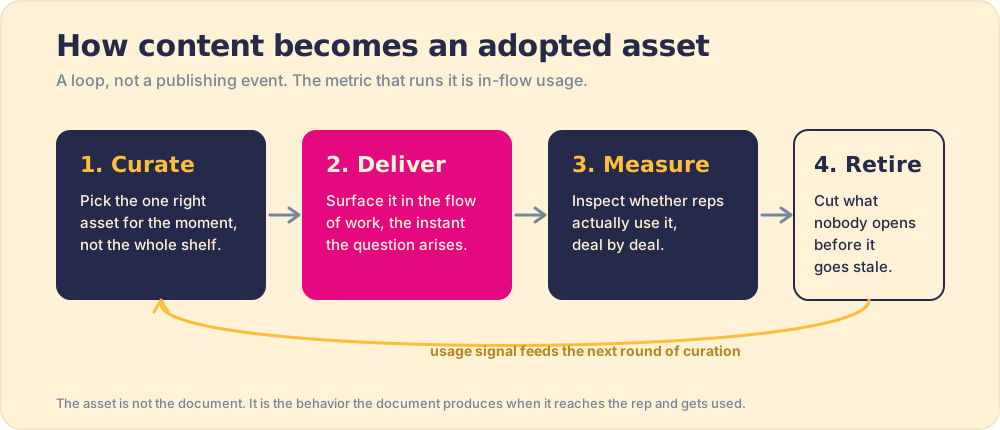
Start from the behavior you want on a real deal, then run a loop instead of a publishing schedule. The aim is not a bigger library. It is a smaller distance between the right asset and the moment the rep needs it, and a usage signal that tells you which assets earn their place.
- Curated content, not the whole shelf. Pick the one right asset for the moment, the case study that matches this buyer’s industry, the battlecard for the competitor in front of you. Too many places to look is dizzying; reps get more effective with a short, curated set tied to a clear next step.
- Delivery in the flow of the work. Surface the asset where the work already happens, inside the CRM and the tools reps live in, the instant the question arises, so reaching it is the path of least resistance instead of a tab switch. This closes the distance the shelf creates.
- Inspection, deal by deal. Track whether reps use the asset, not whether it shipped. You cannot ask “which content should we cut?” until you can answer “is this content being used?” Usage is the keystone metric, and it is the one most programs never capture.
- Retirement on a clock. Cut what reps stop opening before it goes stale and starts misleading. A library that only grows is a liability that only grows; pruning keeps the asset from depreciating into the file reps stop trusting.
Teams whose guidance reaches reps in the flow of work hit quota at 49 percent. Teams whose content lives in docs, wikis, and an LMS hit quota at 15 percent. Same content. The moment of delivery is the lever.
That contrast, from the State of Sales Enablement 2026, is the argument in two numbers. The same guidance, surfaced in the flow of work versus parked in a separate library, more than triples the share of reps hitting quota, 49% against 15% (State of Sales Enablement 2026). The variable is not which assets you built or how many. It is whether the asset reached the rep where the work was already happening. A content strategy assembled as a production calendar will keep failing that test, because it never measures the only thing that decides the outcome.
The moment of delivery carries that much weight because content is trying to change behavior, and friction governs behavior. An asset the rep can act on without leaving the deal gets used; an asset that costs a detour does not, regardless of how good it is. The mechanism is mundane, and it decides everything: reduce the cost of doing the right thing to near zero in the moment, and the right thing happens. Leave that cost in place, and the best collateral in the world stays on the shelf. The same shelf problem governs the broader internal knowledge base: storing knowledge was never the hard part, and delivering it in the moment is.
How do you measure whether sales enablement content is working?
Pick the number that predicts the future, not the one that is easy to report. Assets produced is easy and nearly meaningless, because it tracks an input. In-flow usage is harder to capture and it is the one that matters: how often the right asset reached the rep and got used on a real deal. Reporting that counts assets shipped is reporting a 2022 metric, back when getting the document made was the hard part. The hard part now is getting it used.
Inspection pays for itself here. In our survey, teams that consistently inspect deals against a defined process hit quota at 6.3 times the rate of teams that rarely do, the largest single effect we measured (State of Sales Enablement 2026). Inspection is what turns a content library from a pile of files into a system you can steer: it tells you which assets get pulled, which sit untouched, which to refresh, and which to retire. The catch is that manual inspection eats the time managers should spend coaching, which is why the inspection gets skipped and the library never gets pruned.
The payoff is not internal alone. Gartner has found that 77% of B2B buyers describe their most recent purchase as complex or difficult (Gartner). Content that reaches every rep at the right moment produces a consistent experience for every buyer, the right case study, the right answer, the right next step, in a market where buying already feels hard. The content program pays off with the buyer, well beyond internal tidiness. Get delivery right and the buyer feels it as a team that has its act together.
The product belongs here, after the mechanism is on the table. What closes the distance between the asset and the moment is the Behavior Layer: continuous, in-flow guidance that surfaces the right content and the next step where the rep already works, then measures whether it gets used.
What we recommend
A clear choice sits under the topic, and it is not about how good your assets are. You can run sales enablement content as a production program, build more, file it well, refresh it on a calendar, and accept the staleness and the unused library that come with it. Or you can run it as a delivery problem: curate the one right asset, get it to the rep in the flow of work, measure whether they use it, and retire what they do not.
The evidence favors the second, without hedging. The SEC’s 79.7% says capability filed away from the work goes untouched. The 25% to 40% of the day reps spend selling says you cannot afford to make them go searching. Korn Ferry’s 28% win-rate lift says the input pays only when it changes behavior. Our own data says content in the flow of work more than triples quota outcomes (49% against 15%), and that inspection is the largest single lever there is. Those four point one way: the assets are necessary, and they are not where the value is realized. The value is realized in the moment of work, when the right content reaches the rep and gets used.
So keep building the collateral, and stop scoring yourself on the count. Score yourself on usage, the one number that says the content became behavior. If you want the system that stores and serves the assets, start with sales content management software; if you are sorting where content fits among your other tools, the sales tech stack maps the layers; if you want to remove the manual work from surfacing and refreshing assets, read sales enablement automation; and if you want the system that makes the whole library produce behavior instead of surface area, start with the sales enablement software guide.
Frequently asked questions
What is sales enablement content?+
What are the main types of sales enablement content?+
Why does most sales enablement content go unused?+
How do you make sales enablement content that reps actually use?+
What is a sales enablement content strategy?+
Your process, running itself.