Sales Enablement Best Practices: Sort Them by What a Rep Actually Does
Most sales enablement best practices lists are a pile of inputs: align with marketing, build a content library, run onboarding, buy a tool. Here is the test that sorts the ones that move the number from the ones that just look busy.
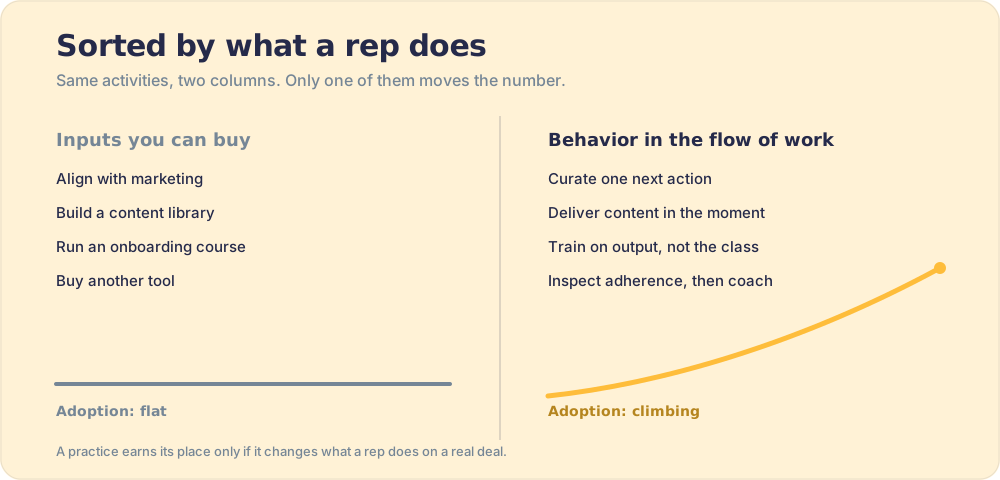
Sales enablement best practices are the recurring habits that improve seller performance, and the ones worth keeping share a single root: they make the right behavior the easy, inspected action in the flow of the rep's work.
Open almost any guide to sales enablement best practices and you get the same pile. Align with marketing. Build a content library. Run a structured onboarding. Pick the right tool. Map the buyer journey. Each one is reasonable, and a team could spend two years dutifully doing all of them and still watch the number sit exactly where it was. The reason is that the list is sorted wrong. It is sorted by inputs, by the things you can buy and build and check off, when the only thing that moves revenue is what a rep does on a real deal. So here is a sharper list, and a single test that sorts it: a practice earns its place only if it changes the behavior of a rep in the flow of the work, and the meta-practice underneath all of them is to inspect that behavior and coach it. Everything else is busywork that looks like progress.
That test is not a stylistic preference. It is what the data keeps showing. Knowledge is solved now: any rep can find the doc, and an AI can summarize it in seconds. What a rep does with three tabs open on a slipping deal is the unsolved problem, and most best-practice lists never touch it.
What are sales enablement best practices, really?
Strip the jargon and a best practice is a habit a team repeats because it tends to make sellers better. Sales enablement best practices are the recurring habits that improve seller performance, and the ones worth keeping share a single root: they make the right behavior the easy, inspected action in the flow of the rep’s work. That definition does real work, because it draws a line through the usual list. On one side sit the practices that change what a rep does in the moment. On the other sit the practices that add a thing to the pile and hope behavior follows. A content library nobody opens mid-deal is on the second side. So is a tool whose features go untouched.
A workshop makes the line easy to see. You can judge it by the tools hung on the wall, every category filled, pegboard gleaming, or you can judge it by whether the right tool is in the craftsman’s hand at the moment of the cut. The first is an inventory. The second is the work. Most enablement programs are scored as inventories, which is why they pass every audit and miss every number. The two readings split every practice on the usual list:
- Inventory practices. A bigger content library, another tool, a longer onboarding. You can buy them, build them, and check them off, and none of them guarantees a rep behaves differently.
- Work practices. The right next action curated and delivered in the moment, inspected, and coached. These are harder to point at in a procurement review, and they are the only ones that change the number.
The cost of getting this wrong is not hypothetical. The Sales Enablement Collective’s 2025 Impact of Enablement report found that 79.7% of enablement leaders say their reps leave at least 40% of a stand-alone tool’s features untouched (SEC). Four out of five teams are paying for capability the people it was bought for never use. The inventory model fails in plain sight: the box is checked, and the behavior never arrives.
How do you tell a real best practice from busywork?
By asking one question of every item: would a rep on a real deal behave differently because of it? Run the standard list through that filter and most entries change shape. Here are the seven that survive, each named in its common form, where it goes wrong, the version that holds up, and the conviction underneath it.
1. Curate the next action, do not align for alignment’s sake
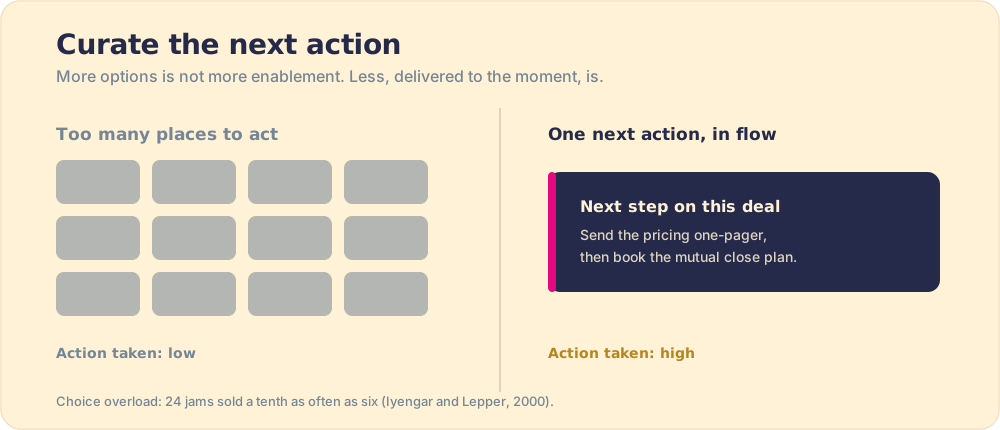
The advice you always hear is align sales and marketing. It is not wrong, but it is usually pursued as an end in itself: shared dashboards, joint planning, a service-level agreement on lead handoff, and a quarterly meeting where everyone nods. None of that reaches the rep. Alignment only matters at the point where it shows up as a single, clear next action in front of a seller who has a deal in motion and a decision to make.
The mechanism is attention. Reps do not get more effective when you hand them more, they get more effective when you hand them less, curated to the moment. Behavioral science has a name for the failure mode: choice overload. In Sheena Iyengar and Mark Lepper’s classic study, shoppers offered 24 jams were a tenth as likely to buy as those offered six (Iyengar and Lepper, 2000). More options, less action. A rep facing six tabs of “aligned” content and three competing plays is that shopper. The best practice is not more alignment. It is curating the one next action the alignment was supposed to produce, and putting it where the rep is already working. This is tenet five: too many places to act is dizzying, and a short, curated set tied to a clear expectation is what makes a rep effective.
2. Deliver content in the moment, do not just build the library
Every list says build a content library, and most teams do, ending with hundreds of approved assets in a platform with a search bar. The trouble is that a search bar is a destination, and a rep under pressure on a live call does not go to a destination. The asset exists. It does not arrive. Sellers already spend only about 25% to 40% of their working time actually selling, the SEC reports, with the rest lost to prep, admin, and hunting for information (SEC). A library that demands its own search adds to the hunt instead of ending it.
The best practice is not more content. It is the right content reaching the rep at the instant the question arises, inside the tool where the deal already lives. Tenet seven states it plainly: any time a rep has to go somewhere else to get what they need, that is a failure. The library is not the asset. The delivery is.
3. Train on output, not on the input of a class
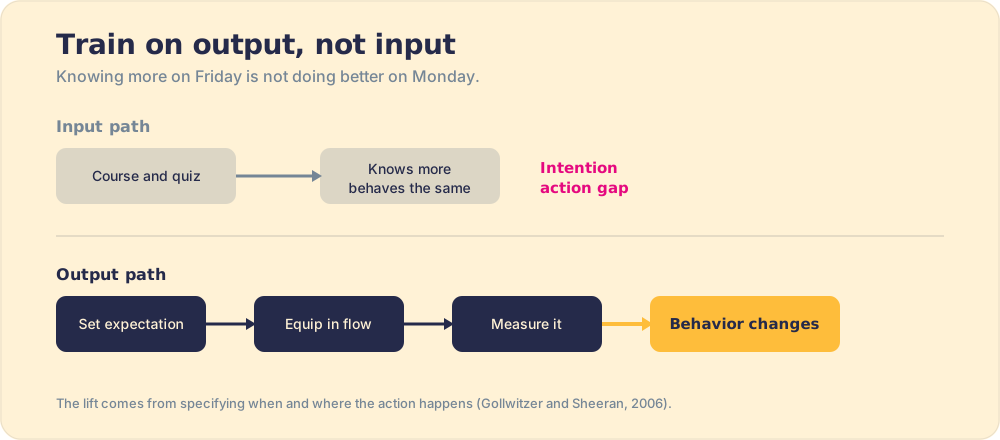
Onboarding is on every list, and it is almost always built as information transfer: weeks of slides, a product certification, a quiz, a graduation. The reps know more on Friday than they did on Monday. Then they get on a call and do what they always did, because knowing better is not doing better. The intention-action gap is one of the most replicated findings in psychology: Peter Gollwitzer’s meta-analysis of 94 studies covering more than 8,000 participants found that simply forming a goal moves behavior far less than people expect, and that the lift comes from specifying exactly when, where, and how the action will happen (Gollwitzer and Sheeran, 2006).
The case against classroom-first enablement rests on that finding. The fix is to train against output: set a specific expectation for what the rep should do on a real deal, then equip and measure against it in the flow of the work, where Gollwitzer’s “when and where” is built into the moment. This is tenet four. Set the expectation, measure against it, and treat the class as the weak lever it is.
4. Meet reps where they work, do not buy another tool
“Pick the right tool” is the practice every vendor loves, because it ends in a purchase. The vendor map is also shifting under buyers: Seismic completed its merger with Highspot in August 2026, combining the two largest content platforms (Seismic). But a new tool is a new place to go, a new tab, a new login, and the more places there are to act, the less likely the right action happens. This is the structural reason behind that 79.7% of untouched features: capability that lives away from the work does not get adopted, because adopting it means leaving the flow of the deal.
The best practice is not buying the tool with the most features. It is choosing the one that surfaces inside the systems reps already live in, the CRM, the inbox, the dialer, the call, and never asks them to go somewhere new or to abandon the CRM. Tenet fourteen: enablement that asks a rep to visit a new destination has already lost. Weigh integration with the existing workflow above the feature matrix, and pilot for whether reps change behavior rather than whether the demo dazzled.
5. Capture the motion your best reps already run
Most programs import a process: a consultant’s template, a methodology bought off the shelf, a framework nobody in the room believes. It does not stick, because it was never theirs. Meanwhile, the motion that actually wins is already running, on the laptops of your top two reps, undocumented and invisible. Gartner found that 77% of B2B buyers describe their most recent purchase as complex or difficult (Gartner), and the reps who consistently win are the ones who have worked out how to make that hard experience feel easy for the buyer.
The best practice is to capture that motion and make it the standard, not to invent a new one. Tenet seventeen: the best process already lives in your best reps, so the job is to spread it, from your best rep to every rep. This is also a sales enablement strategy best practices point that most “tips” lists miss entirely, because copying a winner is humble work, and buying a framework feels like leadership. The framework you bought is a stranger’s map. Your best rep’s motion is the trail people already walk.
6. Inspect adherence, because it is the prerequisite to every other answer
The sixth practice rarely appears on best-practice lists, and it matters most. Before you can ask “what should we change about the process?” you have to answer “is the process being followed at all?” Without that, every other decision is a guess. You cannot say a play does not work if you never confirmed it was run. Adherence is the hidden lever: not because consistency is a virtue, but because it is the only thing that makes the rest of your data mean anything.
The numbers are stark. In the State of Sales Enablement 2026, teams that consistently inspect deals against a defined process hit quota at 6.3 times the rate of teams that rarely do, the largest single effect we measured (State of Sales Enablement 2026). And the delivery of guidance splits the field again: teams whose guidance is embedded in the flow of work hit quota at 49%, against 15% for teams whose guidance lives in docs and a separate tool. Same content. The difference is whether the right step reached the rep where the work was happening, and whether anyone checked.
Teams that consistently inspect deals against a defined process hit quota at 6.3 times the rate of teams that rarely do. Inspection is not bureaucracy. It is the prerequisite to every other answer you want from your sales data.
Blame usually lands at this point. When reps do not follow the process, the instinct is to call them undisciplined and add an accountability meeting. That is the wrong diagnosis. Non-adherence is a system failure, caused by friction, late delivery, and missing inspection, not by lazy reps. The fix is always to make the right action easy and visible in the moment, never to blame the person. Tenet fifteen says as much, and it is why the fix is tooling rather than a sterner email.
7. Automate the inspection burden so managers can coach
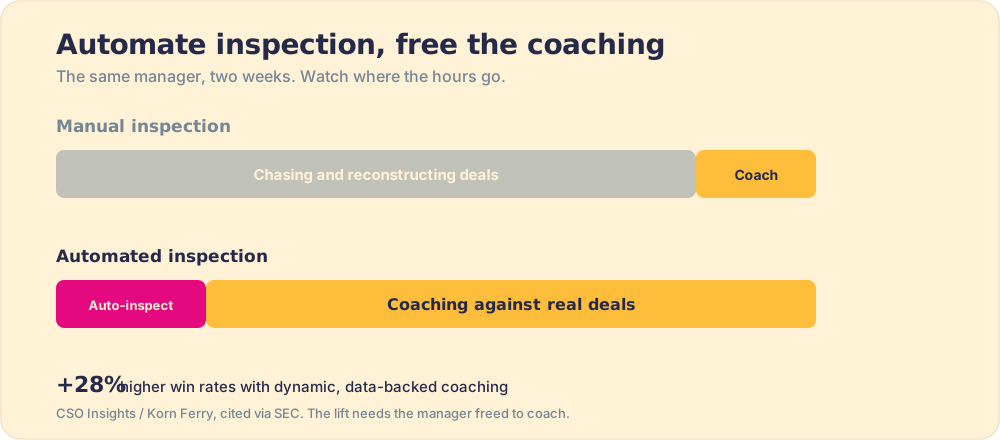
The objection to practice six is fair, and you should say it out loud: inspection sounds like surveillance, and the manager who inspects every deal by hand has no hours left to coach. Both halves are true, and that is exactly the problem to solve, not a reason to skip inspection. The win is not choosing between inspecting and coaching. It is automating the inspection so the human time goes to coaching.
The payoff is measurable. CSO Insights, the research arm now inside Korn Ferry, found that teams running dynamic, data-backed coaching post win rates roughly 28% higher than teams without it (cited via SEC). The lift does not come from owning a coaching tool. It comes from coaching reliably happening against real deals, which only becomes possible once the manager is freed from manual chasing. Tenet eleven: inspection is mandatory, and the move is to lift its burden off the manager so the coaching can occur.
What does this list look like all at once?
The seven practices are not independent tips you can pick from. They form one chain, sorted by the same test, and seeing them together is the point.
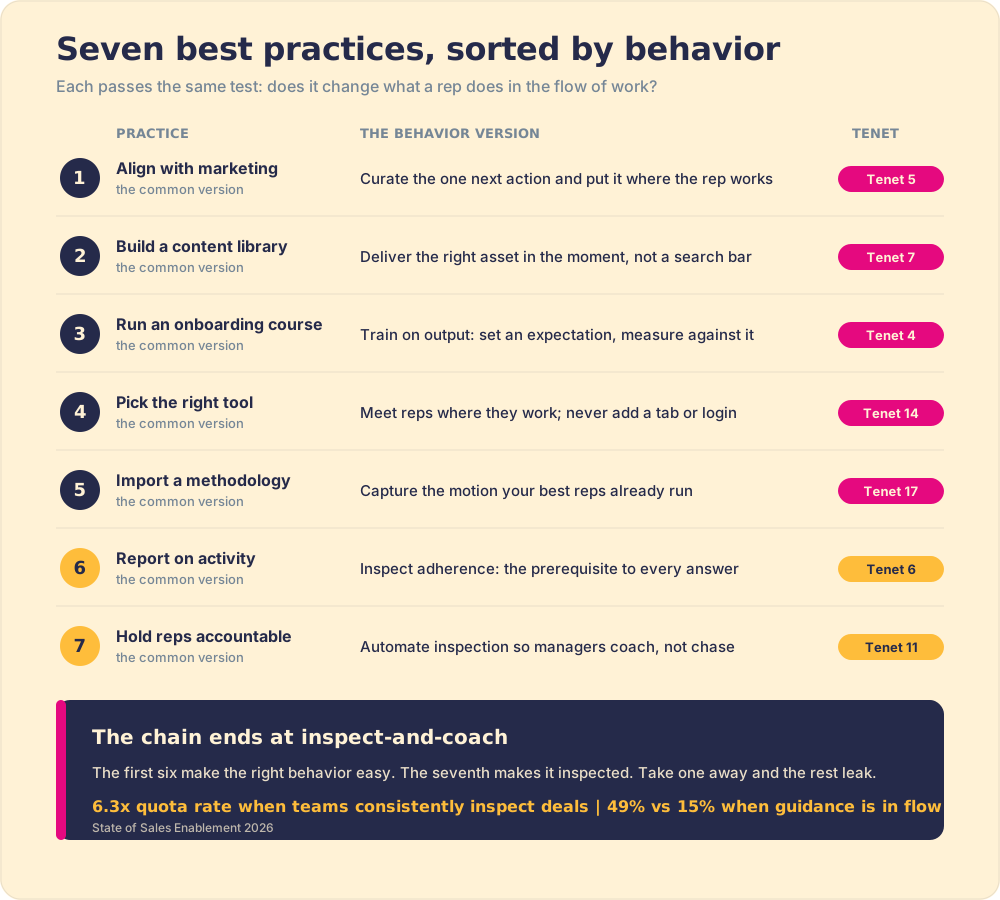
Read top to bottom, the chain has a logic. You capture the motion your best reps run, curate it to a single next action, deliver that action in the moment instead of in a library, choose tools that surface where reps already work, train against the output rather than the input of a class, and then inspect adherence and coach the gaps. The first six make the right behavior easy. The seventh makes it inspected. Take any one away and the others leak.
That ordering is the difference between a list of sales enablement tips and a real strategy. A tips list treats each item as additive: buy more, build more, train more, and hope the sum is performance. A strategy sequences the same items around one root cause, the behavior of the rep in the moment, and tests each against whether it changes that behavior. Same words on the page. Completely different result, because the order and the test are doing the work the words alone never could. If you want the deeper version of why the gap between knowing and doing decides the number, the sales execution gap lays it out, and the sales enablement maturity model shows where most teams sit on this curve.
How should sales enablement use AI in 2026?
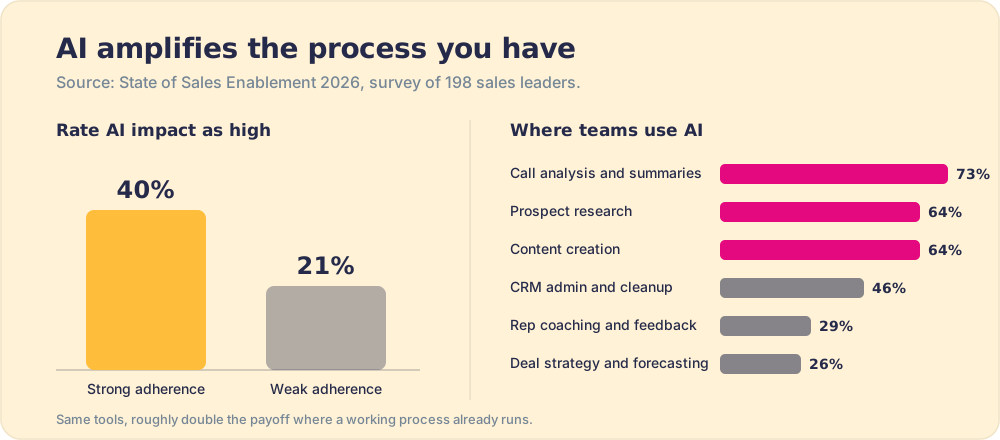
Sequence it behind an adopted process, and judge it on whether it follows that process. AI in sales enablement is now ordinary: in the State of Sales Enablement 2026, the most common uses were call analysis and summaries (73% of respondents), prospect research (64%), content creation (64%), and CRM admin and cleanup (46%), while rep coaching (29%) and deal strategy and forecasting (26%) trailed (State of Sales Enablement 2026). The average self-reported impact was 3.2 out of 5, real and modest.
The split underneath that average is the useful finding. Among teams with strong process adherence, 40% rated AI’s impact as high. Among teams with weak adherence, 21% did. Same tools, roughly double the payoff, and the difference is whether there was a working process for the AI to accelerate. An AI that drafts follow-ups for a team with no agreed follow-up standard produces more emails, faster, in fifteen different styles. An AI working from a written standard produces the standard, at volume.
Three AI best practices follow from that data:
- Rules before prompts. Write the expectations (what a qualified deal has, what follows a discovery call, which fields must be complete by which stage) as short, checkable rules. An AI assistant, whether it is Claude, ChatGPT, or the agent inside your CRM, can read and apply a rule. It cannot read the instinct in your best rep’s head.
- AI on the admin the rules imply. Point AI at the work the rules generate, the recap email, the missing close date, the overdue task, which is where the 46% CRM-admin use already sits. That frees rep time without letting the AI improvise the motion.
- Inspection of the AI itself. Check AI output against the same rules you check reps against. If the AI drafts a recap that skips the next step your process requires, it is off-process in the same way a rep would be, and you need to see it deal by deal.
How do you roll out sales enablement best practices in the first 90 days?
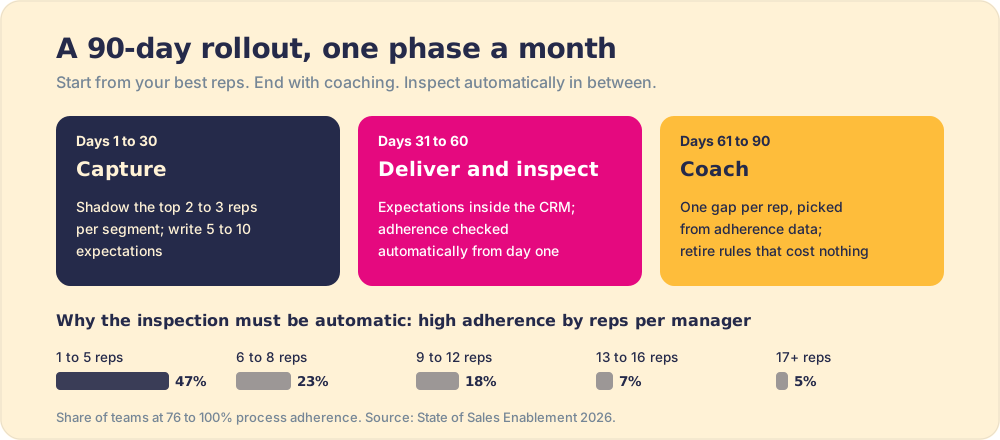
In the same order as the chain above, one phase a month, starting from your best reps and ending with coaching. A 90-day rollout fits most mid-market teams:
- Days 1 to 30, capture. Interview and shadow your top two or three reps per segment (inside and field run different motions, so capture both). Write what they do as five to ten expectations a rep can see and a manager can check.
- Days 31 to 60, deliver and inspect. Put those expectations inside the CRM and the tools reps already use, so the next step appears at the moment of the work. Switch on automatic adherence checks against them from day one, before anyone asks for a report.
- Days 61 to 90, coach. Use the adherence data to pick one gap per rep and coach it in one-on-ones. Retire any expectation that adherence data shows reps skip without any cost to win rates.
The phase that breaks distributed and fast-growing teams is the second, because manual inspection does not scale with headcount. SOSE 2026 found that 47% of teams with one to five reps per manager reach 76 to 100% adherence, against 23% at six to eight reps per manager and 5% at seventeen or more. A plan that depends on managers inspecting by hand will hold for a small inside team and fail for a field team spread across regions, which is why the inspection has to run automatically for the rollout to survive.
Where this leaves you, and what we would do
You have two ways to run enablement. The first is the inventory model: keep adding inputs, a richer library, another tool, a longer onboarding, and judge the program by what you built. It is the model most best-practice lists assume without saying so, and it is why 79.7% of tool features sit untouched while the number does not move. The second is the behavior model: capture the winning motion, curate it to the next action, deliver it in the flow of the work, and inspect adherence so you can coach. Run the behavior model. The 6.3x inspection effect and the 49% against 15% delivery split come from our own survey of 198 sales leaders, the 28% coaching lift from CSO Insights, and the 40% against 21% AI split from the same SOSE data, and each one measures behavior in the moment of the work. Inspection is how you pull that lever, and AI is how you keep pulling it as the team grows.
Doing this in practice means the guidance has to reach the rep where the work already happens, and someone has to be able to see whether it was followed. The Behavior Layer does that job, continuous, in-flow enablement that surfaces the next right action inside the rep’s existing tools and measures adherence deal by deal, so managers spend their time coaching instead of chasing.
The test of any practice on this page is small and uncomfortable: watch a rep in the middle of a real call and ask whether your enablement reached them. If you want the system view of how these practices fit into the tools that serve them, the sales enablement software guide is the place to go next, and if you are still assembling the toolset, the best sales enablement tools ranks them by the job they do.
Frequently asked questions
What are sales enablement best practices?+
What is the single most important sales enablement best practice?+
Why do most sales enablement best practices fail?+
How do you measure sales enablement best practices?+
How should sales enablement use AI in 2026?+
How do you roll out sales enablement best practices across inside and field teams?+
How does sales enablement strategy differ from a list of tips?+
Your process, running itself.