AI Sales Role Play: Peter Roccaforte on Rehearsal, Lazy Bots and Two Enablement Fads
Peter Roccaforte started as a professional actor and now runs sales enablement and coaching. He thinks role play is the most useful tool a rep has, most AI sales role play is too eager to please, and two popular habits in enablement are fads.
AI sales role play is practice in which a rep rehearses a sales conversation with an AI playing the buyer, and it is only as useful as that buyer is realistic: guarded at first, and opening up only when the rep earns it.
Peter Roccaforte was a professional actor when he saw an ad for people to run live infomercials in stores like BJ’s Wholesale Club and Sam’s Club. “Oh, I could do that,” he thought. He spent the first half of his career in retail, then started over at the bottom in software. Today he runs sales enablement and coaching at HiveMQ.
When Caleb King asked him on Enablement for Real what is working in enablement right now, Peter’s answer was role play. He also had a hot take on AI sales role play, where a rep rehearses with a bot playing the buyer: most of those bots, he said, are too generic to teach a rep much.
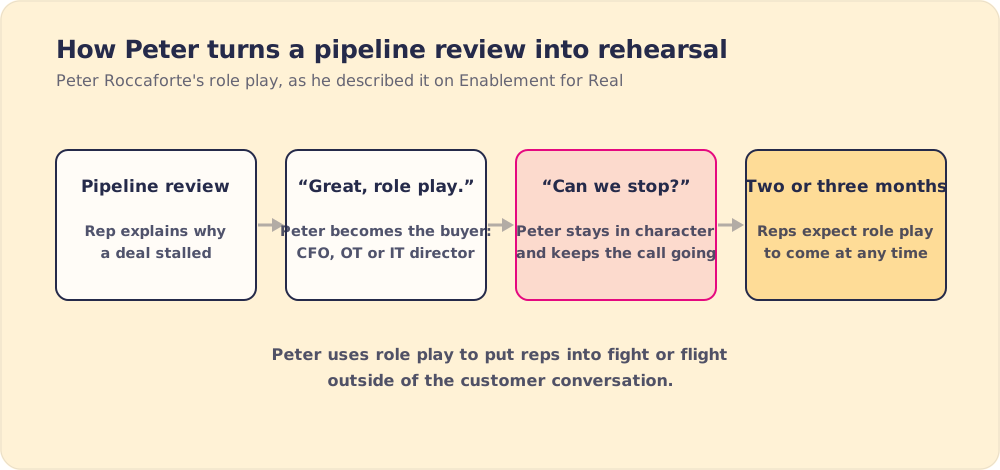
On small teams Peter has been a rep’s coach and manager at once, so pipeline reviews turn into rehearsals without warning. A rep explains why a deal stalled, and Peter says, “Great, role play. Now we’re in the conversation.”
He knows revenue is “the answer I’m supposed to give.” He measures his work by whether reps say they grew as people. “When reps are signaling that they’re growing personally from the work that we do, that is when I know that it’s been a success,” he said. Caleb gave the other answer: “the answer to this question is well, we close more deals at more money.”
Why does Peter Roccaforte think role play is still what’s real?
Peter expected the answer to be unpopular. He said “role play done well, and I say that very like I put a lot of emphasis on done well, is one of the most powerful tools that you can give a rep.”
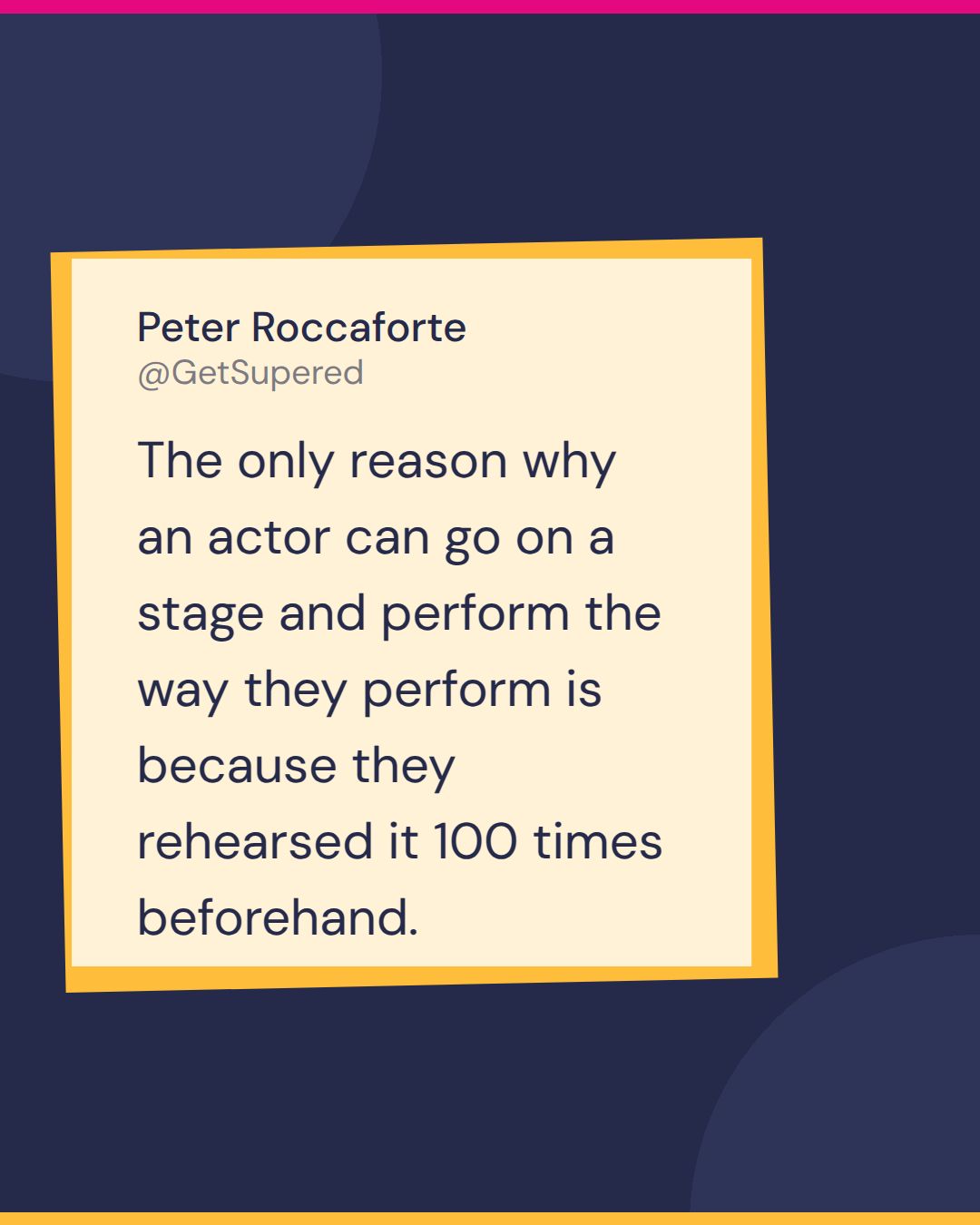
His case comes from the stage. Meryl Streep and Tom Hanks, “they’re some of the most talented actors in the world, and they still go to rehearsal.” Tom Brady still went to practice. Companies put six- and seven-figure deals in a rep’s hands and say, “Hey, just wing it, man. Like you’ll figure it out.”
Peter’s reason is the pressure of a live call. A rep walks in carrying the quota, the commission their family counts on, and the worry of letting the team down. With that much riding on one conversation, Peter said, “it is so easy to go into fight or flight.” So he uses role play “to force reps into fight or flight scenarios outside of the customer conversation.”
Reps hate it at first. When one asked to stop, Peter stayed in character: “Can we stop? What are we stopping? I thought you were showing me your product.” After two or three months, reps accept that “role plays can come basically whenever,” while Peter hops between characters, from Susie the CFO to Jimmy the OT director who only cares about the plant floor.
A 1996 meta-analysis by Saunders, Driskell and colleagues in the Journal of Occupational Health Psychology pooled 37 studies and 1,837 participants. It found that stress inoculation training, which prepares people to perform under pressure, reduced performance anxiety and improved performance under stress (Saunders et al., 1996). Our guide to sales role play covers how a manager runs the drill.
Why do most AI sales role play tools fall flat?
Caleb asked for quick thoughts on AI role play. Peter is building one: “I am low-key working on an AI roleplay plugin in Claude right now that would be customizable for companies.”
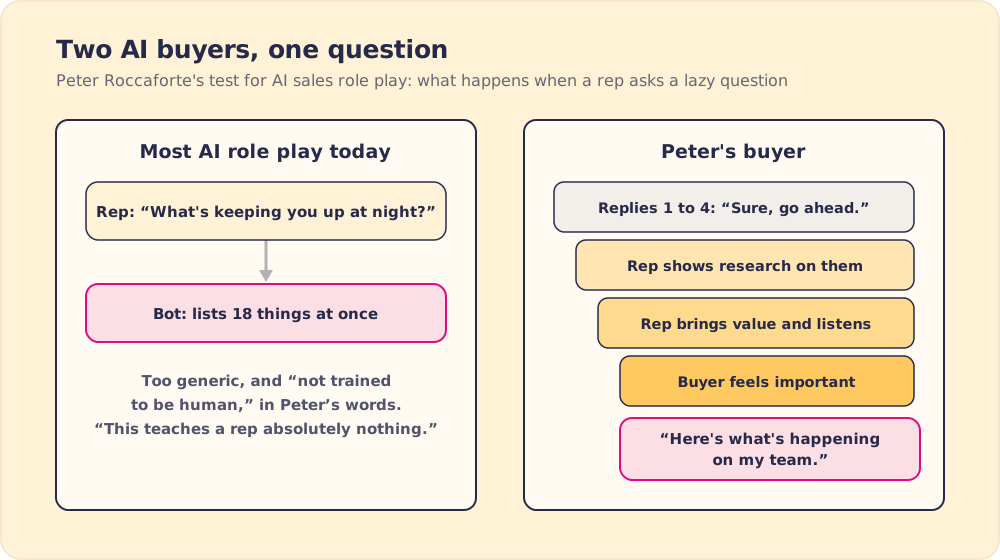
His complaint about most tools on the market is that they are “too generic” and “not trained to be human.” Even at large vendors with years of recorded calls, “you can just tell that whatever’s on the back end is lazy. Like the prompting is lazy.”
He described trying one. He asked the AI buyer what was keeping her up at night, a question he considers lazy, and got this back: “Let me tell you the 18 things that are keeping me up at night.” “This teaches a rep absolutely nothing,” he said. In his view a good rep should not be asking that question at all. “These things can get gamed,” Peter said. They “tell you whatever you want to hear,” and “they don’t think and act like humans.”
OpenAI found the same eagerness in its own model. In April 2025 it rolled back a GPT-4o update that had become “overly flattering or agreeable,” after the company focused too much on short-term user feedback (OpenAI).
Caleb added requests for Peter’s build. He asked him to “make sure to only give one-word answers,” keep the camera off, and “have them interrupt you and say, ‘Get to the point.’” Peter agreed to all of it.
What makes AI sales role play worth a rep’s time?
Our post on AI sales training weighs the software on the market. Peter’s test is quicker, and it works on any tool, bought or built. Ask the AI buyer a lazy question and see what comes back.
His own design starts guarded. “The first four answers that you get from this thing is like sure go ahead,” he said. The buyer opens up only as the rep shows research on them, offers value, listens, and makes them feel important. “Because guess what? That’s how humans are.”
The other half of his design is custom material. His plugin takes a company’s own buyer personas, ideal customer profile, value propositions and product messaging, so a rep rehearses against the buyer they will meet on their next call. Taylor, Russ-Eft and Chan’s 2005 meta-analysis of 117 behavior modeling studies in the Journal of Applied Psychology found skills transferred to the job best when trainees practiced scenarios they helped generate, and when supervisors were trained too (ERIC).
Before buying or building, check for four things:
- A guarded buyer. Short answers until the rep earns more, including one-word replies and interruptions.
- Your own buyers. Personas, ICP and messaging from your deals, loaded in, so reps practice against the buyers they sell to.
- A rep who opens with a hypothesis. Peter credits Anthony Iannarino, author of The Lost Art of Closing, with the better opener: “my hypothesis is this is probably keeping you up tonight. And I just want to know how far off I am because I’m here to help.”
- A manager who still runs the live version. AI adds practice between sessions, and our piece on AI sales coaching covers where the manager’s hour goes.
Why Peter calls AI-generated prospecting messaging a fad
Peter’s first fad was AI-written prospecting messages. In the dream he described, a rep connects Clay to Claude, pipes it into the sequencing tool, lets the model research every LinkedIn profile, and never thinks about prospecting again. As for the posts claiming a whole go-to-market team can run on Claude with no humans, “this is such nonsense,” he said.
He tied it to what makes selling human. “There is a science to sales but sales is an art form,” he said. Managers leave a closer alone. “It’s only when you stop closing deals that people want to add the science to it.”
In Gartner’s survey of 632 B2B buyers, 73% said they actively avoid suppliers who send irrelevant outreach (Gartner, June 2025). Our post on AI sales outreach covers why more messages rarely mean more meetings.
Does a small sales team need a named sales methodology?
Peter’s second fad, the one he thought might get him cancelled, is the rush to declare a methodology. Teams treat MEDDPICC, Command of the Message, Challenger or Sandler “like it’s a Game of Thrones house,” he said, and he has worked at a company that announced it ran on BANT. He told them “bant is like what we did in 1990.”
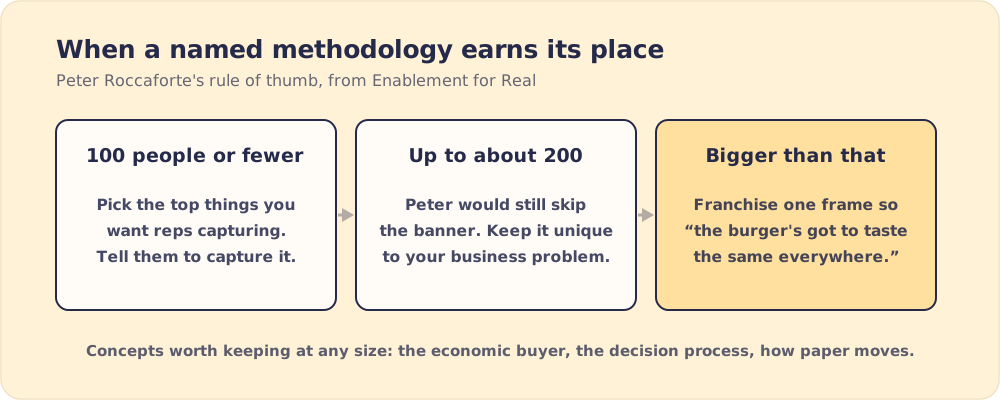
He is not against the ideas inside them. “I don’t want to discredit the concepts that are in all of these different methodologies.” Caleb pressed him, arguing the frameworks exist to help a rep qualify a deal or walk away. Peter agreed that a rep new to enterprise sales needs to know the economic buyer, the decision process and how paper moves. “We don’t have to carry banners around about it in every single company and be like it’s this or bust.”
Instead, he said, “we need to figure out what are the top things that we want our reps capturing. And then we need to tell them to capture it.” He sees a named framework earning its place at scale, when the goal is a franchise and “the burger’s got to taste the same everywhere.” Below that, “that’s not a problem for a company that’s 100 or less. I would even argue it’s not a problem for a company that’s 200 or less.”
In The State of Sales Enablement 2026, the gap between teams that define a process and teams whose reps follow it was a stronger predictor of quota than methodology choice (The State of Sales Enablement 2026). If you do pick one, our sales methodologies guide compares them against that test.
What is Peter betting on next?
Peter’s bet is on AI-native go-to-market operations platforms that pull call recordings, notes and deal progress into one place, so a rep confirms a stage move instead of typing it. Among the old complaints it could ease is “the Salesforce hygiene problem. I can’t get reps to fill out any of their notes.” He kept the hope modest. “I’m not saying that AI is the robot god that’s gonna, you know, save the world,” he said. “I’m just saying that they get iced over a little bit, man.”
Caleb noted the overlap with our work at Supered, and said he never wants Supered to be a product that only fills in fields for reps.
What Peter Roccaforte wants enablement leaders to take away
- Role play under pressure. Peter forces reps into fight-or-flight moments in practice and stays in character when they ask to stop.
- A guarded AI buyer. Most AI sales role play is too generic and too eager, like the bot that listed 18 worries. A useful one keeps its first four answers short.
- Custom scenarios. Your own personas, ICP and messaging, which the 117-study meta-analysis suggests will transfer to the job better.
- Fewer banners. Under roughly 100 to 200 people, pick the few things reps must capture and tell them to capture them.
- Human prospecting. Peter calls hands-off AI messaging a fad, and 73% of buyers in Gartner’s survey avoid suppliers who send irrelevant outreach.
How would Peter have you use AI role play?
Keep the live role play Peter describes, with a manager playing a difficult buyer and staying in character when the rep asks to stop. Put any AI tool through the lazy-question test before reps use it: if the bot rewards “what’s keeping you up at night?” with a full list, it will train the habit you are trying to break. Then write down the short list of things reps must capture on each deal, and check that they do.
Frequently asked questions
What is AI sales role play?+
Does AI sales role play work?+
How do you make AI role play realistic?+
Is AI role play better than role play with a manager?+
Can AI role play help with sales call nerves?+
Your process, running itself.
Turn the playbook into rep behavior.
More from Enablement for Real

Sales Enablement Myths: Adobe's William Libert on the AI Content Reps Never Read
William Libert
RevOps Best Practices: Hope Edmiston on Bolt-On AI and the Classics That Still Work
Hope Edmiston