RevOps Best Practices: Hope Edmiston on Bolt-On AI and the Classics That Still Work
Hope Edmiston has spent close to a decade building enablement and RevOps inside startups. She calls bolt-on AI a fad, still watches her reps' calls, and asks every leader for their top three priorities.
RevOps best practices are the habits that keep a go-to-market team's systems, data and priorities pointed at revenue; for Hope Edmiston that means handing AI unified context, watching reps' calls every week, and knowing each leader's top three pains.
Hope Edmiston spent a year carrying a bag. She is competitive and liked seeing her name at the top of the leaderboard, but she spent her mornings and evenings building systems. She talked her way into an admin license for HubSpot, built dashboards and sequences, and redesigned the handoff from sales to customer success. “Hey, this is actually a job that I could go do,” she remembers thinking.
Close to a decade later, she is two months into being the founding go-to-market enablement hire at Oracel, an AI-native go-to-market operating system. She walked Caleb King through her RevOps best practices on Enablement for Real, and named the AI habit she does not expect to last. Her lens, she warned, is scrappy. The biggest company she has worked for had 150 people.
Why would a startup hire enablement instead of an 11th rep?
Before sales, Hope spent five years running B2B marketing events for CISOs and CMOs. Then, she said, “I got too selfish to keep being a seller.” She wanted a hand in the decisions “that affect every single seller.”
So when Caleb asked how she defines success, she started with a question she asks herself. Why did this startup hire her “and not an 11th person carrying a bag?” Her answer is that one good enablement person should pull the levers that make all ten sellers, and the whole revenue team, far more successful than one more quota carrier would.
She does not use win rate as proof. “I think I can say, you know, in the last quarter, our win rate went up 5%. But you know what else is we changed about 16 different things that would affect that and it’s probably not the three sales trainings that I let.” Her leading indicators are plainer. She can name the top three pains of any go-to-market leader. She watches reps’ calls. Teams pull her into cross-functional projects, and reps bring her problems they cannot solve instead of decks that need updating.
Where does enablement end and RevOps begin?
At the companies Hope has worked for, the two jobs overlap. “If you don’t have alignment, then why bother?” she said. “I’ve done a lot of rev ops in my time,” she added, “because again, that’s the highest priority or the biggest lever I can pull to help reps in that moment.” Caleb said he hears that often from people at companies under about 500 employees. Our comparison of sales enablement and sales operations draws the line for larger teams.
Why does Hope Edmiston call bolt-on AI a fad?
Caleb asked for a fad, and Hope answered right away. “I’m going to call it like bolt-on AI.”
On the teams she talks to, someone has Claude or ChatGPT. Sometimes a rep spends two hours a day building infrastructure for themselves. More often RevOps or enablement connects the model to a fragmented stack through APIs or MCPs, and teams are “bolting on these agents and models over the top of these point solutions and calling it like connected insights.”
She does not expect it to last. “AI is only as good as the data it has access to. But it’s also only as good as how it understands what data is available and what data means in context with each other.”
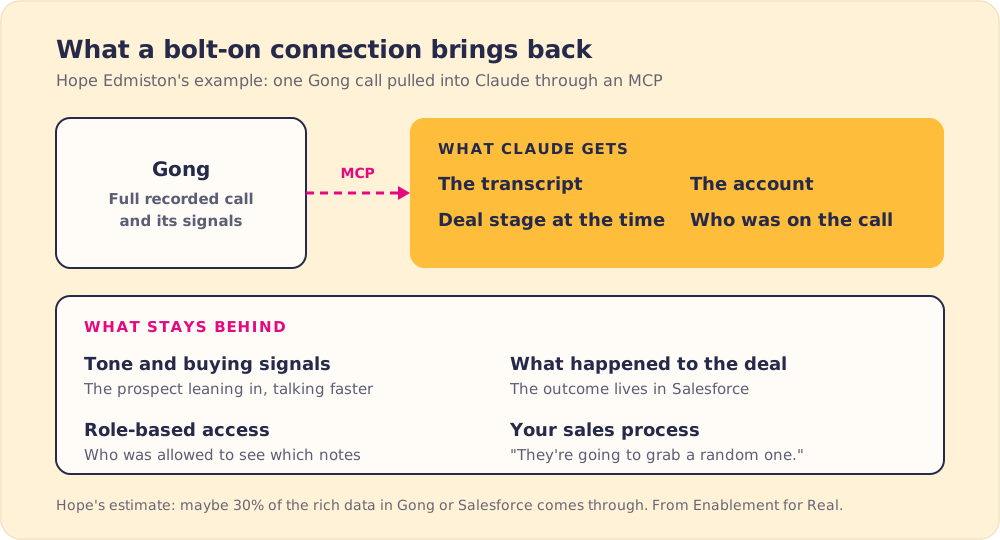
She used Gong as the example. Gong holds full recordings, so if a prospect leans in at the end of a meeting and their voice speeds up, a rep can hear it. Pull the call into Claude and “you’re getting a transcript.” And “that’s pretty much it, right?” You also get the stage the deal was in at the time, the account and the people on the call. What happened to the deal afterward lives in Salesforce, so someone has to stitch the context back together by hand. In her words, teams are “trying to claw their way to some big beautiful unified brain.”
Caleb raised the popular answer, a headless setup where reps never log into their tools, “except they have to log into Claude, which is still a login.” He called it “a version of Frankensteining,” and Hope agreed. You can prompt your way to good data, she said, “but it’s maybe 30% of the rich data you would have access to in that database for a gong or for a Salesforce.”
Then come the questions teams hit next. When does managing the Claude setup become someone’s full-time job? What happens to role-based access, where a VP could see his own call notes and reps could not? The model also gathers context again on each request, and “it basically has amnesia.” And “they don’t know our sales process. They’re going to grab a random one.”
Vendors are building those connections. Gong added MCP support in October 2025 so outside AI agents can query its data (Gong). MIT’s 2025 study of generative AI pilots, based on 150 interviews, a survey of 350 employees and 300 public deployments, found about 5% reached rapid revenue acceleration. The researchers pointed to generic tools that “don’t learn from or adapt to workflows,” and found internal builds succeed about a third as often as purchased tools (Fortune). Our post on knowledge silos covers why connecting the silos is only a first step.
Why does Hope still watch her reps’ calls when AI scores them?
Asked what is working, Hope named “the classics.” After her team’s first calls she gets an email with a scorecard and coaching tips, marked with red, yellow and green emojis. “I love it,” she said. “But they don’t do the call justice.”
The summary leaves out what she watches for: “the nitty-gritty weird objections or where a prospect’s eyes glaze over or the awkward silences where the rep kind of stumbles.” Her advice is to watch reps’ calls about three times a week. “Make it your coffee ritual.”
In The State of Sales Enablement 2026, 73% of teams use AI for call analysis and summaries, while 29% use it for rep coaching and feedback (The State of Sales Enablement 2026). Our guide to AI sales coaching covers where each one helps.
How does Hope Edmiston find her leaders’ top three priorities?
Her second classic is knowing the top three pains and priorities of each leader she supports. Some teams push back that they lack the time, or that it is not their job. “I’m not saying you’re contractually obligated to do anything about it,” Hope said, but it is “such valuable information to have.”
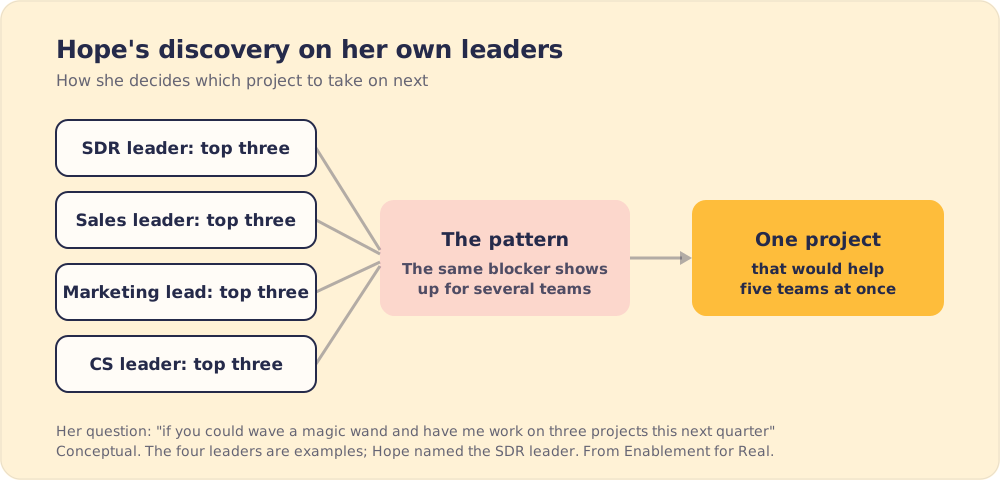
“I think of my job as very sales adjacent and that includes like being good at discovery,” she said. So she runs discovery on her own leaders. She will ask an SDR leader “if you could wave a magic wand and have me work on three projects this next quarter,” or what the top three blockers in the team’s way are. Then she looks for patterns. “Oh man, this one thing would affect five teams right now and really speed up our cycle times or simplify.”
Caleb said stakeholder management keeps coming up on the show as one of the most important skills in enablement, because without a sales leader’s support there is “no oomph” behind the work. He compared it to his own deals, where a customer might name several problems. “They might list three things and we solve the top one.”
Hope uses what she learns in the room. In a meeting with three teams, she can open by explaining that marketing wants a video case study and is blocked until a customer finishes onboarding. “It’s almost like I’m stakeholder manipulation. It’s not. It’s in a good way, but I know what they care about.”
What RevOps best practices does Hope Edmiston rely on?
Hope has done both the enablement job and the RevOps job. These are the practices she named in the episode.
- Unified data with its context. Hand AI the outcome, the access rules and your sales process along with the transcript. A bolt-on connection brings back a fraction of it.
- A weekly call-watching habit. About three calls a week, even with AI scorecards arriving in the inbox.
- Each leader’s top three. Priorities and blockers gathered through internal discovery, then sorted for the project that helps several teams at once.
- A simplicity check. Challenge what AI generates and ask whether it is simple enough for the seller who will use it.
- Better questions. With unified data she asks what her top two sellers do differently on pricing, and what a training should cover.
For a sense of what messy data costs, Gartner research from 2020 estimates poor data quality costs organizations at least $12.9 million a year on average (Gartner).
What is Hope Edmiston betting on?
On the technology side, Hope pointed to the context layers she said Snowflake, Databricks, Looker, Power BI, Oracle and SAP are launching, which learn how a company works and run AI on top. That bet, she said, is “also not mine.”
Her own bet is on people. “Simplicity continues to win out,” she said, and teams need discernment. She looks forward to AI that produces top-tier enablement material. “But until that day, you have to keep challenging what you generate and keep looking at it through a lens of is this simple enough.”
Her advice to a new graduate is to learn which questions to ask. She named the other skills AI will not handle for her: stakeholder relationships, communication, running meetings, and balancing talk time when a sales leader goes off the rails. “So I better become an elite operator in those ways.”
What Hope Edmiston keeps coming back to
- The 11th-rep test. One enablement hire should make ten sellers more successful than one more rep would.
- Leading indicators over win rate. About 16 changes sat behind one 5% rise, so she tracks whether teams pull her in and reps bring her problems.
- Unified context for AI. A model on top of point solutions sees a transcript and misses the outcome.
- Discovery on your own leaders. Three priorities each, and the pattern across them.
What does Hope’s advice look like in practice?
Before you connect another tool to Claude, list what the connection leaves behind, including outcomes, access rules and your own sales process. Put three call recordings a week on your calendar. Ask each leader for their top three before you plan the next project, and pick the one several leaders named. When AI hands you a draft, cut it until a new seller could use it, because, as Hope put it, “simplicity continues to win out.”
Supered keeps the sales process inside HubSpot and Salesforce, where reps and managers already work, so a person and a model looking at the same deal see the same steps. Our AI sales enablement guide covers how to measure AI once it is in place.
Frequently asked questions
What are RevOps best practices for AI?+
What is bolt-on AI?+
Should RevOps and enablement leaders still watch sales calls?+
How do you find out a sales leader's priorities?+
Where do enablement and RevOps overlap?+
Your process, running itself.
Turn the playbook into rep behavior.
More from Enablement for Real

Sales Enablement Myths: Adobe's William Libert on the AI Content Reps Never Read
William Libert
AI Sales Role Play: Peter Roccaforte on Rehearsal, Lazy Bots and Two Enablement Fads
Peter Roccaforte