Sales Training Reinforcement: A Reading Interventionist's Method
Donda Daniels taught fourth grade, carried a $3.2 million quota and ran enablement at Vehlo.
On Enablement for Real she explained why reps should not do their real learning in front of a customer, and how she builds reinforcement in before they get there.
Sales training reinforcement is the practice, repetition, coaching and manager follow-through that come after a training session, so reps change what they do on calls instead of doing their real learning in front of a customer.
Before Donda Daniels worked in sales, she taught fourth grade and then worked as a reading interventionist, the teacher who figures out why a child cannot read. Some of the second graders she worked with did not recognize their letters, and phonics drills would not help them until she found that out. She still starts sales training reinforcement the same way, by finding the exact gap first. When Caleb King had her on Enablement for Real, she argued that enablement teams let reps do their real learning in the one place they should not, which is in front of a customer.
She left the classroom to sell assessment and practice products into schools and districts. “Surely I’ll sell something,” she remembers thinking. Her base pay was not much different from her teaching salary, and the work was commission. She knew her customers, so the hardest part was the vocabulary. She had to learn “what the heck was a CRM,” and what made something an opportunity or a lead. Then it came to her that “selling was actually teaching.” By the end she carried a $3.2 million quota, led new business and made President’s Club.
She also earned a life coach certification. After a pause to take stock, she realized she missed teaching, training and coaching, and that she had seen plenty in her own AE training she wanted to fix. In her last role she scaled enablement across what she counts as 19 private-equity-backed companies brought together at Vehlo. Highspot’s case study with Vehlo credits that program with cutting new-hire ramp time by 50% (Highspot).
Why does Donda call behavior change the actual product?
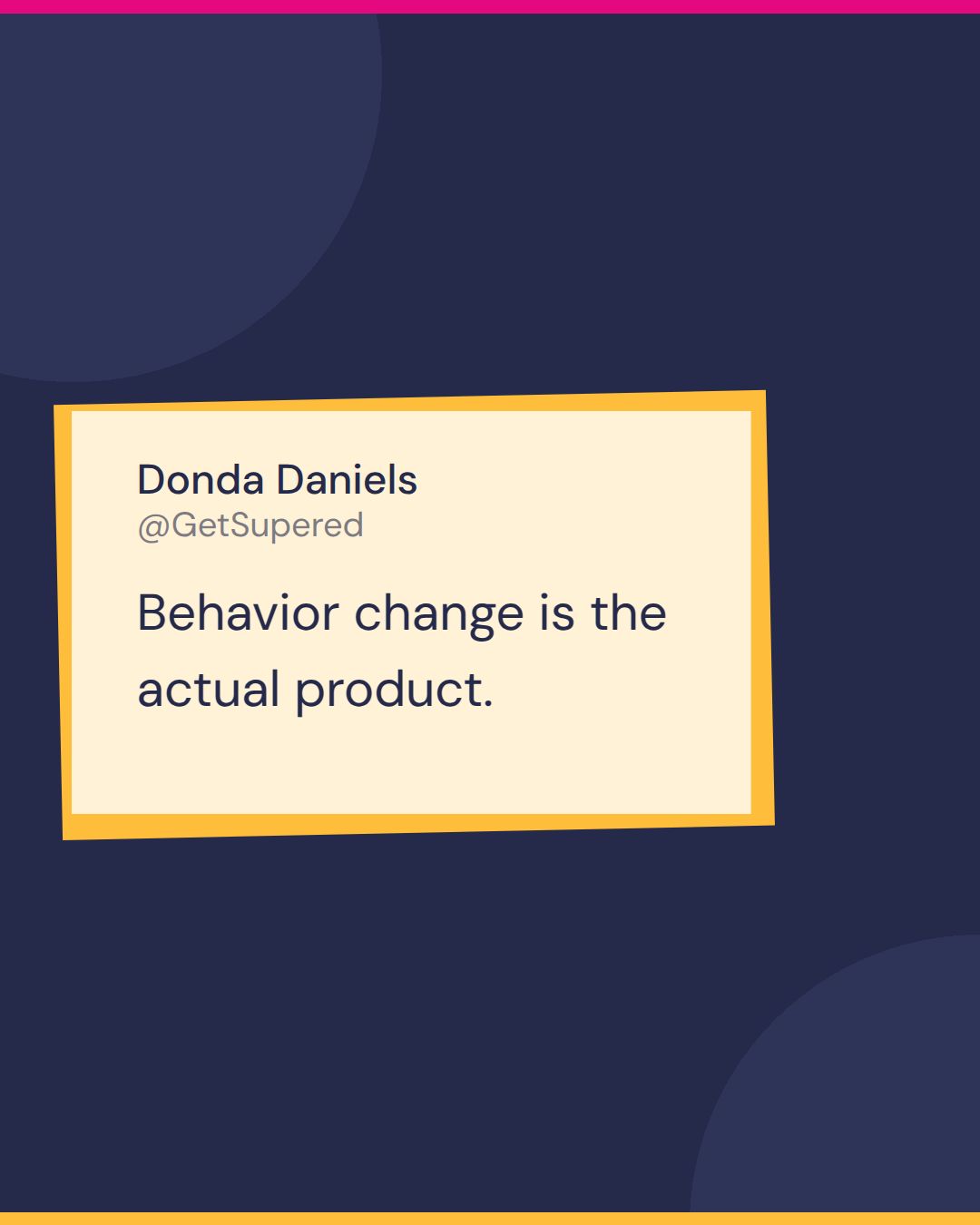
“What I figured out along the way is that behavior change is the actual product,” Donda said in her first minute on the show. She went straight on to how people learn, “being able to meet people where they are and teach them in ways that they actually learn instead of in the ways that we want them to learn.”
When Caleb asked what a finished job looks like, she named the numbers every revenue team answers for: quota, bookings, leads, retention. “But I really believe the end goal is what is the behavior change,” she said. For a rep who is missing quota, she looks for the behaviors, skills and resources that are holding them back. For the reps who are winning, she asks what they do that could be repeated across a role, a region or the whole company. Then she checks whether the changed behavior moved the numbers.
Caleb pointed out that the field has been moving away from course completion as the measure. Our post on why sales training fails covers the same problem from the process side.
How does a reading interventionist diagnose a sales team?
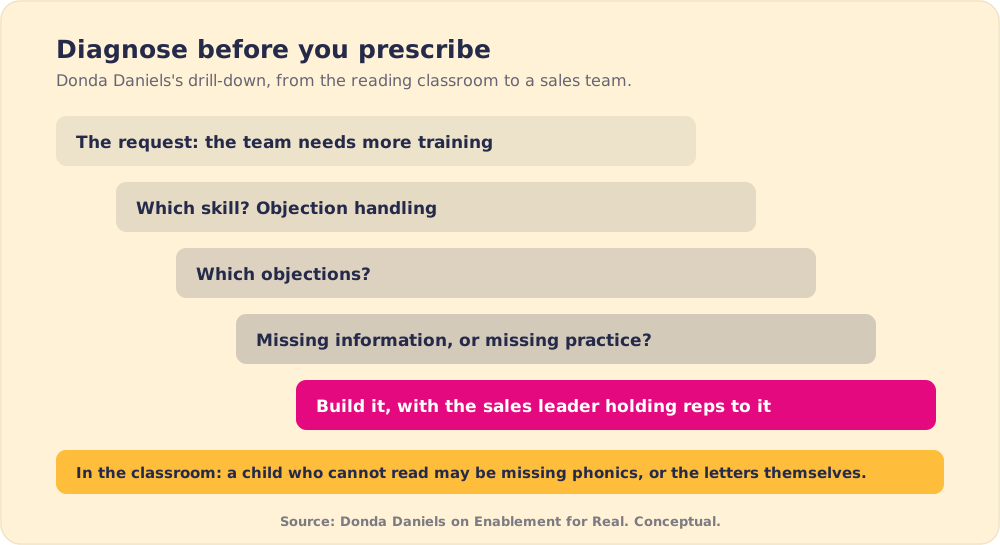
“Diagnose before you prescribe” is Donda’s rule, and it comes straight from the classroom. A child who cannot read might be missing phonics, or might not know the letters at all. “Being able to drill down to the most finite skill that we need to help,” she said, is the job.
She applies it to sales the same way. Is the gap objection handling, negotiating or closing? Then go one level further. A sales leader will often come to enablement and say the team needs more training, and Donda grants they are probably right. Her follow-up questions are the work: “they need help with objection handling. What exactly? Which objections?” What information are reps missing, and do they need more room for role play?
The diagnosis matters because sales problems are spread out. In The State of Sales Enablement 2026, our survey of 198 sales leaders, the stage where deals most often broke down was deal strategy at 22%, followed by pricing and approvals at 20%, handoffs and qualification at 16% each, forecasting at 14% and discovery at 12% (The State of Sales Enablement 2026). A request for more training could point at any of them.
She adds one condition. If the training is built without “the support and the accountability from that leadership, we’re all spinning our wheels.” Caleb pointed out that both halves of her answer are sales terms. Enablement has to do discovery first, and then manage its stakeholders.
Why does Donda call AI content volume a fad?
Donda does not think AI is a fad. “It’s just permeating everything that we’re doing,” she said. The fad is “cranking out so much content.” Teams can make more, and faster, “but at what expense? What is the price of the noise that we might actually be creating and is it really making the impact?”
Caleb remembered the same doubt from his own time selling. Handed a workbook or a playbook, he heard “a small voice inside of me” asking “what percentage of this is actually essential.”
What is sales training reinforcement, and where does Donda build it in?
Donda named one of her biggest pet peeves with training. “There is a real difference between awareness and actual training,” she said. Sometimes awareness is enough. If a new feature is easy to understand, tell reps what it is, give them the resources, and do not take them off sales calls to sit through a session.
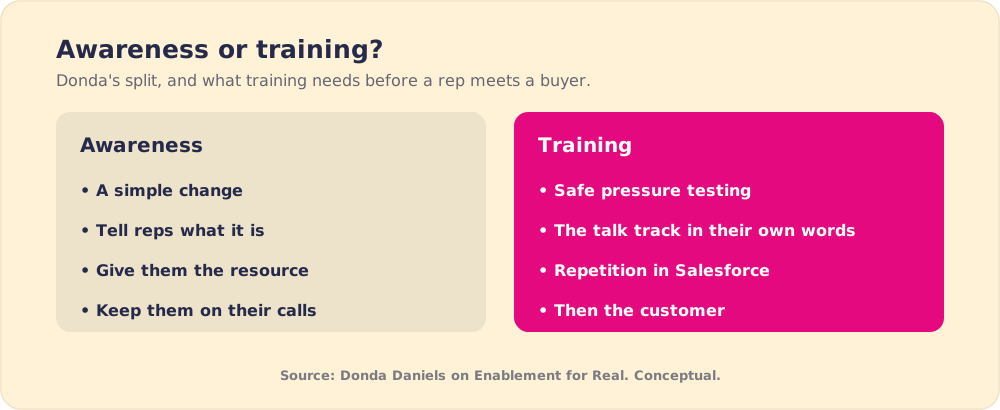
When reps do need training, she says many programs stop too early. Reps watch the videos in the LMS, record a couple of practice pitches and pass the quizzes. Missing from that list are “the pressure testing in an environment that is safe,” time to put the message in their own words, and repetition in Salesforce. “We are allowing them to do their actual learning when it matters in front of a customer,” she said. “And in my opinion, that’s unfair.” She said it is not fair to the rep, who was not set up for success, or to the customer, who is not getting the best, or to the company.
Her way to reinforce sales training runs in this order.
- Diagnosis first. Find the exact skill before building anything, and confirm the sales leader will hold reps to it.
- Awareness kept short. Use a message and a resource for simple changes, and save training time for skills.
- Safe pressure testing. Reps practice the talk track until it sounds like them, where mistakes cost nothing.
- Repetition in Salesforce. Reps rehearse the steps in Salesforce before a customer depends on them.
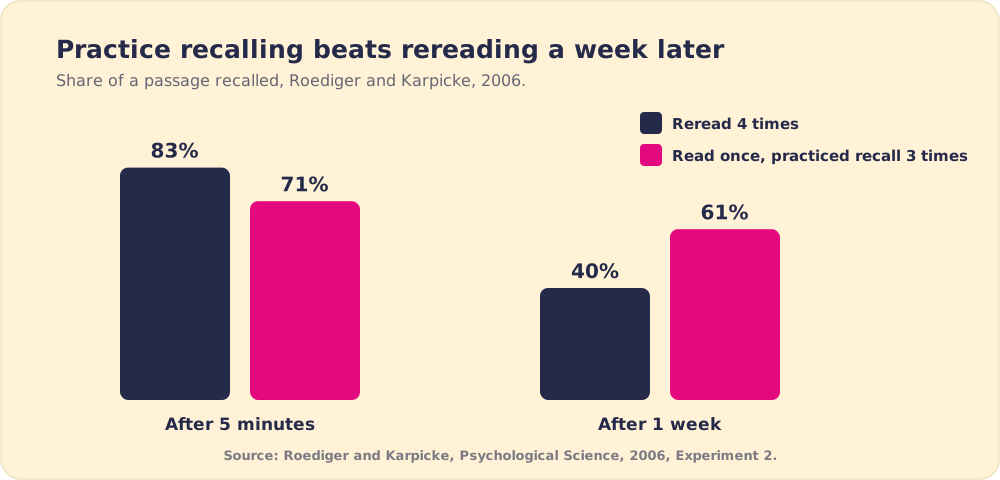
In a 2006 memory study, Henry Roediger and Jeffrey Karpicke had students either reread a passage 4 times or read it once and practice recalling it 3 times. Five minutes later, the rereaders remembered more, 83% against 71%. A week later the result flipped: 61% for the students who practiced recalling against 40% for the rereaders (Roediger and Karpicke, Psychological Science, 2006). A quiz at the end of a video course, taken once, sits closer to the rereading group.
A 2020 meta-analysis in Human Factors by Ashley Hughes, Stephanie Zajac, Amanda Woods and Eduardo Salas found peer, supervisor and organizational support all positively related to whether training transfers to the job, with peer and supervisor support most strongly tied to whether it lasts (Hughes et al., 2020).
Donda knows this asks a sales leader to wait. “Sometimes you got to go slow to go fast,” she said, and the leader will answer that the quota is due this quarter. Finding the balance between the two, she said, is “the real job.”
Live or self-paced: which does Donda choose?
Caleb’s rapid-fire round asked her to pick one. “Both,” she said. Self-paced work lets reps “wrestle with the material,” which is when they connect it to what they already know. The live sessions are “where we get to do the finesse and the coaching and the correction.”
Asked whether the function should be called sales, revenue or go-to-market enablement, she picked revenue or go-to-market, because the thread should run “from lead coming in to retention.” Our revenue enablement post covers that wider scope.
What is Donda betting on next?
She expects enablement to become “more of a backbone function” instead of a support function, and she sees it already at the companies that are winning. She also expects AI to help, by pulling data sources together and surfacing patterns so enablement can “ask better questions.”
The best question, she said, is the one she asked as an interventionist. “The most important question was always why.” Why are numbers going down, or up? Why are tools and resources going unused? “Why are people completing courses, but we’re not seeing the behavior change?”
The other source she credits is her old classroom. Her students taught her “that humans don’t all learn the same way.” She is looking for her next team now, one that values behavior change and diagnosing before prescribing, and you can reach her on LinkedIn.
What Donda Daniels teaches about sales training reinforcement
- Behavior change as the product. Course completion is a step, and the measure is what reps do differently on calls.
- Diagnosis before prescription. Narrow “more training” down to the one skill, the way she narrowed a reading problem.
- Awareness separate from training. Simple changes get a message and a resource, and reps stay on their calls.
- Practice before the customer. Safe pressure testing and repetition in Salesforce come before the live deal.
- Both formats. Self-paced work to wrestle with the material, live sessions for coaching and correction.
- Leadership accountability. Training without the sales leader’s follow-through leaves enablement and sales spinning their wheels.
What should an enablement leader do with Donda’s method?
Take the next training request you get and run her questions on it before you build anything. Which skill, which objections, which reps, and will the sales leader inspect it afterward? If the gap is a simple change, send a short message and a resource and leave reps on their calls. If it is a skill, plan the practice and the repetition before you plan the course.
Repetition is easier when the steps show up where reps work. Supered puts the talk track and the process steps inside HubSpot and Salesforce while reps run real deals, so enablement can see which steps happened on each deal.
For the practice step itself, our post on AI sales role play shows how another enablement leader built it, and our sales training plan post covers the calendar around it.
Frequently asked questions
What is sales training reinforcement?+
Why does sales training not stick?+
How do you reinforce sales training?+
What is the difference between awareness and training?+
Should sales training be live or self-paced?+
Your process, running itself.
Turn the playbook into rep behavior.
More from Enablement for Real

Sales Enablement Myths: Adobe's William Libert on the AI Content Reps Never Read
William Libert
RevOps Best Practices: Hope Edmiston on Bolt-On AI and the Classics That Still Work
Hope Edmiston