GTM Tools: Michael's Top Five for a One-Person Go-to-Market Team
Michael runs go-to-market for First Touch as a team of one and booked more than 300 meetings in the first months of 2026. On Show Me Your Stack he counted down his five GTM tools and explained why the humans still decide the result.
GTM tools are the software a go-to-market team uses to find, reach, win and keep customers, and Michael's one-person stack shows the rule he runs it by: automate the collection and the admin, and keep humans on the actions buyers respond to.
Michael calls himself one of “the newbies on the block” in the HubSpot community. As co-founder of First Touch he runs go-to-market as a team of one, and in the first months of 2026 he booked more than 300 meetings. He does not create deal records by hand. Most of his day, as he put it, “is spent engaging with other people.”
He counted down the five GTM tools behind that number with me on Show Me Your Stack. He lets software gather the data, sort it and keep HubSpot current, and he keeps the conversations with buyers for himself. He also told me that each tool has to be managed, the way you would manage a person, even on a team of one.
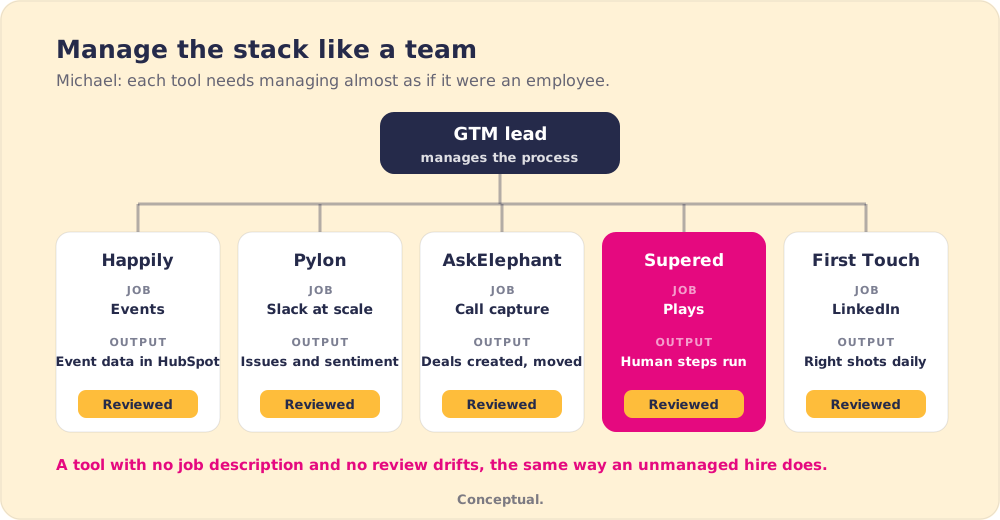
Before his first pick, he gave me the map. Go-to-market, he said, lives in three places: “on social which is LinkedIn,” “in person which is events,” and “in Slack which is where we communicate asynchronously with all of our customers, prospects and partners.” His five go-to-market tools cover those three places, plus the CRM underneath.
#5 Happily: how does event data reach the CRM?
Happily runs First Touch’s events and in-person activations. “It allows us to collect all the data that we need from the folks that we chat with and then bring it right into HubSpot,” he said, “which is where we activate and use all of that data.”
What he cares about is that the event data lands in HubSpot, where his LinkedIn and Slack data also ends up.
We run more events than ever at Supered, and I have not tried Happily. Noted.
#4 Pylon: how do you run 200 Slack channels without drowning?
In the first months of 2026, First Touch created more than 200 Slack channels with partners, customers and prospects. Pylon sits on top of Slack and makes that manageable. The company ships new features every week, and Pylon broadcasts each release to every channel at once. When an issue opens, the team can find it and act on it.
The feature Michael likes most is the one built for someone in his seat. He works mostly on go-to-market and leaves most customer success work to others, and Pylon lets him ask questions of all those channels at once: “what are the big issues that people are facing right now? What are the things that people are liking the most?” He called the resulting sentiment read “incredibly helpful.”
With more than 200 channels, he cannot read every message. He asks Pylon what the channels are saying instead.
#3 Ask Elephant: can call intelligence run your CRM?
Michael’s answer is close to yes. “I no longer create deal records,” he said. Workflows in Ask Elephant create deals from calls and move them through stages. When he closes a deal, it closes in the CRM, and the handoff to customer success happens automatically. Follow-ups after meetings arrive drafted “for me to go edit and approve and send.” He describes the result as running HubSpot autonomously. His colleague Ryan Gunn, on his own episode, called it “semi semi-autonomous,” because someone still checks the output.
Then he added the warning I think matters most in the interview. “This is not like a set it and forget it type of thing,” he said. Each tool in the stack “allows us to do awesome things, but they need to be managed almost like as if they’re an employee.” And: “the effort of management is now no longer as focused on the people, but it’s focused on the process and you have to be really diligent about it to make it work well.”
If you take his comparison at face value, each tool needs what a new hire gets: a job, a standard for its output, and someone who reviews the work. Skipping that step costs money: Zylo’s 2025 SaaS Management Index found SaaS spend averaging $4,830 per employee, up 21.9% in a year (Zylo, 2025), and Salesforce found sales teams use an average of 10 tools to close deals while 66% of reps feel overwhelmed by them (Salesforce, 2023). One news note: Fullcast announced it acquired AskElephant’s technology and customer assets on September 4, 2026, after this episode was recorded (Fullcast, 2026).
#2 Supered: why does the human in the loop decide the result?
Michael ranked our product second, and his reason says more about his business than about us. First Touch’s job, he said, is to “operationalize social,” which means getting a team onto LinkedIn “engaging onetoone with their prospects through the comments,” tagging prospects in posts that matter to them, and “creating onetoone awareness in public that compounds over time.”
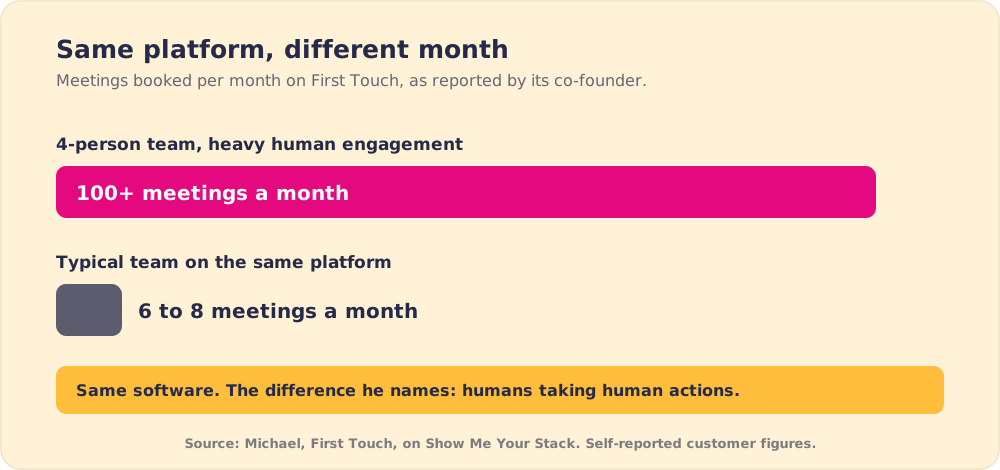
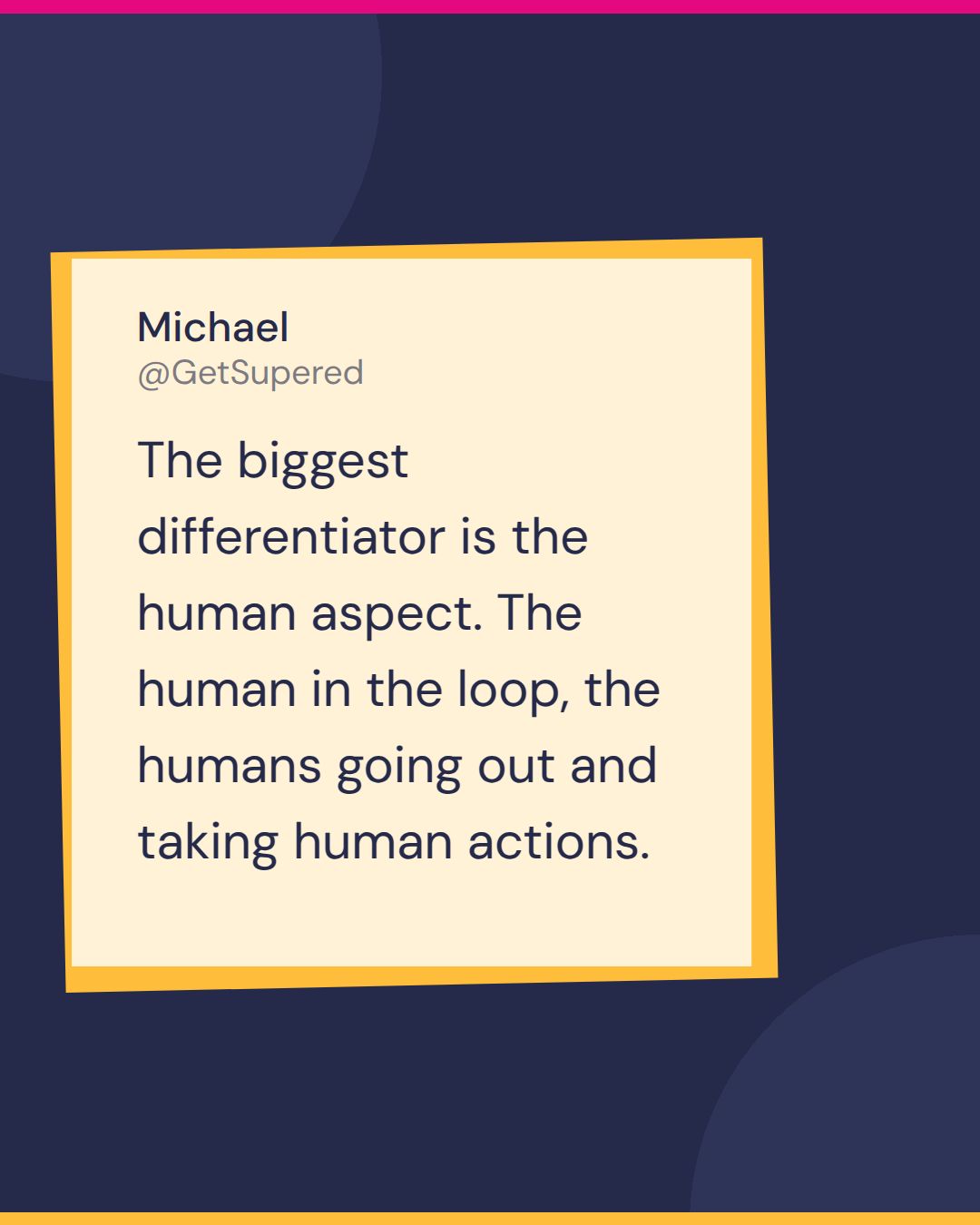
His software can build connections, run outreach and report the results in the CRM. It cannot do the engaging. And he sees the difference in his own customer data. Some teams, like a four-person team at Ask Elephant, book over 100 meetings a month on LinkedIn. Others book six to eight on the same platform. “The biggest differentiator is the human aspect,” he said. “The human in the loop, the humans going out and taking human actions, non AI.”
Supered is how First Touch makes those human steps repeatable, and his second reason was scale through partners. Agencies matter to First Touch because they install the software “as deeply into the nucleus of the business as possible.” The plays that work are similar from customer to customer: handling inbound, account-based campaigns, conference follow-up, event attendance. “A lot of these plays are relatively similar,” he said, and Supered lets his team “create these plays and then copy and paste them across our user base and partner partner ecosystem.”
Buyers back his bet on people. Gartner’s 2026 survey of 645 B2B buyers found 67% prefer a rep-free buying experience, and also that 69% prefer to validate AI-generated insights with a sales rep (Gartner, 2026). Most of those buyers would skip the rep for the routine parts and still want a person to check what the AI told them. Michael makes his case for the human steps in this clip.
#1 First Touch: how did a one-person team book 300 meetings?
“No shame in that,” Michael said when he named his own platform first. His method has two halves. The human half is engagement and posting. “You got to give before you get,” he said, and he posts on LinkedIn “probably six days a week at this point. Some of them do great, some of them don’t.” He does not chase likes: “what matters is are the right people seeing your content.”
The software half collects what the human half creates. First Touch gathers the people who liked or engaged with his posts, qualifies them against his ideal customer profile, removes people outside his market, and tells him who to approach and when. The limit that makes this matter is LinkedIn’s own: “you only get 20 connects and 20 uh 20 connect requests and 20 DMs per day. So you got to make sure you’re taking the right ones.” First Touch suggests which 20 to send, and Michael does the engaging himself.
By the time we recorded in spring 2026, that had added up to more than 300 meetings from a team of one. Our GTM engineer post covers the role that builds systems like this at larger companies.
Why does Michael treat AI like electricity?
No AI product made his list, and he left it off on purpose. “I think of it a little bit more like electricity, right? Like it should be in every part of your business. It should be basically the operating system of how you run your business.” First Touch lets customers plug in any model, and his team picks whichever performs best at the time. To him the models are interchangeable. The question is “how can we do what we’re doing faster and better?”
Economic history supports his image. In 1990 the economist Paul David studied why electricity took decades to raise factory productivity (David, American Economic Review, 1990). Early electrified factories kept their old layout, one big power source driving a long shaft with the machines lined up beside it. The gains came once factories put a motor in each machine and rearranged the floor around the work.
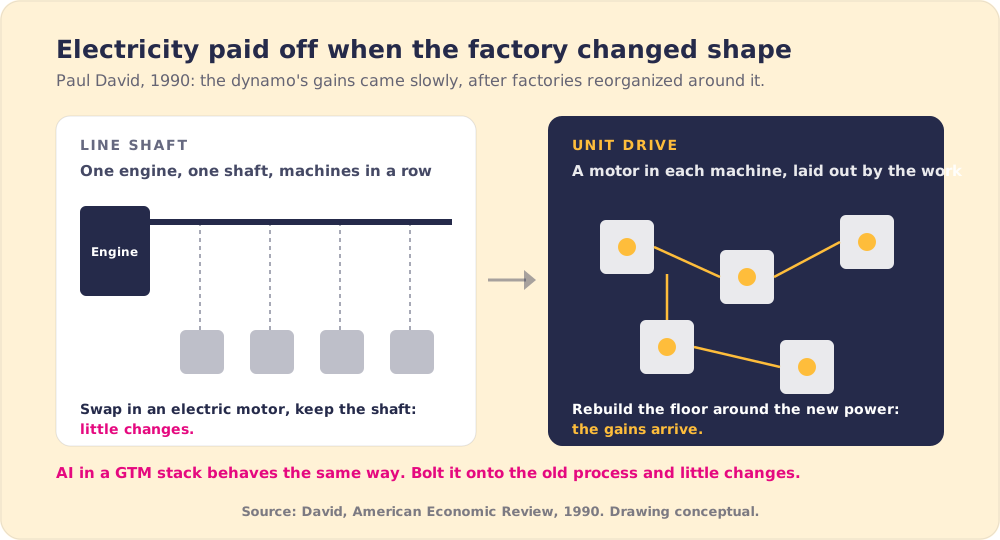
Michael made a small version of that change. He stopped typing deal records, and Ask Elephant now creates the deal from the call and moves it through the stages.
Key points from Michael’s GTM tools
- Three places for go-to-market. Social, in person and Slack, with every conversation brought back to HubSpot.
- Tools managed like employees. Each one needs a job, a standard for good output, and someone who checks it.
- Admin removed at the source. Ask Elephant creates and moves deals from calls, so he never types a deal record.
- Humans on the buyer-facing actions. Comments, tags and personal messages separate 100+ meetings a month from six to eight.
- Plays written once and copied. The same few plays work across customers, so he writes them once and spreads them through partners.
- AI in every tool. No single AI tool on the list, because it should run through all of them.
What we would do with Michael’s list
Write one line for each tool you pay for: its job, what good output looks like, and who reviews it. Michael calls that managing a tool like an employee. If one of the three lines stays blank, the tool is running unmanaged. Then list the human actions your buyers respond to, the comment, the tagged post, the personal message, and protect time for them the way Michael does, because his own customers show the gap those actions make.
Keeping the human steps consistent across a team is the part of his stack we build, and our go-to-market tech stack post shows how the pieces fit. You can see Supered in a demo. If you are deciding what to automate in a sales seat, read our post on the AI SDR next.
Frequently asked questions
What GTM tools does First Touch use?+
What does human in the loop mean in go-to-market?+
Can one person run a GTM team?+
Is AI a GTM tool?+
Do GTM tools run themselves once they are set up?+
Your process, running itself.


