OpenClaw for Business: Lica Wouters's Five-Tool Stack for Running an AI Agency
Lica Wouters rebuilt her agency after a downsizing, this time around AI agents with names, logs and rules. Her five tools, counted down from Slack to HubSpot, and what each one taught her about running a small AI agency.
Lica Wouters uses OpenClaw for business by running named AI agents, including a HubSpot admin that cleans and links records and assistants that draft email replies, with every run logged in HubSpot and a person sending each email.
A few years ago Lica Wouters ran an agency with a full team. Then it downsized, and two years ago she stood on stage at INBOUND talking about comebacks. Since then she has rebuilt Mind & Metrics as an AI agency, with a small human crew and a set of named AI agents she runs on OpenClaw for business work like CRM cleanup and email triage. What keeps her up at night, she said, is “trying to define what agencies look like in the near future.”
I asked her onto Show Me Your Stack because she posts pictures of her agents, names and all, and I wanted to learn how she runs them. She counted down the five tools that let one person move like a larger team. Two ideas run under all five. Agents need a process to follow, the same as people do. And the hours AI saves should go to the work only a person can do, which for her is building trust with clients.
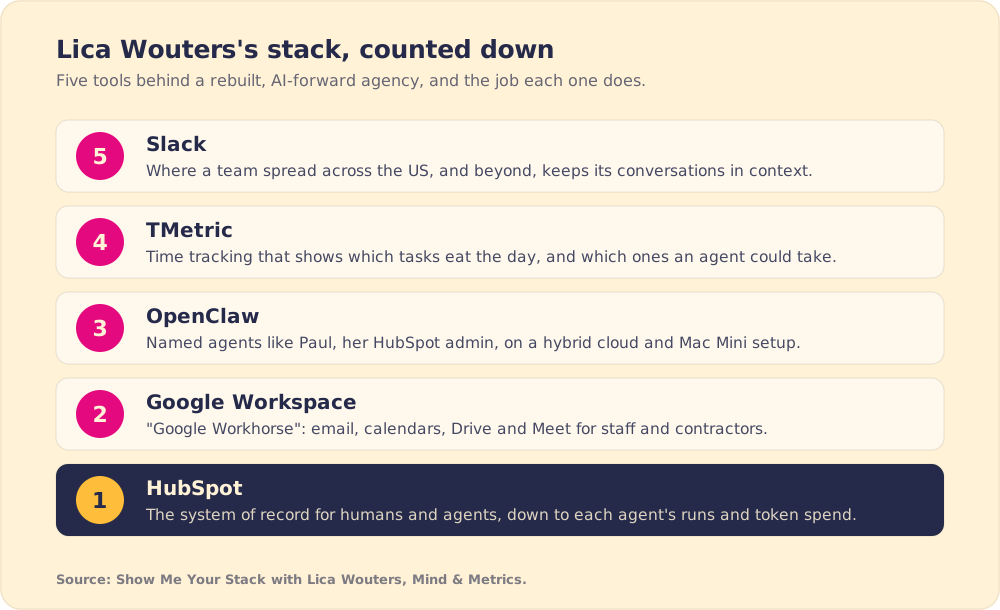
Why does a remote AI agency still run on Slack?
Number five is Slack, for a plain reason. Her team is spread out, and “when you’re dealing with remote teams that are spread throughout the US and if not the world, uh, in order to communicate, it’s got to be Slack.” She had one complaint: “I’m a little bit bummed that HubSpot didn’t buy Slack,” because she would have liked a chat window inside the CRM.
I added one reason it matters more now. Channels keep a conversation grouped by client or topic, and a person or an AI tool can pick up that grouped history later far more easily than a pile of email threads.
What does time tracking teach an AI agency?
Number four is TMetric, her time tracker. She picked it because it puts every time entry back into HubSpot, and she tracks time at all because of the name on the door. At Mind & Metrics you “can’t improve what you’re not tracking.”
Agencies usually track time so they can bill for it, and I said so. Lica tracks it for another reason, which comes from the belief her whole business rests on: “as much as I am AI forward, I do honestly believe that the world is still human.” She doesn’t expect clients to accept an AI in place of a person. “We still crave human connection,” she said, and trust takes time: “trust isn’t built overnight. That’s a timebased thing as well.”
Her timesheets tell her whether the hours are going to meetings and relationships or to manual data entry. The data entry becomes the list of jobs to give an agent next. In her words, the tasks eating your day “become a feedback loop as to what you could potentially use AI to switch out of.”
Gartner lists unclear business value as one of the three reasons it expects over 40% of agentic AI projects to be canceled by the end of 2027 (Gartner, June 2025). Lica can show the value in her own records: the hours an agent took off her plate, and where those hours went instead.
How does Lica use OpenClaw for business?
Number three is OpenClaw, the open-source agent framework, and the reason I invited her. She uses it for two jobs, HubSpot admin work and email triage. She had been building agents in n8n when someone told her to try OpenClaw. Much of what she had built already existed there, and on a virtual server it was “so incredibly fast” that she moved her agents across almost at once.
Then she ran into an argument agent builders have all the time: run it all locally on a Mac Mini, because it is cheaper. She tried it and pulled back. Being small, she said, is what lets her experiment: “if it breaks, the chaos is on me. If you’re building this in a large enterprise and it breaks, the chaos is on everybody.” A solo operator can break a setup in the morning and fix it by evening. What she won’t accept is one point of failure. “If my internet goes down, which it sometimes does, it’s like all your employees calling in sick.” So she runs a hybrid: a skeleton crew of agents on a virtual server, and the rest on one Mac Mini.
She has reason to be careful. OpenClaw first shipped in November 2025, changed its name more than once in its first months, and has drawn published security concerns, including prompt injection and third-party skills that leaked data (Wikipedia, OpenClaw).
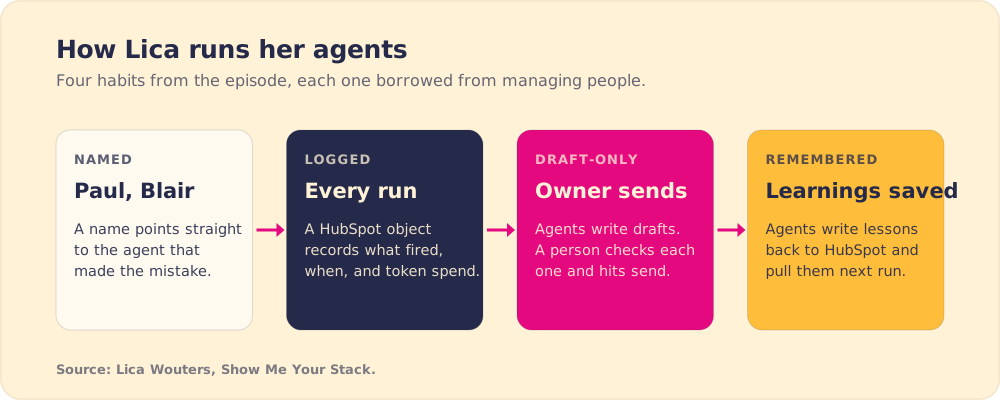
Her busiest agent is Paul, the HubSpot admin. “The amount of cleaning that I have done like database cleaning with this agent is just killer.” Associations sold her on it. Meeting recordings, time entries and projects all land in HubSpot and need linking to the right deal, project or vendor. Basic automation handles the easy cases with rules like “if life cycle stage is customer,” and it gets stuck on a client with an active project and a new expansion deal at the same time. Paul decides based on the whole context, and she says he “has not failed yet.” Plenty of sales teams already use AI this way: 46% in The State of Sales Enablement 2026 use it for CRM admin or cleanup (The State of Sales Enablement 2026).
Her other agents act as executive assistants, triaging email in Google Workspace with HubSpot context. They follow one hard rule. “I do not believe in emailing or or having agents email directly. So, I I always have them create a draft.” Later, the owner opens Gmail to “a series of drafts that they have to go through, QA, and then send.” Email triage is “definitely one of the hardest things” her agents do, so she keeps a human in the loop: a person checks each message before a client sees it.
Why does Lica call Google Workspace a workhorse?
Number two is Google Workspace. “They really should call it Google Workhorse,” she said, since it holds her documentation and much of her operations. When a contractor joins, she can give them email, a calendar, shared Drive folders and Google Meet in one step, which also saves her from buying more Zoom licenses.
Two technical reasons keep her there. Google “has a much better API MCP,” in her experience, so her assistant agents run on Google first and she hasn’t built the same setup for Teams. And the Google Drive connector for Breeze, HubSpot’s AI, is “really powerful also.” When she chooses between two suites now, she asks which one her agents can reach.
Why is HubSpot the system of record for an AI agency?
Number one is HubSpot, and she came to it in a hard stretch. The agency had too many tools, and “out of necessity just because the business wasn’t working so well I decided to move everything in HubSpot.” She is blunt about the cost: “it’s an expensive piece of software. Let’s call a spade a spade.” To make the monthly bill worth it she uses the whole suite, from projects to invoicing to Data Hub, and repurposes objects from HubSpot’s object library in place of custom objects.
One of those objects logs her agents. She can see “exactly what’s fired, when’s fired, how much is my spend, how much tokens are my agents consuming,” and which tasks they run. Another holds the agents themselves, each with a name. “I named my agents because it’s much easier to remember if Paul messes up than agent BYX24.” When something odd turns up, she knows whom to ask, as in her example: “Blair, why did you create, you know, this client folder in my personal drive?”
HubSpot also holds two kinds of agent memory. The first is expertise: the agents write their learnings back to HubSpot and pull them on the next run. The second is the live record of clients, deals and the emails coming in and going out, so each agent works from the same facts the humans see.
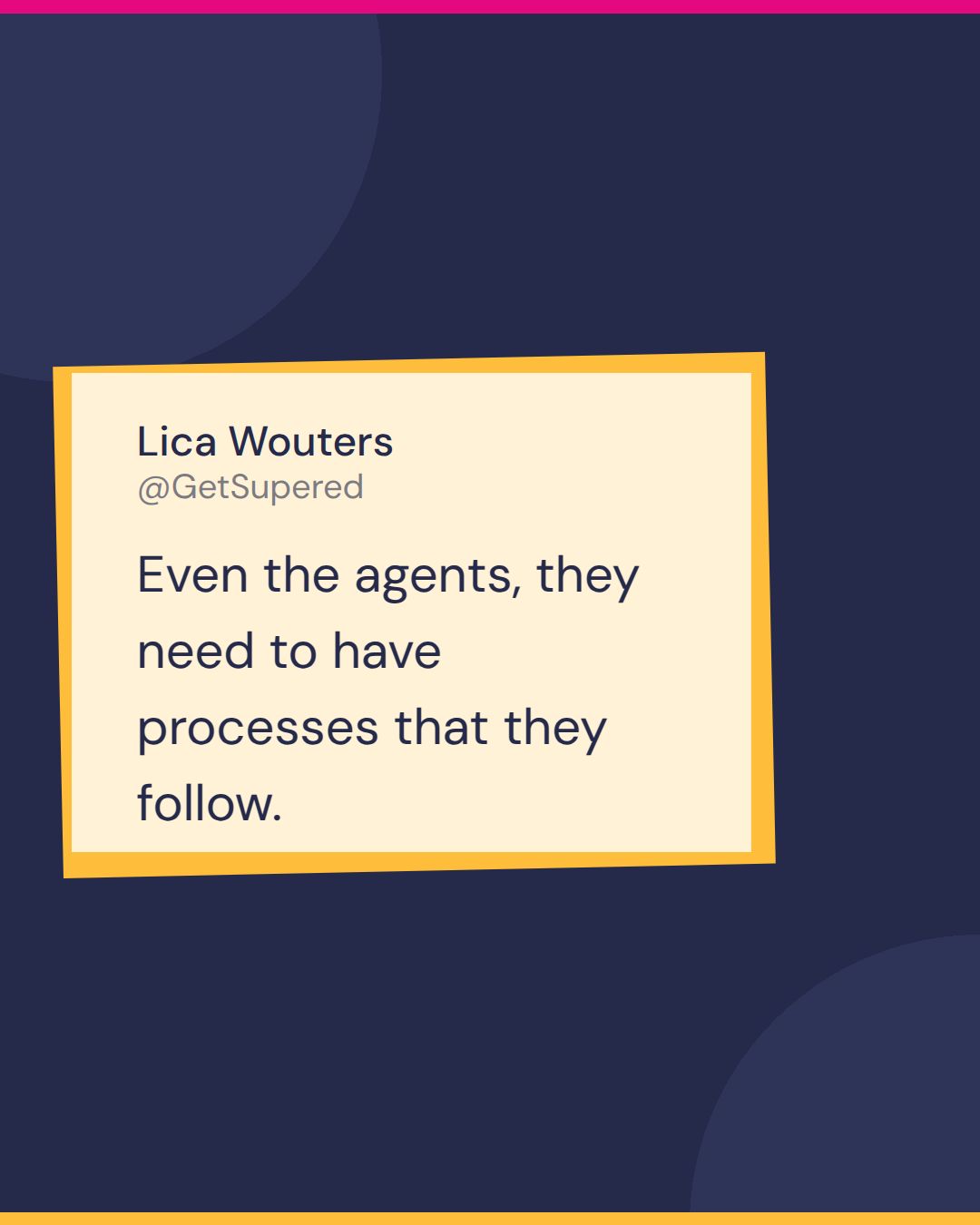
Near the end she named what holds the five tools together: “it boils down to process. Even the agents, they need to have processes that they follow.” She tracks her human processes on Supered process boards, which she added as a bonus sixth tool, and her agents on the HubSpot object.
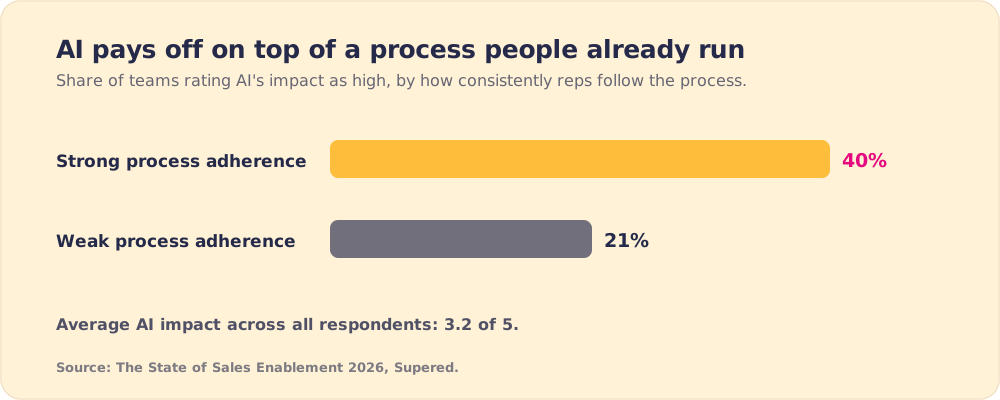
Research on AI rollouts supports putting process first. MIT’s NANDA initiative, drawing on 150 leader interviews, a survey of 350 employees and 300 public deployments, reported that about 95% of generative AI pilots delivered little or no measurable impact, and traced the failures to tools that did not fit real workflows (Fortune, reporting on MIT NANDA, 2025). Our own survey found a matching split: among teams whose reps follow the process consistently, 40% rated AI’s impact as high, against 21% of teams with weak adherence.
Key points from Lica’s stack
- People for trust, agents for the manual work. Lica doesn’t expect clients to talk to AI interfaces. Agents take the data entry so she has time for relationships, which take time to build.
- Time data as a to-do list for agents. Her tracker shows which tasks eat the day, and those are the next jobs to automate.
- Small size as an advantage. When her experiments break, the damage stays with her, so she can try and fix things faster than a large firm.
- A hybrid setup. A virtual server for the critical agents and a Mac Mini for the rest, so one internet outage doesn’t stop the whole crew.
- Names and logs for agents. When Paul makes a mistake she can trace it to Paul, and the log shows the token bill as it grows.
- A draft-only rule for client email. Agents draft, and a person reads and sends.
- Process under the agents. Her agents follow written processes, tracked in HubSpot, the way her people follow theirs.
What should you copy from Lica’s AI agency?
Build the way Lica did: process first, then agents, each with a name, a logged run and a person between the agent and the client. An all-in-one agent platform gets you started faster, but it leaves cost and risk hard to see, and agents wired into everything with no log tell you about a problem only when a client replies to an email you never read. Gartner’s three causes of canceled agent projects are cost, unclear value and weak risk controls, and she has a cheap habit for each: the execution log, the timesheet and the draft-only rule. MIT traced failed pilots to tools that didn’t fit the workflow, and in our survey AI’s impact was highest on teams that already follow their process.
Start this month with one agent: give it a name, a log and a draft-only rule. Then read our guide to AI sales enablement on putting AI behind a working process, and our take on the AI SDR for where agents fit in a sales team. For the wider case against automating first, see sales automation.
Frequently asked questions
What can you use OpenClaw for in a business?+
Is OpenClaw safe for business use?+
What tools does a one-person AI agency use?+
Can a one-person AI agency compete with larger agencies?+
Should AI agents send emails to clients directly?+
How do you track what AI agents are doing?+
Your process, running itself.


