The Sales to Customer Success Handoff Is a Behavior Gap, Not a Missing Doc
Every team tries to fix a broken sales to customer success handoff with a better template.
The handoff does not fail for lack of a document. It fails for lack of a shared reality.
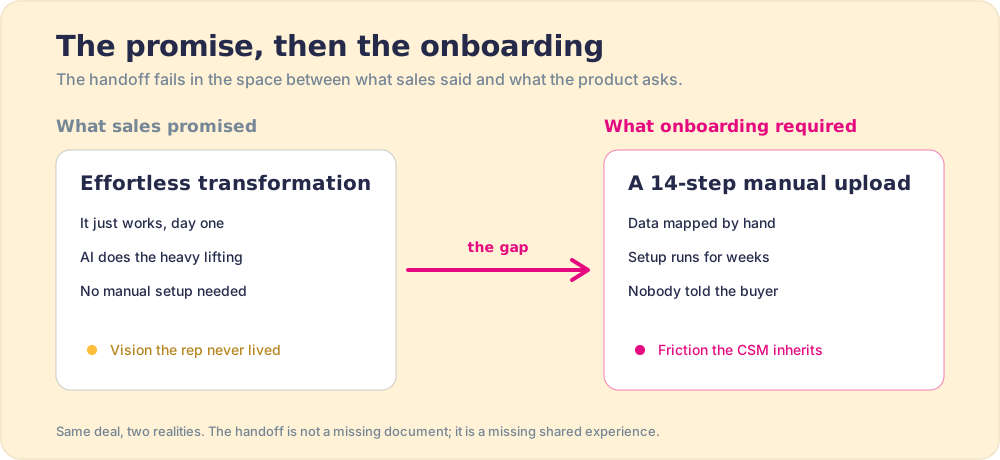
The sales to customer success handoff is the transfer of an account from the closing rep to the team that onboards and keeps it; it fails not because a document is missing but because the rep promised an outcome they never personally produced.
A sales rep paints the picture in the demo. Effortless transformation, AI doing the heavy lifting, the customer’s month-end pain dissolving on its own. The deal closes. Two weeks later a customer success manager is sitting across from a frustrated client who has discovered that the promised utopia begins with a 14-step manual data upload the demo never mentioned. The CSM did not break this. The rep did not lie, exactly. Something softer than a lie happened: the rep sold a place they had never been.
Such is the broken sales to customer success handoff, and the standard advice for fixing it is to build a better artifact. A fuller handoff template. A required CRM field. A dedicated Slack channel. A longer kickoff call. The premise underneath all of them is that the deal fell through a crack in the paperwork, so we patch the paperwork. The premise is wrong. The handoff did not fail for lack of a document. It failed because the rep promised an outcome they have never personally produced, so they had no shared reality to hand over, only a hope dressed as a forecast.
So let us be precise about the thing. The sales to customer success handoff is the transfer of an account from the closing rep to the team that onboards and keeps it, the ownership change your account ownership rules should trigger on a held handoff meeting. The version that matters is not the document. It is whether the rep understood the journey they sold well enough to hand over reality instead of a brochure.
Why does the sales to customer success handoff fail?
Not for lack of a document. The cause is two gaps the template never touches: a behavior gap and a language gap.
The behavior gap is the rep selling a journey they have not walked. Enablement carries a real fear, and it is worth granting in full: train reps too deeply on the product and they turn into feature clerks, reciting menus and pointing at buttons instead of selling value. So enablement teams overcorrect. They drill reps on vision and value and trust the customer to fill in the how. The trouble, as Miranda Marean of the Sales Enablement Collective puts it, is that “if a rep doesn’t understand the how, they can’t defend the why” (Sales Enablement Collective). A vague value proposition is easy for a buyer to wave off. A specific, evidence-based one is not. The rep who has never seen the 14-step upload cannot warn the buyer about it, set the expectation, or frame it as worth the trouble, so the buyer discovers it alone, in onboarding, and reads it as a broken promise.
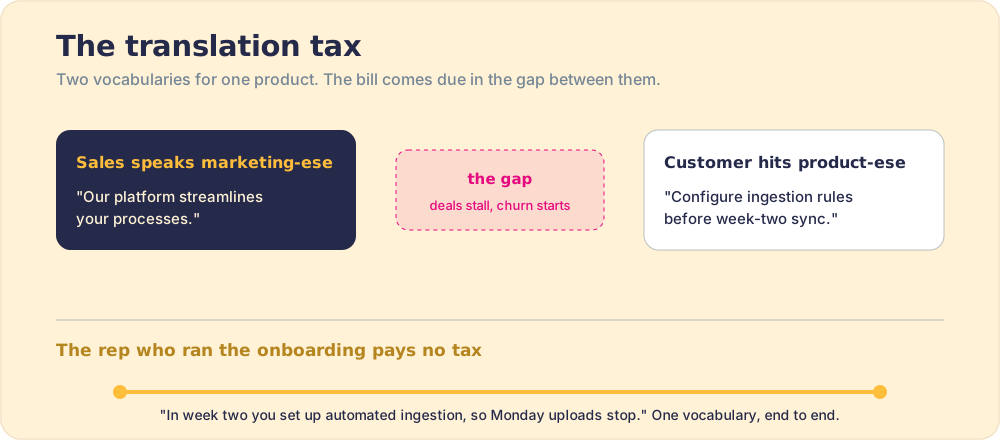
The language gap is what Marean calls the translation tax. When sales skips the customer’s training (the backbone of customer enablement after the sale), sales speaks marketing-ese and the customer, two weeks in, hits product-ese. A rep without onboarding experience says, “our platform streamlines your processes,” and leaves the buyer to imagine what that means in the context of their actual week. A rep who has been through it says, “in week two you set up automated ingestion rules, so instead of uploading files every Monday your team goes straight to the analysis.” One requires imagination. The other hands over a picture. The gap between those two languages is where deals stall, trust erodes, and churn starts.
The problem does not stay at the edges of the funnel. Gartner finds that 77% of B2B buyers describe their most recent purchase as complex or difficult (Gartner). A buyer who already found the purchase hard, then meets a reality the seller never prepared them for, does not give the benefit of the doubt. The misalignment compounds across the whole lifecycle, because the expectation was set in one vocabulary and the product delivers in another. The sales to cs handoff has already failed, weeks before customer success opened the account.
What is the translation tax, and who pays it?
The customer pays it first, in confusion. Then the company pays it, in revenue. The clearest reading of the cost is in the retention numbers, because a handoff that sets expectations badly is a churn event with a delayed fuse.
The link runs through onboarding. In Wyzowl’s survey of 216 consumers, 63% said post-sale support weighs on whether they buy in the first place, and 86% said they would stay loyal to a business that invests in onboarding that welcomes and educates them (Wyzowl, 2020). The sample is small and consumer-side; read it as a direction. When sales sets the runway and the runway is wrong, the onboarding the customer was promised and the onboarding they get diverge on day one. The CSM spends the first ninety days managing surprise instead of building value, and surprise in the first ninety days is where early churn is seeded.
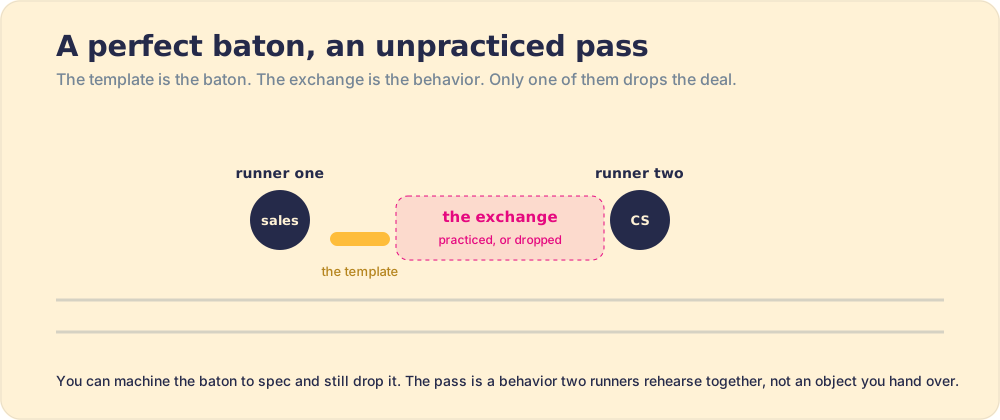
Think of the handoff as a relay exchange, not a delivery. A relay is not won by the runner with the best baton. It is won in the exchange zone, in the half-second where one runner passes to another at full speed, and that pass is a behavior two athletes rehearse a thousand times. A handoff template is the baton. You can machine it to perfect spec, weigh it, paint your logo on it, and still drop the deal in the exchange, because the two runners never practiced the pass together. The artifact is real, and the race is decided somewhere else.
Should sales reps go through customer onboarding?
Yes, and not in a watered-down sales edition. The fix Marean lands on is structural and a little uncomfortable: the field team is the first customer, so reps run the same modules, the same certifications, the same getting-started guides the customer uses, with no slide-deck substitutes. When a rep sits in the same digital seat as the user, the product stops being a stack of slides and becomes a journey with a beginning, a frustrating middle, and a satisfying end. That shift is what lets the rep connect a high-level business problem to a specific moment in the implementation.
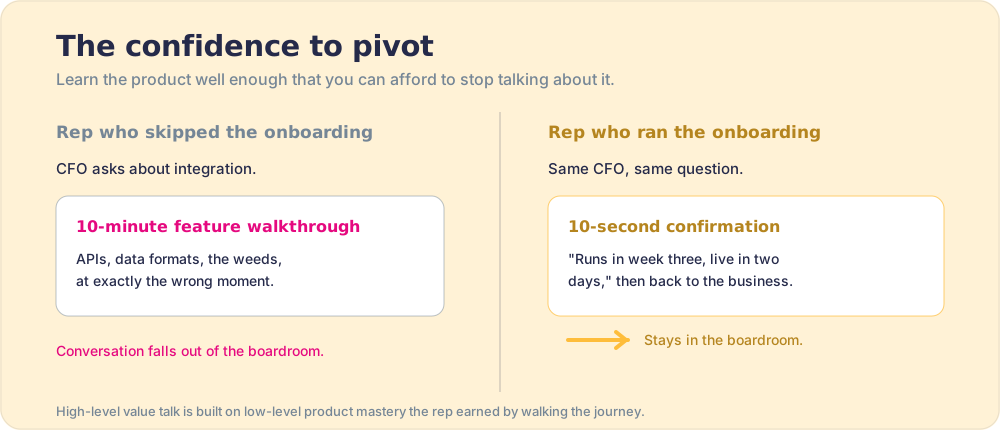
The change shows up first in discovery. A rep who has run the onboarding stops asking generic pain questions and starts asking architectural ones, the kind that prove they understand both the friction of the old way and the milestones of the new one. It shows up again under pressure, in what Marean calls the confidence to pivot. When a CFO asks about integration, the unprepared rep panics and launches into APIs and data formats, a ten-minute feature walkthrough at exactly the wrong moment. The enabled rep gives a ten-second confirmation (“that integration runs in week three, most clients have it live within two days”) and pivots straight back to the business conversation. High-level value talk is built on low-level product mastery. You learn the product so well that you can afford to stop talking about it.
There is a second-order win that reaches the whole revenue motion, and it is the real argument for sales and customer success alignment. A rep who understands the onboarding journey hands customer success a better account, flags the friction points product has stopped noticing, and spots upsell openings during the first sales conversation instead of leaving them to chance. The handoff stops being a wall to throw the account over and becomes a continuation of one shared understanding.
How do you fix a broken sales to customer success handoff?
Keep the template. It is necessary. Then close the behavior gap underneath it, because the template is necessary and not sufficient. Three moves, in order:
- Shared reality. Put reps through the customer’s onboarding, the real one, so they hand over a journey they have walked rather than a vision they recited. Shared reality is the root fix; the rest follows from it.
- One vocabulary. Standardize the language across sales and customer success so the customer hears the same words from the first demo to the week-two sync. Mapping where the two vocabularies diverge is, in Marean’s phrase, one of the most structurally useful things an enablement team can do.
- Process in the flow. Make the agreed handoff steps reach both teams at the moment of the work, so adherence is something you can see rather than something you assume happened. A handoff process that lives in a wiki loses to the deadline.
That last move is where most fixes fall apart, and it is the one our own data speaks to directly. The State of Sales Enablement 2026 found that teams whose guidance is embedded in the flow of the work hit quota at 49%, against 15% for teams whose guidance lives in docs, wikis, and an LMS. Same content. The moment of delivery is the lever. A handoff checklist filed in a shared drive is exactly the 15% case: it exists, and it does not reach the person at the instant they need it, so the box gets checked while the buyer’s reality drifts from what was promised.
Teams whose guidance is embedded in the flow of work hit quota at 49 percent. Teams whose guidance lives in docs, wikis, and a separate tool hit quota at 15 percent. Same content. The moment of delivery is the lever.
The principle holds even when no software is in the room. A process is not run by writing it down; it is run when it reaches the person doing the work, in the moment, and when someone can see whether it was followed. The point of getting the handoff right is not an internal control. It is the buyer’s experience: a customer who hears one consistent story from first touch to first value is a customer who stays. The handoff is buyer-facing in its payoff, and the buyer feels every seam.
What happens during the sales to implementation handoff?
Six steps, from closed-won to a customer who has stopped thinking about the rep. The sales to implementation handoff and the sales to customer success handoff are the same exchange with different receivers: an implementation lead when the product has to be configured first, a CSM when it does not. The steps hold either way.
- Handoff record, within one business day of closed-won. The rep fills the template below in the CRM while the deal is fresh. A day later, half the detail lives only in the rep’s memory; a month later, in a closed deal’s call recordings.
- Internal handoff meeting, 30 minutes, before the customer meets the new owner. The rep walks the record and the CSM asks questions. The CSM’s questions are the point: they surface what the rep thinks is obvious.
- Warm introduction email from the rep. Copy the CSM, restate the goal, name the commitments and the known friction. The email template is further down.
- Joint kickoff, rep opens. The rep restates the goals in the customer’s words, asks what they got wrong, and leaves after the first 15 minutes.
- CSM acceptance in the CRM. Ownership moves only when the CSM accepts, the trigger your account ownership rules should key on, so an account cannot sit between owners.
- Rep on call for 30 days. The rep stays reachable for context questions, and the CSM routes them through one channel instead of asking the customer twice.
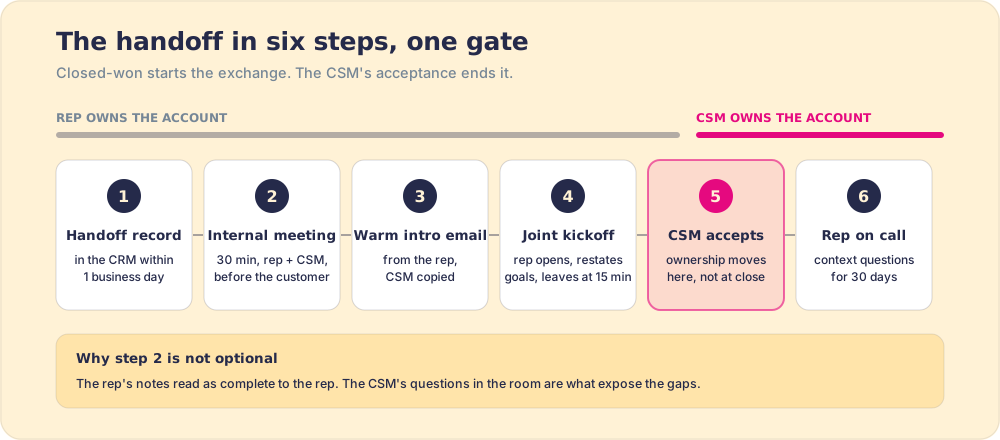
Step 2 exists because of a bias with a famous demonstration. In 1990 a Stanford graduate student, Elizabeth Newton, asked people to tap out well-known songs on a table while listeners guessed the tune. The tappers predicted listeners would name half of them. Listeners named 3 of 120, about 2.5 percent (Chip and Dan Heath, Harvard Business Review, 2006). The tapper hears the melody in their head and cannot un-hear it; the listener gets knuckles on wood. A rep writing handoff notes is the tapper. “Champion is the ops lead, wants faster close” sounds complete to the person who sat through six calls and sounds like knocking on wood to the CSM who sat through none. The internal meeting is where the CSM gets to say “I do not hear the song.”
What should a sales to customer success handoff template include?
A sales to customer success handoff template is the record the rep fills at closed-won so the CSM can run kickoff without asking the customer to repeat anything. Seven fields do the job, and the fourth is the one that prevents the week-two surprise.
| Field | What goes in it | Example entry |
|---|---|---|
| Why they bought | The trigger event and the pain, in the buyer’s words | ”Month-end reporting takes the ops team three days, and the new CFO wants it in one.” |
| Success definition | Outcome, baseline, target, date | Close reporting in one day, down from three, by the end of the first quarter live |
| Promises made | Every commitment from the sale: timeline, integrations, pricing terms, custom work | Live within 45 days; ERP integration in phase one; 10 percent discount tied to an annual term |
| What we have not told them | Known friction the buyer has not heard yet | The first week includes a manual historical data upload |
| Stakeholders | Champion, economic buyer, admin, skeptics, and where each stands | Ops lead (champion), CFO (signs, wants the one-day close), IT admin (wary of the integration) |
| Risks | Competitor still in the picture, budget timing, internal politics | A legacy tool’s contract runs four more months |
| Acceptance | The CSM’s sign-off that they can run kickoff, and the date | Accepted by the CSM, with any open questions listed |
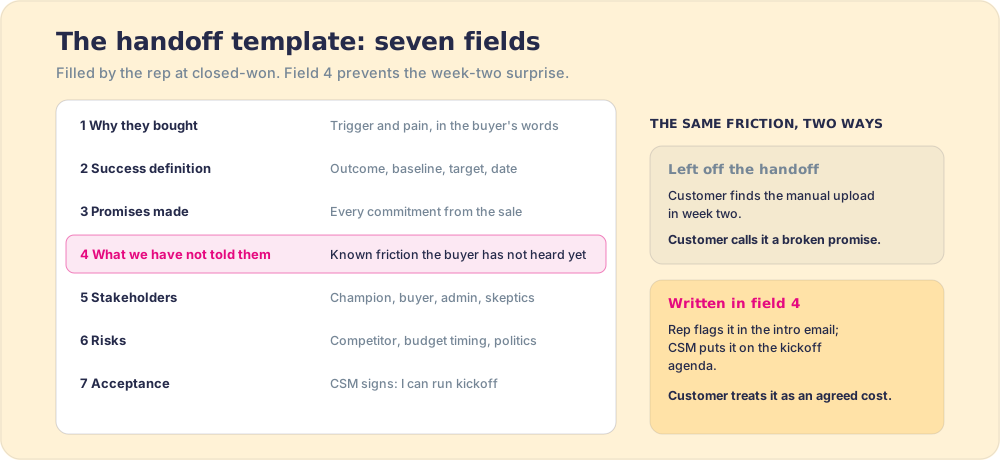
The fourth field carries the argument of this whole post. The 14-step upload from the opening scene was known inside the company; it had no place to travel. A field that asks “what have we not told them” gives the rep permission, and a prompt, to write it down, and it hands the CSM a kickoff agenda item instead of a week-two ambush. Told up front, the upload is a cost the customer agreed to. Discovered in onboarding, it is a broken promise. The fields themselves are the easy half, which is the theme running through workflow documentation: the template only works if both teams use the same one on every deal.
What should a sales to customer success handoff email say?
The introduction email moves the relationship in front of the customer, so it does more than make an introduction. It proves the context traveled. Under 200 words, from the rep, CSM copied:
Subject: Introducing [CSM name], who will lead your onboarding
Hi [Champion],
Thank you again for choosing us. I want to introduce [CSM name], copied here, who will lead your onboarding from today.
I have walked [CSM] through everything we discussed: that you want [goal, in their words], that success means [metric] by [date], and that we committed to [promise one] and [promise two].
One thing I want to flag now rather than later: [the known friction, for example, the first week includes a manual upload of your historical data]. [CSM] will walk your team through it at kickoff.
[CSM] will send a kickoff invite for [week]. I will join the first 15 minutes, and I am still your contact for anything from our conversations that needs context.
[Rep name]
The flagged-friction paragraph is the one reps resist, because it feels like reopening a closed deal. It does the opposite. A buyer who already found the purchase hard (77 percent, per Gartner, above) hears a known cost from the person who sold them, before it bites, and the CSM inherits a customer who was told the truth instead of one who is about to discover it.
What we recommend
Keep the template, and make it the seven-field version above, with the “what we have not told them” field filled on every deal. Then close the behavior gap underneath it, because the template alone treats the handoff as a paperwork problem, and the accounts that stall in onboarding stall for reasons the paperwork never held.
The evidence points at three moves. Send reps through the same onboarding the customer will run, because, in Marean’s words, a rep who does not understand the how cannot defend the why, and the deal pays the translation tax once in the room and again in the first ninety days. Run the six-step exchange with the internal meeting intact, because Newton’s tappers show what a handoff note sounds like to someone who never heard the song. And put the agreed steps where both teams meet them in the flow of the work, because our own field data puts in-flow guidance at 49 percent quota attainment against 15 percent for guidance parked in a doc, and a handoff checklist in a shared drive is the 15 percent case.
If you want the broader case for building selling behavior rather than briefing it, start with sales onboarding; for what a leaky handoff costs in dollars, read revenue leakage; for the customer’s side of the first 90 days, see client onboarding; and for the system that puts a shared process in front of both teams in the flow of the work, start with the sales enablement software guide.
Frequently asked questions
What is a sales to customer success handoff?+
Why does the sales to customer success handoff fail?+
What is the translation tax in a sales to customer success handoff?+
Should sales reps go through customer onboarding?+
What should a sales to customer success handoff template include?+
What happens during the sales to implementation handoff?+
What should a sales to customer success handoff email say?+
How do you fix a broken sales to customer success handoff?+
Your process, running itself.