Christian Palmer's Sales Enablement Tech Stack, From Loom to NotebookLM
Christian Palmer, a director of sales enablement, counted down his sales enablement tech stack on Show Me Your Stack, from Loom to NotebookLM, then described the one tool he wishes existed: a loop that scores methodology adherence on every call.
A sales enablement tech stack is the set of tools an enablement team uses to build training, deliver it, and check on real calls that reps use it; Christian Palmer's runs on Loom, Slack, Gong, Claude Cowork and NotebookLM.
Christian Palmer used to spend weeks building an onboarding program: the deck, the right material, and, in his words, “finding memes for everything else.” When his company needed onboarding it had never had, he loaded his source material into Google’s NotebookLM and asked for an explainer video, a deck, and speaker notes to go with it. Work that used to take him “weeks and weeks” came back as a draft he could edit.
Christian is a director of sales enablement at a company that sells on the Sandler methodology, and he has used Gong for close to 10 years. On Show Me Your Stack he counted down his sales enablement tech stack, the five sales enablement tools he runs his job on, then described a sixth that, as far as he knows, does not exist yet.
Across the list, his time has moved away from making training, which AI now speeds up, and toward checking on real calls whether reps do what they were trained to do.
#5 Loom: how do you coach a rep on video?
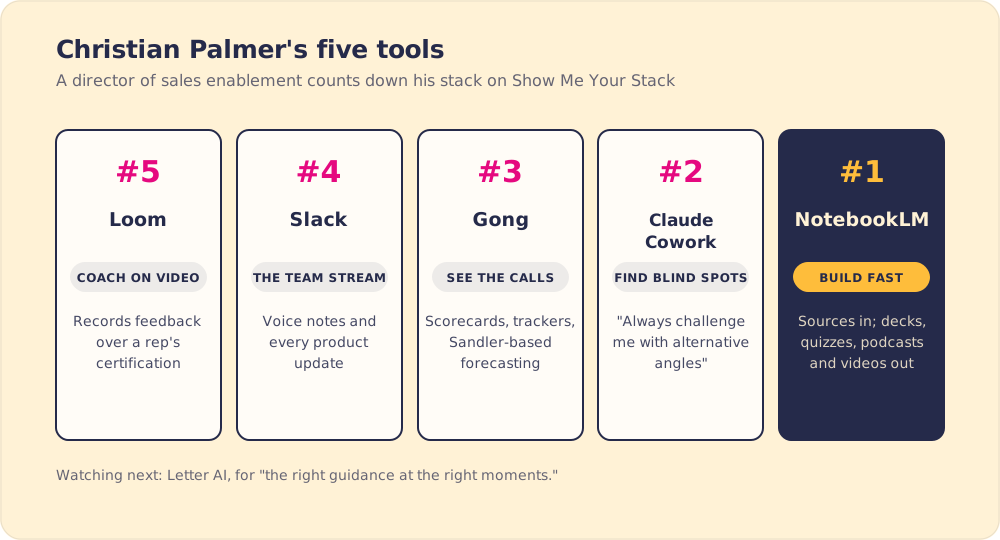
Christian’s fifth tool is Loom, the screen and camera recorder. He uses it to review product certifications. When a rep submits a recording, “I’m able to look at their recording and then record myself over uh browser page of their recording and go to certain areas of the call where you know I want to give them feedback on and pause there.” The rep gets their own call back with his voice over the parts he wants them to fix. The share link also shows him who opened it, and he takes that as a sign of who is trying.
We standardized on Loom at Supered because a GIF thumbnail of the video pasted into an email makes the message feel like it came from a person. Atlassian bought Loom in 2023 and kept it as a standalone product (Atlassian, 2023).
Christian’s habit is easy to copy. Coach on the rep’s own recording, paused at the moment in question, and skip the separate meeting about it.
#4 Slack: why does it hold the team’s stream?
Slack came fourth. “What better tool to have all the streams of consciousness within?” Christian has worked at companies with so many channels that he did not know where to post, and at others with too few. He prefers Slack to Teams for its search and because it is fun to use, down to the huddle music he compared to elevator music. He sends voice notes there all day. At his current company, product updates reach reps through Slack and no other formal channel. For a global team, “you have to have it.”
I admitted I once standardized a company on Discord. “It didn’t work, so don’t do it, guys.”
#3 Gong: can a director see training on real calls any other way?
Two or three years ago Gong might have been his number one, and it is still a mainstay. “If orgs didn’t have any other tools and they just had a CRM and a gong, you’d be okay,” he said. He has used it for close to 10 years, six or seven of them as an administrator.
He does not know another way to see whether training took. “I don’t think there’s really any other way to see unless your reps are doing it in person and you’re standing next to them, how they’re actually implementing the things that you’re enabling them upon and is it resonating for them? Are they showing improvement?” He uses scorecards, trackers and Gong’s AI builder. He recently used the builder to write a guide on video production language for a team that was unsure of it, drawn from their own calls. When he interviews manager candidates, he sends them call snippets and has them coach the rep in a role play.
The feature he singled out was forecasting on a sales methodology. His company runs Sandler, and Gong lets him set Sandler as “the underpinning of all the different velocity of deal stages.” He can see whether a deal cleared each step on time, “so then I can then go and coach back to where maybe that gap is.” I asked about the upfront contract, Sandler’s agreement at the start of a call on what will happen and how the call ends. “That bar none is probably like one out of the two most important things for that entire methodology,” he said. Our breakdown of the Sandler sales methodology covers the other steps.
Coaching research supports the way he uses it. CSO Insights found organizations with random, unstructured coaching won 43.9% of forecast deals, and the most targeted approach added 13.8 percentage points, a 31.4% lift (CSO Insights, 2018). Forecasting on the methodology tells Christian which stage to coach.
#2 Claude Cowork: what can an AI assistant teach an enablement lead?
Claude Cowork was a close second. I asked what it made possible that was impossible before. “I think probably like the biggest thing is teaching me things that I didn’t know I didn’t know.”
He got there by editing the instructions Claude keeps about how he likes to work. His first version asked for lots of analogies, and that “was like kind of overkill.” So he rewrote it: “always challenge me with alternative angles to what it is that I’m trying to achieve.” That line changed his days more than the manual tasks he has automated. He used to find his blind spots by luck and experience. Now, he said, Cowork puts them “out on a silver platter.”
If you use an AI assistant at work, his edit is worth copying. Tell it to argue with you.
#1 NotebookLM: how does it speed up onboarding?
His number one is Google’s NotebookLM. “I need to digest, analyze, comprehend information quicker than I ever thought I could before,” he said, and the tool “absolutely saved my life in propping up product knowledge, methodology knowledge, day-to-day sessions that are somewhat reactive.”
His method starts with collecting. He gathers every source on a topic, a Zoom recording, a Slack message, notes from a conversation with his boss, and loads them into one notebook. He did this when he had to learn open source video diffusion models. Then he chats with a model that knows only those sources and uses the studio tools to make flashcards, quizzes, decks, a podcast that teaches the topic, or an explainer video.
I asked why he does not do the same in Claude. He answered with the deck. “If I’m making a deck in Claude, it’s like sure it it’s going to be somewhat what of what I want,” and then he goes back and forth with it. In NotebookLM, “it’s all in one place. It’s exactly what I need and I can make different notebooks.” He does not use it in place of the LMS. It has become his “starting point.”
What goes in a sales enablement tech stack?
Christian’s five tools cover four jobs. NotebookLM, with the LMS behind it, makes the training. Slack carries it to reps along with the product news. Gong shows whether reps use it on calls, and Loom is how he coaches the gaps he finds there. Claude Cowork sits across all four as the tool that questions his plans.
He also named the floor. In the Gong segment he said a company with only a CRM and Gong would be okay. The rest of his list saves him hours. Those two tell him whether any training reached a live call.
Christian’s list covers the enablement part of a revenue team’s tools. For the CRM, content management and conversation intelligence layers the whole team buys, see our guide to the sales tech stack.

Why is Christian watching Letter AI?
The tool on his watch list is Letter AI, an AI-native LMS and content platform that raised a $40 million Series B led by Battery Ventures (Letter AI). He liked that he could drop in a Zoom recording of a product manager and get a full course back, which helps when new hires “need to know the information yesterday.” Then he described where he thinks his field is going: “it’s less about like did we build the right training and more about did we surface the right guidance at the right moments.”
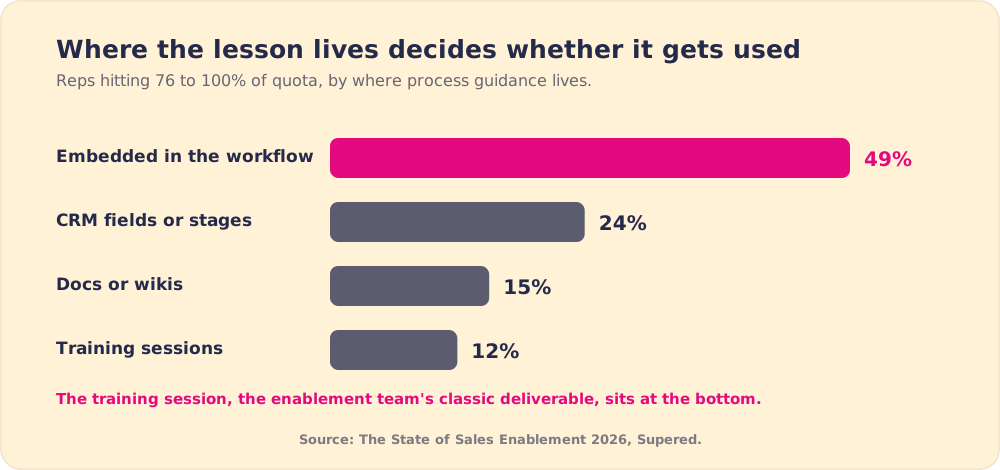
Our survey data agrees with him. When process guidance was embedded in the workflow, 49% of reps hit 76 to 100% of quota. With CRM fields or stages it was 24%, with docs or wikis 15%, and with training sessions 12% (The State of Sales Enablement 2026).
What tool does Christian wish someone would build?
I closed by asking what he would fund if he could back a founder. He said the tool he would have named a few years ago now exists. His answer today is a loop.
“I’m always thinking about how do we get granular with adherence to a sales methodology because the way somebody does an upfront contract if you’re really skilled at it is going to differ because you put your own spin on it. And I could do a keyword tracker and gong but it’s not going to pick up on all the nuances.”
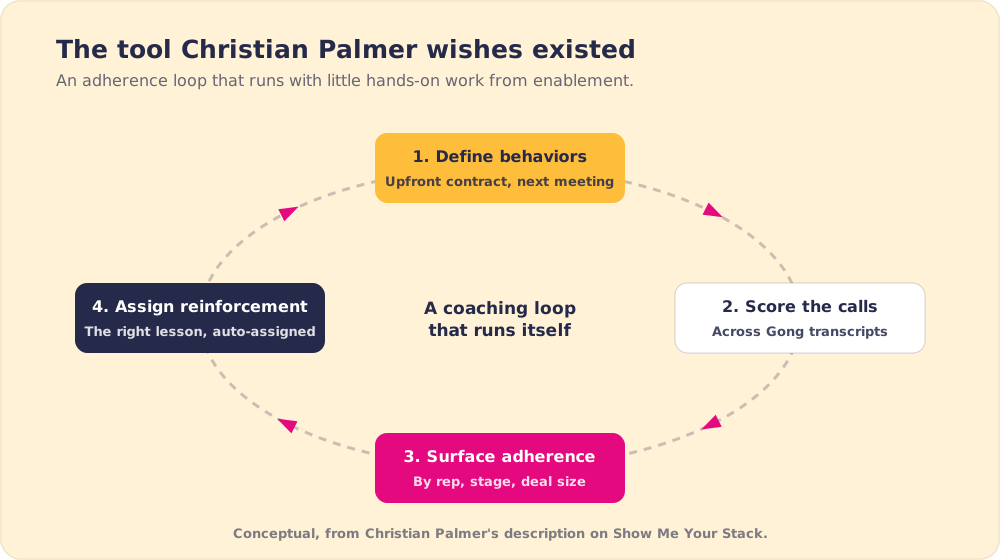
Then he laid out how it would work. Define the behaviors he wants reps to show, “kind of like scoring steps if you will.” Apply them across Gong transcripts. “Surface an adherence score maybe by the rep, the stage, the deal size.” Then “feed that back to the LMS to auto assign reinforcement content. So everything would kind of be in this like constant loop of coaching that is relatively handsoff for me.”
I told him it sounded like he was describing Supered. “I like the plug,” he said. He walks through the whole design in this part of the episode.
His point about keyword trackers applies to anyone measuring sales methodology adherence. A skilled rep sets an upfront contract in their own words, so a tracker listening for the phrase can mark the best rep as a miss. A behavior you can score is one a listener can answer yes or no on, such as whether the rep agreed on the agenda and how the call would end.
Key points from Christian Palmer’s sales enablement tech stack
- Feedback on the rep’s own recording. Loom lets him pause a certification call and coach over the exact moment.
- One home for updates. Slack carries product news and voice notes, so reps look in one place.
- Training that shows up on calls. Gong is how he sees whether reps use what he taught, and Sandler-based forecasting tells him which stage to coach.
- An AI that argues back. One instruction, “always challenge me with alternative angles,” turned Claude Cowork into a source of blind spots.
- Content from sources, fast. NotebookLM turns recordings and notes into decks, quizzes and videos, and it has become his starting point.
- Guidance at the right moment. His Letter AI line and his wished-for loop point the same way: score the behavior, then reinforce where it slipped.
What we would do with Christian’s list
Let AI make more of the training, as Christian does, and put the saved hours into the part he wants automated. Pick one behavior, such as the upfront contract, write it as a yes-or-no question, and score ten calls by hand. The misses tell you which content to build next. Our post on sales enablement KPIs covers which of those numbers to show leadership.
We built Supered to run the loop he described inside HubSpot and Salesforce. It guides reps through the process while they work and shows adherence by rep and stage.
For how the program work divides under a director, read our post on the sales enablement manager.
Frequently asked questions
What is in a sales enablement tech stack?+
Why does an enablement team need call recording?+
How do you measure sales methodology adherence?+
How is NotebookLM used for sales onboarding?+
What is the minimum sales enablement tech stack?+
Your process, running itself.


