Sales Tech Stack: It Is a Set of Behaviors, Not a Shopping List
Most sales tech stack guides hand you a category checklist: CRM, engagement, content, conversation intelligence. The boxes are the easy part. Here is what actually decides whether a stack works.
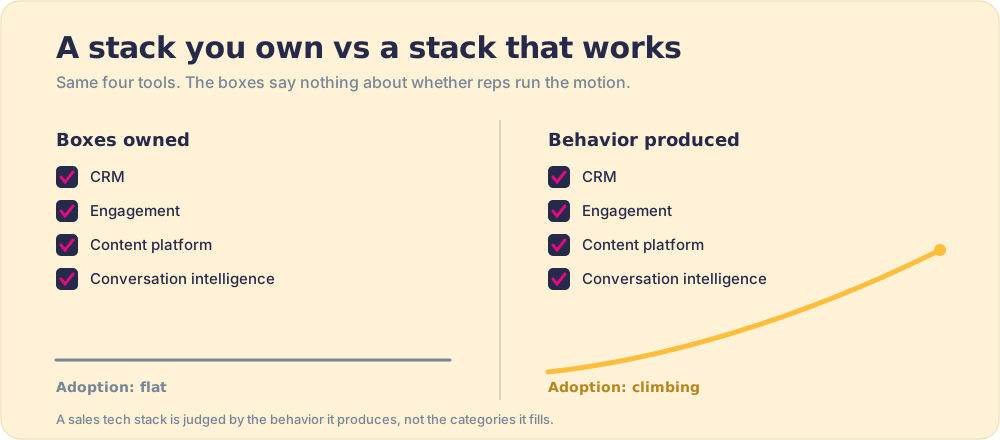
A sales tech stack is the connected set of software a revenue team uses to find buyers, run deals, and coach reps; the better definition is behavioral, the system meant to put the right next action in front of a rep in the moment of the work.
Picture a fully equipped sales tech stack. The CRM is licensed, the engagement tool fires cadences on schedule, the content platform holds nine hundred approved assets, and conversation intelligence records every call. Every box on the buyer’s guide is checked. Now watch a rep on a live call, asked a pricing question they have not seen before, and notice what they actually do: they alt-tab to a folder, type a guess into Slack, and promise to follow up. The stack has everything. The rep, in the only moment that mattered, had nothing.
That gap is the whole subject of this post, and almost no stack guide names it. The market treats a sales tech stack as a shopping list, a set of categories you assemble until the picture looks complete. Buy a CRM, add engagement, layer in content, top it with conversation intelligence, and you have a stack. The trouble is that a stack is not a collection of tools. It is a set of behaviors those tools are supposed to produce, and you can own every category and produce none of them.
So here is the more useful definition. A sales tech stack is the connected set of software a revenue team uses to find buyers, run deals, and coach reps. The behavioral version, the one that predicts whether the spend pays off, is this: a stack is the system meant to put the right next action in front of a rep at the moment of the work. Judge it by the behavior it produces, not the boxes it owns.
What is a sales tech stack, exactly?
Strip away the brand names and a sales tech stack is the software a revenue team runs deals through. It has a system of record, a way to reach buyers, a place to keep the materials reps sell with, and a way to see what happened on the call. Useful, ordinary, and worth defining in plain words before we argue about it.
The reason the behavioral definition matters is that the two readings lead to different decisions. Read the stack as a category list and every gap looks like a purchase: no readiness tool, buy one; no revenue intelligence, add it. Read it as a behavior system and the question changes to whether reps do the thing the tool was bought for. A content platform nobody opens mid-deal is not a content layer. It is a shelf. The category is filled and the behavior is missing, and only one of those shows up in a procurement review.
Some teams call it the sales enablement tech stack, or more grandly their sales enablement technology. The label changes nothing about the test. What matters is whether the software changes what a rep does.
This matters more every year because the stack keeps growing. Enablement budgets are not shrinking: 41.9% of enablement leaders planned to grow their budgets this year, per the Sales Enablement Collective’s 2025 Impact of Enablement report (SEC). More budget means more tools, and more tools mean more places a rep has to go. The hard part was never acquiring capability. It is getting capability to show up in the moment a rep needs it.
What are the layers of a sales tech stack?
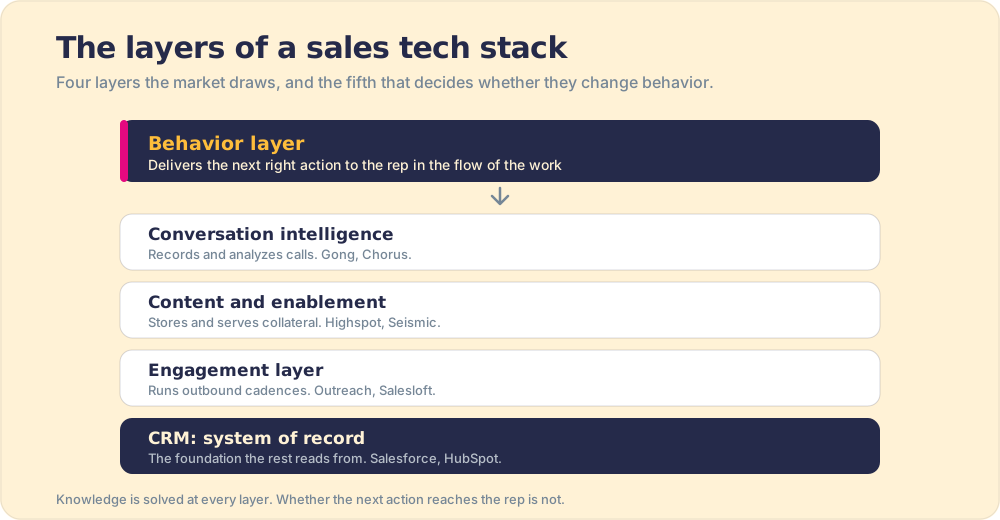
Almost every stack, however many logos it carries, organizes into four working layers plus a fifth that decides whether the first four pay off. Naming them cleanly is half the battle, because most teams buy by brand and then cannot say what job each tool actually holds.
- The system of record (CRM). Salesforce, HubSpot, and the rest. This is where the deal lives, the source of truth for stages, fields, and forecast. Everything else reads from it or writes to it. A misconfigured CRM is not a small problem; it is a cracked foundation the other three layers sit on.
- The engagement layer. Outreach, Salesloft, and similar tools run the outbound motion, the cadences, the sequenced emails and calls. They answer the question of how a rep reaches a buyer at volume without dropping the thread.
- The content and enablement layer. Highspot and Seismic, which completed their merger in August 2026 (the consolidation we wrote up here), store and serve the decks, case studies, and battlecards reps sell with. The promise is the right asset at the right moment. The reality is usually a search bar a rep does not open under pressure.
- The conversation intelligence layer. Gong, Chorus, and peers record and analyze calls, surfacing coachable moments a manager would otherwise have to dig for by hand. We covered what this layer sees and misses in conversation intelligence.
Those four are the stack as the market draws it. The fifth layer is the one that decides whether any of them change what a rep does.
- The behavior layer. This is not a category most buyer’s guides list, and it is the one that determines the return on the other four. It is the layer that takes the process, the content, and the coaching signal and delivers the next right action to the rep in the flow of the work, the instant the question arises, so following the process is the path of least resistance instead of a memory test. Knowledge is solved; any rep can find the doc and an AI can summarize it in seconds. What a rep does with three tabs open on a slipping deal is the unsolved problem, and it is the problem this layer exists to close.
Why do most sales tech stacks fail?
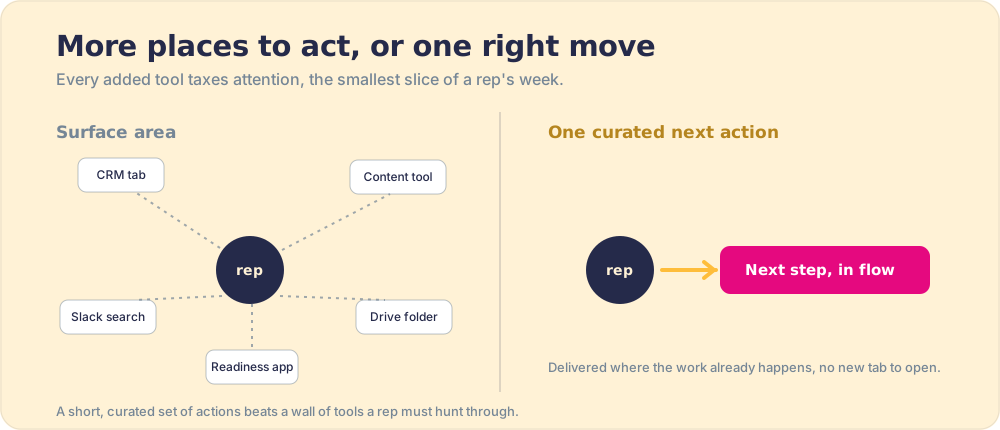
Not because a layer is missing. Because the layers add surface area faster than they add behavior. Every tool you bolt on is one more place a rep has to go, one more login, one more tab, and the math of attention is unforgiving: the more places there are to act, the less likely the right action happens in the moment it matters.
The evidence is blunt. The SEC’s 2025 Impact of Enablement report found that 79.7% of enablement leaders say their reps leave at least 40% of a stand-alone tool’s features untouched (SEC). Read that slowly. Four out of five teams are paying for capability that the people it was bought for never use. That is not a training gap you can lecture away. It is a structural one: features that live in a separate tool, away from the work, do not get adopted, because adopting them means leaving the flow of the deal to go somewhere else.
It compounds with how little of a rep’s day is even available for this. Sellers spend only about 25% to 40% of their time actually selling, the SEC reports; the rest goes to prep, admin, and hunting for information (SEC). Every tool that demands its own search, its own tab, its own moment of context-switching is taxing the smallest and most valuable slice of the week. Add a tool to “save reps time” and you can easily spend more of their time than you save, because the cost is paid in the currency of attention, deal by deal, and the savings only land if the rep actually changes what they do.
Think of it like a kitchen. A serious cook does not get faster by buying more gadgets and scattering them across three rooms. They get faster when the knife, the board, and the salt are within arm’s reach at the moment of the cut. A stack that spreads capability across four tools the rep must visit separately is a kitchen with the salt in the garage. The gear is excellent. The reach is the problem.
Sales tools versus sales enablement tools: what is the difference?
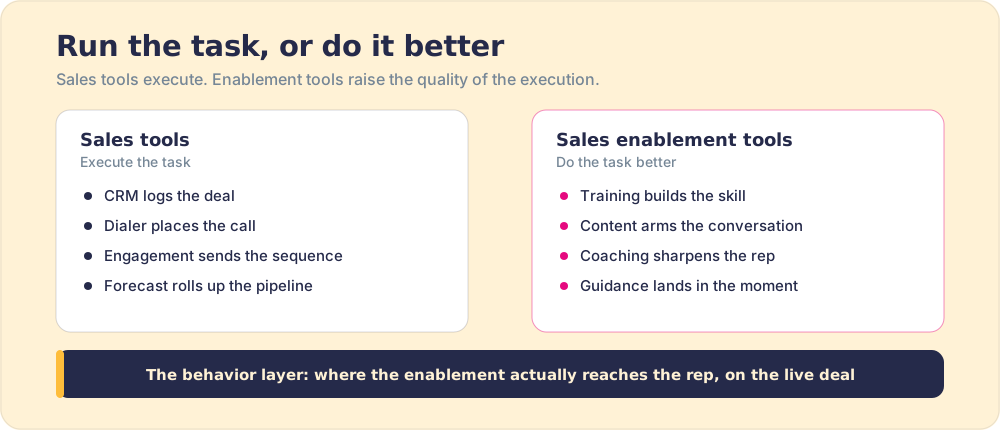
This distinction is where a lot of stack money gets misspent, so it is worth drawing cleanly. A sales tool helps a rep execute a task. A sales enablement tool helps the rep execute it better.
The CRM logs the deal; the dialer places the call; the engagement tool sends the sequence. Those are sales tools, and they run the daily motion. Enablement tools sit one layer up: training, content, coaching, and in-the-moment guidance that change the quality of how those tasks get done. A readiness platform that drills a rep on objection handling is not placing calls. It is trying to make the calls land.
In practice the line blurs, and that is fine. The moment a CRM starts surfacing the next best action or tracking which content moved a deal, it is doing enablement work inside a sales tool. The point of the distinction is not to sort logos into bins. It is to force a question for every tool in the stack: is this here to let a rep do a task, or to make them do it better? If you cannot answer, you cannot judge whether it earns its seat.
There is real evidence that the enablement layer moves numbers when it changes behavior rather than just storing assets. CSO Insights, the research arm now inside Korn Ferry, found that teams running dynamic, data-backed coaching post win rates roughly 28% higher than teams without it (cited via SEC). The lift does not come from owning a coaching tool. It comes from the coaching happening, reliably, against real deals. The tool is the means. The behavior is the cause.
How do you choose tools for your sales tech stack?
Start from the behavior you want to change, not the category you are missing. The conventional buying process runs the other way: identify a gap in the matrix, shortlist vendors, compare feature lists, pick the richest one. That process optimizes for the wrong variable. It selects the tool with the most features, when what you need is the tool whose features reps will adopt in the flow of the work.
A behavior-first selection runs in a different order:
- Name the change in what reps do. Not “we need a content platform,” but “reps should pull the right case study into a live deal without leaving the CRM.” State the behavior as something you could watch happen on a real deal.
- Ask where the tool lives. A capability reps must leave their workflow to reach is one most of them will not. Weight integration with the CRM and the tools reps already work in (Salesforce, HubSpot, Gmail, the call) above almost everything else. Meeting reps where they already work is not a nice-to-have; it is the difference between a feature used and a feature paid for.
- Pilot for adoption, not for features. Most vendors offer a trial. Use it to measure whether reps actually change behavior, not whether the demo dazzled. Watch a small group for a few weeks and count the behavior, not the logins.
- Judge it on adherence, then renew on it. A tool earns its renewal when you can show the behavior it was bought to produce is happening on real deals. If you cannot point to the change, you are paying for a shelf.
Teams whose guidance is embedded in the flow of work hit quota at 49 percent. Teams whose guidance lives in docs, wikis, and a separate tool hit quota at 15 percent. Same content. The moment of delivery is the lever.
That contrast, from the State of Sales Enablement 2026, is the whole argument in two numbers. The same guidance, embedded in the flow of work versus parked in a separate tool, more than triples the share of reps hitting quota, 49% against 15%. The variable is not which tool you bought. It is whether the tool delivered the next step where the work was already happening. A stack assembled by category will keep failing that test, because category buying never asks the question.
What the best stacks do differently
The strongest sales tech stacks are not the ones with the most layers. They are the ones where the layers reach the rep as a single, curated next action instead of four separate destinations. Buy the behavior, not the box. The CRM holds the truth, the engagement tool runs the cadence, the content and intelligence layers feed the guidance, and the behavior layer delivers all of it to the rep at the moment of the work, so the right move is the easy move.
That is also why measurement belongs at the center of the stack, not bolted on at the end. You cannot ask “which tool should we cut?” until you can answer “is this tool changing what reps do?” In our survey, teams that consistently inspect deals against a defined process hit quota at 6.3 times the rate of teams that rarely do, the largest single effect we measured (State of Sales Enablement 2026). Inspection is what turns a stack from a pile of licenses into a system you can steer. The catch is that manual inspection eats the time managers should spend coaching, which is exactly the burden the behavior layer is meant to lift.
The payoff is not internal alone. Gartner has found that 77% of B2B buyers describe their most recent purchase as complex or difficult (Gartner). A stack that delivers a consistent next step to every rep produces a consistent experience for every buyer, which is what actually closes deals in a market where buying already feels hard. The process is buyer-facing in its payoff, not just an internal control. Get the behavior right and the buyer feels it.
So when you next audit your sales tech stack, do not start by counting the boxes. Start by watching a rep in the middle of a live call and asking whether the stack reached them. That one question reorders everything. If you want the broader category overview, what sales enablement tools are maps the field; if you are picking specific platforms, the best sales enablement tools ranks them by job; and if you want the system that makes the whole stack produce behavior instead of surface area, start with the sales enablement software guide.
Frequently asked questions
What is a sales tech stack?+
What tools belong in a sales tech stack?+
What is the difference between sales tools and sales enablement tools?+
How do you choose tools for a sales tech stack?+
How much should a sales tech stack cost?+
Your process, running itself.