The GTM Engineer Builds It. The Rep Runs It. Who Inspects It?
Clay coined the GTM engineer in 2023 and about 100 job listings for the role go live every month. Here is what a GTM engineer builds, the gap the role cannot close alone, and the one thing a sales leader should ask their GTM engineer for.
A GTM engineer is the operator who builds a company's revenue systems, the enrichment waterfalls, signals, CRM automations, and workflows, using AI and no-code tools so that reps can run plays that once needed a developer.
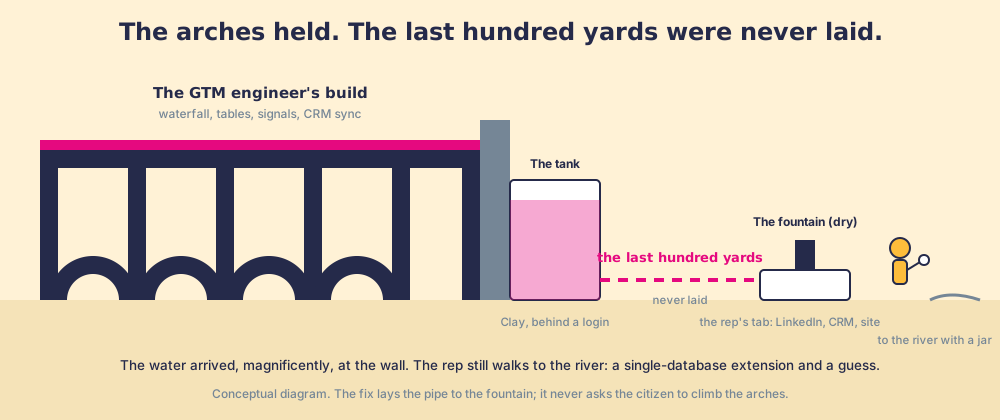
Rome’s aqueducts were a marvel of building, and they had one humbling feature: most of them stopped at the city wall. The engineers carried water fifty miles across valleys on stone arches, and then the pipes that took it the last few hundred yards to a courtyard fountain were somebody else’s problem. Where those pipes were never laid, the water arrived, magnificently, at a distribution tank, and the citizens went on walking to the river with a jar. The arches did not fail. The last hundred yards did.
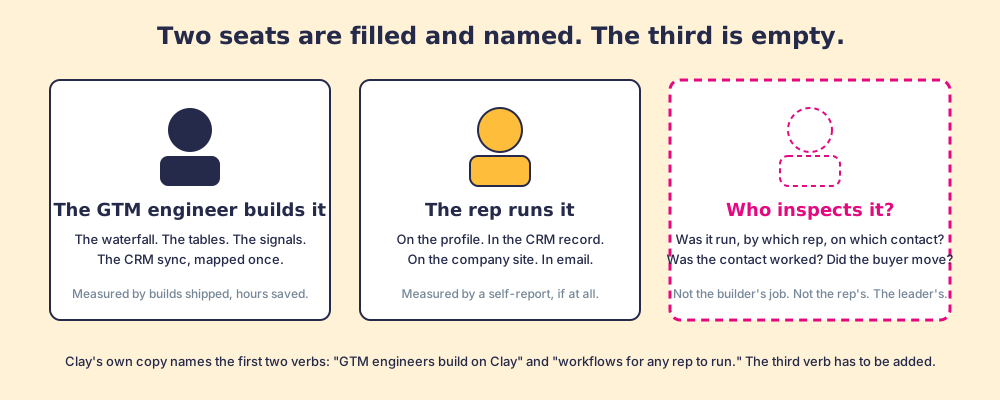
The GTM engineer is the aqueduct builder of the modern revenue team, and the last hundred yards is the rep. That is the whole argument of this post, so state it plainly up front: the GTM engineer builds it, the rep is supposed to run it, and almost no one is inspecting whether the running happens. Clay, which invented the role, says the first two halves in its own copy. The third half is the one a sales leader has to add.
What is a GTM engineer?
A GTM engineer is the operator who builds a company’s revenue systems, the enrichment waterfalls, signals, CRM automations, and workflows, using AI and no-code tools so that reps can run plays that once needed a developer. The cleanest definition belongs to the company that named the job. In Clay’s guide to the role, updated April 21, 2026, Varun Anand writes: “GTM engineers build revenue engines using AI and automation.” He adds the provenance: “Since we coined this role in 2023, it has emerged at companies like Cursor, Lovable, and Webflow. Today, about 100 GTME job listings go live every month.”
What is a GTM engineer, then, in kitchen words? A person who used to be called an ops analyst and now builds instead of maintains. Clay’s own framing of the shift is the best sentence in the piece: the job “is changing from data plumber to growth architect.” The same guide describes the role as a hybrid, “half commercial thinker, half builder,” and gives the hiring signal as “a willingness to learn by tinkering” with tools like Clay, n8n, Zapier, or SQL rather than a computer science degree. Compensation has followed the title. Apollo’s February 2026 compensation guide cites aggregators at $132,000 to $241,000 for the role, an analysis of 1,000 GTM engineering postings in October 2025 with a median of $127,500, and the Bureau of Labor Statistics median of $121,520 for Sales Engineers as the nearest established benchmark.
What does a GTM engineer build?
The workshop, and it is a good one. Clay lays the work out as three rungs, and the order matters because the first rung is where the role earns its keep:
- Data foundation. “Keep CRM and warehouse records clean, deduped, and trustworthy.” Enrichment jobs, schema audits, merge-and-purge routines, ownership rules. Clay’s guide is blunt that this is where companies stumble: they “waste 80% of their time on data hygiene” and leave 20 percent for the work that moves a number.
- Data modeling. “Collect unique data points that predict purchase, expansion, or churn.” Propensity scores, ICP attributes, AI-researched fields on the account.
- Data activation. “Deploy unique data points in revenue-generating workflows.” Automated outreach, meeting notes, churn nudges, the plays a rep runs.
The examples Clay gives from its own team are the builds a sales leader has wanted for years and never had the hours for: inbound routing that scores a sign-up for “$25k-plus potential” and auto-assigns it, signal digests piped into Slack for call prep, a script that “listens to calls, extracts firmographics, and backfills Salesforce, so reps don’t waste time in the CRM.” At Verkada, Clay reports the growth team’s GTM engineers automating “80% of SDR workflows so they can book 4x the number of meetings per month.” Grant all of it. The GTM engineer role is real, and a mid-market team with one good one has a workshop no amount of budget could have bought five years ago.
That is the good news, and it is genuinely good.
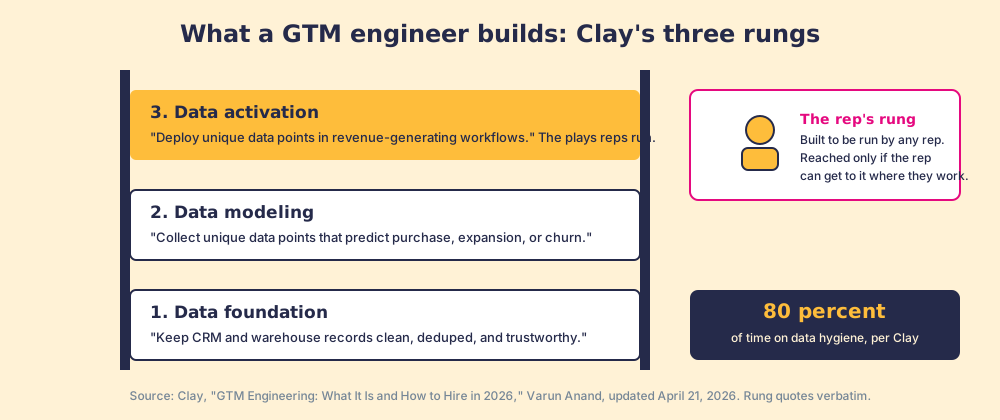
Then read how Clay measures the work, because the measure is where the seat goes empty. The guide says GTM engineers act “like an internal product team,” and that they measure success “by metrics like meetings booked and hours saved.” Both are outcomes of the build. Neither says which rep ran the play, on which contact, and what the buyer did next. That is not a criticism of the metric. It is the correct metric for a builder. It is the wrong metric for the person who owns the number, and the two are rarely the same person.
What is the gap a GTM engineer cannot close alone?
The last hundred yards. Clay’s own copy describes the intended handoff with unusual clarity: the homepage says “GTM engineers build on Clay” and, a few sections later, “Build centralized workflows for any rep to run.” The rep-prospecting page puts the waterfall a click away: “One click runs Clay’s waterfall enrichment. If one source misses, it tries the next.” The builder builds; the rep runs. Clay is explicit and consistent about this, and it is the right division of labor.
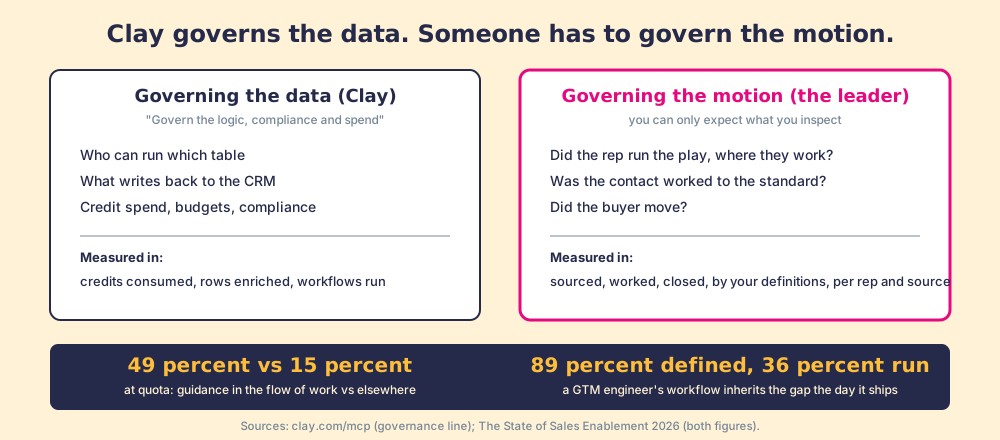
The trouble is geography. The waterfall and the premade tables live in the builder’s tool, behind a login and a tab. The rep lives on a LinkedIn profile, in a Sales Navigator search, on a company’s website, inside the CRM record, in Gmail. Between the two sits a trip, and a trip is the one thing a rep with three deals open and a buyer waiting will not take, no matter how good the destination. This is our tenet, and it is measured: in The State of Sales Enablement, teams whose guidance reaches reps in the flow of work hit quota at 49 percent, against 15 percent for teams whose guidance lives somewhere the rep must go. The same study found 89 percent of teams with a defined process and 36 percent seeing reps run it. A GTM engineer’s workflow inherits that 53-point gap the day it ships, because a workflow in another tool is a document in another folder with better plumbing.
Clay’s guide contains its own evidence for this, in a line meant as a success story. “A seller recently built a custom Clay table to track buying signals and draft outreach for top prospects. The GTME team templated the build and rolled it out org-wide within days.” Read it as a sales leader and two questions arrive at once. Of the reps it was rolled out to, how many opened it? And of the contacts it surfaced, how many were worked to the team’s standard? The guide does not say, and it is not the guide’s job to. Rolled out is a builder’s verb. Ran is a rep’s verb. Nothing in the sentence measures the second.
The guide gets one more thing right, and it is the sentence a sales leader should hold onto when the workflow goes unused: “Your revenue problems aren’t people problems. They’re systems problems.” We would sign that. When reps do not run what the GTM engineer built, the cause is distance, late delivery, and missing inspection, and the fix is to the system, never a talk with the rep about discipline. The knowing-doing gap is a system property, and so is its cure.
The GTM engineer builds it, the rep runs it. Who inspects it?
Here is where we go one step past Clay, and it is a step Clay’s own vocabulary invites. Clay’s MCP page says “Reps get the right data faster while Ops keeps control” and offers to “Govern the logic, compliance and spend.” That is governance of the data: who can run which table, what gets written back to the CRM, how many credits a rep can burn. It is necessary and Clay does it well. It is also a different question from the one that decides the number. Whether the rep, standing on the profile with the table one click away, ran the play; whether the contact it produced was worked to the standard; whether the buyer moved. Clay governs the data. Something else has to govern the motion.
A process exists only to the degree adherence to it is inspected, and a GTM engineer’s build is a process with no one at the counter. The inspection cannot be the GTM engineer’s job, because the builder measures builds. It cannot be the rep’s, because a self-report is the rep’s optimism wearing a lab coat. It belongs to the leader who owns the number, and the burden of it has to be lifted off that leader or it will be done for two weeks and then abandoned; the sales prospecting guide and the sales prospecting process post lay out the six-stage version with a signal at each stage. Inspection is mandatory. The win is automating its burden so the leader’s hour goes to coaching the rep whose worked-to-sourced ratio fell, not to reconstructing it from a credits report.
The mechanism is not mysterious, and it is old. Peter Gollwitzer’s work on implementation intentions found that a plan held as a goal (“use the new table”) loses to the situation in front of a person, while the same plan delivered as an if-then trigger at the moment its situation arises (“if I open a profile in this segment, then I enrich it here”) wins, with Gollwitzer and Sheeran’s meta-analysis of 94 studies putting the lift at d=0.65. A GTM engineer’s table is the goal. The trigger has to be delivered on the profile, at the instant the rep is looking at it, and then someone has to count whether it fired.
What should a sales leader ask their GTM engineer for?
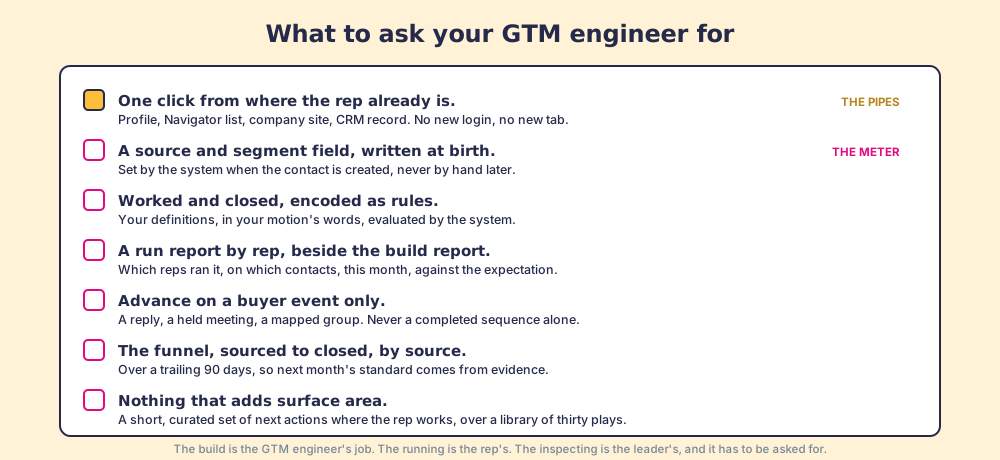
Most requests to a GTM engineer are for a build: a new table, a new signal, a cleaner sync. The asks below are different in kind. They are the pipes for the last hundred yards and the meter on the fountain, and a GTM engineer can lay most of them in the same tools they already use.
- One click from where the rep already is. The waterfall and each segment’s table reachable from the LinkedIn profile, the Sales Navigator list, the company site, and the CRM record, with no new login and no new tab. If the play requires a trip, it will be run by the two reps who like the tool.
- A source and segment field, written at birth. Set at the moment the contact is created, by the system, never by hand later. Without it the question “which sources close” is unanswerable forever.
- The worked and closed definitions, encoded as rules. Your definitions, in your motion’s words: a full sequence across two channels inside a window; an AE-accepted opportunity. Rules the system can evaluate, not lines in a kickoff deck.
- A run report by rep, beside the build report. The GTM engineer already reports what was built and how many rows ran. Ask for the column next to it: which reps ran it, on which contacts, this month, against the expectation.
- Advance on a buyer event only. A stage rule that will not let a contact move forward on a completed sequence alone; a reply, a held meeting, or a mapped buying group has to be present. This keeps the pipeline true to the buyer’s position, which is the point of tracking the seller’s activity in the first place.
- The funnel, sourced to closed, by source. Over a trailing 90 days, so next month’s segment standard comes from evidence.
- Nothing that adds surface area. A short, curated set of next actions where the rep works beats a library of thirty plays in a tool they have to open. Too many places to act is dizzying, and dizziness reads as non-adoption.
What we recommend
Two paths sit in front of a team that has hired, or is about to hire, a GTM engineer. The first is to let the role do what Clay describes, build a good workshop and measure it by builds, and to hope the reps walk to it. The evidence on this page says a share of them will, and that the share will be invisible. The second is to treat the GTM engineer’s build as the first stage of a process the team inspects: the tables and the waterfall one click from where the rep works, the definitions encoded, the run counted by rep, the funnel visible sourced to closed. Same GTM engineer, same Clay account, and for the first time an answer to whether the aqueduct reaches the fountain.
We recommend the second, and we hold Clay’s own frame while doing it. The GTM engineer builds it. The rep runs it. And the leader who owns the number inspects it, with the counting automated so the inspecting does not eat the coaching. Clay’s vocabulary already carries the first two verbs; the third is the one a sales leader has to supply, and the one no builder’s dashboard will supply for them.
That third verb is what we built Supered’s sourcing to carry, and it is the one place on this page the product belongs. Supered is the Behavior Layer, and it runs on the customer’s own Clay account: whatever the GTM engineer built, the waterfall, the premade and custom tables, is one click from the LinkedIn profile, the Sales Navigator list, the company website, or the CRM record the rep already has open, with no Clay login and nothing to learn. One click sends the enriched contact to HubSpot or Salesforce, and from there it enters the motion Supered guides and measures: the next expected action reaches the rep in the flow of the work, and the manager sees sourced, worked, and closed, by the team’s own definitions, per rep and per source. The power of the GTM engineer, in the rep’s hands, and inspected. If you have Clay, you have Supered.
For what the role builds on, read what Clay is and why it is not a data source; for the rep-side surface, the Clay Chrome extension and what a rep can reach from the page they are on; and for why the gap between a defined process and a run one is a system property, sales process adoption.
Frequently asked questions
What is a GTM engineer?+
What does a GTM engineer do day to day?+
What is the difference between a GTM engineer and RevOps?+
How much does a GTM engineer earn?+
Why do reps not use what the GTM engineer built?+
What should a sales leader ask a GTM engineer for?+
Your process, running itself.