Go-to-Market Tech Stack: Adam Chin's Five Tools, Counted Down
Adam Chin, CRO at FinStrat Management and a former CIO, runs his go-to-market tech stack on five tools. His countdown from Gemini to HubSpot, why he bets on incumbents, and why he thinks human adoption sets the pace of AI.
A go-to-market tech stack is the set of software a company uses to find, win and keep customers, and Adam Chin, CRO at FinStrat Management, keeps his to five tools chosen for what his team can adopt as well as what the tools can do.
Adam Chin has worked on both sides of the software purchase. He came up through marketing, spent a stretch as a CIO, and is now CRO at FinStrat Management, a fractional accounting and finance firm for companies between pre-seed and Series B. His job is finding founders the firm can help reach product-market fit or get ready for their next raise. I met him the ordinary way, as a prospect. I looked at about five firms like his, and FinStrat’s sales process came out on top.
So I asked him onto Show Me Your Stack to rank the five tools in his go-to-market tech stack. Adam picks software for what his people will take on as well as for what it can do, and his CIO years left him convinced that people adopting new tools, more than the tools themselves, set the pace for AI in revenue teams.
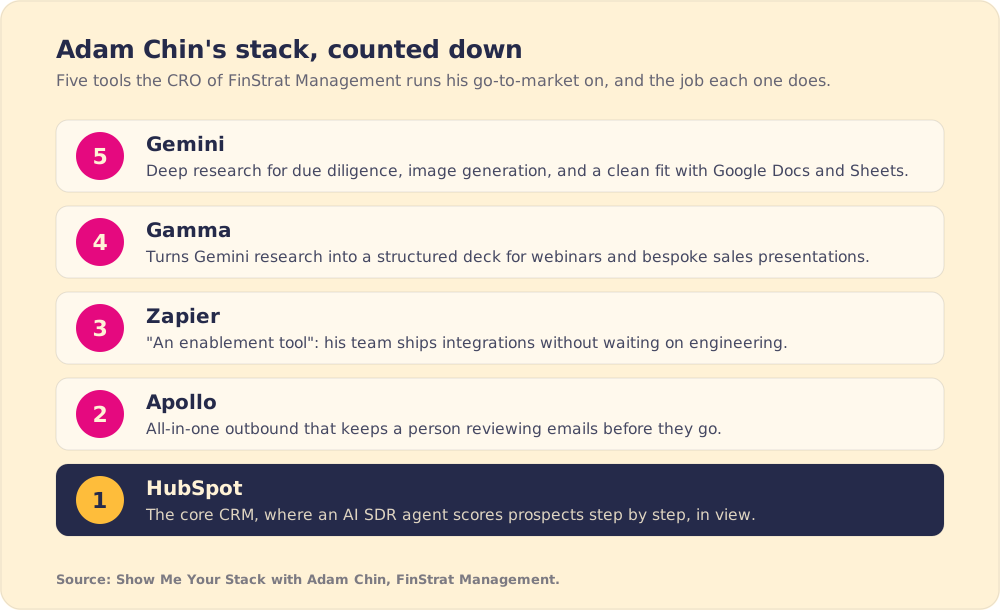
Why is Gemini Adam’s AI of choice?
Number five was a close call between Claude and Gemini, and Gemini won. Adam came to the CRO job from marketing, and he admits a bias: Google’s Nano Banana, in his words, “is incredible from image generation.” He also likes Gemini’s deep research mode, which has “proven really well at doing some general market research, due diligence.” FinStrat already runs on Google, so Gemini sits inside the Docs and Sheets the team uses all day: “it just works.” He still uses Claude a lot.
I added a bet of my own on the episode. Whoever owns the browser will be a big winner in AI, and Google owns Chrome. Adam’s reason was more practical. His team already works in Google, so they will use an AI that lives there.
What does Gamma do for a CRO?
Number four is Gamma, the AI presentation tool. FinStrat produces marketing presentations, webinars and custom sales decks for particular prospects. Adam takes research from Gemini, drops it into Gamma, and gets it “condensed down into the right kind of structure for a presentation.” “It excels at that and it kind of speeds up my process quite a bit,” he said.
The team still uses Canva, Google Slides and PowerPoint where they fit. Gamma took over one job, turning a pile of research into a deck with a clear order, which used to eat hours of Adam’s week.
Why does Adam call Zapier an enablement tool?
Number three is Zapier, and Adam files it under a heading I did not expect: “I see Zapier as an enablement tool.” He leads marketing, sales and customer success, and Zapier “enables non-technical users to bring some of these integration solutions to market much quicker.” FinStrat has an engineering team for custom API work. Zapier handles the connections that do not need engineers.
His example is the firm’s show, the Innovators and Investors Podcast. Episodes are recorded in Zoom and pass through several tools in post-production. With Zapier, his team connected HubSpot, WordPress and the content tools on their own, and Adam puts the time savings at 90%, “and I’m probably being conservative here.” He cared as much about the waiting it ended: “we’ve removed an internal bottleneck.” Requests to engineering go into a backlog, get prioritized, and “the business users are sometimes kind of left wondering.” Now the marketing team fixes its own connections.
Why does Adam keep a human in the loop on outbound?
Number two is Apollo. Adam has tried several newer AI-native outbound tools and likes to experiment rather than put “all my eggs in one basket,” but Apollo stays because it does most of the job in one place. It builds lists automatically, records calls and pushes the notes to the HubSpot deal, and drafts one-to-one emails from the ideal customer profile, pain points and language he feeds it. He conceded Apollo can be slower to pick up new AI trends, “but the reality is they they have the backing.” He expects it to catch up.
He stops the automation early. FinStrat sells B2B, on relationships, to a narrow ideal customer profile. “We want to automate top top funnel, but we have to very quickly get it over to one-on-one.” He is happy to let consumer founders with huge markets experiment with AI outbound. In his own market, “I just don’t think these complete automated tools are there yet I don’t trust it,” because “our our brand reputation very much matters.” He reviews AI-drafted emails before they go out. I asked whether he sends 10,000 emails a day. He laughed and confirmed he does not.
Why does HubSpot stay at number one?
Number one is HubSpot, and his first reason comes from years of watching companies use CRMs: “I’ve worked with CRM throughout my career and I would say 90% of the instances are using 10% of the functionality.” That is one operator’s estimate, and the measured data comes close. Pendo’s analysis of 615 software products found 80% of features rarely or never used, with 12% of features generating 80% of daily usage (Pendo, 2019 Feature Adoption Report). Gartner’s 2025 Marketing Technology Survey found only 49% of the tools in a typical martech stack actively used (Gartner, marketing technology research). Adam concludes that most of the value is already sitting inside the tools a company owns, and he wants AI to help people use more of it.
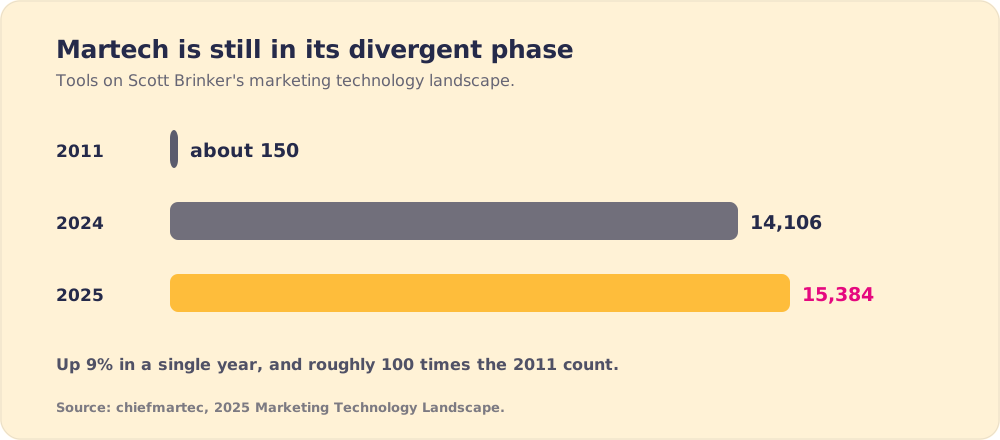
His second reason is about where the market is headed. He watched martech go through this before, when the well-known industry charts counted 7,000 and then 8,000 tools. He says AI is now in the divergent part of the cycle, where “the barrier of entry to build this stuff is so low.” He expects a convergent part to follow: “who’s going to win out when we hit the convergent part of the cycle? It’s going to be these big incumbents with all the resources.” HubSpot runs a venture program that backs startups building on its platform, and to think it is “resting on their laurels, right, I think is is ignorant.” All-in-one platforms also make training easier, which Adam weighs as heavily as features.
Scott Brinker’s annual count shows how far the divergent phase has run. His map listed about 150 martech solutions in 2011, 14,106 in 2024 and 15,384 in 2025, up 9% in a single year (chiefmartec, 2025 Marketing Technology Landscape). The number of tools is still climbing. Adam is not waiting for the market to shrink. He is doing the consolidating inside FinStrat, on HubSpot and Apollo, while those platforms keep adding functions.
Inside HubSpot, his newest build is an AI SDR agent. Website tracking and custom scoring models feed it, it pushes prospects to Apollo lists for outbound, and deals get created back in HubSpot automatically. He builds it in HubSpot’s workflow builder, one gate at a time, on purpose. “I think the blind faith in these tools that do it all for you, especially for maybe new people in the market, they’re not understanding the actual step-by-step process. And I’m a big believer in business process.” Being able to see each gate “allows us to really have a continuing improvement cycle,” he said. When a lead goes wrong, his team can find the step where it happened and change that step.
What does Adam think will slow AI down?
I asked for the emerging tool to watch, and Adam named a problem instead. New tools change people’s daily work and their business processes, and “the capabilities of AI is far uh exceeding the ability of humans to comprehend and adopt these tools.” In his words, “It’s still a human gate that we have to get through. So change management is key, training is key, getting people to understand how and why is key.”
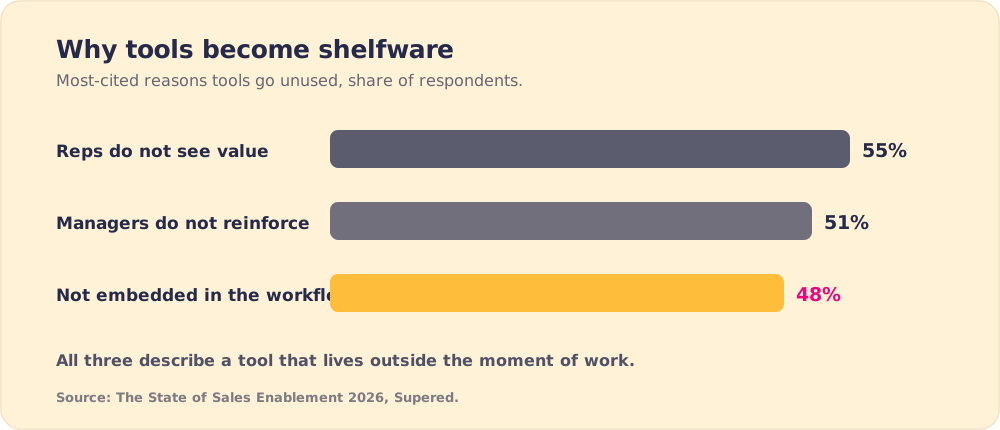
We asked sales leaders the same question in The State of Sales Enablement 2026: why do tools go unused? Their top three answers were that reps do not see the value (55%), managers do not reinforce the tool (51%), and the tool is not embedded in the workflow (48%) (The State of Sales Enablement 2026). Each of those is about people and habits, which is where Adam puts his gate.
His closing advice was about the cost of change. Leaders have to weigh “value today versus value tomorrow,” and the limit is resources, including “the switching costs and the tax you put on humans to constantly change new processes and new systems.” He wants growth, and he thinks growth needs solid ground under it: “at some point you really need to hit the J curve and scale, which means you need to have a stable foundation.” His team keeps a 20% time habit borrowed from Google and tries new tools freely, but “the quality bar it must hit to integrate it into daily operations is still pretty high.” He calls the stance “optimistic yet skeptical.” Before any switch, he thinks six, 12 and 18 months out.
His wish list, for the record, is more detailed marketing attribution: leading indicators that show which lever to pull, below the overall lifetime value and acquisition cost numbers.
Key points from Adam’s stack
- Fit with the team’s current tools. Gemini won partly because FinStrat already works in Google.
- One slow step made fast. Gamma turns research into a structured deck, a job that used to drag.
- Integrations in the hands of the business. Zapier lets marketing connect its own tools without an engineering backlog, with time savings Adam puts at 90% on podcast post-production.
- A person in the loop where the brand is at stake. Automate list building and scoring, hand off to one-to-one early, and review AI drafts before they send.
- A bet on the incumbents. Adam expects the big platforms to absorb the best AI ideas, so he builds on HubSpot and Apollo while the number of tools is still growing.
- Agents built gate by gate. He builds his SDR agent in the workflow builder so the team can see each step and improve it.
- Adoption as the limit. AI can do more than people have learned to use, so training and change management decide what a tool is worth.
How should you build a go-to-market tech stack that gets used?
A revenue leader has a few ways to go. Buy the best tool for each job and wire them together, and accept that your team will keep relearning its day. Wait for the market to consolidate, though Brinker’s count shows no sign of it yet. Freeze the stack and sit out AI. Or copy Adam: a platform at the center, a small set of tools that pay off today, a high bar for anything new, and a hard look at how much of the current stack people use.
We recommend Adam’s approach. Judge the stack by what people do inside it. Gartner found 49% of martech tools actively used and Pendo found most features rarely touched, and the top reasons our respondents gave for unused tools were all about adoption. Before adding anything, spend some of that effort getting your team into the features you already pay for.
Before you add the next tool to your GTM tech stack, write down what it replaces and how long your team will take to learn it. Then read our piece on the sales tech stack for choosing by behavior, sales enablement tools for why a bigger stack can backfire, and technology adoption for why rollouts stall.
Frequently asked questions
What is a go-to-market tech stack?+
How many tools should a GTM tech stack have?+
Will the AI sales tool market consolidate?+
Why do go-to-market tools go unused?+
Should AI agents run outbound in a GTM stack?+
Your process, running itself.

