AI SDR: It Automates the Half of the Job That Was Never the Problem
The AI SDR promises to replace your sales development team. It automates the rote half of the role brilliantly and the judgment half not at all, and it scales the exact thing that is already broken in outbound: volume.
An AI SDR is software that automates sales development outreach, researching accounts, building sequences, and sending first-touch messages, and it handles the rote half of the role well while failing at the qualification judgment that is the actual point of an SDR.
The AI SDR is the most aggressive replacement pitch in sales technology: hand the entire sales development role to software, fire or never hire the team, and watch pipeline appear. The reality, now visible in the wreckage of the first generation of these tools, is more specific. An AI SDR automates one half of the sales development job superbly and the other half not at all, and the half it automates was never the hard part. Worse, the thing it scales most easily, raw outbound volume, is precisely the thing that is already broken in outbound. So the default deployment, point the AI SDR at maximum volume, pours fuel on the fire it was sold to put out.
An AI SDR is software that automates sales development outreach, researching accounts, building sequences, and sending first-touch messages, and it handles the rote half of the role well while failing at the qualification judgment that is the actual point of an SDR. Understand which half is which, and the tool finds its real use.
The category arrived loud. Through 2024 and 2025, a wave of well-funded AI SDR tools, names like 11x, Artisan, and a dozen others, launched on an explicit replacement pitch, often personified with a stock-photo “digital worker” given a human name. The promise was a tireless rep at a fraction of a salary. The funding followed the promise: the AI sales development representative became one of the hottest sub-categories in sales tech almost overnight. Then the operating data started coming back, and it told a more specific story than the pitch. The tools were doing something real. They were not doing the thing the pitch claimed.
Why can an AI SDR not replace the whole role?
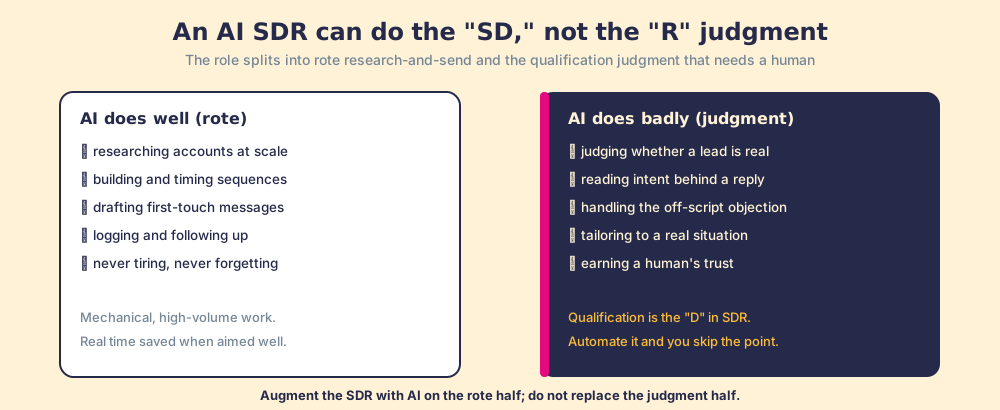
Because the sales development role splits into a rote half and a judgment half, and AI only does the first. The economist David Autor’s framing is the cleanest lens: automation substitutes for human work where it can do the whole task and complements it where it can only do a piece (Autor, on automation and labor). Autor’s deeper point, which most AI SDR marketing skips, is that the tasks hardest to automate are precisely the ones rich in tacit judgment, the things experts do well but cannot fully write down as rules. Sales development is split right along that seam. The research, the sequencing, the first-touch drafting, the follow-up logistics, all of that is codifiable, well-represented in training data, and genuinely better done by tireless software. But the “qualification” in sales development, judging whether a lead is real, reading the intent behind a reply, handling the objection that is not in any script, is exactly the tacit-judgment work Autor names as automation-resistant. An AI SDR that claims to replace the role is selling you the codifiable half and silently dropping the half that was the point.
The early results bear this out. The first wave of full-replacement AI SDRs produced striking failure reports: sales leaders documenting tens of thousands of messages with zero meetings, and one prominent vendor reportedly seeing customer churn near 80% as the tools failed to deliver (an independent 11x review, 2026). Even a leading vendor’s own CEO conceded that first-generation AI SDRs had “a pretty low response rate.” That is what happens when you automate the rote half and pretend it is the whole job: a lot of activity, little qualified pipeline. The activity itself is not the failure, capturing what was done is necessary and useful, but activity was never the finish line, and a tool that scales activity while the qualified-meeting count stays flat has scaled the wrong thing.
The honest framing for the buyer is not “AI SDR yes or no” but AI SDR vs human on a task-by-task basis. On research, sequencing, and drafting, the machine wins on cost and tirelessness. On reading a reply, judging fit, and improvising past a real objection, the human wins, and the gap is not closing fast, because that work resists being written down as rules. A team that maps its own SDR role against that line, automate this column, keep the human on that one, gets the value without buying the fantasy.
Why does scaling AI SDR volume backfire?
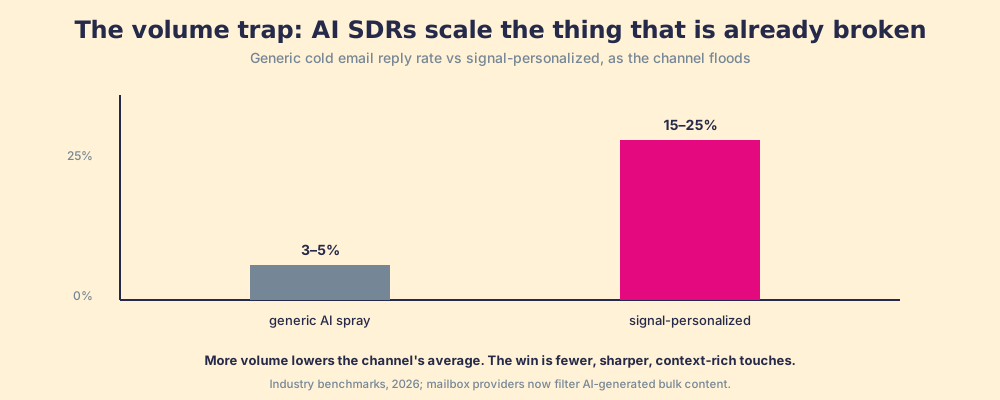
Because outbound is already drowning in volume, and an AI SDR’s easiest setting is more of it. There is a market force here that the economist George Akerlof described in his famous paper on the market for lemons: when buyers cannot tell good from bad, the average quality of what is offered collapses, and good offerings get driven out (Akerlof, on the market for lemons). A buyer’s inbox is exactly that market. As AI SDRs make generic, competent-looking outreach nearly free to produce, the inbox floods, buyers can no longer distinguish a real message from a generated one, and they respond to none of them. Mailbox providers added AI-content filters in 2025 for the same reason. The result is measurable: generic cold email now draws roughly 3 to 5 percent reply rates, while signal-personalized outreach draws 15 to 25 percent. The same collapse documented in AI sales outreach is the water an AI SDR swims in, and pumping more volume into it lowers everyone’s average, including yours.
This is the trap. The AI SDR’s headline capability, generate and send at scale, points reps toward the one behavior the channel punishes hardest.
- Volume is the broken variable. More generic touches lower the channel’s reply rate, including your own, so scaling volume scales the problem.
- Signal is the scarce one. Fewer, context-rich, genuinely personalized touches still earn replies, and that depends on judgment AI lacks.
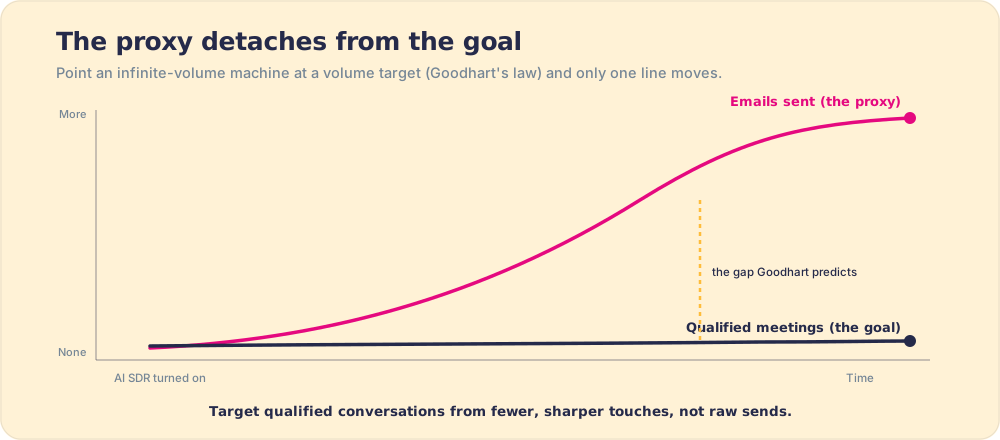
- The default setting is wrong. An AI SDR aimed at “maximum sends” optimizes the metric (emails out) and decouples it from the goal (qualified pipeline), which is Goodhart’s law in one product.
There is a name for the failure mode the volume setting creates, and it is worth saying out loud because it generalizes far beyond email. Goodhart’s law holds that when a measure becomes a target, it stops being a good measure (Goodhart’s law). Sends-per-day was once a rough proxy for SDR effort and, loosely, for pipeline. Hand that proxy to a tool whose entire advantage is producing sends at near-zero cost, and the proxy detaches from the goal completely: the AI SDR optimizes emails-out to the moon while qualified meetings flatline, because nothing in “maximize sends” was ever connected to “earn a real conversation.” The metric goes up and to the right while the thing it was supposed to stand for stays still. That is not a tuning problem you fix with a better prompt. It is the predictable result of pointing an infinite-volume machine at a volume target.
How should you deploy an AI SDR in practice?
As an augmentation of human SDRs, pointed at signal rather than volume. Let the tool do the rote work that eats an SDR’s day, the account research, the sequence building, the first-draft writing, the follow-up tracking, and give those reclaimed hours to the human for the qualification judgment and the real personalization that earns replies. Aim it at fewer, better-targeted accounts where there is genuine buying signal, not at the largest possible send list, because the largest send list is how you lower your own reply rate. The best AI SDR tools are built to support this, surfacing account context and draft touches for a human to sharpen rather than firing autonomously at a list; the teams that win with them treat them as a force multiplier on a human’s judgment, the same augmentation logic in AI sales assistant. The teams that lose treat them as a replacement for the judgment, and discover that the half of the job they automated was never the half that mattered.
What we recommend
Buy the AI SDR for what it truly does: automate the mechanical, rote half of sales development, the research, sequencing, drafting, and follow-up that drain a rep’s hours. Do not buy the story that it replaces the role, because the half it cannot do, the qualification judgment and the real personalization, is the half that was always the point, and the early full-replacement tools proved it with near-zero response rates and brutal churn. Above all, resist the tool’s strongest instinct, which is to scale volume, because outbound is already collapsing under generic volume and more of it lowers your own reply rate alongside everyone else’s. Point the AI at the rote work and at fewer, sharper, signal-rich accounts, and keep the human on the judgment. The AI SDR is a fine assistant to a sales development rep. It is a poor replacement for one, because it automates the easy half and calls it the whole job.
From here: the channel collapse in detail in AI sales outreach, the augmentation pattern in AI sales assistant, the honest jobs question in will AI replace sales jobs, and the wider frame in AI sales enablement.
Frequently asked questions
What is an AI SDR?+
Can an AI SDR replace human SDRs?+
Do AI SDRs work?+
How should you use an AI SDR?+
Your process, running itself.