SDR Playbook: Script the Plays, Then Watch the Film
Most SDR playbooks are reference binders.
A playbook that changes what reps do is short: tiers, a daily rhythm, plays written as triggers with an ending, a clean handoff, and the five things the manager checks each week. One-page template included.
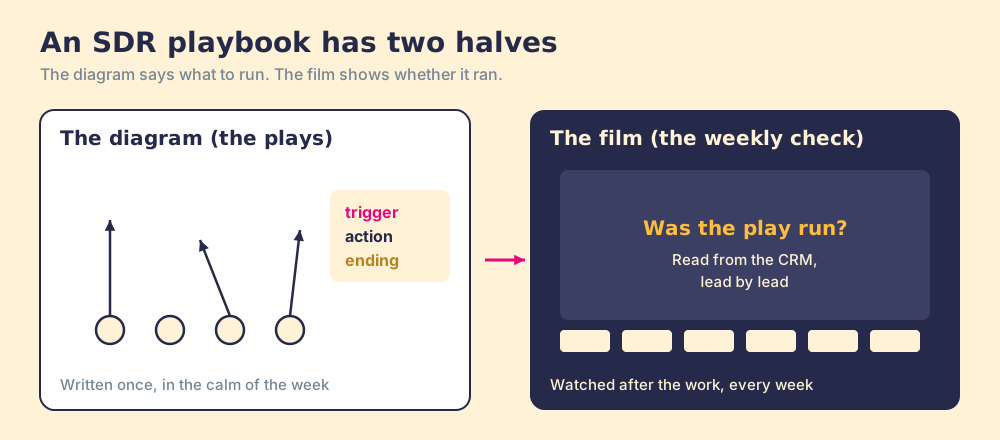
An SDR playbook is the written set of plays a sales development team runs: who to target, how the day is spent, which play fires on which trigger, when a lead goes to an account executive, and what the manager checks each week to see the plays were run.
A football playbook has two halves, and only one of them is a book. The first half is the diagrams: circles and crosses, arrows for the routes, a name for each play. The second half lives on a screen in a dark room the morning after the game, when the coaches run the film back and watch, play by play, whether the receiver ran the route on the page or the route he liked better. A football coach would never call the diagrams alone a playbook. The film is where the plays become real, because it is the only place anyone can see whether they were run.
Most SDR playbooks are the first half with the second torn out. They run thirty pages, open with the company history, and end with a messaging library, and on the day a new rep has three tabs open and a prospect on the phone, none of it is in reach.
What is an SDR playbook?
An SDR playbook is the written set of plays a sales development team runs: who to target, how the day is spent, which play fires on which trigger, when a lead goes to an account executive, and what the manager checks each week to see the plays were run. The last clause is the half that goes missing.
The templates that rank for this term are built like reference binders. Vouris’s widely shared SDR playbook template has eight sections: company overview, industry info, product and pricing, SDR process, a messaging library, best practices, metrics, and resources. Most of it is knowledge, and in 2026 knowledge is the cheap part: a rep with an AI assistant can pull the company overview in a minute. What a rep cannot look up is the decision in front of them, which account first, which play, when to stop. Keep the binder; put it in a folder. The playbook proper is the seven parts below, short enough that a rep can hold it in their head.
The case for short comes from the field data. The Bridge Group’s 2025 SDR report, drawn from 351 B2B companies, puts the median SDR at 112 activities a day, yet only 60 percent of SDRs reached quota, “the lowest reported in study history,” and held meetings per SDR fell 40 percent since 2018 (The Bridge Group, 2025). The shortfall sits in where the effort lands and whether each lead gets finished.
How do you set the ICP and tiers in an SDR playbook?
Start from closed-won deals, write the ideal customer profile as one sentence with its disqualifiers, then split the accounts that fit into tiers. Tiers exist for one reason: a rep’s hour is the scarcest thing on the team, and it should be spent where an hour changes the outcome.
- Tier 1, named accounts. Twenty to fifty accounts per rep that fit the profile and show a trigger. Each gets research by hand and the buying group mapped. Gartner puts the typical B2B buying group at 6 to 10 people, so a Tier 1 account worked through one contact is one chair at a ten-chair table.
- Tier 2, fit with a trigger. Accounts that match the profile and did something this month: hired a sales leader, raised money, changed CRM, visited the pricing page. Two or three people each, a lighter personal touch, a full cadence.
- Tier 3, fit without a trigger. The long tail. A short automated sequence, no research, recycled after a set window until a trigger moves the account up a tier.
The tier is written on the account when it enters the CRM. A tier that lives in a rep’s head drifts toward whichever accounts answer the phone.
What does an SDR’s daily rhythm look like?
The Bridge Group medians give the shape of the day: 112 activities, of which 44 are phone, 41 email, 19 LinkedIn and 8 text or other, producing 4.1 quality conversations. A rhythm turns that into blocks, so the rep never decides from scratch what to do next.
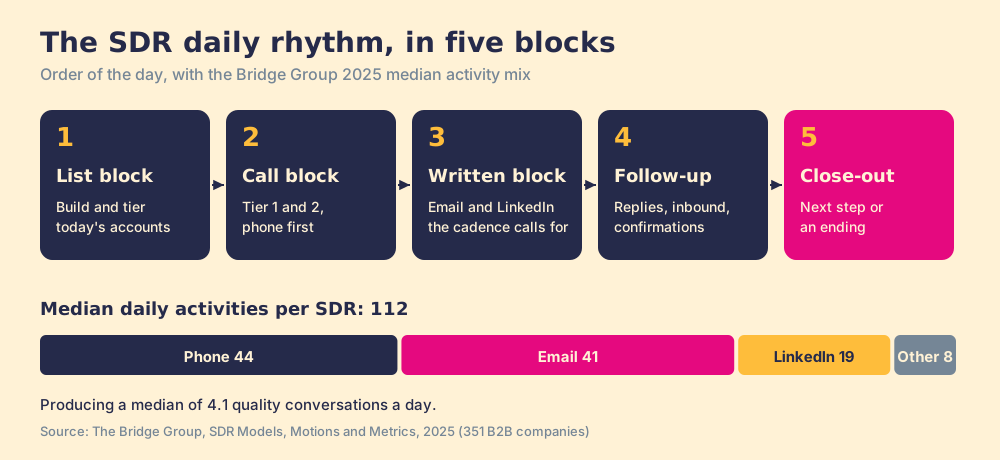
- List block. Build and tier today’s new accounts and people before any outreach, from the profile, the Navigator list, the company site or the CRM record already open.
- Call block. The phone first, while energy is highest, Tier 1 and Tier 2 only.
- Written block. Email and LinkedIn touches that the cadence calls for today.
- Follow-up and inbound block. Replies, booked-meeting confirmations, any inbound lead routed to the rep.
- The close-out. Each lead touched today gets a next step with a date, or an ending. No lead goes home without one.
Jeb Blount gives the reason the list block comes first and runs daily: as one reader’s notes on Fanatical Prospecting record it, “the prospecting you do in this 30-day period will pay off for the next 90 days.” Skip the list block for a week and the pipeline hole shows up ninety days later, long after anyone remembers why.
How should SDRs build lists?
From where they already are, with the source tagged at birth. A list Ops builds in another tool arrives cold and gets worked in the order it was pasted. A list a rep builds from the page in front of them carries the rep’s own judgment about fit, and reps work what they chose. The lead list post covers the mechanics; the playbook only needs three rules.
- Source and tier on creation. The record says where it came from and which tier it sits in, or it is not created. Without the tag, the question “which source closes” is unanswerable forever.
- Owner check before outreach. The rep confirms no other rep owns the contact or worked them last month. Two reps calling one buyer in a week is a bad first impression of the whole company.
- Contact data through a waterfall. A single database returns what it has. A waterfall asks provider after provider until one returns a verified email or phone; Clay’s marketplace, which its homepage counted at 200+ vendors on September 25, 2026, is the common way teams run one (how Clay prospecting works).
Which plays belong in a prospecting playbook?
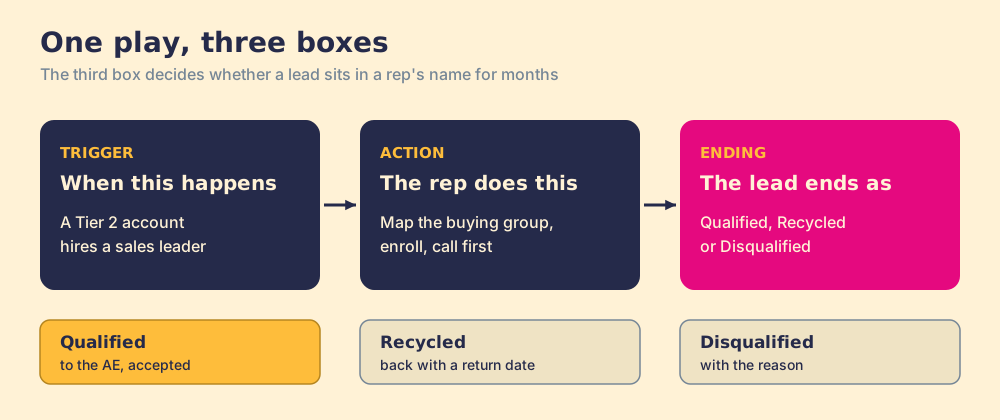
A play is a trigger, an action and an ending. The football parallel holds here: Bill Walsh’s innovation with the 49ers was scripting the first 15 offensive plays of the game (he went as far as 25) before kickoff, so the decision was made in the calm of the week and the players executed it in the noise. The psychology behind it is old and well tested. Peter Gollwitzer’s implementation intentions take the form “Whenever situation x arises, I will initiate the goal-directed response y!” (Gollwitzer, 1999), and Gollwitzer and Sheeran’s meta-analysis of 94 studies put the lift in follow-through at d=0.65. A play written as “when X, do Y” gets run. A best practice written as “be persistent” does not.
| Play | Trigger | Action | Ends when |
|---|---|---|---|
| New logo | A Tier 1 or 2 account shows a trigger | Map the buying group, enroll two or three people in the tier’s cadence, call first | Meeting held, or the cadence completes and the lead is Recycled |
| Inbound follow-up | A form fill or demo request routes to the rep | First touch the same business day, phone and email | Qualified or Disqualified, never left open |
| Job changer | A past champion or user starts at a new company | Congratulate, then reach the new team with the old context | Meeting held, or Recycled after the cadence |
| Expansion | An existing customer has teams you have not met | Find the adjacent buyers, warm intro through the customer’s champion | Handed to the account manager or Recycled |
| Stalled deal assist | An AE flags an open deal with one contact | Add the economic buyer and two peers before the forecast call | AE confirms new contacts engaged |
The inbound play earns its own line because the cost of skipping it is measured. When Harvard Business Review audited 2,241 US companies, 23 percent never responded to an inbound lead at all, and firms that reached out within an hour were nearly seven times as likely to qualify the lead as firms that waited even one hour longer (Oldroyd, McElheran and Elkington, HBR 2011). The fix is a routing rule and a same-day first touch, and speed to lead walks through both.
How many touches should an SDR cadence have?
Set the number by tier, and set the end before the start. Tier 1 runs longer and across more channels; Tier 3 runs short and automated. The sales cadence post has the research on where reps quit too early and where extra touches start to hurt. Two SDR best practices hold across every tier:
- The reason for the call, stated early. Gong’s cold-call data shows “a 2.1x higher success rate for salespeople who state their reason for calling” (Gong). A play that hands the rep the reason (the trigger) is a play that makes the opener easy.
- An ending when the cadence completes. Each lead ends Qualified, Recycled or Disqualified. Recycled means back to marketing or to Tier 3 with a date; it is an ending with a return address. A lead with no ending sits in a rep’s name, untouched, until someone cleans the CRM.
What is the handoff from SDR to AE?
The point where a team is most likely to leak, which is why the playbook defines it in writing. The Bridge Group’s 2025 medians put one SDR beside 2.4 account executives, with 82 percent of companies aligning SDRs to AE territories, and of a median 10 held meetings a month, 6 convert to a Stage 1 opportunity. The four held meetings a month that never become an opportunity are where the handoff definition pays for itself. The BDR vs SDR post makes the full case that handoffs are where deals leak.
- The qualified-meeting definition. Written criteria the AE agreed to: the role of the person, the problem confirmed, the trigger, the next meeting on the calendar. Use whichever lead qualification frame your team already speaks.
- The handoff note. Trigger, research, who else is in the buying group, what was said. The AE should never ask the buyer a question the SDR already asked.
- Acceptance, recorded. The AE accepts or returns the meeting within a set number of business days, with a reason. Returned meetings are coaching material for the SDR and the AE alike.
What does the manager inspect each week?
The film session. Five checks, every week, read from the CRM. The SDR metrics post goes deeper on each number and how to build it.
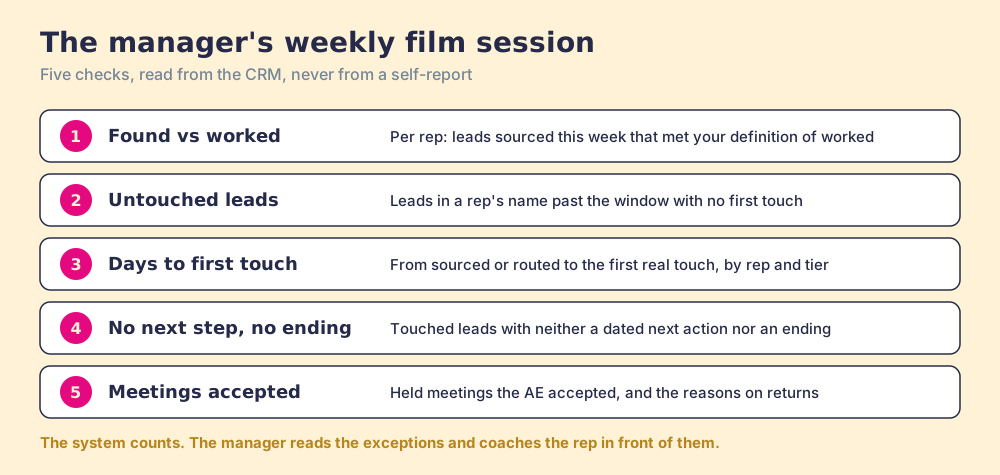
- Found versus worked, per rep. Of the leads each rep sourced this week, how many met your definition of worked.
- Untouched leads. Leads in a rep’s name past your window with no first touch at all.
- Days to first touch. From sourced (or routed) to the first real touch, per rep and per tier.
- No next step, no ending. Leads touched but left with neither a dated next action nor Qualified, Recycled or Disqualified.
- Meetings accepted. Held meetings the AE accepted, and the reasons on the ones returned.
The film session is where coaching starts. When a rep’s worked count falls, the first question is what in the system made the play hard to run: a list built badly, a cadence too long, a trigger the rep cannot see. When reps skip a play, the system needs fixing.
The one-page SDR playbook template
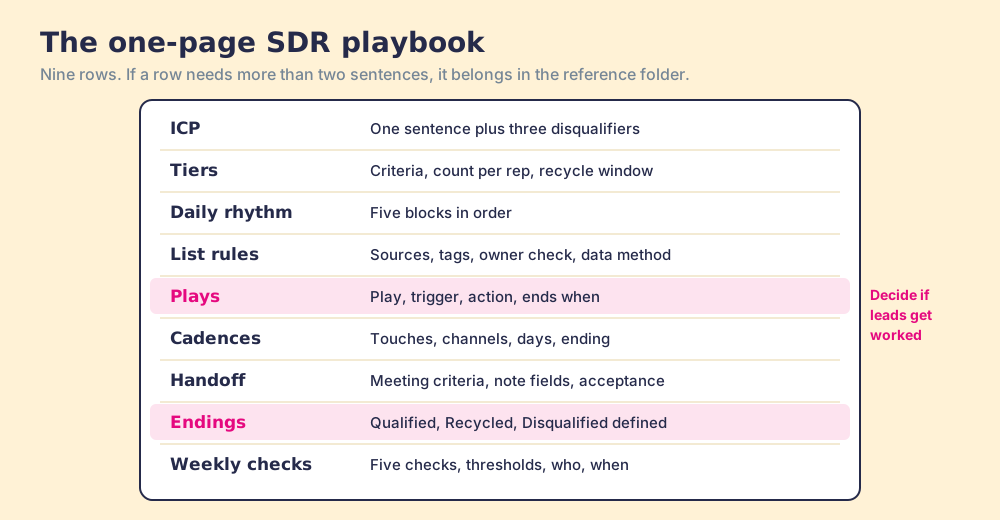
Fill each line in a sentence or two and the playbook fits on a page. If a line takes more than two sentences, it belongs in the reference folder.
| Section | Fill in |
|---|---|
| ICP | One sentence: industry, size, trigger. Three disqualifiers. |
| Tiers | Tier 1 criteria and count per rep. Tier 2 triggers. Tier 3 rule and recycle window. |
| Daily rhythm | The five blocks in order, with the share of the day for each. |
| List rules | Allowed sources, required tags (source, tier), owner check, contact-data method. |
| Plays | Four or five rows: play, trigger, action, ends when. |
| Cadences | Per tier: touches, channels, length in days, the ending at completion. |
| Handoff | Qualified-meeting criteria, handoff note fields, AE acceptance window. |
| Endings | Definitions of Qualified, Recycled, Disqualified, and where Recycled leads go. |
| Weekly checks | The five checks, the threshold for each, who reviews, when. |
What we recommend
There are three ways to run an SDR team, and they differ in where the plays live. The binder: thirty pages of knowledge, read at onboarding, run from memory after that. The page without film: the one-page template above, run well for as long as the manager has hours to count by hand, which in practice means the first month. The page with film: the same one page, with the five weekly checks counted by the system so the manager’s hours go to coaching.
We recommend the page with film. The Bridge Group’s numbers say effort is not the gap, Gollwitzer’s say plays written as triggers get run, and the HBR audit says the leads lost most often are the ones no rep touched. The weekly checks are what catch those, and they only survive past the first month if a person is not doing the counting.
For teams on Clay, that is the job we built Supered Prospector for. The GTM engineer builds the tables once in Clay, and reps run them as plays from where they work: a research play on a company website that checks ICP fit and pulls the buying committee you defined, a new-logo play from a lead that loads the right sequence, an expansion play across a customer’s teams, a job-changer play, a stalled-deal play that adds the economic buyer before the forecast call. Before pushing, the rep sees whether the person is already in the CRM, who owns them, and whether they were prospected before. One click sends the result to HubSpot, Salesforce or Pipedrive, and the manager sees each list found, worked and closed, with every lead ending the way your process says: Qualified, Recycled or Disqualified. Prospector works within LinkedIn’s terms and does not copy search results in bulk; the contact data comes from Clay’s waterfall on the customer’s Clay account. It runs inside the Supered Chrome extension, costs $45 per rep per month billed annually, and needs your own Clay account. If you are not on Clay, the template above works with any data source, and Prospector for sales leaders is the page to read when you are.
The next read is the film itself: SDR metrics, and how to see whether reps work the leads they prospect. For the role this playbook is written for, start with what an SDR is; for the stages a sourced lead moves through, the sales prospecting process.
Frequently asked questions
What should an SDR playbook include?+
What are SDR best practices that hold up in 2026?+
What is the difference between an SDR playbook and a prospecting playbook?+
How many plays should an SDR playbook have?+
What should the SDR manager inspect every week?+
How often should an SDR playbook be updated?+
Your Clay waterfall, where reps already work.