BDR vs SDR vs AE: The Title Is Not the Point
BDR vs SDR vs AE, explained: what each role does, inbound versus outbound, what they earn, and the part most guides skip, why the handoff between them is where deals leak.
In the bdr vs sdr distinction, a BDR (business development rep) sources outbound, cold pipeline while an SDR (sales development rep) qualifies inbound, warm leads, but both hand a qualified meeting to an AE, who owns closing the deal.
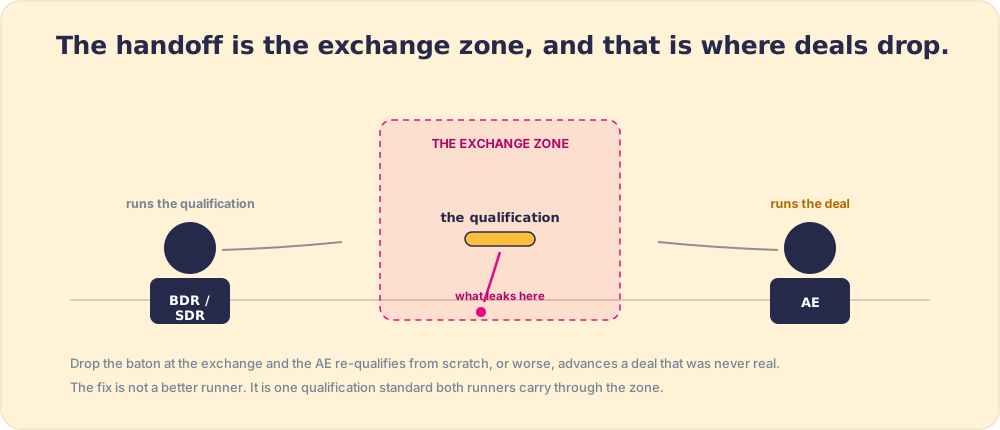
A relay team does not lose the race on the straightaway. It loses it in the exchange zone, the twenty-meter stretch where the baton passes from one runner to the next. Both sprinters can be world class, and the team can still finish last if the handoff is fumbled, because a baton on the track is a baton that finished nowhere. Coaches know this, which is why elite teams drill the exchange more than the running. The runners are already fast. The handoff is the variable.
The BDR vs SDR vs AE structure is a relay, and most writing about it obsesses over the runners while ignoring the exchange. In the bdr vs sdr distinction, a BDR (business development rep) sources outbound, cold pipeline while an SDR (sales development rep) qualifies inbound, warm leads, but both hand a qualified meeting to an AE, who owns closing the deal. That is the definition you came for, and the rest of this post gives it to you with comp numbers and a clean table. But the title on the business card is the least interesting thing here. The real question is whether the qualification motion is consistent and inspected across the seam between the roles, because the seam, not the runner, is where deals leak.
What is a BDR, and what is an SDR?
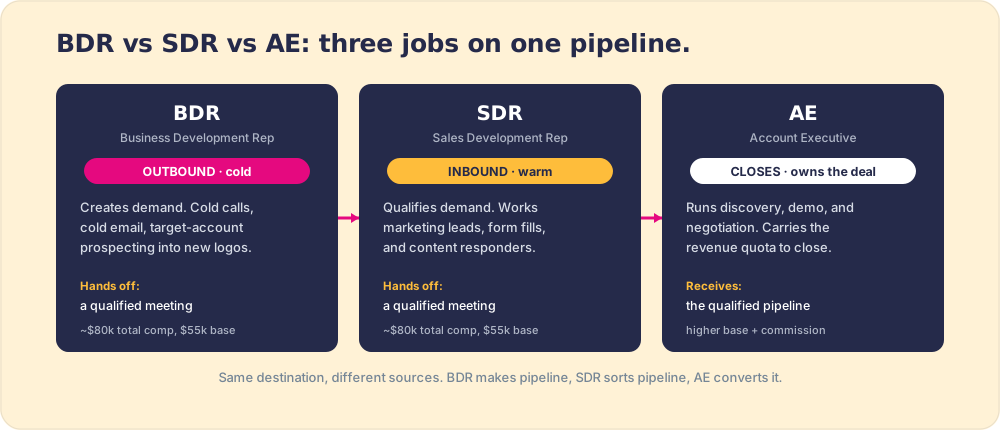
A BDR, a business development rep, is an outbound prospecting role. The job is to create demand that did not exist yet: cold calls, cold email sequences, and named target-account outreach to find prospects who fit and are worth a meeting. When one qualifies, the BDR books it for an account executive and moves to the next account. If you want the mechanics of the calling half of that job, the cold calling tips field guide covers it.
An SDR, a sales development rep, is the inbound counterpart. The job is to qualify demand that already raised its hand: the marketing leads, the form fills, the people who downloaded the report or requested a demo. The SDR sorts the genuinely interested from the merely curious and books the qualified ones for an AE. The work overlaps heavily with lead qualification, which is the discipline underneath both roles.
Here is the honest part most definitions skip. These titles are not standardized. The bdr vs sdr line, outbound versus inbound, is the most common convention, but plenty of companies use the terms interchangeably, and some flip them outright. HubSpot tends to call the inbound role a BDR; Salesforce popularized SDR as the catch-all. So before you argue about which is which, learn how your specific company defines them, because the org chart will not.
- BDR, the outbound source. Creates net-new pipeline from cold prospecting into accounts that have shown no prior interest. The hardest top-of-funnel job, and the one most exposed to rejection.
- SDR, the inbound sorter. Qualifies warm, hand-raised demand that marketing generated, deciding which leads are worth an AE’s calendar. Higher connect rates, lower demand-creation burden.
- The shared output. Both roles produce the same deliverable, a qualified meeting handed to an AE. That shared output is exactly why the handoff matters more than the title.
How is a BDR or SDR different from an AE?
The account executive is the closer. An AE takes the qualified meeting a BDR or SDR books and runs the deal from there: discovery, demo, proposal, negotiation, and close. They carry a revenue quota, where the BDR and SDR carry a pipeline or meetings quota. In the sdr vs bdr vs ae ladder, the development roles make and sort the pipeline, and the AE converts it.
Comp follows the responsibility. According to The Bridge Group’s Sales Development Metrics Report, which compiles data from hundreds of SaaS companies, an SDR earns roughly $80,000 in total compensation, of which about $55,000 is base salary, with the remainder in variable pay tied to qualified meetings and pipeline (The Bridge Group SDR Metrics Report). BDR comp sits in the same band. AEs earn meaningfully more, with a higher base and a commission structure tied to closed revenue, because they own the number. That gap is also why the development seat is the standard entry point into a sales career and the feeder for AE roles.
| BDR | SDR | AE | |
|---|---|---|---|
| Full name | Business Development Rep | Sales Development Rep | Account Executive |
| Pipeline source | Outbound, cold | Inbound, warm | Receives qualified pipeline |
| Core motion | Prospect, cold call, cold email | Qualify marketing leads | Discovery, demo, negotiate, close |
| Primary output | Qualified meeting | Qualified meeting | Closed revenue |
| Quota type | Meetings / pipeline | Meetings / pipeline | Revenue |
| Typical comp | ~$80k OTE, $55k base | ~$80k OTE, $55k base | Higher base + commission |
Why is the handoff where deals actually leak?
Because a qualification is only as good as the version that survives the pass. When a BDR or SDR books a meeting and hands it to an AE, the thing that transfers is more than a calendar invite. It is everything the development rep learned: the pain, the timeline, the budget signal, the buying committee, the reason this prospect is real. If that context drops at the exchange, the AE starts cold, re-discovers from scratch, and the buyer pays for it.
And the buyer notices. The most uncomfortable number in B2B selling is from Gartner: across an entire purchase, buyers spend only 17 percent of their time meeting with potential suppliers, and because they evaluate several vendors at once, any single sales team gets roughly 5 percent of the buyer’s total buying time (Gartner B2B buying research). You do not have spare minutes to waste making the buyer repeat their story because your two reps ran different motions. A fumbled handoff costs more than internal efficiency. It spends the buyer’s scarcest resource, their attention, on re-telling what they already told the last person.
This is the part the org-chart debate misses entirely. You can hire two brilliant runners and still lose, because the deal does not experience your titles. It experiences whether the qualification motion was consistent from the first touch to the close. A documented bar that the development rep gathers but the AE ignores is a baton lying on the track.
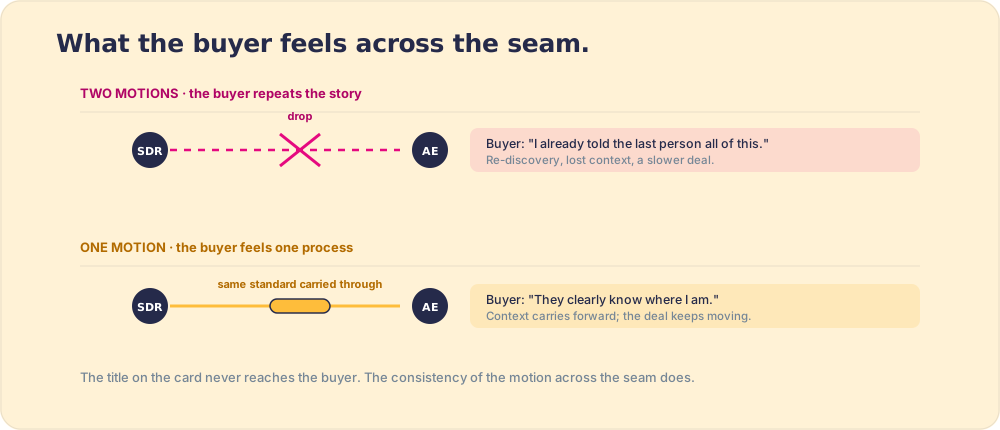
The fix is not a better runner. It is one qualification standard, carried through the exchange and inspected on both sides. That standard is what frameworks like BANT are for: a shared definition of what “qualified” means so the AE inherits a known quantity, not a guess. But a framework written in a deck does not survive the pass on its own. The State of Sales Enablement 2026 found that teams who consistently inspect deals against a defined process hit quota at 6.3 times the rate of teams that rarely do, the largest single lever in the study. The handoff is exactly where that inspection earns its keep: not “did the BDR book a meeting,” but “did the meeting clear the bar the AE needs.”
Should you split the BDR and SDR roles at all?
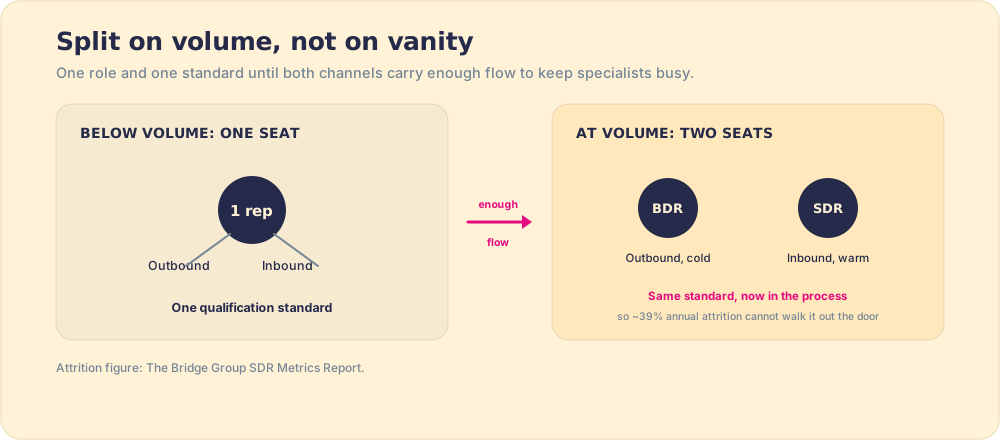
Usually not yet. Splitting outbound and inbound into separate BDR and SDR seats is a volume decision, not a maturity badge. It pays off only when you have enough flow in both channels to keep each role specialized and fully utilized. Below that, one rep covers both motions fine, and the specialization only adds a second handoff to manage. For a small team, the better move is to get the qualification standard right with one role before you multiply the roles.
There is a real cost to splitting too early, and it compounds with a number most leaders underrate: churn. The Bridge Group found SDR attrition averaging around 39 percent annually, with average tenure near 2.2 years (The Bridge Group SDR Metrics Report). Every departure resets the qualification motion for that seat, and ramp eats months before the replacement is productive. The more seams you have in the relay, and the faster the runners turn over, the more the consistency of the handoff depends on the system rather than the people. When the standard lives only in a tenured rep’s head, it walks out the door with them.
- Split on volume, not vanity. Separate BDR and SDR seats once both inbound and outbound have enough flow to keep specialists busy. Before that, one role and one standard.
- Inspection of the seam, not the seats. The org chart does not qualify anyone. A shared, inspected definition of “qualified” does, and it has to survive the pass to the AE.
- Build for turnover. With roughly 39 percent annual attrition, the qualification standard cannot live in a person. It has to live in the process the next hire inherits on day one.
What does the AI SDR trend change here?
It raises the stakes on the handoff, and it changes little else. As of 2026, AI SDR tools that autonomously prospect, research accounts, write outreach, and book meetings are real and adopting fast, with the broader AI sales-agent market projected to grow several-fold by the end of the decade (MarketsandMarkets AI sales agents). On paper, an autonomous SDR removes a runner from the relay. In practice, it moves the runner.
The early data is a warning, not a victory lap. Industry reporting on AI SDR deployments finds that a large majority churn within the first year, and the most common cause is not weak AI, it is poor data and an undefined process: when the CRM is incomplete and the qualification bar is fuzzy, the agent generates confident, personalized outreach to the wrong people at scale. That is the whole lesson in one sentence. AI amplifies the qualification process you already have. Point an autonomous SDR at a fumbled handoff and you get a faster fumble, with a better email template. The teams getting value from AI SDRs are the ones that defined and inspected the motion first, then handed it to the machine. There is more on that sequencing in the AI SDR field guide.
What we recommend
There are two ways to think about the BDR vs SDR vs AE question, and only one of them survives contact with a real pipeline. The first is to treat it as an org-design problem: get the titles right, draw clean lanes, hire to the chart, and assume the rest follows. The second is to treat it as a handoff problem: accept that the titles are non-standard and largely cosmetic, and put your attention on whether the qualification motion is consistent and inspected from the first touch through the AE’s close.
We recommend the second, and the evidence is not subtle. Gartner says you get about 5 percent of the buyer’s time, so you cannot afford a re-discovery tax at the seam. The Bridge Group says roughly 39 percent of these reps turn over every year, so the standard cannot live in their heads. And our own data says the single biggest quota lever is inspecting deals against a defined process, which is precisely what a clean handoff requires. Those all point the same way: name the roles however your company names them, then spend your real effort on the exchange zone, because the buyer experiences one process or a fumbled one, and that, not the title, is what closes the deal.
So drill the handoff like a relay coach. If you want the qualification bar that travels across it, read lead qualification and BANT; for where these roles sit in the larger motion, the sales process steps; for why a documented standard so often goes unrun, sales process adoption; and for how it all ladders into one runnable system, the sales playbook guide.
Frequently asked questions
What is the difference between a BDR and an SDR?+
What is a BDR in sales?+
What is the difference between a BDR, SDR, and AE?+
Do you need both a BDR and an SDR role?+
Are AI SDRs replacing human SDRs?+
Your process, running itself.