Sales Cadence: A Persistence Schedule With a Stopping Rule Built In
A sales cadence is usually treated as a question of how many touches. The two findings that matter are where reps quit too early and where extra touches start doing harm. Here is how to design between them.
A sales cadence is a structured, timed sequence of outreach touches across channels used to engage a prospect, and a good one is designed around two facts: most reps stop before the touch that would have worked, and past a point more touches stop helping and start eroding trust.
A sales cadence is usually argued about as a number: how many touches, how many days, how many emails versus calls. That framing misses the two findings that decide whether a cadence works, and they pull in opposite directions. The first is that most reps quit far too early, abandoning prospects who would have replied to one more touch. The second is that past a certain point, more touches stop helping and start doing harm. A good cadence is not a number; it is a structure designed to live in the narrow band between quitting too soon and pushing too long.
A sales cadence is a structured, timed sequence of outreach touches across channels used to engage a prospect, and a good one is designed around two facts: most reps stop before the touch that would have worked, and past a point more touches stop helping and start eroding trust. Build for both, and the cadence does the thing instinct cannot.
A cadence is a dose. Too little does nothing: the patient feels no effect and you conclude the medicine failed when it was never truly given. Too much poisons. The right dose is a band, and the art is staying inside it. A cadence is the dose schedule for a prospect’s attention, and almost every team gets it wrong in one of the two directions, usually the first, the under-dose, where the rep stops before the medicine takes.
Why does a sales cadence need a defined number of touches?
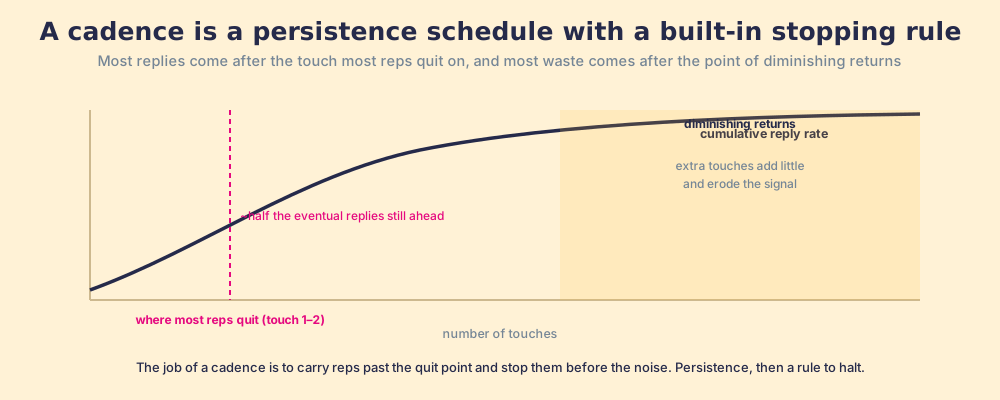
Because human persistence runs out before opportunity does, and a cadence exists to override that. Study after study of outreach finds that a large share of eventual replies arrive on the third, fourth, or fifth touch, well past the point where the average rep, following instinct, has already given up. The often-cited figure from sales-development research is that most conversions require five or more follow-ups, while the majority of reps stop after one or two (on follow-up persistence). The Brevet Group’s widely cited synthesis puts the same number more bluntly: 80 percent of sales require five follow-up calls after the meeting, and 44 percent of reps give up after one (The Brevet Group). Read those two figures together and you have the entire problem in one sentence. The work needs five; the median rep quits after one. The gap is rarely about motivation or talent. It is a memory and attention failure, and a cadence is the cure for it.
Left to memory and mood, reps follow up once or twice on a prospect who seemed warm and abandon the rest, which means they systematically quit on the touches that convert. There is a cognitive reason this happens, and it is worth naming, because once you see it you stop treating the fix as a pep talk. A single non-reply carries almost no information. A second non-reply feels like a verdict. The mind reads two silences as a closed door and reassigns the rep’s attention to the prospect who did answer, which is the wrong allocation, because the answered prospect needs you less. The cadence’s first job is to carry the rep past their own quit point, on the prospects who went silent, because the data says the reply they wanted was often one touch beyond where they stopped.
But persistence is not a free variable you maximize, which is the half most cadence advice skips. The same curve that rewards passing the early quit point flattens hard, and then turns negative. Past a point, each additional touch adds almost nothing to the reply rate and starts subtracting from something else: the prospect’s goodwill and your domain’s reputation. We traced this collapse in AI sales outreach, where flooding the channel drove average cold-email reply rates down to 3.43%. A cadence with no ceiling is how a rep turns a cold prospect into someone who blocks the domain.
How do you build a sales cadence that works?
Design the four variables around that band, and add the one most cadences leave out. These are the parts a sales cadence template should specify.
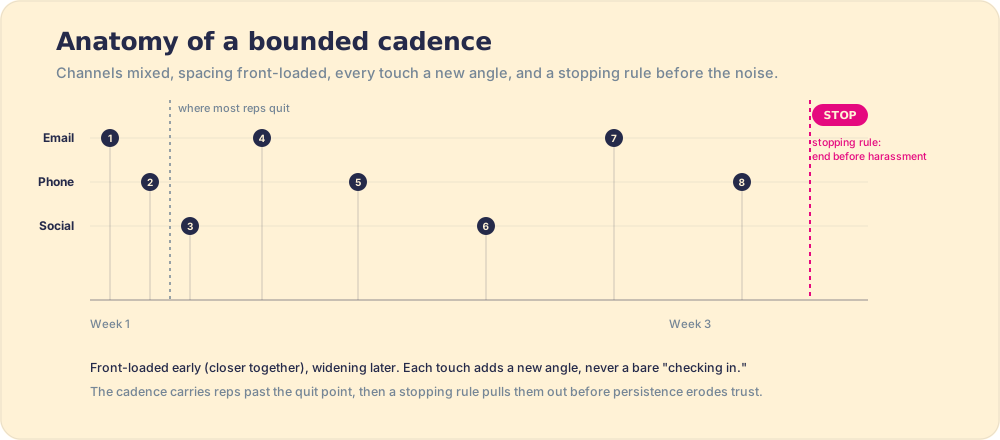
- Touch count past the quit point. Enough touches to clear where instinct gives up, commonly six to ten, not the one or two reps default to.
- A channel mix, not a single thread. Vary email, phone, and social so you are not relying on one channel a prospect ignores. Single-channel cadences fail silently when that channel is dead to them.
- Front-loaded spacing. Touches closer together early, while interest is fresh, then widening, rather than an even drip that loses momentum.
- A message progression. Each touch adds a new angle, a different value point, a relevant trigger, never a bare “checking in again,” which adds volume without adding a reason to reply.
- A stopping rule. The part almost every cadence omits: a defined point at which a non-responsive sequence ends, so reps stop before the diminishing-returns zone instead of running it to the trust-eroding end.
The deeper truth under all five is that a cadence is part of the sales process, not a standalone outreach trick, and like any process its value is whether reps run it consistently rather than improvising follow-up deal by deal. Good sales cadence examples all share that discipline: a defined, bounded rhythm, run the same way every time. Whether you call it an outreach cadence or a sequence, the rule is identical: persistence, made consistent and given a ceiling.
Why does the channel mix matter more than the touch count?
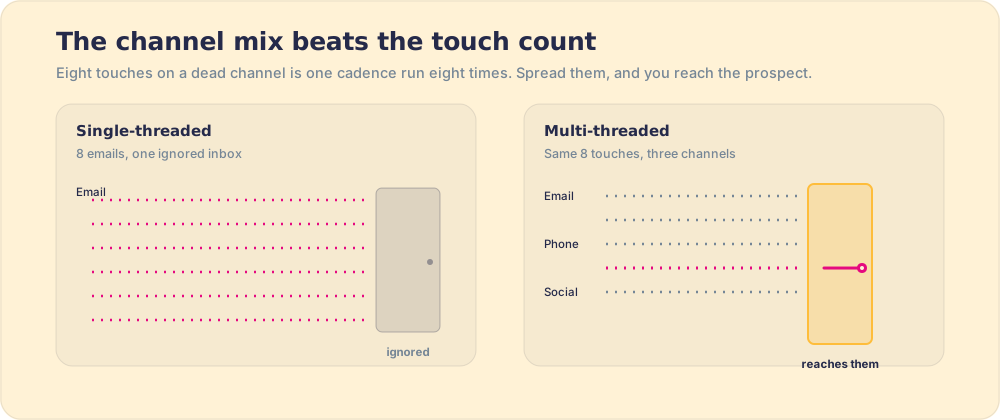
Because a touch on a dead channel barely registers. It is a wasted entry in a log that makes the cadence look busier than it is. A rep who fires eight emails at an inbox the prospect ignores has run a one-channel cadence eight times over, when the cadence on paper promised eight different touches, and that difference decides the whole result. Single-threading the channel is how a disciplined-looking cadence fails without anyone noticing: the spacing is right, the message progression is right, the count is right, and none of it lands, because the one door you keep knocking on is the one nobody is standing behind.
The fix is to spread the touches across email, phone, and social, so the sequence routes around whichever channel is dead to a given prospect. This is not a preference; it is how attention distributes. Some buyers never open a cold email and answer a LinkedIn message the same hour. Some screen every unknown number and read every email. You do not know which kind a given prospect is until they reply, so the cadence has to cover the spread rather than bet on one channel. The same logic extends inside the account: research on complex deals from the Corporate Executive Board found the typical B2B purchase now involves six to ten decision-makers, which means a cadence aimed at a single contact is single-threaded on the person as well as the channel, and one silent stakeholder can stall a deal a perfect email sequence never reaches.
What we recommend
Stop treating your sales cadence as a touch-count to maximize and design it as a bounded persistence schedule. Set the number of touches high enough to carry reps past the point where they instinctively quit, because the replies they want are usually a touch beyond it, and set a stopping rule so persistence does not curdle into the harassment that erodes trust and deliverability. Mix channels, front-load the spacing, and make every touch add a new reason rather than repeat the last. Then do the unglamorous part: get reps to run it consistently, because a cadence improvised from memory reproduces exactly the two errors it was meant to fix. Persistence past the quit point, a rule to stop before the noise, run the same way every time. That is the whole design.
From here: the process it lives inside in sales process steps, why more volume backfires in AI sales outreach, the engagement tools that run it in sales engagement platform, and the adherence underneath in sales process adoption.
Frequently asked questions
What is a sales cadence?+
How many touches should a sales cadence have?+
How do you build a sales cadence?+
What is the difference between a sales cadence and a sales sequence?+
Your process, running itself.