Speed to Lead: The Leads You Lose Are the Ones Nobody Answers
Speed to lead gets sold as a sprint.
Five studies from 2007 to 2026 say the bigger loss is the lead nobody answers at all, and the causes the researchers named are routing and rules. What to measure, what a good lead response time is, and the rules that close the gap.
Speed to lead is the time between a buyer raising a hand (a form, a demo request, a chat) and the first real contact from your team, and it is best measured as the share of leads touched inside a written deadline, with unanswered leads counted as misses.
Seven lenders once bought the same mortgage lead. The man behind it was the president of InsideSales.com, who had filled out a form with a top lead provider asking for quotes. The first lender called 30 minutes later. The last called three days later, and the study he was helping run asked whether that lender knew its odds of qualifying him were “several thousand times less than if they had called in five minutes” (MIT and InsideSales.com Lead Response Management study, 2007). Seven companies paid for one raised hand, and the fastest took half an hour.
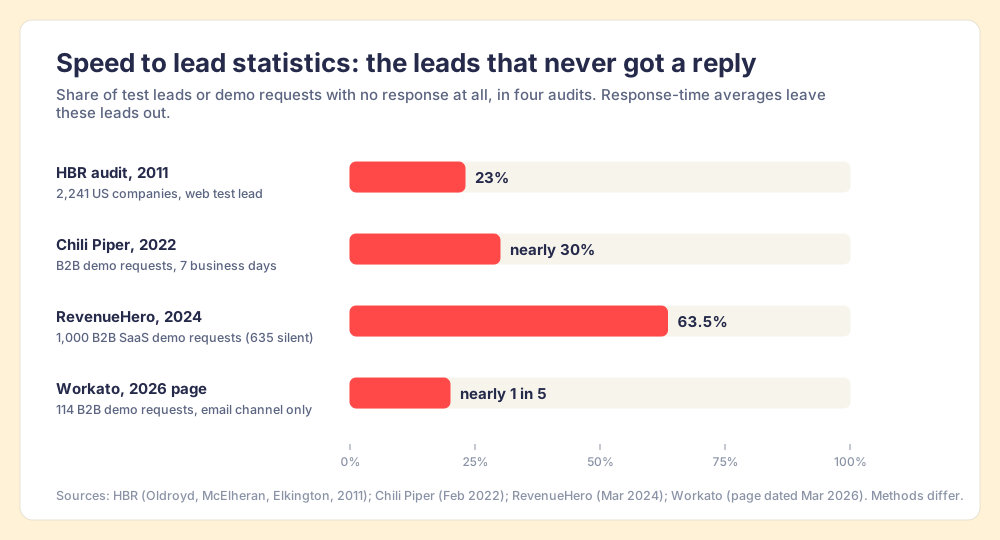
Speed to lead is the time between a buyer raising a hand (a form, a demo request, a chat) and the first real contact from your team, and it is best measured as the share of leads touched inside a written deadline, with unanswered leads counted as misses. The second half of that definition is where this post parts company with most of what ranks for the term. The usual advice treats speed to lead as a sprint: faster reps, faster dialers, an AI that replies in seconds. The studies the advice quotes say something less comfortable. Across four audits from 2011 to 2026, somewhere between a fifth and nearly two thirds of leads got no reply at all, and the averages leave those leads out. The authors of the most-quoted study also named the causes, and none of them was effort.
What is speed to lead, and when does the clock start?
The clock starts when the buyer submits, and it stops at the first real contact: a call that reaches a person, a personal email, a booked meeting. An autoresponder does not stop it. Neither does a lead being assigned.
That sounds obvious until you look at what your CRM measures. HubSpot sets a property called Lead response time automatically, and its own definition is “Time it took the current owner to do first qualifying engagement” (HubSpot knowledge base, default contact properties). The phrase to read twice is “current owner.” A lead that sat unowned for three hours, or bounced between two reps, may still report a fast number for the rep who finally picked it up. Before you put speed to lead on a dashboard, check which event starts your clock. If it starts at assignment, it hides the routing delay, and routing is where most of the time goes.
What do the speed to lead statistics say?
Five studies carry nearly all the lead response time numbers you will see quoted. They differ in age, method and who paid for them, so here they are side by side, each checked against its own source on 2026-10-02.
| Study | Year | Sample | Headline finding | No reply at all |
|---|---|---|---|---|
| MIT and InsideSales.com (Oldroyd, Elkington) | 2007 | 6 companies, 15,000+ leads, 100,000+ call attempts | Odds of contact drop 100 times from a 5-minute to a 30-minute call; odds of qualifying drop 21 times | Not measured |
| HBR, “The Short Life of Online Sales Leads” | 2011 | 2,241 US companies audited; 1.25 million leads at 42 firms | 37% replied within an hour; within an hour, nearly 7 times as likely to qualify as an hour later | 23% |
| Chili Piper, B2B vendor response times | 2022 | Demo requests across software categories | 7% replied instantly; average 4 hours 50 minutes among responders | Nearly 30% |
| RevenueHero, 1,000 B2B SaaS companies | 2024 | 1,000 demo requests, built with Clay | 365 replies; average 1 day, 5 hours, 17 minutes | 63.5% |
| Workato, 114 B2B companies | 2026 (page date) | 114 demo requests | 1 of 114 sent a personal email inside 5 minutes; 31% called at all | Nearly 1 in 5 by email |
Sources: MIT and InsideSales.com, HBR, March 2011, Chili Piper, February 2022, RevenueHero, March 2024, Workato, March 2026.
Three things stand out once the studies sit in one table.
- Old evidence carrying a new market. The two studies with academic authors are from 2007 and 2011, and both were co-run by InsideSales.com, a company that sold lead-response software. They are still the best evidence on decay, and the direction has held in every audit since. Trust the direction more than the exact multipliers.
- Blended citations. The studies get merged in the retelling. One of the top-ranking speed to lead guides credits HBR with “15,000 unique leads and 100,000” calls, which is the MIT sample. The 42-hour figure often quoted as today’s B2B average is HBR’s 2011 number across industries, and it counts only firms that replied within 30 days.
- Averages that exclude the misses. Chili Piper’s 4 hours 50 minutes is “excluding non-responders.” HBR’s 42 hours covers responders only. A lead that never gets a reply cannot have a response time, so it drops out of the average, and the worst outcome makes the average look better.
Two other numbers travel widely: a 391% conversion lift for calling in the first minute, and “78% of people buy from the first company to contact them.” Neither came with a method we could read on 2026-10-02, so neither is in the table.
One fair caveat on the missing replies. RevenueHero went back after a reader pointed out that some of its 635 non-responders may have screened the request out on purpose with enrichment, and many of those companies were not a fit for RevenueHero’s pitch. Silence can be a decision. The trouble is that from the buyer’s side, a decision and a dropped lead look identical, and a manager cannot tell them apart unless the owner recorded which one it was.
Why are teams slow to respond to leads?
The HBR authors answered this in the same 2011 article, and the answer gets quoted far less than the seven-times figure. They listed three reasons: “retrieving leads from CRM systems’ databases daily rather than continuously; sales forces focused on generating their own leads rather than reacting quickly to customer-driven signs of interest; and rules for distributing sales leads among agents and partners based on geography and ‘fairness’” (HBR, 2011).
Read those as a building. A lead walks in the door and has to pass through three waiting rooms before anyone speaks to it. The first is the overnight batch, where it waits for the next pull. The second is the rep’s own prospecting list, where an inbound lead competes with work the rep chose. The third is the fairness queue, where a rule decides whose turn it is or whose territory the lead belongs to. No one in the building is slow. The floor plan is.
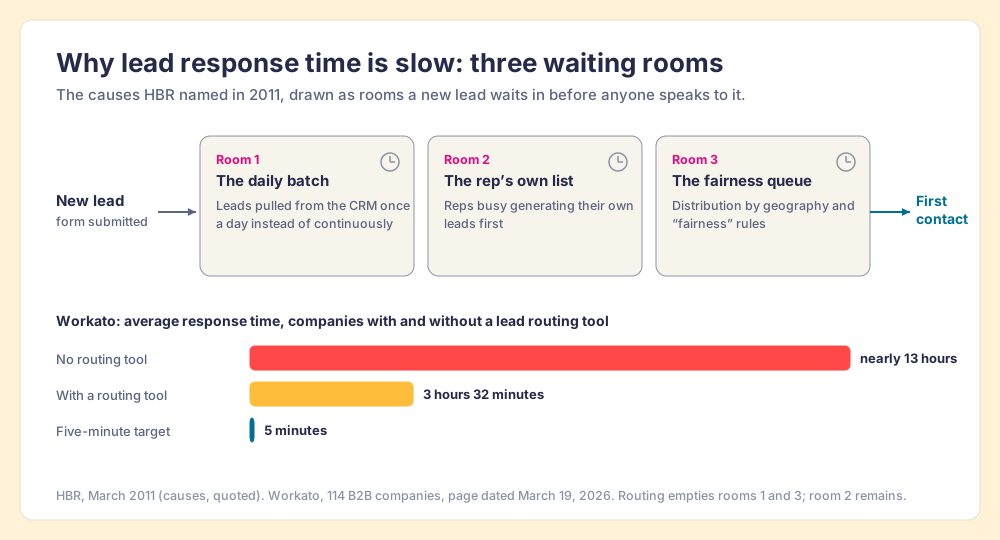
Fifteen years later, the floor plan still explains the numbers. Workato found that companies using a lead routing tool averaged 3 hours 32 minutes to respond, against nearly 13 hours for companies without one. Routing removes the first and third rooms. It does not empty the second, which is why 3 and a half hours is still forty times the five-minute target. A rep who is mid-call on their own prospect will finish the call, and should. The fix for the second room is a rule about what happens when the owner cannot get there. Our guide to lead routing covers how to design the assignment side.
What is a good lead response time?
A fire department does not get to five minutes by asking firefighters to run faster. The NFPA 1710 standard, as the District of Columbia’s fire department applies it, splits the response into pieces with a target for each: a “Turnout Time” of 60 seconds from the alarm to the truck rolling for a medical call, and a “Travel Time” of 240 seconds for the first unit, which together make a 300-second response. Then the department reports the share of calls that meet the target, and the bar is not less than 90% (DC Fire and EMS, NFPA 1710 benchmarks, 2016).
Sales teams can borrow two things from that design. The five minutes is cut into segments, and each segment has an owner: dispatch owns processing the alarm, the station owns turnout, the crew owns travel. And the measure is a percentage of calls inside the target. An average would let three fast responses hide one engine that never left the station.
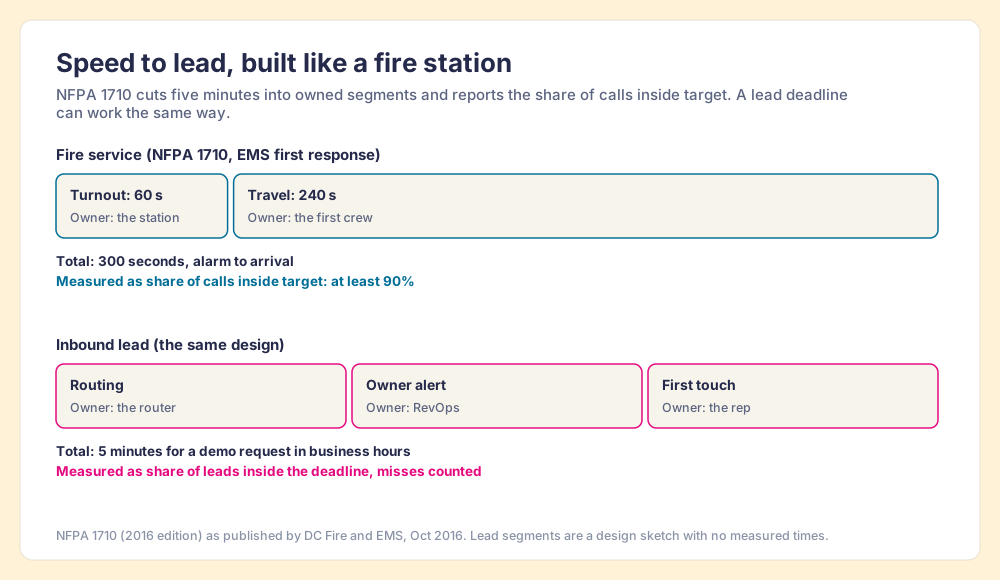
The fire station comparison has one limit. A fire department never decides a fire is not worth the trip. A sales team should, for some leads: a student, a competitor, a company far outside your market. So a lead response standard needs two clocks. The first is measured in minutes and covers the leads you want. The second is measured in a day and covers every lead: by the end of one business day, each one has either a first touch or a recorded decision not to make one.
For the minutes clock, the evidence points to five minutes for a demo request or a contact-sales form during business hours. The MIT data found the odds of contact fell five times from a 5-minute call to a 10-minute call, and 100 times by 30 minutes. For a webinar sign-up or a content download, a same-day touch is a sensible floor, because the intent is lower and the buyer did not ask to talk. The MIT authors also found something the five-minute crowd rarely quotes: “After 20 hours every additional dial your salespeople make actually hurts your ability to make contact to qualify a lead.” Front-load the attempts. A rep who calls a lead nine times in week two is not making up for missing it on day one.
How do you measure speed to lead?
Measure the share of leads touched inside the deadline, by lead type, and count every lead with no touch as a miss. That one change moves the leads the averages hide into the middle of the report.
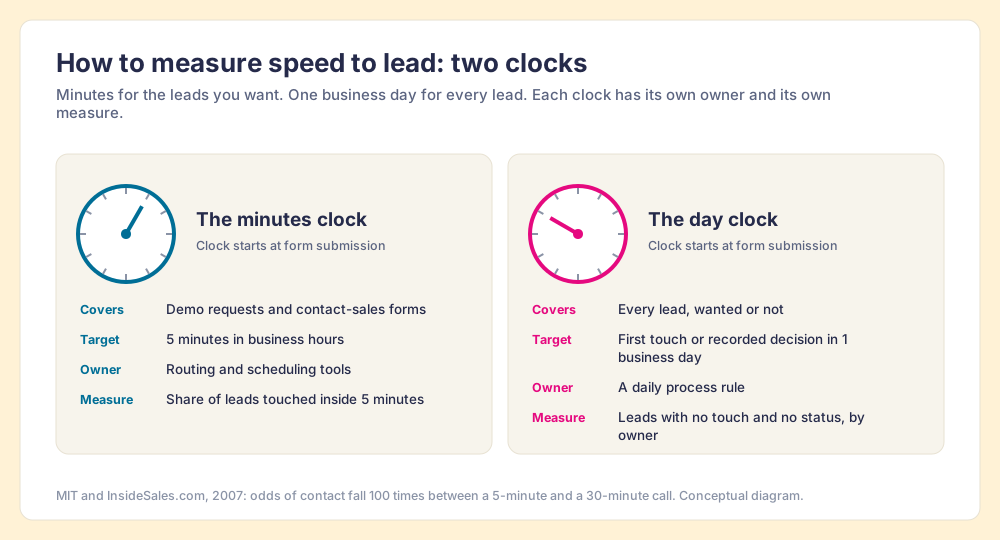
- Share inside the deadline. The headline number is the percentage of leads with a first real touch inside the written target for their type. Report it weekly, by rep and by source.
- Unanswered leads as misses. A lead with no touch and no recorded decision counts against the share. The count tells you how many raised hands went into the dark.
- Median next to the share. If you want a time, use the median. One lead answered three days late will drag an average around; the median tells you what a typical buyer waited.
- Clock from submission. Start at the form post so routing delay shows up where you can fix it.
A deadline works only if someone checks it. In The State of Sales Enablement 2026, 89% of teams had a defined sales process and 36% saw reps run it, and teams that inspect deals against a defined process at the highest frequency hit quota at 6.3x the rate of the lowest band (The State of Sales Enablement). A response deadline is a process rule like any other. Written down and never checked, it is a wish.
How do you improve speed to lead?
Fix the floor plan first, then put a rule on top of it that someone checks every day.
- Continuous routing. Assign an owner the moment the form posts, with a fallback owner when the first one is out. This empties HBR’s first and third waiting rooms.
- Booking on the form. Let a qualified demo request pick a time on the thank-you page. A booked meeting is a first contact, and it happens in seconds without a rep in the loop.
- A written deadline per lead type. Five minutes for demo requests in business hours, same day for lower intent, and a named owner for after-hours leads. Write it where reps work, next to the lead, so a rep does not have to remember it.
- A daily decision rule. Each lead gets a first touch or a recorded outcome (a lead status, a disqualification reason) within one business day. The rule catches the leads the averages hide.
- A morning board for the misses. The leads that broke the rule show up for the owner and the manager at the start of the day, so the manager coaches the pattern instead of hunting for the leads.
The last two are the ones a tool will not hand you. Routing tools and schedulers are good at the minutes clock. They do not tell a manager that a lead from two days ago still has no status, and they do not tell the rep either, while there is still time to call. That check is a process rule, and it is the part of lead qualification that happens before anyone has qualified anything.
Where does Supered fit, and where does it not?
Supered keeps the rules and checks them. You write a Process Rule describing the bad state, the way Supered’s help center tells you to build rules: for example, lead status is New, the create date is more than 1 day ago, and Last contacted is unknown (Supered help center, Process Rules logic). The rule runs against your contact or lead records in HubSpot, Salesforce or Pipedrive. The leads that break it land on a Process Board that reps open inside their CRM, and managers can get a daily or weekly summary by email or in Slack. If a rep works in Claude, the same rules are readable there, and Claude can draft the first-touch email for each lead on the board for the rep to review. The day clock runs without a manager reading records.
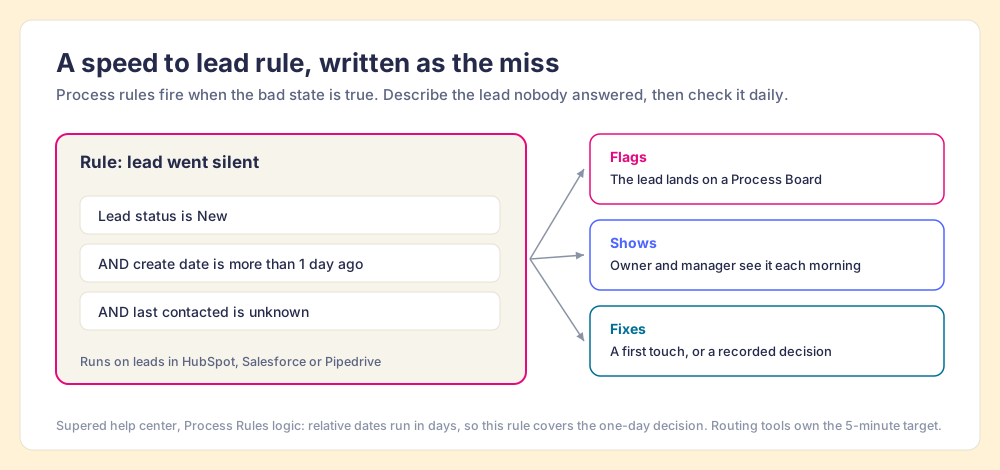
Choose something else if your problem is the minutes clock. Supered’s relative date conditions are counted in days, so it will not page a rep at minute four. For assignment and the first five minutes, use routing and scheduling tools built for that job: HubSpot workflows or Salesforce assignment rules if your logic is simple, and a dedicated router or scheduler if you have territories, round robins and fallbacks to manage. Use Supered for the rule underneath, the one that says no lead goes silent, and for the board that shows who is keeping it.
Process Compliance, which includes the rules and boards, is $40 per user per month paid yearly ($45 monthly), with a five-user minimum (Supered pricing). Supered started inside RevPartners, the HubSpot partner I founded, and it is rated 4.9 on G2 from 81 reviews (checked 2026-10-02). The sales expectations use case shows the board, and you can book a demo to see a response rule running on your own leads.
The recommendation
You have three ways to spend the next month on speed to lead. Buy a faster tool and push the average down. Run a contest and push the reps. Or write two rules, a minutes deadline for the leads you want and a one-day decision rule for all of them, and check the second one every morning.
I would do the third, and in that order. The 2011 data and the 2026 data agree on the causes: the time goes in batches, in competing priorities and in distribution rules, and the biggest loss is the lead that never gets a reply. A tool fixes the first. Only a checked rule fixes the last. Once the rule is running, the next question is who gets the lead in the first place, which is where our guide to lead routing picks up, and how you decide which leads deserve the five-minute clock, which is the job of HubSpot lead scoring.
Frequently asked questions
What is speed to lead?+
What is a good lead response time?+
What are the most reliable speed to lead statistics?+
Why do companies respond to leads so slowly?+
How do you improve speed to lead?+
Can HubSpot track lead response time?+
Your process, running itself.