What Is an SDR in Sales? The Job Is Triage, and Triage Runs on a Protocol
An SDR sorts leads so account executives spend their hours on real buyers.
What the role does all day, the 2025 numbers on pay, ramp, and turnover, and why the sort only works when it runs the same way for every rep.
What is an SDR in sales: a sales development representative (SDR) is the rep who qualifies incoming leads, prospects into target accounts, and books qualified first meetings for account executives, who then own the deal through to close.
A sales development representative (SDR) is the rep who qualifies incoming leads, prospects into target accounts, and books qualified first meetings for account executives, who then own the deal through to close. That answers “what is an SDR in sales,” and it is correct as far as it goes. It leaves out the part of the job that decides whether an SDR team makes money or burns it.
Walk into a hospital emergency room and the first person you meet is the triage nurse. The surgeon comes later, if at all. She sees each person who comes through the door, the broken wrist and the chest pain and the man who wants a note for work, and she decides who gets the doctor’s time, in what order. The doctor is the expensive, scarce resource. Triage exists to protect it.
An SDR is the triage nurse of a sales team. The account executive’s calendar is the doctor’s time, and the SDR decides who gets it. Most writing about the role counts the SDR’s calls and emails. We think the count matters less than the sort, and the sort only works when every SDR on the team runs it the same way, then hands the patient over with the chart intact.
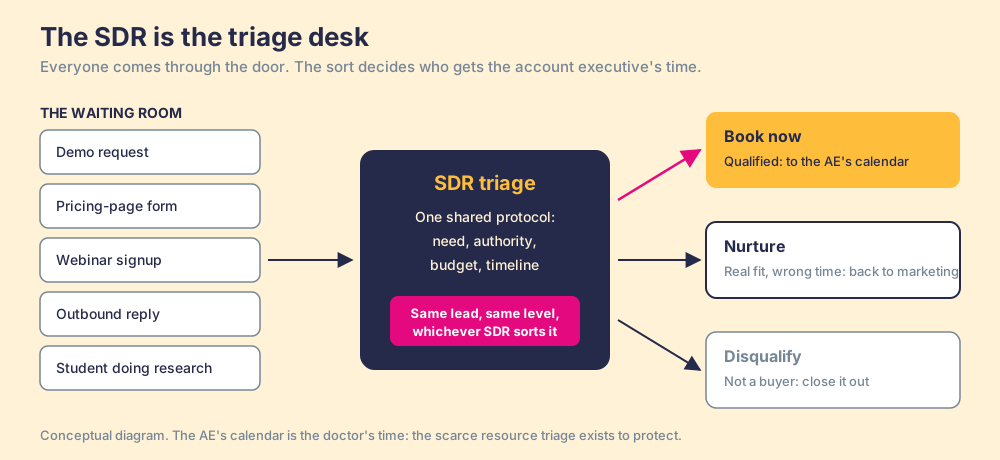
What is an SDR in sales, and what does the role do?
The role was born from a split. At Salesforce in the early 2000s, Aaron Ross separated prospecting from closing and gave each to a specialist, an idea he later laid out in Predictable Revenue. The sales development representative took the front half: find and qualify the buyer, then hand them over.
In practice, the SDR meaning has two flavors, and most SDRs do some of both.
- Inbound qualification. The lead raised a hand: a demo request, a pricing-page form, a webinar signup. The SDR’s job is speed and judgment, reaching the person fast and deciding whether they are a buyer or a browser.
- Outbound prospecting. The prospect never raised a hand. The SDR researches target accounts, finds the right people, and works sequences of calls, emails, and LinkedIn touches until someone agrees to a meeting.
- Meeting booking. The deliverable in both cases is a qualified first meeting on an AE’s calendar, with enough context that the AE does not start from zero.
- CRM records. The SDR logs what they learned, because the next person to touch the account reads it there or reads nothing.
Speed is where inbound SDR work lives or dies. When researchers James Oldroyd, Kristina McElheran, and David Elkington audited 2,241 US companies with test web leads for Harvard Business Review, only 37 percent responded within an hour, and 23 percent never responded at all. Firms that reached a lead within the hour were nearly 7 times as likely to qualify it as firms that waited even one hour longer, and more than 60 times as likely as firms that waited a day. A lead is a patient in the waiting room. Leave them long enough and they walk out.
What does an SDR’s day look like, and which metrics matter?
The best current picture comes from The Bridge Group, which has surveyed SDR teams every two years since the late 2000s. Its 2025 SDR report, covering 351 B2B companies, gives the median day and month:
| Metric (median) | 2025 value |
|---|---|
| Daily activities | 112 (44 phone, 41 email, 19 LinkedIn, 8 text or other) |
| Quality conversations per day | 4.1 |
| Held meetings per month | 10 |
| SDRs at quota | 60% |
| Pipeline sourced per SDR per year | $3.78M |
Run those numbers forward and a shape appears. Across roughly 21 working days, 10 held meetings is about one meeting every other day (our arithmetic). So a typical SDR makes 112 attempts to produce 4.1 real conversations, and about one conversation in eight turns into a meeting that happens. The job is a steep funnel run fresh each morning.
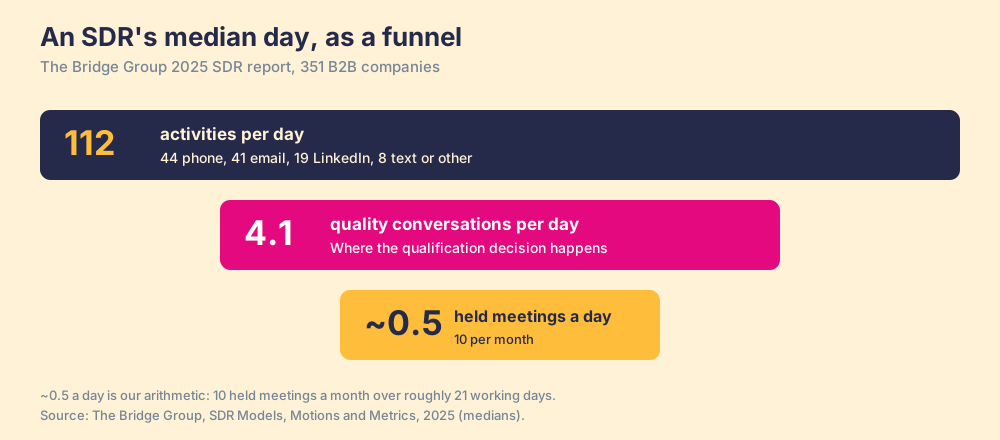
Activity counts earn their place. They tell a manager whether the SDR ran the motion, and they are the first thing to check when meetings dry up. But activity alone does not tell you whether the buyer moved. A useful SDR scorecard tracks both sides:
- Activity metrics. Calls, emails, and social touches per day. The input that proves the motion ran.
- Conversation metrics. Quality conversations per day and the rate at which they convert to meetings. The step where judgment shows up.
- Held-meeting metrics. Meetings that happened, measured instead of meetings booked, because a no-show costs the AE an hour and gives nothing back.
- Acceptance metrics. The share of meetings the AE accepts as qualified. It is the only number that checks the SDR’s sort against the receiver’s view of it.
From the field
Everybody you add is sourced. What does it mean to work them, and what does it mean to close them? And you put your standards on top of it: “I expect you to be working this many contacts. I expect you to have closed this many contacts per week.”
Which qualification frameworks do SDRs use?
Triage nurses in the United States mostly use the Emergency Severity Index, a five-level algorithm developed in 1998 by two emergency physicians and three emergency nurses. It sorts patients on two things: how sick they are, and how many resources their care will take. Its job is consistency. Two nurses on two different shifts should put the same patient in the same level.
A sales qualification framework does the same work. For SDRs, the common one is BANT: Budget, Authority, Need, and Timeline, built at IBM to triage high volumes of inbound interest. It is light enough to run in a fifteen-minute call. Heavier frameworks like MEDDPICC belong mostly to the AE, who has the time and access to prove eight facts about a deal. A good SDR gathers the early letters (the pain, a hint of the economic buyer, the timeline) and passes them on.
The framework you pick matters less than whether the whole team runs the same one. If one SDR books every lead with a pulse and another books only confirmed budget, your AEs are seeing patients sorted by two different hospitals. The deeper mechanics are in our guide to lead qualification.
Why does the SDR-to-AE handoff leak?
Because the chart gets lost between the triage desk and the doctor. The SDR spent a real conversation learning why this buyer is here. If that picture does not survive the pass, the AE re-runs discovery, and the buyer tells their story a second time to a company that already heard it.
Medicine has studied this exact seam, and the results are hard to ignore. In a nine-hospital study of 10,740 patient admissions, published in the New England Journal of Medicine in 2014, residents adopted a structured handoff called I-PASS: Illness severity, Patient summary, Action list, Situational awareness, and Synthesis by receiver. According to Harvard Medical School’s summary, medical errors fell 23 percent, from 24.5 to 18.8 per 100 admissions, and preventable adverse events fell 30 percent, from 4.7 to 3.3. The handoffs took no longer than before.
Look at the last letter. Synthesis by receiver means the doctor taking over says the plan back. The handoff is not done until the receiver can repeat it. The sales version needs the same five fields and the same readback.
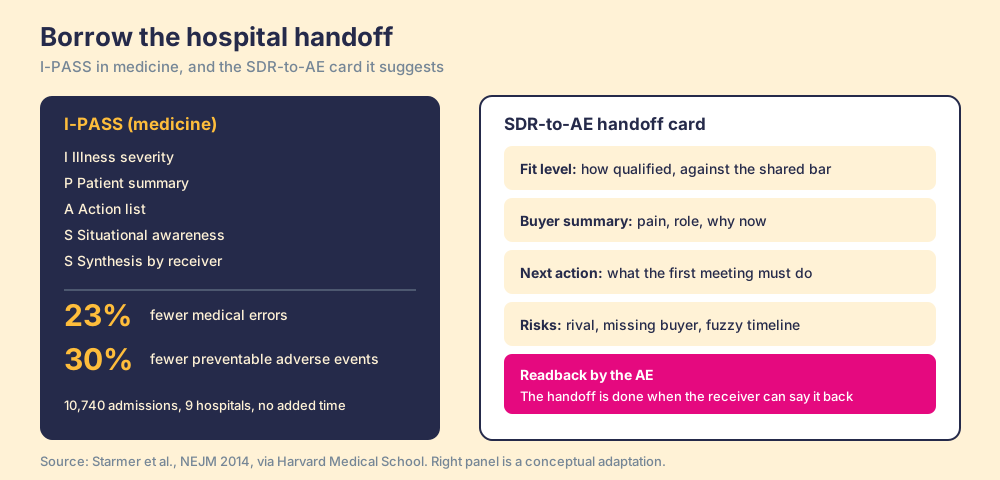
When the handoff fails, look at the system before the rep. An SDR who skips the notes is usually an SDR whose notes live in a field the AE never opens, on a form with no required order. Our BDR vs SDR post goes further into the handoff as a relay exchange; the short version is that the standard has to sit in the CRM, at the moment the meeting is booked, where both people see it. We hold our own team to that with a rule rather than a reminder:
From the field
When we do the sales-to-CS handoff, we have AI fill all of that out. But I do have an expectation. Supered comes up and says, “You haven’t filled out your notes,” you push it, it automatically triggers [HubSpot’s AI] with a prompt, it all fills out, and the reps don’t do anything.
How long does an SDR take to ramp, and what does an SDR earn?
The Bridge Group’s 2025 numbers again:
- Pay. Median on-target earnings of $80,000, split 68 to 32 between a $55,000 base and $25,000 variable, usually paid on held meetings or pipeline.
- Ramp. An average of 3.0 months to full productivity, the lowest since 2010.
- Tenure. A median of 1.9 years in the seat.
- Attrition. 40 percent a year: 13 percent involuntary, 11 percent voluntary, and 16 percent promoted out.
Put ramp and attrition together and you get the hidden tax on the role. Take a team of ten SDRs. At 40 percent attrition, four seats turn over in a year. At three months of ramp each, that is 12 seat-months of ramping out of 120, or one seat in ten always learning the job (our arithmetic, from the Bridge Group medians). Our sales ramp time guide covers why a thicker onboarding binder does not shrink that number.
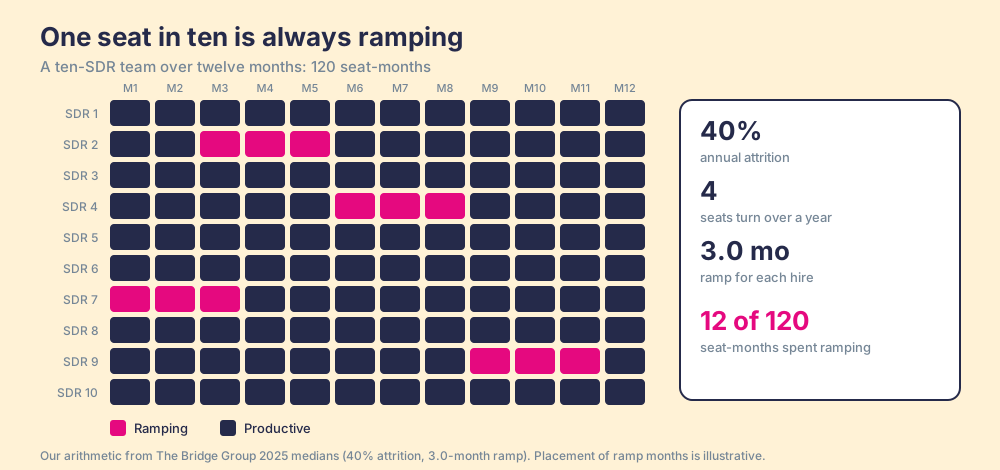
Turnover at that rate decides where the process has to live for an SDR team. In our State of Sales Enablement 2026 survey of 198 sales leaders, 89 percent said they have a defined sales process, and 36 percent said reps follow it as designed. Teams whose process lives inside the CRM workflow hit quota at 49 percent; teams whose process lives in a doc, wiki, or LMS hit 15 percent. A role that turns over this fast cannot keep its triage protocol in the heads of the people leaving.
What is an AI SDR, and will it replace the role?
An AI SDR is software that researches accounts, writes outreach, and books meetings without a human sending each message. The category is real but early: AI SDRs appeared in the Bridge Group’s 2025 research for the first time, at 1 percent of respondents.
The tools are strongest at the part of the job that was already mechanical: finding contacts, drafting first touches, running sequences. They are weakest at the sort. Point an AI SDR at a team with no shared definition of “qualified” and it books unqualified meetings faster. AI multiplies whatever triage protocol you already run, good or bad, so the protocol comes first. For the wider question, see will AI replace sales jobs.
What is the difference between an SDR and a BDR?
By the most common convention, the SDR works inbound demand that raised a hand, and the BDR, a business development representative, sources outbound pipeline from accounts that never asked. Both hand a qualified meeting to an AE. The titles are not standardized, and plenty of companies swap them. Some drop both: a sales manager at a PE-backed B2B training SaaS company told us, “We canceled the BDR program, so you have to call it something else. But the role is an appointment setter.” Our BDR vs SDR comparison lays out the full split, and what is a BDR covers the outbound seat on its own.
What is the SDR career path?
The SDR seat is a front door. In the Bridge Group data, 16 percent of SDRs leave the role each year through promotion, the largest single slice of the 40 percent attrition. The usual paths:
- Account executive. The most common step. The SDR who learned to qualify now carries a revenue number and runs full deals.
- Senior SDR or team lead. A step that keeps the rep in development while they coach newer hires.
- SDR manager. A leadership track with median on-target earnings of $146,000 in the 2025 report, managing about 6.4 SDRs each.
- Adjacent roles. Sales operations, marketing, and customer success hire former SDRs for their feel for the buyer.
Build the SDR team as a triage desk, not an activity engine
Define “qualified” once, make every SDR sort against it the same way, and make the handoff a structured step the AE reads back. A daily call target on its own will not get you there, because the Bridge Group data says 40 percent of the people doing the sort leave each year, and a standard that lives in them leaves with them. At three months of ramp, that is one seat in ten always learning the job. The HBR data says the sort has to happen within the hour, I-PASS shows a structured handoff cutting errors without adding time, and our own survey found teams with the process in the CRM workflow hitting quota at 49 percent against 15 for teams with the process in a doc.
Supered does that job: it surfaces the qualification standard and the handoff steps inside HubSpot and Salesforce at the moment an SDR books the meeting, and shows managers whether they were followed. If you want to see it on your own SDR motion, book a demo. If you are still building the motion itself, the sales playbook guide is the next read.
Frequently asked questions
What does SDR stand for in sales?+
Is an SDR an entry-level job?+
How much does an SDR make?+
What is the difference between an SDR and an AE?+
What is the difference between an SDR and a BDR?+
How long does it take an SDR to ramp?+
Will AI replace SDRs?+
Your process, running itself.