The Sales Prospecting Process You Can Inspect (Six Stages, Each With a Signal)
A sales prospecting process is only real to the degree someone can inspect it. Here are the six stages, the expectation for each, the signal that proves it ran, and the 30-day cadence that keeps it running.
A sales prospecting process is the sequence of stages a contact moves through from sourced to closed, each with a written expectation and an inspection signal the system can answer without asking the rep.
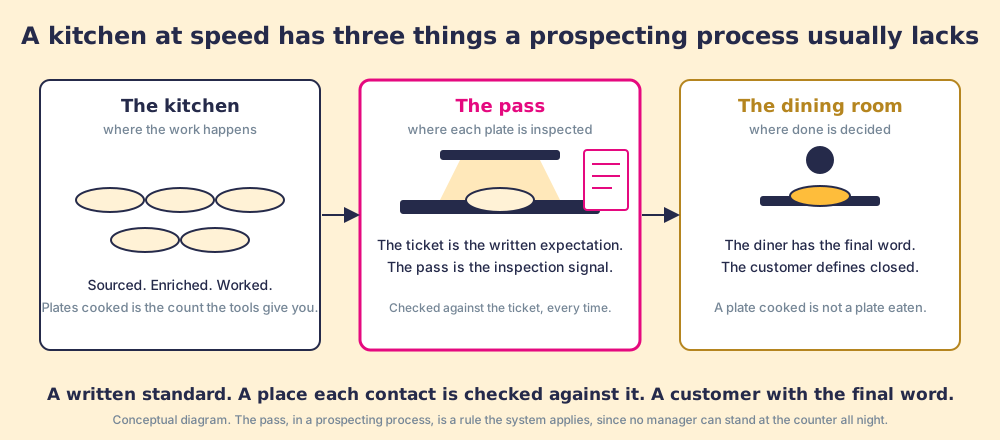
Watch a good restaurant kitchen on a full night and you will see a strange piece of furniture: a flat steel counter with a heat lamp over it, between the cooks and the dining room, called the pass. A plate is not finished when the cook finishes it. It is finished when it crosses the pass and the head chef looks at it against the ticket. The ticket says what was ordered. The chef checks the plate against the ticket. And even then the plate is only truly done when the diner eats it, because the diner, not the chef, decides what “done” means. Three things make that kitchen run at speed without collapsing: a written standard, a place where each plate is inspected against it, and a customer who gets the final word.
A sales prospecting process is the same three things, and almost no team has all three. There is a standard, usually unwritten. There is no pass; the plates go out the back door in the dark and the manager finds out a month later which ones came back. And the definition of done is borrowed from whichever vendor sold the dashboard, which counts plates cooked and has never once asked the diner.
What is a sales prospecting process?
A sales prospecting process is the sequence of stages a contact moves through from sourced to closed, each with a written expectation and an inspection signal the system can answer without asking the rep. That last clause carries the weight. A list of steps is a recipe. A process is a recipe with a pass, and the difference shows up in the numbers, because a process exists only to the degree adherence to it is inspected. You can only expect what you inspect.
The sales prospecting guide makes the long argument for why sourced is not pipeline. This is the working version: the prospecting process steps, the expectation and the inspection signal for each, who defines the words, and how often to look.
Why do activity counts advance nothing on their own?
Take the pipeline’s own vocabulary and read it slowly. “In sequence.” “Touched.” “Attempted.” “Dials.” All of them describe something the seller did. None describes where the buyer is. A car’s odometer is the same kind of instrument: it counts with perfect accuracy, and it cannot tell you whether you are closer to where you were going. You could drive four hundred miles in a circle and the dial would report progress the whole way.
Say plainly what that does and does not mean, because the point is easy to overstate. Counting the miles is necessary. A manager who cannot see that a rep made 44 dials has no way to know the process is being run, and the buyer’s experience is shaped by those touches whether anyone counts them or not. The Bridge Group’s 2025 SDR report, drawn from 351 B2B companies, puts the median at 112 activities a day: 44 phone, 41 email, 19 LinkedIn, 8 text or other (The Bridge Group, 2025). That is a lot of odometer, and all of it is real work.
The failure is narrower than “activity is vanity,” which is lazy and wrong. The failure is letting a contact advance on activity alone. The same report shows what that looks like at scale: 4.1 quality conversations a day, a median of 10 held meetings a month with 6 converting to Stage 1, a record $3.78M of pipeline sourced per SDR, and 60 percent of SDRs at quota, “the lowest reported in study history.” The report labels its own headline number: “Pipeline figures represent raw pipeline generated, not forecast or closed-won revenue.” Record miles. Record raw pipeline. Fewest arrivals the study has ever recorded.
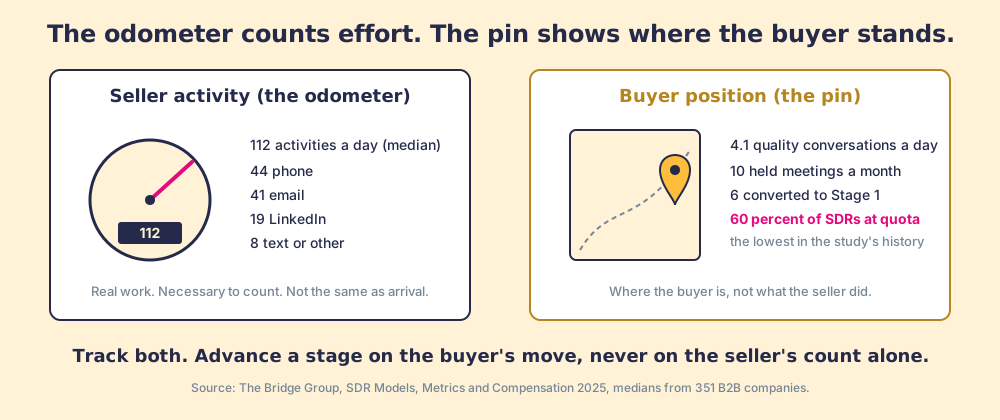
So the rule that decides whether a prospecting process is a process: track the seller’s activity and the buyer’s position, and never let a stage advance on the first without the second. A stage should reflect the buyer’s reality as well as the box that was checked. The six stages below are built to enforce that.
What are the six prospecting process steps?
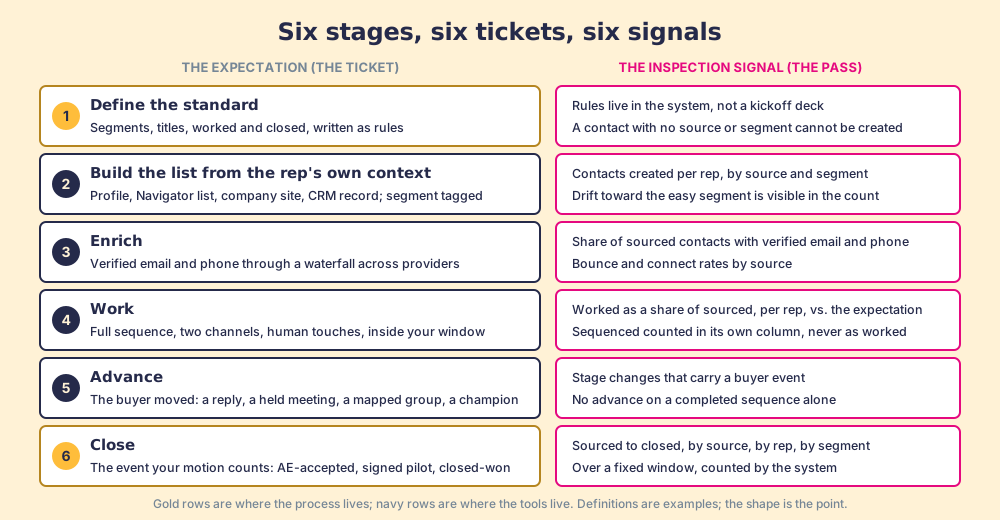
The deal-review format we use for MEDDIC works here too: for each stage, the expectation, and the evidence a skeptic would accept that it was met. The middle four stages are where the tools live. The first and the last are where the process lives, and they are the two that get skipped.
| Stage | The expectation (the ticket) | The inspection signal (what crosses the pass) |
|---|---|---|
| 1. Define the standard | Segments and titles written down; “worked” and “closed” defined in your motion’s terms; a source field that must be filled | The definitions exist as rules in the system, not in a kickoff deck; a contact with no segment or source cannot be created |
| 2. Build the list | The rep assembles the list from their own context: the profile, the Navigator search, the company site, the CRM record; segment tagged at creation | Contacts created per rep, by source and segment, against the segment the rep was assigned; the drift toward the easy segment is visible in the count |
| 3. Enrich | A verified email and phone, from a waterfall across providers, before the contact enters the CRM | Share of sourced contacts with a verified email and phone; bounce and connect rates by source |
| 4. Work | The full sequence completed across at least two channels, with the human touches made, inside the window you set | Of contacts sourced, the share that met the worked definition, per rep, against the expectation; “sequenced” counted separately from “worked” |
| 5. Advance | The buyer moved: a reply, a held meeting, the buying group mapped, a champion named, whatever your motion counts as movement | Stage changes that carry a buyer event, not a seller event; a contact cannot advance on a completed sequence alone |
| 6. Close | The event your motion counts: an opportunity accepted by the AE, a signed pilot, closed-won | Sourced to closed, by source, by rep, by segment, over a fixed window |
A few of the stages hide a decision, so take them in turn.
- The standard, written as a trigger. A goal (“source 40 a week”) is the form the brain executes worst. The psychologist Peter Gollwitzer spent a career on the gap between intending and doing, and his fix was the implementation intention, a plan of the form “Whenever situation x arises, I will initiate the goal-directed response y!” (Gollwitzer, 1999). Gollwitzer and Sheeran’s meta-analysis of 94 studies put the effect at d=0.65, a medium-to-large lift in follow-through. So the sourcing standard reads “if I open a profile in segment A, then I enrich it and tag the segment,” and the working standard reads “if a sourced contact has had no reply in ten days, then the second channel starts.”
- The list, built from the rep’s own context. How to build a prospect list is usually taught as a search problem: filters, exports, a spreadsheet. Built that way by Ops, the list arrives cold and gets worked in the order it was pasted. Built by the rep from the page already open, the profile that looks right, the company site with the buying committee on it, the CRM account missing its champion, the list carries the rep’s judgment about fit, and a rep works what they chose. The rule that makes this inspectable: source and segment tagged at the moment of creation, or the closed rate by source is unknowable forever.
- Enrich through a waterfall, never one well. A single database returns what it has. A waterfall asks provider after provider until one returns a verified result; Clay’s rep-prospecting page puts it in a sentence, “One click runs Clay’s waterfall enrichment. If one source misses, it tries the next”, across a marketplace Clay counted at 200 plus vendors on its homepage this month (what Clay is, and why it is not a data source, is its own post). The process point: enrichment has a measurable output, the share of contacts with a verified email and phone, and that number belongs on the pass.
- Worked, counted apart from sequenced. Enrolling a contact in an automated cadence is a click. Working a contact is the cadence completed and the human touches made. The two must be separate columns or the second gets counted as the first within a month. The moves inside the working stage are well documented in cold calling tips and the sales cadence; what the process adds is the count of contacts that met your definition, per rep, against the expectation.
- Advance on a buyer event. This is tenet-level for us and it is the stage most CRMs cannot enforce without a rule: a contact moves forward when the buyer did something, never when the seller finished something. A completed sequence with no reply is a worked contact. It is not an advanced one.
Who defines “worked” and “closed”?
You do, and the reason is arithmetic rather than philosophy. Gartner’s research on B2B buying puts the typical buying group at 6 to 10 people, spending only about 17 percent of their buying time with all potential suppliers combined, and 77 percent of those buyers describe the purchase as complex or difficult. Read those numbers against a single sourced contact and the definition of worked changes shape with the room. In a small-business motion the buying group is often one person, so one person reached and one meeting held is a fair definition. In a mid-market motion, two chairs across two functions before the contact counts as more than a name. In an enterprise motion, a single contact reached is one chair at a ten-chair table, and worked means the group was mapped and a champion identified.
A vendor’s dashboard cannot know which room you sell into, which is why a borrowed definition measures the wrong thing with great precision. “Closed” bends the same way: an opportunity accepted by the account executive, a signed pilot, closed-won, a renewal. Pick the event your motion treats as the harvest, write it down, and let the system count it.
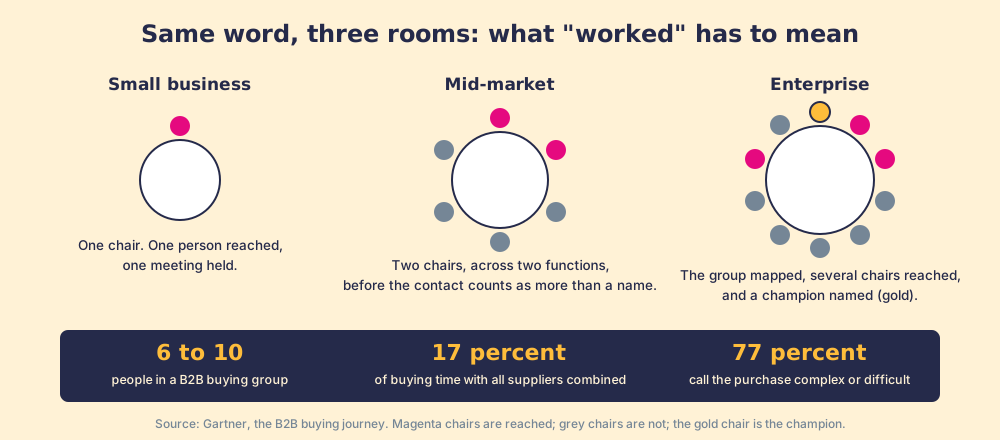
There is a second reason the definitions belong to you, and it is the buyer’s. A contact who receives the motion your team designed, the right second touch at the right interval, a rep who states the reason for the call, gets a clearer buying experience than one who receives whatever the rep improvised at the end of a long afternoon. Gartner’s 77 percent who call the purchase complex are describing, in part, what it feels like to be prospected by a process no one inspects. The definitions are a promise to the buyer, and the pass is how you keep it.
How often should a prospecting process be inspected?
Once every 30 days, on a fixed agenda, with the counting done by the system. Both halves of that sentence matter, so take them separately.
The window comes from the field. Jeb Blount’s Fanatical Prospecting holds a rule SDR teams hand to new hires: as one reader’s notes on the book record it, “the prospecting you do in this 30-day period will pay off for the next 90 days.” Blount means it as an argument for consistency, and it is also an argument for cadence. If this month’s sourcing feeds the pipeline three months out, a stage no one worked this month is a hole in the forecast you will not see until it has aged 90 days. Thirty days is short enough to catch it and long enough for a sequence to complete.
The reason the system has to do the counting is in our own data. In The State of Sales Enablement, 89 percent of teams reported a defined sales process and 36 percent reported seeing reps run it as designed. The same study found that teams whose managers inspect consistently hit quota at 6.3 times the rate of teams that rarely do, the largest effect we measured. The trap that eats the 6.3x is manual labor: a six-stage review done by hand, across each sourced contact for eight reps, is a full day a month, so the review shrinks to the biggest deals and the self-report creeps back for the rest. Inspection is mandatory. The manager doing it by hand is not. Lift the counting off the manager and the hour goes to coaching the rep whose worked-to-sourced ratio fell.
The 30-day agenda is five questions, each answered by a number the system already holds:
- Sourcing to standard. Contacts created per rep, by segment and source, against the assigned segment. The drift to the easy segment shows here first.
- Enrichment coverage. The share of sourced contacts with a verified email and phone, and the bounce and connect rates by source.
- Worked as a share of sourced. The one number that turns a seed count into a process. Per rep, against the expectation you set, with sequenced shown beside it so the two never blur.
- Advanced on a buyer event. Of the contacts worked, how many moved on a reply, a meeting, a mapped group, and how many sit at “sequence complete” with no buyer event behind them.
- Closed by source. Over the trailing 90 days, which sources of sourced contacts closed, so next month’s standard can be set from evidence rather than habit.
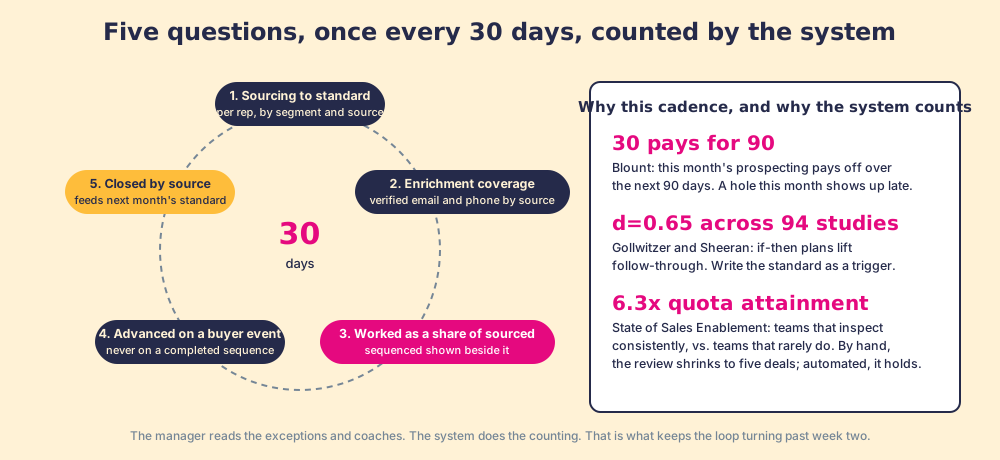
One caution, because the picture can overreach. A kitchen pass works because the chef stands there all night, and no sales manager can. That is the edge of the analogy and the reason the counting has to be automatic: the pass in a prospecting process is a set of rules the system applies to each contact as it moves, and the manager reads the exceptions. If the inspection depends on a person at the counter, it holds for two weeks and then the plates go out the back door again, and the fault is the counter’s, never the cook’s. When reps do not follow a process, it is a system failure. The remedy is always to the system.
What we recommend
Three paths sit in front of a team that sources contacts and cannot yet say what happened to them. The first is to keep counting what the tools count, contacts created and sequences completed, and accept that the answer to “is prospecting working” arrives three months late. The second is to write the definitions and run the six-stage review by hand, which works for as long as the manager’s calendar allows and then decays to the top five deals. The third is to treat sourcing as the first stage of a process the system inspects: the standard written as if-then triggers, the list built from the rep’s own context with source and segment tagged at birth, worked and closed defined in your motion’s words, and the five questions answered automatically every 30 days.
We recommend the third, and the evidence here is why. The Bridge Group’s raw-pipeline label and its record-low quota attainment say activity alone advances nothing. Gartner’s buying group says the definitions have to be yours. Gollwitzer’s if-then effect says how to write them. Blount’s rule says how often to look. And our own 53-point gap and 6.3x inspection finding say the looking, more than the writing, is what moves the number. Write the definitions first. Then build the pass.
That pass is what we built Supered’s sourcing to be, and it is the one place on this page the product belongs. Supered is the Behavior Layer, and it runs on the customer’s own Clay account: the waterfall and the segment’s premade or custom table sit one click from the LinkedIn profile, the Sales Navigator list, the company website, or the CRM record the rep already has open, with no Clay login and nothing to learn. One click sends the enriched contact to HubSpot or Salesforce with the source and segment attached, and from there the contact enters the motion Supered guides and measures: the next expected action reaches the rep in the flow of the work, a contact advances on a buyer event and never on a completed sequence alone, and the manager sees sourced, worked, and closed, by the team’s own definitions, against the expectation the manager set. Clay governs the data. Supered governs the motion. If you have Clay, you have Supered.
The next read is the one that says what the sourced contact becomes: what a sales pipeline is, and the sales pipeline stages a worked contact enters once it advances. The science of getting any process run is in sales process adoption.
Frequently asked questions
What are the steps in a sales prospecting process?+
What is the difference between a prospecting process and a sales cadence?+
How do you build a prospect list that reps will work?+
Why should worked and closed be defined by the customer?+
How often should a prospecting process be inspected?+
Is tracking prospecting activity a bad idea?+
Your process, running itself.