How to Motivate a Sales Team: Ryan Beebe on Controllables, Reinforcement and Results Reps Can See
Ryan Beebe went from BDR to AE to CSM to Head of Enablement at Dreamdata, and competes in karate as the Karate Cowboy. When numbers are down, he points reps at what they control and makes sure they see results from their own actions.
To motivate a sales team, as Ryan Beebe practices it, is to point reps at what they control (the quantity and quality of their activity), coach each person the way they take coaching, and make sure they take an action and see a result.
Ryan Beebe showed up to the recording in a pink cowboy hat. He has trained in martial arts for 27 years and competes in karate weapons, kata and kumite, the fighting event and his favorite. On the karate circuit he is the Karate Cowboy. At work he goes by Beebs, Head of Enablement at Dreamdata, a Series B marketing technology company in Denmark with a little under 100 employees.
When Caleb King had him on Enablement for Real, the conversation kept circling one problem: how to motivate a sales team when the numbers are down and most of the outcome feels out of the rep’s hands. Ryan starts with what a rep can control, and he borrows a rule about how adults change from one of the authors of The Sales Enablement Playbook.
Why does Ryan Beebe measure enablement by other people’s numbers?
Ryan has spent the past decade in B2B SaaS as a BDR, an account executive, a customer success manager and now in enablement. The hardest of those jobs, he said, was his first AE role, at Salesforce, when he was “young, mid-20s, part of an acquired company.” He says he grew up in tech sales there.
Caleb asked whether enablement people need to have carried a quota. Ryan said doing the job earns “an inherent trust” from the person “who’s carrying a bag.” Then he gave the other side. Some of his favorite enablers were teachers first, and his favorite former colleague, Jessica Phelan, is a practicing psychotherapist.
He judges enablement by other people’s results. “Our success is our stakeholders’ success,” he said. For a revenue enablement team that means SDRs book their meetings, AEs hit quota and the post-sale team keeps customers. He adds career pathing, because reps buy in “when they feel like someone is genuinely in their corner trying to help them out outside of just hitting those numbers.” Our explainer on revenue enablement covers how the function spans those teams.

How do you motivate a sales team when the numbers are down?
Caleb asked about the hard part. An AE already feels much of the result is outside their control, enablement sits one step further back, and Caleb wanted to know how Ryan handles the emotional side of that.
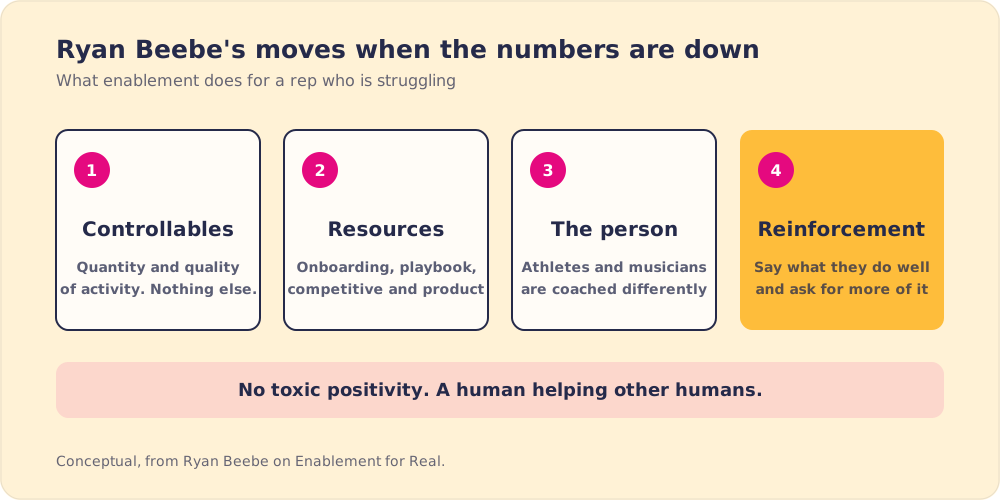
Ryan answered by level. He runs what he calls vertical enablement, for individual contributors, front-line and second-line leaders, and executives. With reps, he talks most about “controlling their controllables,” which “usually translates into the quantity and the quality of your activity. Nothing else.”
When a rep is struggling, he reminds them what they already have: onboarding, the playbook, competitive enablement and product enablement. He watches his tone. “It’s not about providing toxic positivity because we have a goal to accomplish, but it is an important reminder that enablement professionals are charged with, which is that you’re a human helping other humans.” He also shapes the help to the person. “Athletes are coached differently than musicians,” he said.
Teresa Amabile and Steven Kramer, who studied the daily diaries of knowledge workers for The Progress Principle, found that of all the events at work, the one with the biggest positive effect on emotions, perceptions and motivation “is simply making progress in meaningful work.” When they asked 669 managers to rank five motivators, the managers put progress last (Amabile and Kramer, The Progress Principle). Ryan’s controllables give a rep something to make progress on in a week when the target is far away.
Why does an adult change only after an action and a result?
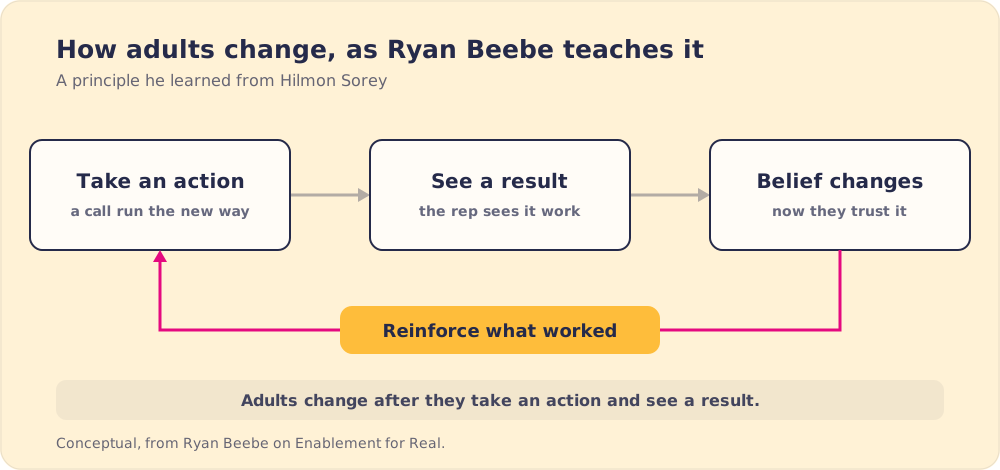
“A big part of enablement’s job is to get the folks who won’t change their behaviors to change their behaviors,” Ryan said. He credits Highspot with calling enablement “change management in the service of revenue.” The rule he leans on most comes from Hilmon Sorey, who wrote The Sales Enablement Playbook with Cory Bray and whom Ryan once worked for. “In order to get an adult to change their behavior, they have to take an action and see results,” Ryan said.
He tested it on a flat-earther. Walk up to a man who thinks the earth is flat, tell him it is round, and he will not move. “Unless you show me evidence or I take an action and see a result, it’s not going to work out.”
Caleb said Ryan was the third guest in a run of interviews to name behavior change as the goal, and said it matched what we believe at Supered. “Knowing better never has equaled doing better,” Caleb said. He wants reps to get fast feedback on a plain question: “Am I doing this right? Yes, no.”
Ryan added a mistake he sees enablers make. “Make sure you’re telling your teams and individuals what they’re doing amazing and what you want them to keep doing over and over again,” he said. Coaching often goes straight to what needs fixing, and he said reinforcing good behavior matters as much. Research by Gallup and Workhuman found that well-recognized employees are 45% less likely to have turned over two years later (Gallup).
In The State of Sales Enablement 2026, our survey of 198 sales leaders, the top reason reps skip the sales process was that managers do not enforce it (29%). Reps not seeing the value came second (18%), and a lack of training rarely came up (The State of Sales Enablement 2026). By Ryan’s rule, the reps in that 18% have not yet tried the process and watched it pay off.
What motivates a sales team, in Ryan’s order
Laid end to end, Ryan’s approach to sales team motivation gives a manager six moves to make this week.
- Define success as the team’s own number, whether that is meetings booked, quota or retention.
- Point each rep at the quantity and quality of their activity.
- Remind them of the resources they already have before building new ones.
- Coach the person in front of you, the way that person takes coaching.
- Set up an action the rep can take soon, with a result they can see.
- Tell them what they are doing well and ask them to keep doing it.
Our guide to sales coaching techniques goes deeper on steps four and six.
Why Ryan Beebe calls “AI will take your job” a fad with bite
Asked for a fad, Ryan named the fear of AI “quote-unquote taking your job.” What he tells the people he coaches: “AI might not take your job, but someone else using AI will, right? Doing it extremely well.” He files AI with the internet and mobile phones, “something new that we all have to live with,” so to him the fear is a fad with some “bite to its bark.”
The economist Richard Baldwin said nearly the same thing at the World Economic Forum’s Growth Summit in 2023. “AI won’t take your job,” he said, “it’s someone using AI who will take your job” (World Economic Forum). Employers already hire that way. Microsoft and LinkedIn’s 2024 Work Trend Index, a survey of 31,000 people in 31 countries, found 66% of leaders would not hire someone without AI skills, while only 39% of AI users had received AI training from their company (Microsoft).
Ryan uses AI where he is weakest. “I am the worst at creating decks,” he said, and AI has helped. What he expects to last is older than any software. “Hard work beats talent when talent doesn’t work hard,” he said, a line he also uses with his karate athletes. Outworking the people around you, he said, “also brings some peace of mind” because you know you tried your best against the goals you set. Our post on whether AI will replace sales jobs looks at what the hiring data says so far.
Why is Ryan Beebe betting on early-career reps?
Ryan’s bet is “the youth,” by which he means “the 20-something-year-olds that are finding their way in tech nowadays.” He was clear that he does not like them because they are easy to mold. “They’re also usually on the frontier of the stuff that’s happening,” he said, in technology and in culture. He learns from people with decades in the game, but he draws the most inspiration from “the unpolished kind of go-getters that are just out there trying to figure it out.”
Caleb has watched teams react both ways to a newcomer’s naive question. Some write the new person off. Others find a kernel of truth in what they asked. Hiring managers in Microsoft’s survey lean toward the newcomer: 71% said they would rather hire a less experienced candidate with AI skills than a more experienced one without them, and 77% said early-in-career talent will be given greater responsibilities with AI (Microsoft WorkLab). Those hires still need a first 90 days, which is where sales onboarding comes in.
What Ryan Beebe teaches about sales team motivation
- Other people’s numbers. Ryan measures enablement by whether SDRs, AEs and the post-sale team hit their targets, and by whether reps grow their careers.
- Controllables in hard weeks. The quantity and quality of activity belong to the rep, and he keeps their attention there.
- A human tone. No toxic positivity, and coaching fitted to the person, the way an athlete and a musician get coached differently.
- An action and a result. Adults change once they try something and see it work, so a small win the rep produces beats another lecture.
- Praise said out loud. Telling reps what to keep doing counts as much as correcting what to change.
- AI as a fad with bite. The threat to a job comes from people who use AI well, and early-career reps are often first in line.
What should a sales leader do when the numbers slip?
Start with Ryan’s controllables. Sit with each rep, agree on the quantity and quality of activity for the next two weeks, and write it where you can both see it. Then set up one action whose result the rep will see soon, such as a call run the new way or an objection answered from the playbook, and point out the result when it comes. Finish by telling them what they did well.
Seeing those actions is the hard part. A manager with eight reps cannot sit in on every call, and a rep cannot tell from a monthly report whether the new habit is paying off. Supered helps with that inside HubSpot and Salesforce. It guides reps through the process while they work and shows each step as it runs, so the rep and the manager both see the action and the result the same day.
If behavior change is the goal, our post on the knowing-doing gap explains why reps who know the process still skip it.
Frequently asked questions
How do you motivate a sales team when sales are down?+
What can a sales rep control when the numbers are down?+
Why doesn't training alone change how reps sell?+
Does recognition help motivate a sales team?+
Will AI take sales jobs?+
Your process, running itself.
Turn the playbook into rep behavior.
More from Enablement for Real

Sales Training Plan: Justin Swapp on the Discovery Step Enablement Skips
Justin Swapp
Sales Enablement Team Structure: Why Fiona Simpson Stopped Fighting RevOps
Fiona Simpson