Will AI Replace Sales Jobs? The Honest, Evidence-Based Answer
AI is automating the knowledge work of selling fast. Whether it replaces the salesperson depends on a 250-year-old economic mechanism the headlines never mention: complementarity.
Will AI replace sales jobs asks whether AI eliminates salespeople; the answer is that AI replaces sales tasks (research, drafting, summarizing) while the behavior that closes deals stays human, so transactional roles are exposed and judgment-heavy ones are not.
A headline announces every few months that the salesperson is finished, and a few months later a sales team hits its number anyway. Both things are true at once, and the contradiction is the whole subject. AI is taking over large parts of the selling job, faster than most people expected. And the salesperson is not going away, because the part AI took was never the part that closed the deal. To answer the question well you have to do one thing the headlines skip, which is to separate a task from a job, and then reach for a piece of economics that is older than the panic.
So here is the honest version. Will AI replace sales jobs asks whether AI eliminates salespeople; the answer is that AI replaces sales tasks, the knowledge work of research, drafting, and summarizing, while the behavior that closes deals stays human, so transactional roles are exposed and judgment-heavy ones are not. A job is a bundle of tasks, and automation does not take jobs in one bite. It takes tasks, and the bundle reshapes around what is left, in a direction the economics can predict.
What is AI replacing in sales?
The knowledge work, which fills most of a rep’s calendar and decides almost none of the deal. Break a selling day into its parts and the line is clean. On one side sit the tasks that produce or process information: researching an account, drafting the email, summarizing the call, updating the CRM, scoring and routing leads, running first-pass qualification at volume. AI does all of these now, cheaply, and roughly as well as a competent human. On the other side sits the behavior a rep performs with a live buyer: reading the room, handling the objection nobody scripted, multi-threading a buying committee, judging when to push and when to wait, running the process when it counts.
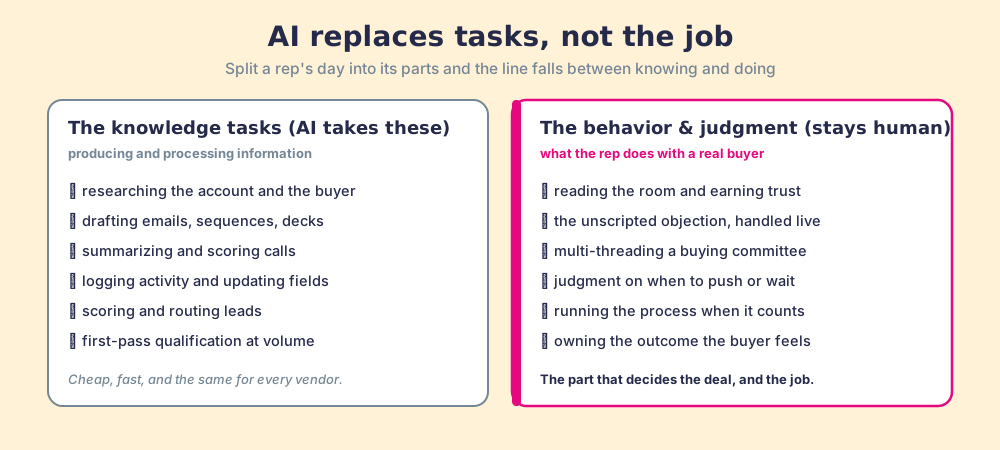
This is the task-based view of automation that the economists David Autor, Frank Levy, and Richard Murnane introduced in 2003: technology substitutes for routine, codifiable tasks and struggles with non-routine ones that resist being written as rules. Research and drafting are codifiable, so they go first. The judgment in a live negotiation is not, so it stays. The headline question “will AI replace salespeople” is the wrong unit of analysis; the right unit is the task, and the answer differs task by task inside the same job.
The economics nobody quotes: why automation creates value for the human
Here is the part that turns a scary story into a useful one, and almost no one selling AI mentions it. When a tool automates one task, it does not merely subtract a job; it changes the value of the tasks around it. David Autor laid this out in his 2015 essay Why Are There Still So Many Jobs?, written precisely to explain why two centuries of automation never produced the mass unemployment each wave was predicted to bring. His sentence is the one to memorize: “automation does indeed substitute for labor. However, automation also complements labor, raises output in ways that lead to higher demand for labor, and interacts with adjustments in labor supply” (Autor, Journal of Economic Perspectives, 2015).
Read that into a sales team and the fear inverts. When AI makes research and drafting nearly free, the deal can move faster and at greater scale, which raises the number of moments where a human’s judgment is the bottleneck, the discovery call, the committee, the negotiation. The routine task got cheaper; the complementary non-routine task got more valuable, because there is now more of the work it gates and less of everything around it. The bank teller is Autor’s favorite example: the ATM automated cash handling and the number of tellers rose, because branches got cheaper to run, banks opened more of them, and the teller’s job shifted to the relationship work a machine could not do. The machine ate the routine and fattened the complement.
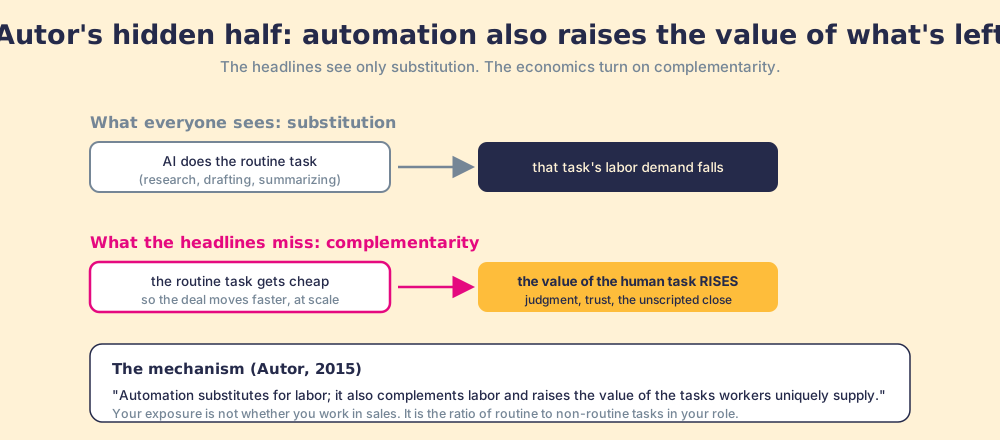
This is the mechanism under our whole worldview, stated in economic terms. We say knowledge is solved and behavior is the unsolved problem; Autor says the codifiable tasks get automated and the non-routine, complementary ones get more valuable. The salesperson survives AI for the same reason knowledge alone never closed a deal: the part of selling that resists codification, the behavior with a real buyer, is exactly the part automation makes scarcer and therefore dearer.
Which sales jobs will AI replace, and which will it not?
Now the honest, harder half, because complementarity is not a promise that no one gets hurt. Autor’s other famous finding is polarization: automation hollows out the middle, lifting demand at the high-skill top and the hard-to-automate bottom while gutting the routine roles in between (Autor, 2015). In sales, the routine middle is the transactional layer. So the honest version of “can AI replace sales reps” is role-specific, because exposure runs by role, and the sorting principle is the task ratio: the more a role is routine information relay, the more AI takes it.
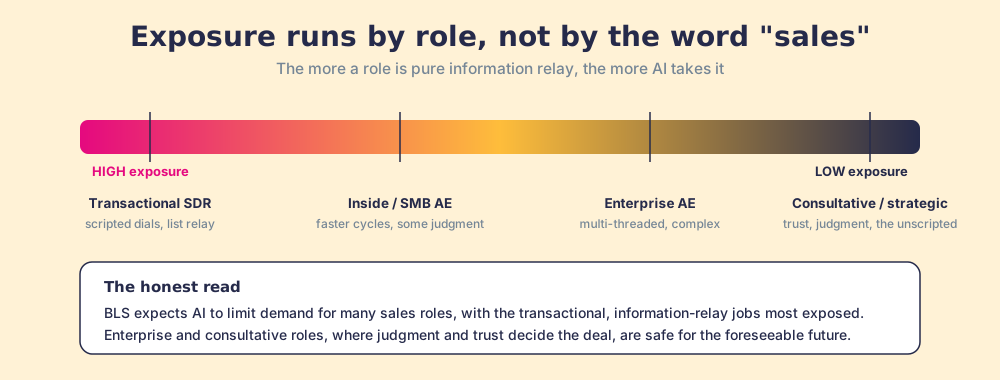
The official projections say the same thing in drier language. The US Bureau of Labor Statistics, building AI into its 2024-34 occupational outlook, expects AI in routine calls, chats, and analysis to limit demand for many sales workers, with retail and transactional roles hit hardest, while noting that many exposed occupations still grow where AI augments rather than replaces (BLS, 2025). McKinsey’s executive survey points the same way and faster: 30% of respondents expect their marketing and sales headcount to fall by more than 20% within three years (McKinsey, 2023). Read those together with Autor and the message is neither “sales is safe” nor “sales is doomed.” It is that the routine layer contracts, painfully, and the judgment layer grows, and a given career lands wherever its task mix sits on that line.
Why did the attempt to fully replace reps fail?
Because someone ran the experiment, and comparative advantage returned the verdict Autor would have predicted. The clearest test of “will AI replace salespeople” was the autonomous AI SDR, a fully automated rep that prospects, writes, and books with no human. It was funded heavily and pitched as the end of the SDR. Then the receipts came in: a March 2025 TechCrunch investigation reported inflated customer claims and 70 to 80% early churn at 11x, the category’s most prominent name (TechCrunch, via Pavilion), and companies that deployed autonomous SDRs as full headcount replacements largely reverted to hybrid models. We treat the category in full in the best AI sales tools.
The failure was not bad AI. The AI was good at the task it was given, producing outbound. It was handed a job, and the job bundled non-routine judgment it could not supply: which buyer was real, when the script was failing, how to recover a thread going cold. Hand an autonomous system a job that is mostly its comparative disadvantage and you get fast, confident failure, the same thing that happens when you point AI at a process reps do not follow.
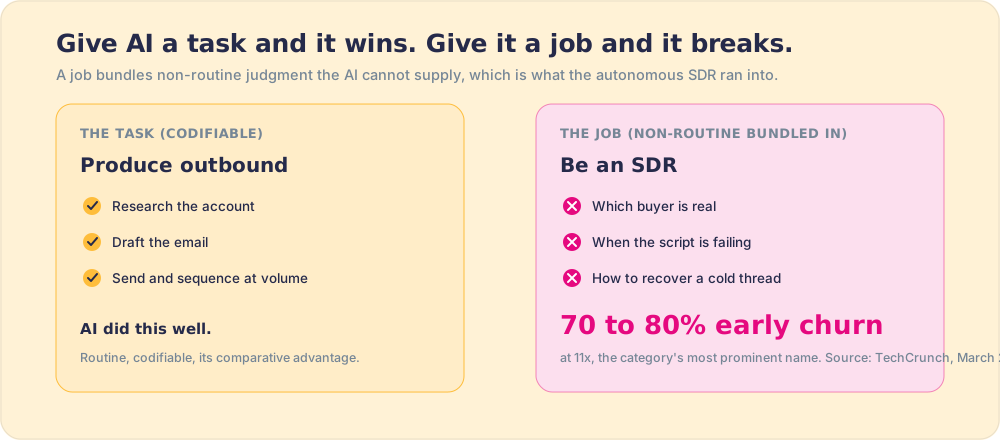
It amplifies what you feed it and cannot supply the judgment itself. That is the deeper mechanism under the whole question, and we unpack it in generative AI for sales.
How do salespeople stay valuable as AI improves?
By deliberately reallocating their hours toward the tasks automation complements, away from the ones it substitutes. Autor’s framework is more than a forecast; it is career advice. Spend your time where your comparative advantage is rising.
- Judgment over relay. Stop competing with AI on information, which is its comparative advantage and your comparative disadvantage. Compete on what to do with the information: the read, the call, the recovery a model cannot make.
- The process, run well. The rep who reliably runs the motion that wins is doing the non-routine work AI amplifies rather than replaces, which is why sales process adoption is the most durable skill on the team.
- Trust as the product. Buyers dislike being sold to by a machine; a human who earns trust and gives a clear, helpful experience supplies exactly the non-codifiable task that gets dearer as everything around it gets cheaper.
- AI as the amplifier. The reps who pull ahead treat AI as a multiplier on a strong process, not a rival. They let it take the routine tasks and pour the reclaimed hours into the complement.
What we recommend
The two most common answers to this question are both wrong, and it is worth saying so by name. The doomers who declare the salesperson obsolete have mistaken task substitution for job elimination, and the 11x retreat is what that mistake looks like in the field. The Pollyannas who wave it all away with “automation always creates jobs” have skipped Autor’s other finding, polarization, which says the transition is real and the routine middle genuinely contracts. The honest position sits between them, and it is the one the evidence supports.
So if you run a team: use AI to automate the routine, information-relay tasks, redirect the reclaimed hours into the judgment and trust that automation makes more valuable, and resist the pitch to replace the behavior wholesale, because comparative advantage is not on its side and the people who tried it came back. If you are a salesperson: the fear of AI replacing sales jobs reads differently once you make the task-versus-job distinction, and the logic turns to good news. The drudgery, the research, the data entry, the drafting, is the routine half going to the machine. Your judgment in a live deal is the non-routine half that appreciates as the machine cheapens everything next to it. The rep AI replaces is the one who only relayed information. The rep who runs the process and earns the trust is the one AI makes more valuable, exactly as the economics predict. The future of selling is not no salespeople. It is fewer people doing the knowing, and the ones who remain doing far more of the doing.
From here: the mechanism in generative AI for sales, the buyer’s guide in the best AI sales tools, the coaching shift in AI sales coaching, the wider argument in AI sales enablement, and the skill that compounds in sales process adoption.
Frequently asked questions
Will AI replace sales jobs?+
Which sales jobs are most at risk from AI?+
Will AI replace SDRs?+
How do salespeople stay valuable as AI improves?+
Your process, running itself.