Feature Dumping: How a Former Teacher Trains Reps to Sell the Pain
Joel Adkins spent 18 years in public education before running sales enablement at ParentSquare. He calls feature dumping building the giant nacho plate, and he trains reps out of it with recipes, practice and a weekly AI battle card.
Feature dumping is when a seller pitches every feature a product has, whether or not it touches the buyer's problem, instead of finding the buyer's pain and showing only the features that answer it.
Joel Adkins has a picture for the habit he is training out of his reps. The rep skips the buyer’s problem and throws every feature on the table, “building the giant nacho plate right in front of them, and shoving it in their face.” ParentSquare’s team calls it feature dumping, or kitchen sinking. When Caleb King had him on Enablement for Real, Joel explained how he is moving reps toward the buyer’s pain and why he tracks the change in weeks.
“I started my career doing 18 years in public education,” Joel said. He taught computer applications to sixth, seventh and eighth graders back when video editing meant “tape-to-tape, VCR-to-VCR,” then trained teachers on classroom technology and, later, trained customers on software. He has run sales enablement at ParentSquare, a family engagement platform for schools, for two to two and a half years.
What does a former teacher bring to sales enablement?
Joel did not start out sure of himself. When he moved onto the sales team, he said, “I felt like imposter syndrome. I was like, ‘I don’t have sales background. And I don’t know that I’m in the right spot.’” It still comes back when he hears acronyms he does not know, or lands in a Slack channel where “I think they are calling on the the other person named Joel in the company.”
What he did have was time with customers. A customer trainer does more than run webinars, he said. “You’re in their house when you’re doing training in front of a room of their staff who are using it.” So when product marketing writes the words reps should say, Joel holds them up against what he saw in those rooms and asks, “is that really how this works?”
Schools also taught him to work to a deadline. When a school board spent millions of dollars of public money on iPads, projectors and interactive whiteboards, the board did not give teachers a school year to start using them. “They wanted the PR person to be able to take pictures of kids learning using that technology within a few weeks of it being installed,” Joel said.
Why does Joel measure time to behavior change?
Caleb asked what success looks like. Sales leaders will always say winning more deals, Joel said, and Caleb called that answer “very true and very vague.” Joel’s measure is narrower. “It’s always about the time to behavior change.”
ParentSquare had just rebranded, with a new logo and new pitch decks. “The features haven’t changed. It’s just some of the language that we use,” he said. “So, now we’re monitoring to see is that language being used in how our reps are talking?” Then he looks at whether it shows up in higher win rates.
He runs the same clock on onboarding. With the LMS and other tools, his team now gets a new hire able to talk about ParentSquare in much less time than when he joined. The State of Sales Enablement 2026, our survey of 198 sales leaders, recommends swapping training-hours dashboards for dashboards that show what reps do on deals (The State of Sales Enablement 2026). Joel’s clock is one way to build that.
What is feature dumping, and how does Joel train reps out of it?
In a feature dump, the rep walks through feature, feature, feature and leaves the buyer to work out which one matters. Joel’s team is changing its framework “to discovery the pain points that someone might be experiencing and then pairing the conversation more towards that.”
He has a competitive reason as well. “I know that our product isn’t the only one on the market,” he said. Claims ParentSquare reps used to make, “we do this thing that no one else does,” stopped being true once rivals caught up. AI is the newest example. “Everyone is putting it into whatever it is that they have,” he said. So Joel wants reps to find the small differences that matter to the buyer in front of them, and a rep can only find those after hearing the buyer’s problem.
Gong’s research team analyzed 67,149 sales demos and did not find “a single demo that lead to a closed deal” with more than 76 seconds of uninterrupted pitching. Successful demos had 21% more speaker switches per minute (Gong Labs). In a separate study of more than 519,000 B2B calls, Gong found that successful discovery calls asked 11 to 14 targeted questions about the customer’s business issues, challenges and goals (Gong Labs).
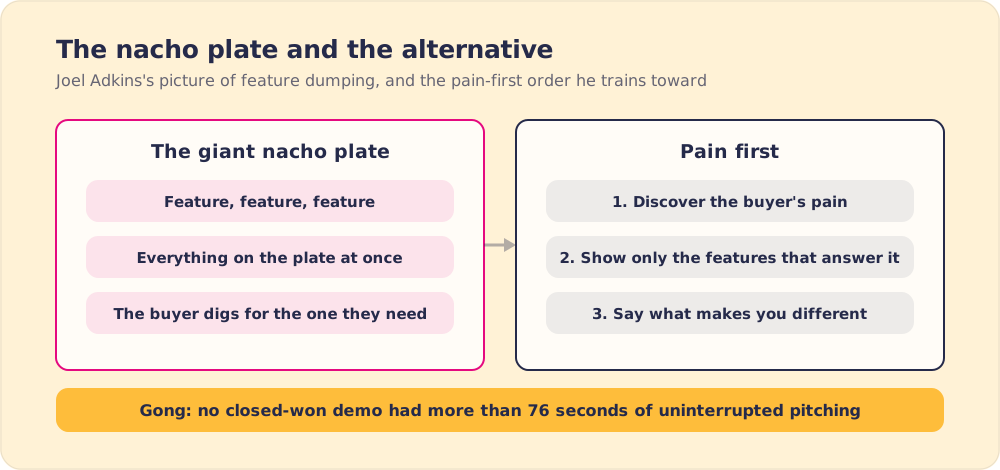
To stop feature dumping on your team, work through the three changes Joel described.
- Discovery before the demo. Reps find the pain first, and our list of discovery call questions helps.
- Features paired to pain. Each feature a rep shows answers something the buyer said, and the rest stay off the plate.
- Winning phrases spread. Joel’s team looks for “what are the reps saying now that’s working,” then works out “how do we ramp that up for other people to make sure they know to say it that way as well.”
In our survey, Scott Sobel, a senior AE at Aptitude 8, put the problem this way: “Enablement over-invests in content and under-invests in behavior change. Discovery is the most under-enabled motion.” Joel’s training sessions are built to fix the second half of that.
Why does Joel call AI content generation a fad?
Joel uses several AI tools and likes them. He objects to one use. “More content. Not better content, but just using it to create more,” he said. He described someone who makes a thing with AI, then builds an automation that keeps making more, “and now it’s like you’ve created a tsunami of things to give to people.” He has a short name for what comes out. “Your slop, as they say.”
That content lands on sellers who already have too much to look at. In Gartner’s survey of 1,026 B2B sellers, run from January to March 2024, 50% said they were overwhelmed by the amount of technology their job requires, and overwhelmed sellers were 45% less likely to attain quota (Gartner, 2024).
Why does Joel want slide-deck training gone, and what replaced it?
Joel’s second fad is older. In education he sat through meeting after meeting where “someone would read a slide deck to the audience. They would read it to us.” He once went to his boss’s boss and said he would stop coming. “If you don’t want me there to contribute, send it to me and I promise you I’ll read it.” He feels the same way about training.
He replaced it with a session he calls Enablement Kitchen. Every few weeks or once a month, reps join a session built around one feature, served as a dish. “Here’s the value prop, here’s the pain points it solves, here’s the recipe to assemble it in your demo site and build it out.” Then they practice. Joel wears a chef hat, sometimes a virtual one that does not fit, and keeps one rule for the room. “It is okay to fail in this room.”
Caleb had to ask whether real food ever shows up. “No, cuz we’re all on Zoom,” Joel said. “All of the language for talking about this is all foody related, too.”
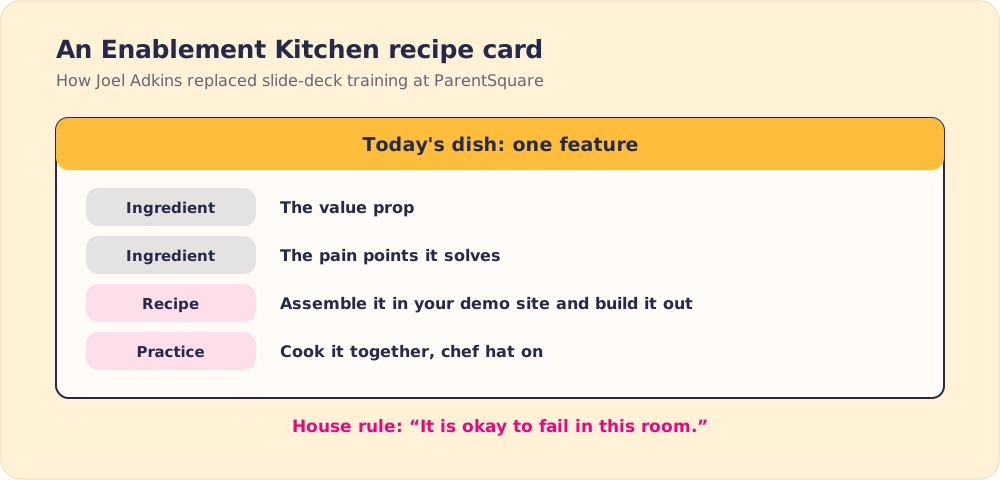
Each recipe gives reps the pain a feature solves along with the feature, the same pairing Joel wants them to make on calls. In 2015 Jaap Murre and Joeri Dros repeated Hermann Ebbinghaus’s 1880 memory experiment, testing recall at intervals from 20 minutes to 31 days, and got a forgetting curve much like his (PLOS ONE, 2015). Practice gives reps a second pass at the material before much of it is gone. For more formats built around practice, see our sales training ideas.
How does Joel keep battle cards current?
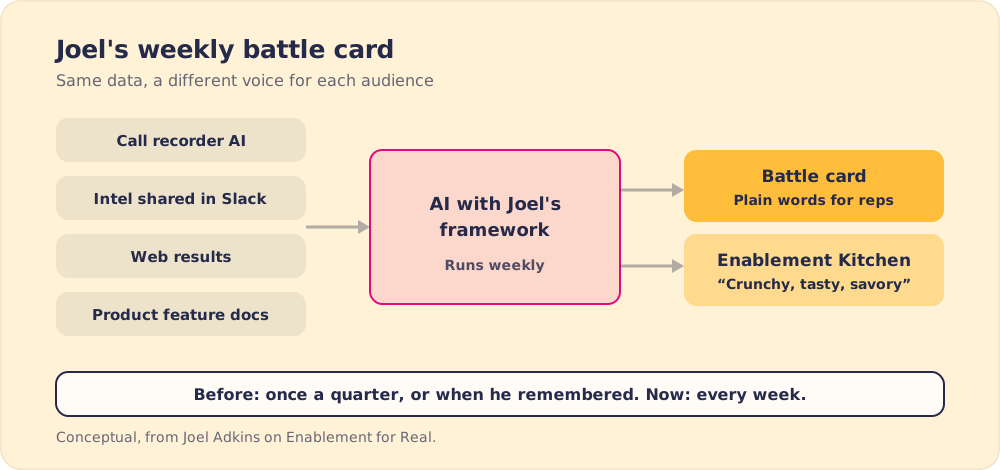
“Instead of me updating battle cards once a quarter or like when I remember to and I’m not so busy, now it’s a weekly task,” Joel said. He chains several AI tools. The call recorder’s built-in AI summarizes what reps are hearing. A second AI searches the competitive intel people share in Slack and what it finds on the web, and a third reads the feature documents the product team is working on. A framework Joel wrote turns all of it into the output he needs, and the voice changes by audience. Enablement Kitchen copy uses words like “crunchy, tasty, savory.” “I can’t have that in a battle card,” he said.
“It’s the same data, but it’s going to the output differently by how I’ve told it to speak.”
Crayon’s 2026 State of Competitive Intelligence reports that 80% of teams now use AI to generate sales-facing competitive content, up from 61% in 2025 (Crayon, 2026). Joel’s weekly card starts from his own framework and his own call data, which is how he keeps it from turning into more of the slop he complained about. Our guide to sales battle cards covers what belongs on one.
His bet for the next few years takes the same idea wider. Google Alerts, the people reps follow on social media, the news, the competition channel and marketing all carry signs of what buyers are hearing, down to state mandates, legal challenges and families’ concerns. “All of this data coming in and getting it to the right sources in a faster amount of time. That’s key,” Joel said.
What Joel Adkins teaches about feature dumping and training
- A classroom background. Eighteen years in schools gave Joel instructional design, and customer training showed him how buyers use the product.
- Time to behavior change. He tracks how fast reps start using new language on live calls, and whether the reps who use it win more.
- The nacho plate. A feature dump buries the one feature that matters. Gong found no closed-won demo with more than 76 seconds of uninterrupted pitching.
- Better content over more content. AI can turn out a tsunami of material, and Joel keeps his output tied to a framework.
- Enablement Kitchen. Recipes, practice and a chef hat replaced slide decks read aloud, with one rule: it is okay to fail in the room.
- Weekly battle cards. Several AI tools, one framework, a voice for each audience, and a fresh card every week.
What should an enablement leader do about feature dumping?
If your reps pile features on buyers, start where Joel did and change the training before you blame the reps. Replace one slide-deck session with a recipe session for a single feature, covering the pain it solves, then the build, then practice. Then pick the phrases your best reps use in discovery and track, call by call, how fast the rest of the team picks them up.
That tracking is hard to keep up by hand. Supered puts the discovery steps and the talk track inside the CRM while the rep works the deal, and shows the enablement team which steps happened, so you can count time to behavior change instead of guessing at it.
For questions that surface the pain before the demo starts, our guide to discovery call questions has a working list.
Frequently asked questions
What is feature dumping in sales?+
Why is feature dumping bad?+
How do you stop feature dumping?+
How do you train reps out of feature dumping?+
How often should battle cards be updated?+
Your process, running itself.
Turn the playbook into rep behavior.
More from Enablement for Real

Sales Training Plan: Justin Swapp on the Discovery Step Enablement Skips
Justin Swapp
How to Motivate a Sales Team: Ryan Beebe on Controllables, Reinforcement and Results Reps Can See
Ryan Beebe