Sales Enablement Team Structure: Why Fiona Simpson Stopped Fighting RevOps
Fiona Simpson of Boomi used to want RevOps out of her way. Now she says the best enablement programs she has seen run on the same data as RevOps. She explains why, what worries her about AI role play, and what she is betting on next.
Sales enablement team structure is how a company arranges its enablement people: who they report to, which teams they partner with, and which data they answer to, so that training turns into measurable change in what reps say and do.
Fiona Simpson now admits it in public. “I used to be a RevOps hater,” she told Caleb King when she came on Enablement for Real. Three or four years ago, when enablement people argued over whether their function belonged under marketing, the CRO or RevOps, someone told her it should live inside RevOps. “I was like, you’re crazy. And now I’m a believer.” How she got from one answer to the other is a useful guide to sales enablement team structure, because she changed her mind by watching which programs worked.
Fiona is the senior revenue enablement business partner for customer success, globally, at Boomi, an integration and data company. She also runs a side practice, Reflect Path, where she packages what she learned in ten years of enablement work into workshops and advisory projects.
What does Fiona Simpson think enablement is for?
Caleb opened with the end state. “My take is it’s about behavior change. Period. Like end of story,” Fiona said. She defines the job as “the process of getting sellers or CSMs or anybody in the field to change their behavior towards what works better.”
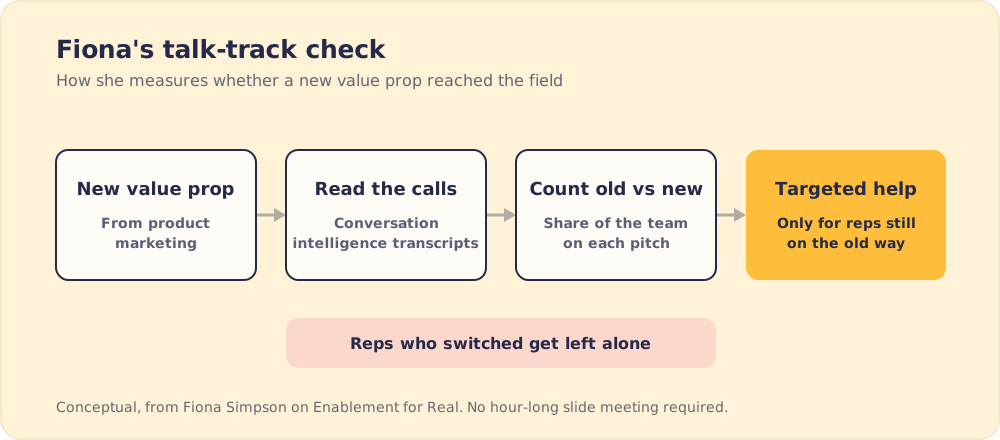
Caleb asked for an example. “I’ll use an easy example,” she said. Product marketing ships a new value proposition. The behavior you want is reps who used to pitch it one way now pitching it the new way. For years that was hard to check. With conversation intelligence pulling call transcripts, Fiona said, “it’s really easy to measure what percentage of the team is doing it the old way and what percentage of the team is doing it the new way.”
The count tells her who needs help. Reps still on the old talk track get targeted coaching, and reps who switched get left alone. She does not reach first for the 60-minute meeting with a slide deck showing the old way and the new way. “That’s not always the most effective route for enabling a new behavior or changing a behavior,” she said.
Plenty of teams already have the transcripts she needs. In The State of Sales Enablement 2026, 73% of teams said they use AI for call analysis and summaries, while 29% said they use it for rep coaching and feedback (The State of Sales Enablement 2026). Most of those teams are recording the calls and not yet counting what reps say on them.
To try her method, pick one message change from this year, write down the old phrasing and the new, and have your call tool count both for a month. Our guide to conversation intelligence covers what those tools can pick up.
Why does Fiona think AI role play as a coaching substitute is a fad?
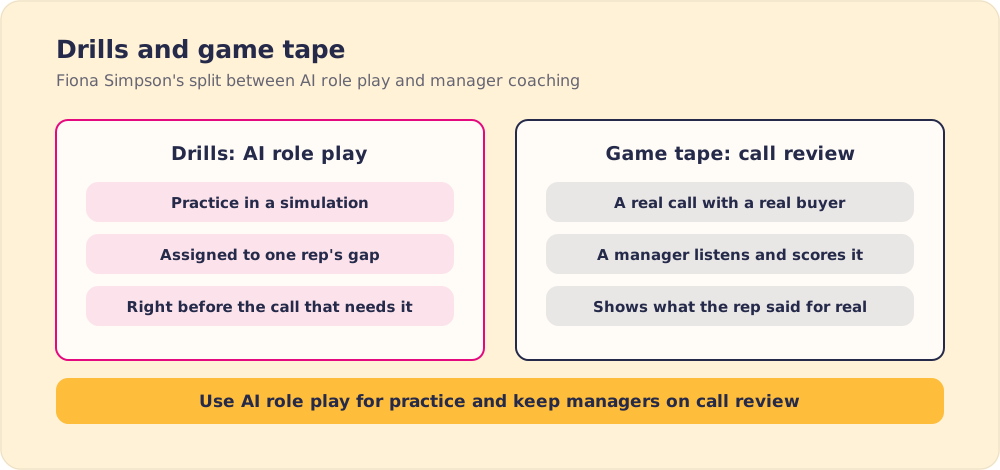
Fiona likes AI role play and calls it a game changer. What worries her is organizations using it as “a replacement for frontline managers doing coaching.” She separates the two with basketball.
A manager reviewing calls and filling in scorecards is “like watching the game tape,” she said. The rep played the real game with a real buyer, and the manager goes back to see what happened. AI role play is the drills. “It’s not the same as the real environment,” Fiona said.
“Cuz you might nail it when you’re doing your AI role play and the AI role play is like you’re amazing and you did it perfectly and like good job and 10 gold stars for you, but that doesn’t necessarily mean that you’re going to execute on it the same way for real.”
Caleb took up her picture, layup lines and dribbling drills on one side and game film on the other. Then he asked whether AI role play is a fad or will last in some other form.
Fiona thinks it lasts if it gets smarter. She pointed to Luster, whose idea she described as “almost like taking the idea of just in time enablement, but it’s like just in time practice.” The software knows a rep has a pricing call coming up and has struggled with pricing conversations, so it assigns that practice to that rep before the call. Fiona supports about 150 people. “I cannot individualize enablement in that manner,” she said, so she sees a real advantage in tools that can. Generic practice misses for her: “you wouldn’t make, you know, Shaq practice his dunk. He can dunk all day.”
Matthew Dixon and Brent Adamson, writing in Harvard Business Review about the Sales Executive Council’s research, reported that “no other productivity investment comes close to coaching in improving reps’ performance” (HBR, 2011). The coaching they studied is managers working with their own reps on real deals, which is Fiona’s game tape.
To test your own program, put the last month of AI role play scores next to the call reviews for the same reps. A rep who aces the drill and misses on the call needs a manager’s time, and our guide to sales coaching covers how to spend it.
Should RevOps and enablement be the same role?
Fiona’s admission came when Caleb asked what is working. She used to think RevOps and enablement “needed to stay out of each other’s way.” Now she says that when the two teams partner, “that is the most successful enablement programs I’ve ever seen,” because RevOps knows what enablement is doing and “enablement is working from the same data as RevOps.”
She has also seen the other case. When enablement ignores what the field data shows, she said, “that’s when enablement becomes a little fluffy. There starts to be questions about like ROI and blah blah blah.”
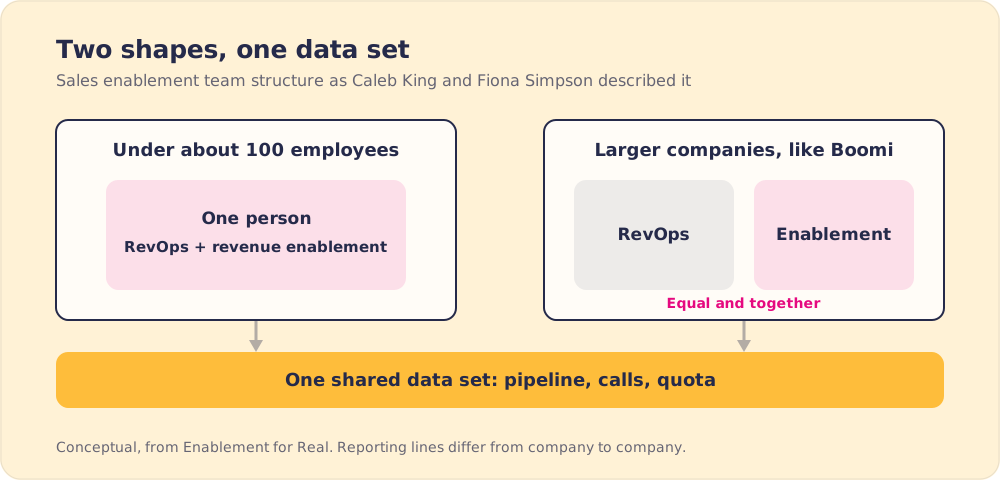
Caleb has watched the two jobs merge at small companies. Large companies like Boomi keep separate roles, but over the last two to five years, at companies under 100 employees, he has seen a joint RevOps and revenue enablement title spread. “That’s a lot of work,” he said, though he agreed the systems have to match. Before they moved on, the two of them described the relationship as “equal and together.”
In the Sales Enablement Collective’s 2024 landscape report, 39% of respondents named a lack of formal internal alignment on what enablement is or does as one of their team’s biggest challenges, and only 51% said they agree with their leadership on which metrics enablement should be judged on (Sales Enablement Collective, 2024). To see where your team stands, ask your RevOps lead and your CRO, separately, which three numbers enablement should move this year, and compare the lists.
What sales enablement team structure fits Fiona’s view?
A sales enablement org structure has to answer two things: who does sales enablement report to, and how does it split work with the teams around it.
Companies answer the first one differently. Federico Presicci’s summary of the Sales Enablement Collective’s 2024 report puts 27% of enablement functions under Revenue Operations, 24% under Sales and 17% directly under a C-level leader, most often the CRO (Presicci, citing the Sales Enablement Collective). Fiona’s own title shows another pattern, a business partner assigned to one organization, in her case customer success.
Built from what Fiona and Caleb described, the structure has four parts:
- A business partner per organization. One enablement lead attached to one part of the field, who knows its people and its numbers and is judged on their behavior.
- A shared data set with RevOps. Enablement and RevOps read the same pipeline, call and quota data, so someone besides the program’s builder can check its results.
- A joint role while the company is small. Under about 100 employees, Caleb sees one person holding both titles, which works if that person has the hours.
- Separate teams with equal standing once the company grows. At Boomi’s size the roles split, and someone has to build the partnership on purpose.
When Fiona explained what makes enablement programs succeed or stall, she talked about field data and RevOps, and said nothing about which department enablement reports to. So draw the reporting line where your company’s size makes sense, and then set up the RevOps partnership deliberately. Our piece on sales enablement vs sales operations covers where the line between the two jobs usually falls.
What is Fiona betting on next?
Her bet builds on the RevOps partnership. For a long time, she said, enablement “was just like the content factory, the training factory, the like crunch out the one-pagers and the battle cards and all that stuff.” She wants enablement to move toward what she calls revenue activation: skill changes, behavior changes, and a record of a rep’s quota attainment and close rate before a program and after it.
“I think that is the path forward for enablement is really moving away from that production-based drive and really looking at change,” Fiona said.
That before-and-after record depends on RevOps, since enablement rarely owns quota and close-rate data. Our revenue enablement guide covers the wider version of the move she describes.

What Fiona Simpson learned about enablement and RevOps
- Behavior change as the end state. Fiona judges enablement by whether reps do something differently, and she counts it in call transcripts, old talk track against new.
- Drills and game tape. She treats AI role play as practice and manager call review as film of the real game. A rep with “10 gold stars” from the simulation still needs someone to review the live call.
- Practice aimed at one rep’s gap. The AI role play she believes in assigns practice to one person before a specific call, which one enablement lead supporting 150 people cannot do by hand.
- One data set with RevOps. Her best programs ran on the same data as RevOps. Without that data, she said, enablement “becomes a little fluffy” and the ROI questions start.
- A structure built around the partnership. A joint role at small companies, separate teams with equal standing at large ones, and the same numbers in both.
How should you set up your enablement team?
If you are deciding where enablement should sit, we would start where Fiona ended up. Give enablement and RevOps one data set before you redraw any reporting line, and write down the behavior each program is meant to change so both teams can check it in real calls. Keep managers on call review after you buy AI role play, and point the role play at each rep’s measured gap.
The last step is getting the new behavior in front of the rep while they work. A rep who has to open another tab to find the new talk track, with a buyer waiting on the line, often skips it. Supered puts the process and the new message inside the CRM at the moment a rep needs them and records whether the step happened, so enablement and RevOps look at the same evidence.
When enablement and RevOps sit down to pick shared numbers, our list of sales enablement KPIs covers the options.
Frequently asked questions
Who does sales enablement report to?+
Should RevOps and sales enablement be the same role?+
What is the best sales enablement team structure?+
Can AI role play replace sales coaching?+
How do you measure whether sales enablement worked?+
Your process, running itself.
Turn the playbook into rep behavior.
More from Enablement for Real

Sales Training Plan: Justin Swapp on the Discovery Step Enablement Skips
Justin Swapp
How to Motivate a Sales Team: Ryan Beebe on Controllables, Reinforcement and Results Reps Can See
Ryan Beebe