The Knowing-Doing Gap: Why Your Reps Know What to Do and Still Do Not Do It
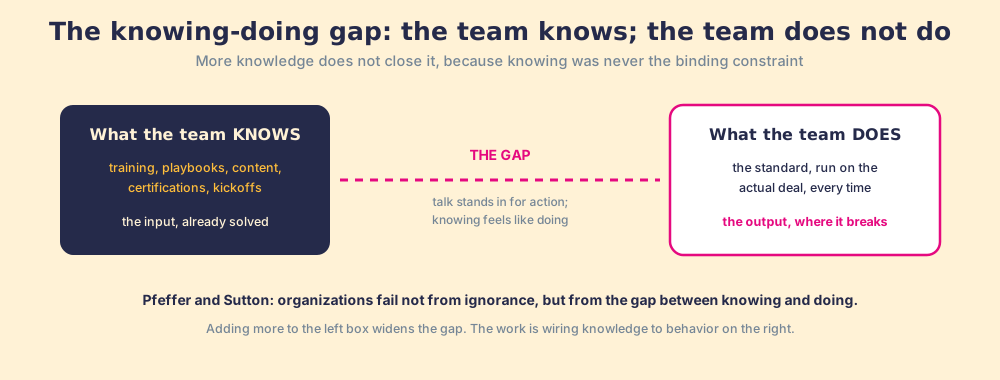
The knowing-doing gap is the distance between what a team knows and what it does, and it is the real reason sales training does not stick. More knowledge widens it. Closing it is a behavior problem, not a knowledge one.
The knowing-doing gap is the distance between what an organization knows and what it truly does, named by Pfeffer and Sutton, and it is why sales training fails to change behavior: knowing the right move is not the constraint, doing it consistently on real deals is.
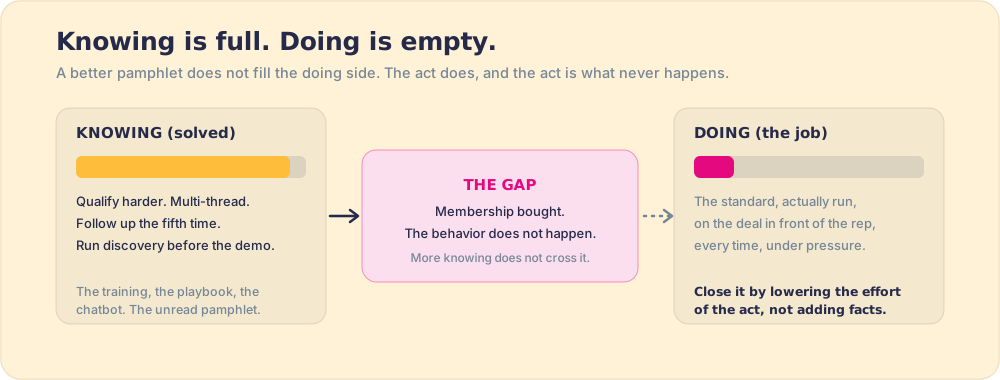
Almost every rep already knows the right move. They know to qualify harder before they build a proposal, to multi-thread the account so it does not ride on one champion, to follow up the fifth time when the fourth went unanswered, to run discovery before the demo instead of after. They have been trained on it, sat through the kickoff, nodded at the playbook. And on Monday morning they run their deals exactly the way they did the Monday before. The knowing did not become doing. That distance, between what a team plainly knows and what it does, is the most expensive thing in your business, and almost everything sold as a remedy (another course, more content, one more certification) is poured onto the side of the scale that was never light.
The knowing-doing gap is the distance between what an organization knows and what it truly does, named by Pfeffer and Sutton, and it is why sales training fails to change behavior: knowing the right move is not the constraint, doing it consistently on real deals is. Name the gap correctly, and you stop pouring resources into the side that was never broken.
It is worth being honest about how this feels from the inside, because the trap is comfortable. A great kickoff genuinely feels like change. The room is loud, the slides are sharp, everyone leaves believing this is the quarter the team finally tightens up. Nothing about Tuesday is different. The feeling of having decided to change is so close to the experience of changing that we mistake one for the other, and the calendar proves the difference three months later when the same deals stall in the same places.
Why does knowing not lead to doing?
Because converting knowledge into action is a distinct, and harder, problem than acquiring the knowledge, and most organizations only invest in the first. In 2000, Stanford professors Jeffrey Pfeffer and Robert Sutton studied why companies stuffed with smart people and good ideas so often failed to act on them, and named the result the knowing-doing gap (Pfeffer and Sutton, The Knowing-Doing Gap). Their central finding was counterintuitive and has aged well: the bottleneck on performance is rarely ignorance. Most teams already know what they should do. What stops them is a set of organizational habits that let knowing pose as doing, so the team feels productive while behavior never moves.
Pfeffer and Sutton put the sharpest version of it in an HBR essay a year earlier, and named the central villain: the smart-talk trap. “Talk, and especially smart talk,” they wrote, is so rewarded in organizations that confident, articulate analysis comes to feel like accomplishment, and companies “let talk substitute for action” (Pfeffer & Sutton, “The Smart-Talk Trap,” Harvard Business Review, 1999). Sounding like you have solved a problem and solving it light up the same part of the corporate brain. The meeting where everyone agrees the team must qualify harder is not qualifying harder. It only feels, satisfyingly, as though it were.
This reframes the entire enablement question, and it is the reframing at the center of the sales execution gap. In 2026 the point lands harder than it did in 2000, because the knowing side has been driven nearly to free. Every rep carries the playbook, the training library, and a chatbot that will explain MEDDIC, Challenger, or SPIN on demand in the time it takes to ask. Knowledge is solved. If knowing were the binding constraint, the curve of sales performance would be bending up as fast as access to knowledge has. It is not. Which is the cleanest available proof that the constraint sits entirely on the doing side, where no amount of added knowing can reach it.
Think of it the way a doctor thinks about a gym membership. Almost nobody who buys one lacks the knowledge that exercise is good for them; the information is not the missing piece, and a more persuasive pamphlet about cardiovascular health changes nothing. The membership is bought, and then most of the behavior never happens, not for want of knowing but for want of the act. Enablement that answers a doing problem with more knowing is selling the unread pamphlet to the person who already owns the unused membership.
What causes the gap in practice?
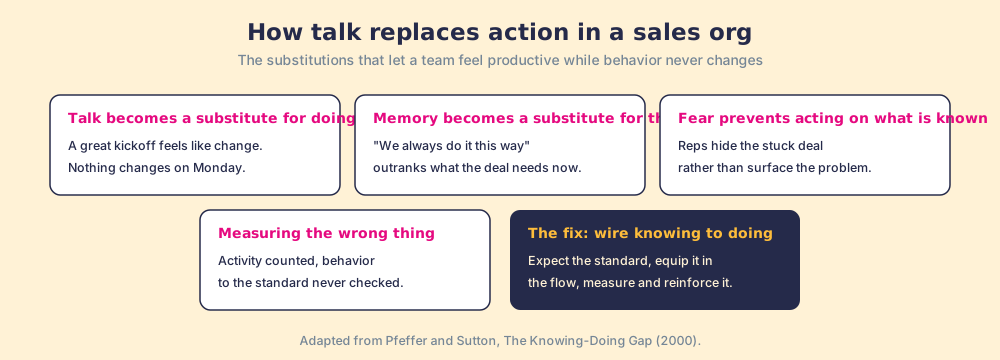
A handful of substitutions that let talk and memory and measurement stand in for the behavior itself. Pfeffer and Sutton catalogued five, and every one is visible on a sales floor by lunch.
Talk becomes a substitute for action: the stirring kickoff produces the feeling of change with no change in what reps do the following week. Memory becomes a substitute for thinking: “we have always run it this way” overrides what this specific deal needs now, so reps re-run an old motion on a buyer it does not fit. Fear blocks acting on what is known: a rep who senses a deal is dead leaves it in the forecast rather than surface the problem, because surfacing it invites a hard conversation, and so the team cannot act on a thing half of it already suspects. Internal competition turns colleagues into rivals, so the discovery script that works for the top rep never spreads, because sharing it costs them their edge. And measuring the wrong thing rewards motion over the move that matters: the team counts calls and emails while never checking whether the rep ran the standard, deal by deal, on the work in front of them.
That last one is the silent killer, and it connects to a hard truth about sales metrics. Activity is easy to count and feels like accountability, but counting activity tells you whether reps were busy, never whether they did the right thing. A team can hit every activity target with a wide-open knowing-doing gap, because none of those numbers asked the only question that decides the deal: did the rep run the standard. We are not saying activity is vanity; capturing what a rep did is how you ever verify the process ran at all. The error is stopping there, mistaking the count of actions for evidence that the right action happened.
There is a thread running under all five. Each one is a way the organization gets the reward of competence (the good meeting, the familiar routine, the avoided confrontation, the busy dashboard) without paying its price, which is the friction and risk of doing the new, harder thing in the flow of real work. The gap is not laziness. It is a system that keeps handing out the feeling of progress for free.
- Talk substitutes for action. The kickoff, the all-hands, the memo. It feels like progress; behavior is unmoved.
- Memory substitutes for thinking. Habit overrides judgment, so reps run the old motion instead of the one this deal needs.
- Fear blocks known action. Stuck deals get hidden rather than raised, so the team cannot act on what it half-knows.
- Internal competition starves the team. The winning motion stays in one rep’s head because sharing it costs them their edge.
- Measuring activity, not behavior. Busyness is tracked; whether the standard was run is not, so the gap stays invisible.
Pfeffer and Sutton’s own answer pointed the same way. The firms that closed the gap, they found, were the ones whose leaders understood the work in detail, used “plain language and simple concepts,” and built “strong mechanisms that close the loop” so that decisions were checked against what really happened, with experience treated as the real teacher rather than the presentation (Pfeffer & Sutton, HBR, 1999). Strip the academic phrasing and that is an operational instruction: stop rewarding the talk, and build a loop that inspects whether the doing occurred. Twenty-six years later, that is still the assignment.
How do you close the knowing-doing gap?
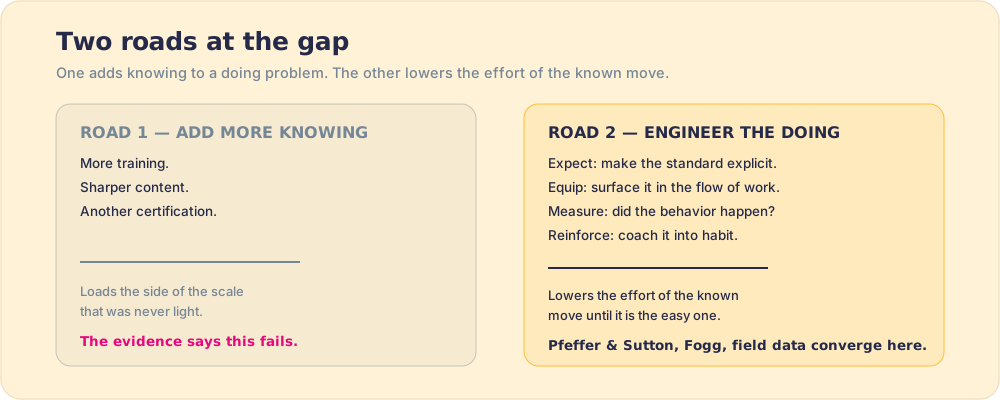
Stop feeding the knowing side and start engineering the doing side. The known behavior has to become the path of least resistance on a real deal, which is a design problem, not a teaching one. Make the standard explicit so there is no ambiguity about the expected move. Equip it in the flow of work, so the right action appears at the moment the rep is working the deal, rather than in a course they took last quarter. Measure whether the behavior happened, not whether activity occurred, because what you measure is what closes or hides the gap. And reinforce it through coaching, so doing the standard becomes the habit. This is the loop at the heart of sales performance management and sales coaching: expect the behavior, equip it, measure it, reinforce it. None of those steps is about teaching reps something new, because they already know. All four convert what they know into what they do.
The reason this works where training does not is that it changes the cost of the act, not the supply of the knowledge. Behavioral science is blunt on the point: in BJ Fogg’s model, a behavior fires only when motivation, ability, and a prompt arrive together, and the lever most teams ignore is ability, how little effort the right move takes in the moment (Fogg Behavior Model). Training pushes on motivation, the axis that was rarely the problem. Surfacing the standard in the flow of work pushes on ability, lowering the effort of the known move until it becomes the easy one. The gap is, at bottom, an effort gap, and you close an effort gap by removing effort, not by adding willpower or facts.
What we recommend
Accept the uncomfortable premise first: your reps already know what to do, so any fix that adds to their knowledge is solving a problem you do not have. The knowing doing gap sales leaders keep trying to train away is a behavior problem, caused by the everyday substitutions, talk for action, memory for thinking, fear for honesty, activity for the move that matters, that let a team feel productive while doing nothing differently. You have two roads. One is to keep treating it as a knowledge to action gap that more knowing will eventually bridge, more training, sharper content, another certification, which is the road most teams take and the road the evidence says fails, because it loads the side of the scale that was never light. The other is to engineer the doing side: make the standard explicit, equip it in the flow of work where the deal is run, measure whether the behavior happened rather than whether reps were busy, and reinforce it with coaching until it is habit. We recommend the second without hesitation, because three independent things converge on it. Pfeffer and Sutton found organizations fail from the gap, not from ignorance. Fogg’s model says the missing lever is ability, not motivation. And the field shows knowledge has gone nearly free while performance has not moved. The reason the second road works when the first does not is that it stops talking about the behavior and starts wiring it into the work. Knowing is solved. Doing is the job. Build for the gap between them, and your team finally does what it has known all along.
From here: the broader frame in the sales execution gap, the discipline that closes it in sales process adoption, the loop that sustains it in sales performance management, and the coaching that reinforces it in sales coaching.
Frequently asked questions
What is the knowing-doing gap?+
Why does more sales training not close the gap?+
What causes the knowing-doing gap?+
How do you close the knowing-doing gap in sales?+
Your process, running itself.