Revenue Enablement: A Wider Name Is Not a Wider Result
Revenue enablement widens enablement from sales to the whole revenue motion. Done right, it fixes the handoffs where revenue leaks. Done as a rebrand, it is the same input-based content delivery with a bigger title.
Revenue enablement is the practice of driving the right behaviors across the entire revenue motion (marketing, sales, and customer success) rather than the sales team alone, and it works only when it targets the outcome across the funnel, not a relabel of sales enablement.
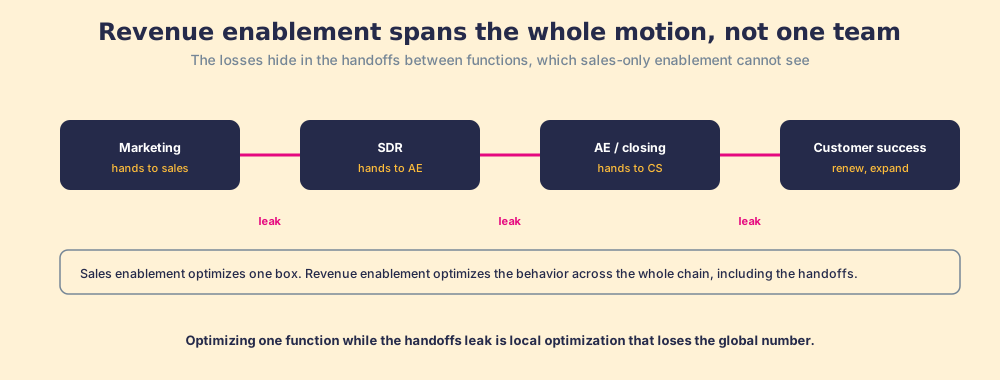
Revenue enablement is the fashionable upgrade to sales enablement: widen the mandate from the sales team to the whole revenue motion, marketing through sales through customer success, and orient everything to revenue rather than to sales activity. As a concept it is correct and overdue, because revenue is produced by the entire chain, and the biggest losses hide in the handoffs between its links, which no sales-only function can reach. But the concept comes with a trap. For many teams, revenue enablement is a new name on the same old work: input-based content delivery for one team, now with “revenue” on the org chart. A wider title is not a wider result, and the difference between the real thing and the relabel is the difference between fixing the revenue system and renaming a box in it.
So what is revenue enablement, stated plainly? Revenue enablement is the practice of driving the right behaviors across the entire revenue motion (marketing, sales, and customer success) rather than the sales team alone, and it works only when it targets the outcome across the funnel, not a relabel of sales enablement. Judge it by what it changes, not by what it is called.
Why widen enablement to the whole revenue motion?
Because revenue is produced by the entire chain, and the largest losses occur in the handoffs that any single-function program cannot see. A sales team can be perfectly enabled and the company still leak revenue, because the leaks are between functions: a marketing-qualified lead handed to sales with no context, a deal closed on promises customer success cannot keep, an expansion that never happens because no one owned the handoff. These are the joints of the revenue motion, and optimizing one function while the joints leak is a textbook case of local optimization, improving one part of a system while the system as a whole underperforms, the failure that systems thinkers from W. Edwards Deming onward have warned against (on local versus global optimization). Enabling only sales tightens one link of a chain whose breaks are mostly at the connections.
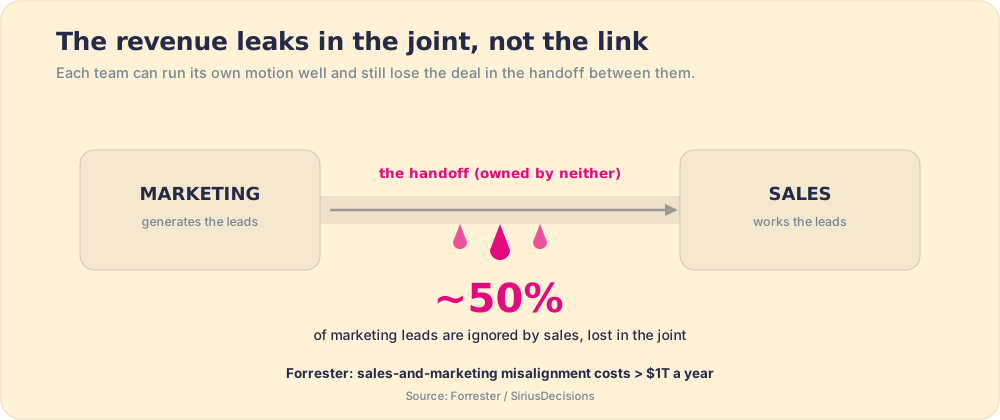
The size of that joint loss is not a guess. The marketing-to-sales handoff alone is one of the most studied leaks in B2B, and the numbers are grim: SiriusDecisions, now part of Forrester, has long reported that sales reps ignore roughly half of all marketing-generated leads, and Forrester estimates the global cost of sales-and-marketing misalignment runs past a trillion dollars a year (Forrester / SiriusDecisions). A lead can be perfectly generated and perfectly worked, and still die in the gap between the two teams, because the gap belongs to neither. That is the joint, and a sales-only enablement function cannot see it, let alone fix it. The leak we traced in revenue leakage is the same loss seen from the org chart: much of what a company loses is not lost inside a function but between functions, in handoffs no one is enabled to run well. Revenue enablement exists to put the behavior across those handoffs in scope, which is exactly the part sales enablement leaves out.
How do you tell real revenue enablement from a rebrand?
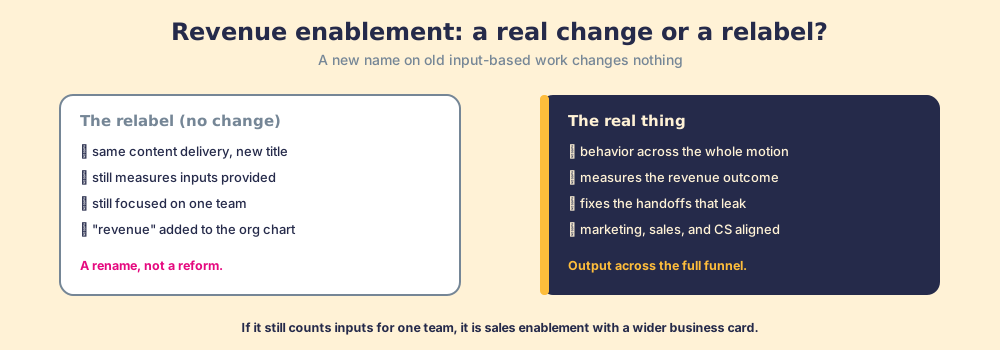
The whole revenue enablement vs sales enablement debate comes down to this one test: check what it measures and what it covers, because a relabel changes the title and neither of those. The rebrand keeps the old machinery: it still measures inputs provided rather than the revenue outcome, still serves one team rather than the whole motion, and adds “revenue” to a job title and a department name. The real thing changes the substance: it measures the revenue outcome across the funnel, covers marketing and sales and customer success, and fixes the handoffs where the motion leaks. The test is not the name on the door; it is whether the practice widened or only the label changed.
This matters because the rebrand is the more common outcome, and it produces the worst of both worlds: the disruption of a reorganization with none of the benefit, since the underlying work, input-based content delivery for one team, never changed. The diagnostic is concrete.
- A relabel measures inputs for one team. Same content delivery, same single-function scope, new word on the org chart. A rename, not a reform.
- The real thing measures the outcome across the funnel. Behavior across marketing, sales, and customer success, judged by revenue, with the handoffs explicitly in scope.
- The tell is the handoff. If the program owns the behavior in the joints between functions, it is real; if it still stops at the sales team’s edge, it is sales enablement renamed.
Where did revenue enablement come from, and is the analyst shift real?
The term is not marketing froth invented by a vendor; the analysts moved first, and the move is worth understanding because it tells you whether the category has substance. For most of the 2010s the software market and the research firms tracked “Sales Enablement.” Then in 2025 Gartner published its inaugural Magic Quadrant for Revenue Enablement Platforms, retiring the older sales-enablement framing and evaluating vendors on whether they “support multiple customer-facing roles,” from sales through customer success, rather than sellers alone (Gartner, on evolving sales enablement toward revenue). When the category’s scorekeeper renames the category, the change is real at the level of language. The open question, the one this whole post turns on, is whether it is real at the level of practice.
This is also where convergence is reshaping the market. The same span that revenue enablement claims, marketing through sales through success, is the span the platforms are racing to cover, which is part of why the field consolidated: Highspot and Seismic, the two largest sales-enablement platforms, announced a merger in February 2026, and Gartner’s own quadrant now scores a single platform on content, coaching, guided selling, and buyer analytics at once. The structural bet across the industry is that enablement should span the revenue motion. That bet can be right and a given team’s reorganization can still be empty, which is the distinction the rest of this post insists on.
How should you do revenue enablement well?
Take the output-based definition of enablement and apply it across the whole motion, with the handoffs in scope. The right version of revenue enablement is not a bigger content portal for more teams; it is driving the right behaviors across marketing, sales, and customer success, and measuring the revenue outcome rather than the inputs delivered, the same shift argued in what is sales enablement, widened to the full funnel. In practice that means naming the behaviors that produce revenue at each stage and, critically, at each handoff, surfacing them in the flow of work for every function, and measuring whether they happen, which is the loop in sales process adoption extended beyond sales. The win is not in renaming the function. It is in owning the behavior across the joints where revenue truly leaks, which is the one thing sales enablement structurally could not do.
What we recommend
Treat revenue enablement as a change in substance, not a change in name, because the rename is the common version and it accomplishes nothing. The concept is right: revenue comes from the whole motion, and the biggest losses are in the handoffs between marketing, sales, and customer success that no single-function enablement can reach. But that only pays off if the practice genuinely widens, measuring the revenue outcome across the funnel rather than inputs for one team, and owning the behavior in the handoffs rather than stopping at the sales team’s edge. So before you reorganize around revenue enablement, check whether you are reforming the work or only relabeling it, and build the revenue enablement strategy around the joints where revenue leaks, because that is the part sales enablement was never built to cover. A wider title changes the org chart. Only a wider practice changes the number.
From here: the losses it must close in revenue leakage, the output-based definition it extends in what is sales enablement, the adherence loop across functions in sales process adoption, and the wider category in sales enablement software.
Frequently asked questions
What is revenue enablement?+
How is revenue enablement different from sales enablement?+
Is revenue enablement just a rebrand of sales enablement?+
Why focus on the handoffs in revenue enablement?+
Your process, running itself.