Sales Training Plan: Justin Swapp on the Discovery Step Enablement Skips
Justin Swapp has built and fixed sales and success teams for 20 years at AOL, MarketStar and Pluralsight. His sales training plan starts with discovery and a before-and-after snapshot, and he draws a firm line on what AI should never take over.
A sales training plan is the written sequence for changing one sales behavior: the metric it should move, the behavior behind that metric, a snapshot before training, the training itself, a way to watch reps use it, and a second snapshot that shows whether the metric moved.
Justin Swapp met his wife at AOL in the dial-up days. She was his trainer, and the family still jokes about it more than 20 years later. Since then he has built and fixed sales and success teams at AOL, at the outsourcer MarketStar and at Pluralsight, running business development, channel, account management, renewals and customer success. His sales training plan starts well before anyone builds a course.
Caleb King asked him on an episode of Enablement for Real what enablement tends to miss. Justin answered with two questions. “Is there proper discovery to know what the behavior is that you’re trying to change?” he said. “Are you just repackaging some training and throwing it at the team?”
Why does Justin Swapp call enablement a change agent?
Justin draws the Greek letter delta, the small triangle mathematicians use for change, and he thinks of Delta Force too. “When you drop the Delta Force in on something, they’re going to change the situation,” he said.
In his experience the request comes from a sales leader. Justin acted it out for Caleb: “We’re not selling like we should. We’re not closing like we should. The deal size is too small.” Then the ask: “I need you to come fix it for me.”
He wants enablement to hear that as a request to change what reps do. “Your behaviors equal your results,” he said. “And if you have the wrong behaviors, you’re going to get the wrong results.” His example was a discount. Tell every rep to give 50% off, and “our sales will go up, but our average deal size will go down. Now, I have a new problem.”
Caleb asked if the missing piece was “the proper discovery and diagnosis.” Justin said yes.
What should a sales training plan start with?
Justin starts with one metric and the behavior he thinks drives it, written down before the course exists. He used negotiation. The close rate is low, the sales leader suspects reps give ground too early, so someone lists what good negotiation looks like first. “Don’t project your idea of cost on the customer,” he said. “Sell what you’re trying to sell. Add value to it.”
Even training aimed at the right problem wears off. Alan Saks and Monica Belcourt surveyed training professionals for a 2006 study in Human Resource Management, and they estimated that 62% of what employees learn gets used on the job right after training, 44% after six months and 34% after a year (Saks and Belcourt, 2006). If a third of the course survives the year, Justin wants that third spent on the behavior the sales leader named.
How do you know sales training worked?
Justin wants two pictures of the same number, one taken before the training and one after. In between, someone watches reps use the new behavior. “And then you should be able to take another snapshot after the fact and see if there was an impact and there was that delta that we talked about.”
Caleb pushed on this. Enablement people had told him they report course completion rates because those are the easiest numbers to pull. “Yeah, I mean, that’s a really flawed way of thinking of it,” he said. “All that tells you is did they take the course?” A rep can finish a module and still not believe it, skip it on calls, or try it once and fumble. “Maybe they kind of half did it or the execution wasn’t great.”
Donald Kirkpatrick’s training model, now kept by Kirkpatrick Partners, has levels for what Justin is after. Level 3 “measures the degree to which the target audience performs the critical behaviors in its environment,” and Level 4 measures whether the targeted results followed (Kirkpatrick Partners). Completion is neither. Our own survey agrees. In The State of Sales Enablement 2026, which asked 198 sales leaders about their teams, teams at 76% to 100% of quota averaged 3.83 out of 5 on deal-execution consistency and teams at 0% to 25% averaged 3.00, while training volume was about the same in both groups (The State of Sales Enablement 2026).
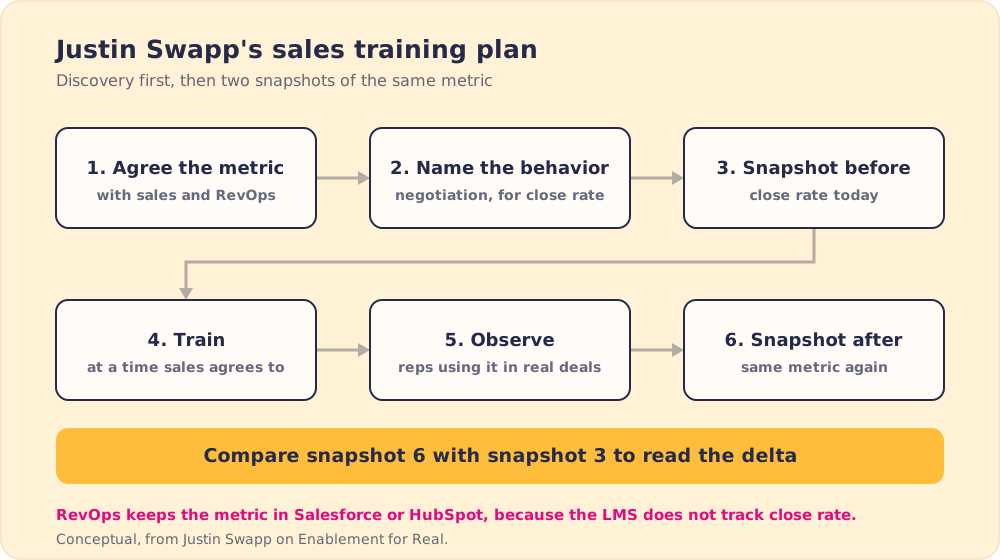
To get both snapshots, Justin brings RevOps in before the training starts. He calls RevOps “a watchtower role” and says it is like Switzerland, sitting where it can serve every team. His reason is practical. “Your LMS probably doesn’t track close rate,” he said. RevOps can put close rate in a Salesforce or HubSpot dashboard, so the after number exists when you go looking for it. Our guide to sales training metrics covers which numbers to watch.
How to build a sales training plan, step by step
In order, Justin’s method has seven steps.
- Agree on the metric with sales and RevOps before building anything. In Justin’s words, “what are the metrics we’re trying to change, right? We’re change agent, what are we trying to change?”
- Name the behavior you think moves that metric. For a low close rate, that might be negotiation.
- Break the behavior into pieces you can observe, like holding on value before price.
- Take the first snapshot of the metric.
- Pick the timing with sales. Justin has seen companies force training on reps “at the end of a quarter,” and he would rather ask the sales leader, “when does this work for you?”
- Train in a way the team will accept, because reps who resent a session will not use it. “You need them bought into it and believing in it,” he said.
- Watch the behavior in real deals, take the second snapshot and compare the two.
Our guide to sales training programs covers the wider program a plan like this sits inside.
Why Justin Swapp thinks remixed AI content is a fad
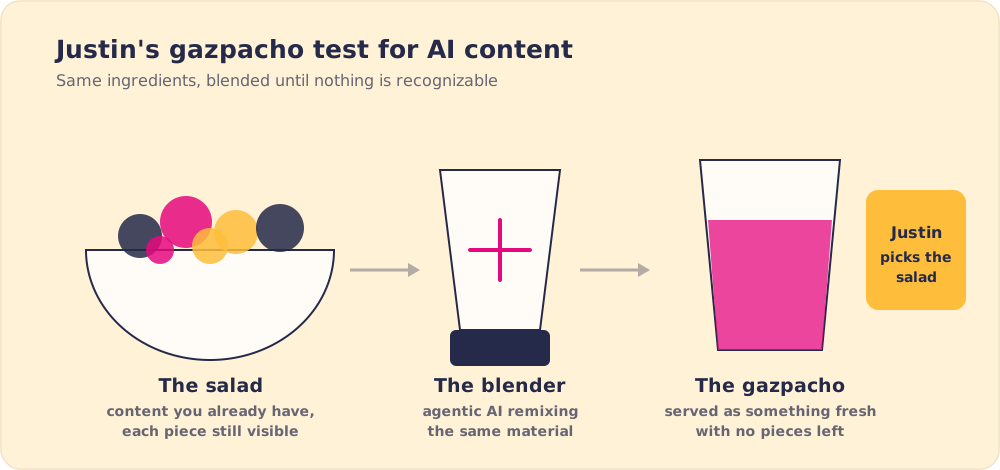
Caleb asked for a fad. Justin named the idea “that agentic AI can remix content that you’ve already got and then spit out something that’s fresh.”
Then he asked Caleb if he had ever been to Spain. In a hot Spanish summer, he said, people decide it is too hot to eat a salad of greens, tomatoes and olive oil, so they put it in a blender and drink it. That is gazpacho. Justin has turned it down more than once. “I would rather the salad than like a gazpacho,” he said. AI-remixed training is gazpacho to him, and he sees people pull back from “content that’s being created that doesn’t have a soul.”
He still likes AI. “Like AI is awesome,” he said, and in the next breath, “we have to be mindful of how we use it.” In a Boston Consulting Group field experiment with 758 consultants, those using GPT-4 finished 12.2% more tasks on work the model handled well and were 19% less likely to reach a correct answer on a task outside its abilities (Dell’Acqua et al., 2023).
What should you offload to AI, and what should stay human?
Justin sees two promises in AI, more output and time given back to people, and he asks which work belongs where. “What could we offload to AI? We could offload anything, but what should we offload to AI?” On AI coaching, he keeps the human. AI can make a coach faster, he said, “but I wouldn’t turn it all over to AI,” because he thinks teams would lose relationships and buy-in. Our post on AI sales coaching looks at where the software helps a manager and where it cannot stand in for one.
Caleb offered a line someone once told him: “you have to be very, very careful when your knowledge and skill capacity outrun your wisdom and discernment.” Justin went to Jurassic Park, the book. One character complains that the park’s builders stood on the work of earlier scientists without earning it, and Justin paraphrased the line he remembers: “It’s a lot like martial arts. By the time you learn to kill with your hands, you’ve learned that you shouldn’t.”
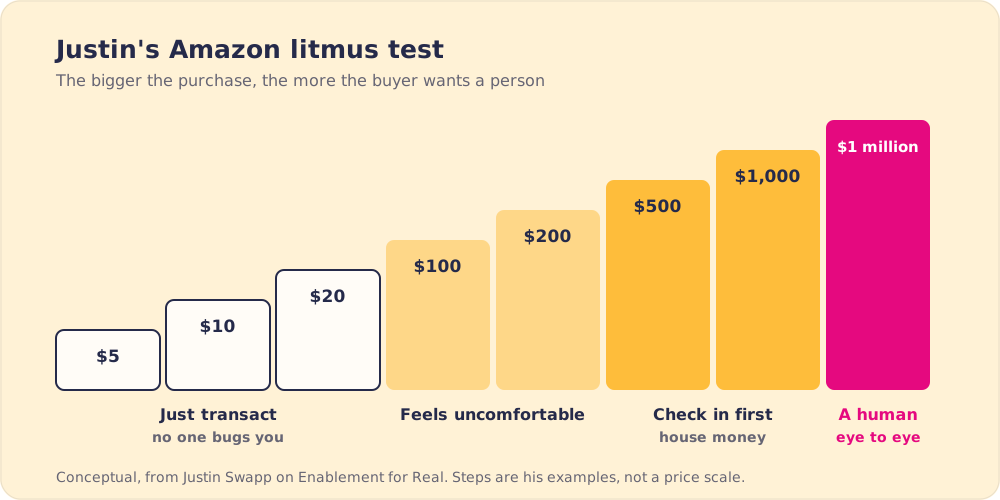
Then he tested Caleb with Amazon. How much can you spend before you have to talk to your spouse? Five, ten or twenty dollars goes through. At $100 or $200 it starts to feel uncomfortable, and at $500, “no, I got I got to check in.” A thousand dollars is “house money.” Justin thinks business buying works the same way, and he cannot picture anyone spending a million dollars through a chatbot. The buyer at that size says, “I’m putting my budget on the line. I’m risking my career. I’m going to the CFO asking for X.” Gartner’s research on B2B buying lines up with him: buyers are 1.8 times more likely to complete a high-quality deal when they use a supplier’s digital tools together with a sales rep than when they use them alone (Gartner).
He still carries a line from a Franklin Covey trainer: “The experiences we give people inform their beliefs.” His bet is on companies “building systems and workflows where you’ve made a logical, ethical, methodical decision on what you’re going to offload to AI and what you’re not.” He is also betting on signal hunting, where enablement teaches reps to reach the right person at the right time with the right message. The alternative is “Hey, I just wanted to catch up with you,” and Justin’s view of that email: “Like that stuff’s lame.”
Caleb ended the segment with Justin’s own story. “Let’s hope that we’ve practiced martial arts enough to make these decisions.”

What Justin Swapp puts in a sales training plan
- Discovery before a course. Name the behavior behind the sales leader’s complaint first.
- One metric and one behavior. Close rate and negotiation, in his example. A blanket 50% discount lifts sales and shrinks deal size.
- Two snapshots. One before training, one after, and someone watching reps in between.
- RevOps from day one. The LMS does not track close rate, so RevOps puts it in a dashboard.
- Timing the team agrees to. Training dropped on reps at the end of a quarter loses their buy-in.
- A written line for AI. Productivity work can go to AI. Coaching and the big purchases where a buyer’s career is on the line stay with people.
What should an enablement leader do next?
Run Justin’s discovery on the next training request before you open a slide deck. Ask the sales leader which number is wrong, which behavior they think causes it, and what that number is today. If the sales leader cannot say, go to RevOps and get the snapshot first. With a before number in hand, you can show whether the training moved it, and that is the start of a sales training ROI figure.
Then write down your AI line task by task, and keep coaching and high-stakes buyer conversations with people.
Watching reps use the behavior deal after deal takes the most manager time. Supered carries part of that load. It guides reps through your process inside HubSpot and Salesforce while they work and records whether each step ran, so the after snapshot shows behavior as well as attendance.
If you are not sure which number belongs in the before snapshot, our guide to sales enablement KPIs lists the candidates.
Frequently asked questions
What should a sales training plan include?+
How do you measure whether sales training worked?+
Why are course completion rates a weak sales training metric?+
When is the worst time to roll out sales training?+
Should AI replace human sales coaching?+
Your process, running itself.
Turn the playbook into rep behavior.
More from Enablement for Real

Sales Enablement Success: How Intuit's Alex Davis Measures It Without Overclaiming
Alex Davis
How to Motivate a Sales Team: Ryan Beebe on Controllables, Reinforcement and Results Reps Can See
Ryan Beebe