Data Enrichment Services: A File, a Feed, or a Function, and the Day the Accuracy Number Is Taken
Data enrichment services sorted by what they deliver: a file from an outsourced research shop, a feed from a data company, or a function you run on your own Clay account. Why the accuracy claim is measured on delivery day, the decay arithmetic, graded options, and 2026 prices.
Data enrichment services are companies that fill the missing fields on your contact and company records, such as work email, mobile and title, by delivering an enriched file, keeping a database feed current, or running enrichment on demand when someone needs the record.
A new VP of Sales inherits a CRM with forty thousand contacts and a nagging feeling about them. She searches for data enrichment services, and the first page hands her a nonprofit donor bureau, an outsourcing firm with a thousand researchers, a listicle of software, and a company promising 99.99% accuracy in 24 hours. They all use the same three words. They are selling four different things.
Data enrichment services are companies that fill the missing fields on your contact and company records, such as work email, mobile and title, by delivering an enriched file, keeping a database feed current, or running enrichment on demand when someone needs the record. A file, a feed, or a function. The shape of the delivery decides more than the vendor’s name, because B2B contact data ages by roughly 2% a month (Only-B2B, cited by Apollo), and the accuracy number on most service pages is taken on the day the file leaves the building, while your rep picks up the phone weeks or months later.
The shortlist, for a B2B sales team:
- Supered Prospector on your own Clay account. For teams already on Clay whose reps never open it: the waterfall runs at the moment a rep needs the person, from Sales Navigator, a company website, or the CRM record.
- A data company feed (Cognism, ZoomInfo, or Apollo). For teams that want one vendor, one contract, and a CRM connector that keeps known records current.
- An outsourced research service (HabileData, SPAN Global Services, Datamatics). For a one-time cleanup with an end date, such as a legacy database before a CRM migration.
What are data enrichment services, and which kind are you shopping for?
Search the term and Google serves four businesses on one page. Sorting them takes one question: what arrives when you pay?
- Donor-data bureaus. Blackbaud’s data enrichment services run National Change of Address screening, flag deceased constituents, add missing emails and phones, and flag numbers on the Do Not Call registry, for nonprofits, schools and healthcare organizations (Blackbaud, October 2, 2026). Excellent at its job, and its job is the donor file.
- Outsourced research shops. HabileData describes “1000 + Skilled Data Management Experts,” a “24 Hrs Turnaround Time,” and “15M+ records a year” (HabileData). SPAN Global Services cites an “800+ strong team of data validation experts” and “short delivery cycles of 2 to 10 days” (SPAN). You send records; you get a file back.
- Data companies. ZoomInfo (“500 million contacts,” per its August 2026 results), Cognism, Apollo, Lusha and Kaspr each own a database and sell access to it, with a connector that pushes fields into your CRM. Cognism’s CRM Enrichment add-on promises “Enrich a contact once, and we keep it up to date” (cognism.com/pricing). You get a feed.
- An aggregator on your own account. Clay owns no database. It routes a lookup across “200+ providers in one place” in sequence, a waterfall, and charges only when one of them returns a result (clay.com/pricing, October 2, 2026). You get a function, and it runs whenever you call it.
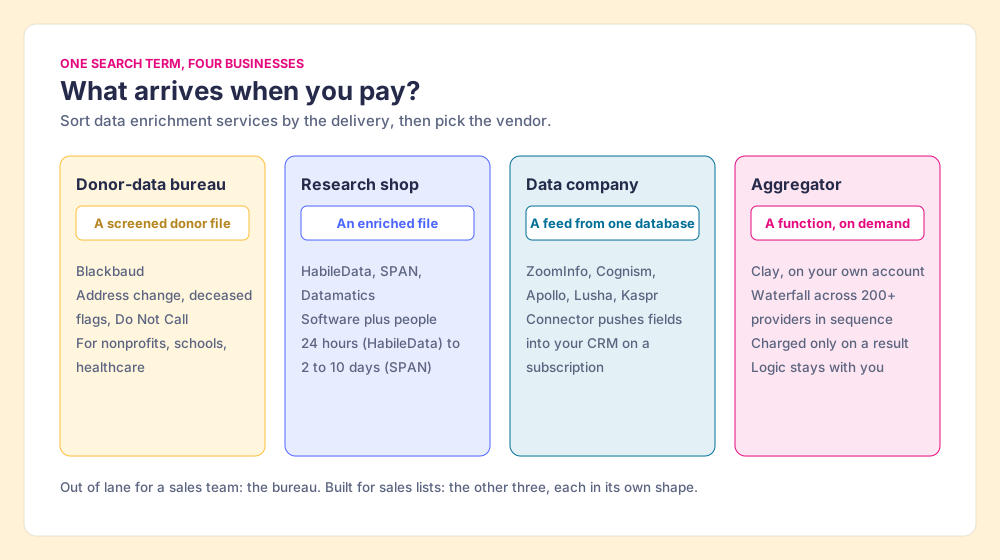
The data enrichment tools page sorts the software by the fields each fills. This page sorts the companies by what they hand you, because a buyer picking among data enrichment companies is picking a delivery shape first and a vendor second, usually without being told.
Why is the accuracy number on a data enrichment service taken on the wrong day?
Think about bread. A bakery can tell you, truthfully, that its loaf was perfect when it came out of the oven. That is a real claim about a real loaf. It says nothing about the slice you eat next week. Data behaves the same way, with a slower crust.
The service pages quote the oven. HabileData advertises “99.99% field accuracy.” SPAN promises deliverability “over 95%.” Datamatics’ own roundup describes “230 million verified B2B contacts” with “95% accuracy” (Datamatics). None of these is false. Each is measured at delivery, and a file starts to age the moment it lands.
How fast? Apollo’s April 2026 guide cites Only-B2B: “B2B data deteriorates at an average monthly rate of 2.1%, which compounds to roughly 22.5% annually” (Apollo). Apollo is quoting another vendor, so treat the figure as directional. The Bureau of Labor Statistics counted 5.1 million job separations in August 2026, a rate of 3.2% of employment in one month, which puts a federal number of the same order beside the vendor’s (BLS JOLTS, released September 29, 2026). A separation is a work email that stops answering.
Now run the arithmetic on the best claim in the market. Take a file that is 99.99% accurate on delivery and let 2.1% a month do its work, if it holds:
| Days on the shelf | Accuracy if 2.1% a month holds |
|---|---|
| Delivery day | 99.99% |
| 30 days | about 97.9% |
| 90 days | about 93.8% |
| 180 days | about 88.0% |
| 365 days | about 77.5% |
Our arithmetic, applying the cited rate month on month; no vendor measured these. Change the rate and the curve moves, but it never goes flat, so an accuracy figure means little until it carries a date. Apollo’s guide reaches a cadence from the same logic, “For active prospects, 90 days is a common threshold,” and SPAN refreshes its own database “every 45 days.” A lookup run the moment the rep needs the person skips the shelf altogether.
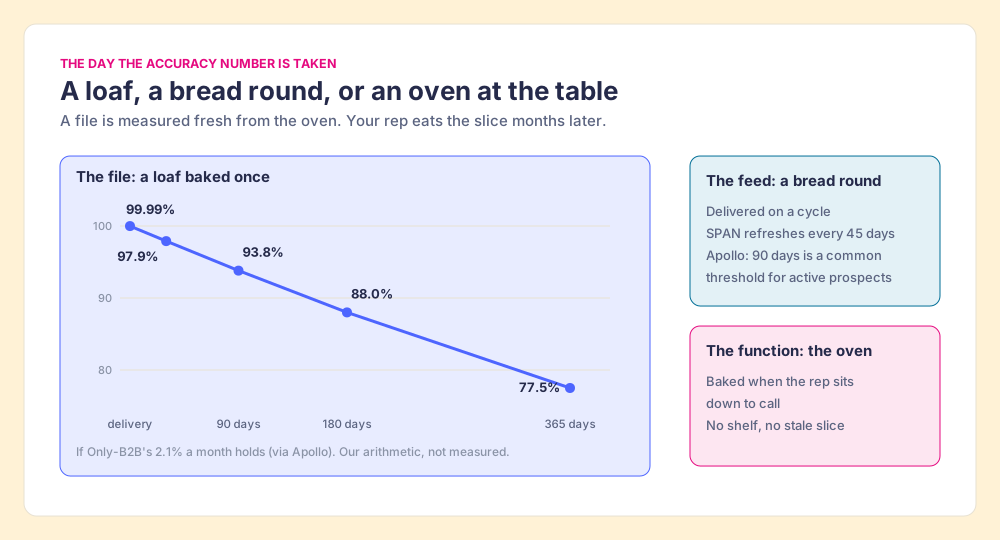
The bread picture has an edge, and it is worth naming so it does not overreach. Data does not go stale evenly. The BLS put median tenure with a current employer at 4.1 years in January 2026, and 3.0 years for workers aged 25 to 34 (BLS), so a list of young SDRs ages faster than a list of CFOs, and the 2.1% is an average across both. Cognism’s 2026 research headline makes the point for the top of the org chart: “Half of C-suite CRM data out of date in less than two years” (Cognism newsroom). The average hides the spread. The direction does not change.
Which data enrichment companies fit which job?
The lens: a B2B sales team of ten to fifty reps, filling emails and mobiles on the people reps are about to contact, with a leader who wants to know whether the work became pipeline. A RevOps lead migrating a decade of records to a new CRM would weight these rows differently, and the research shop would rise.
| Job | Weight | What a 5 looks like |
|---|---|---|
| Accuracy on the day of use | 3 | The lookup runs when the rep needs the person |
| Coverage across sources | 2 | Many datasets asked in sequence |
| Who owns the logic | 2 | Provider order, validation and fields set by your team, kept if you leave |
| Cost tracks results | 2 | You pay for found fields only |
| Effort on your side | 1 | Little to build or run |
Each row scores 1 to 5 per job, times the weight, out of 50. Bands: A 44 and up, B+ 36 to 43, B 32 to 35, B- 28 to 31, C+ 24 to 27. Our scoring, from the vendor pages and Vendr, opened October 2, 2026.
| Rank | Option | Grade | Score | Best fit | CRM integration | Setup effort | Pricing seen | Reason to switch |
|---|---|---|---|---|---|---|---|---|
| 1 | Supered Prospector on your Clay | A | 46 | Sales teams already on Clay | Native: HubSpot, Salesforce, Pipedrive | Medium: needs Clay and a builder | $45 a rep a month, billed annually, plus your Clay plan | Reps run the waterfall at the moment of use, no Clay login |
| 2 | Clay run by your builder or a Clay agency | B+ | 39 | RevOps enriching on a schedule or CRM trigger | Clay CRM sync on Growth | High: tables to build and maintain | Growth $446 a month billed yearly; credits from $0.05 | Same coverage; reps wait on the builder |
| 3 | Seat platform with its own waterfall (Apollo, Kaspr) | B | 33 | Teams with no builder that want one login | Native connectors | Low | Apollo $49 to $119 a user a month; Kaspr $49 to $79 | One vendor first, partners second |
| 4 | Data company feed (Cognism, ZoomInfo) | C+ | 26 | Teams that want one database kept current | Native connectors and add-ons | Low | Vendr medians $32,750 (Cognism), $33,500 (ZoomInfo) a year | One database’s holes, annual contract |
| 5 | Outsourced research service (HabileData, SPAN, Datamatics) | C+ | 25 | One-time cleanup with an end date | Usually a file you import | Lowest | Quote per record or per project | A file that starts aging on delivery |
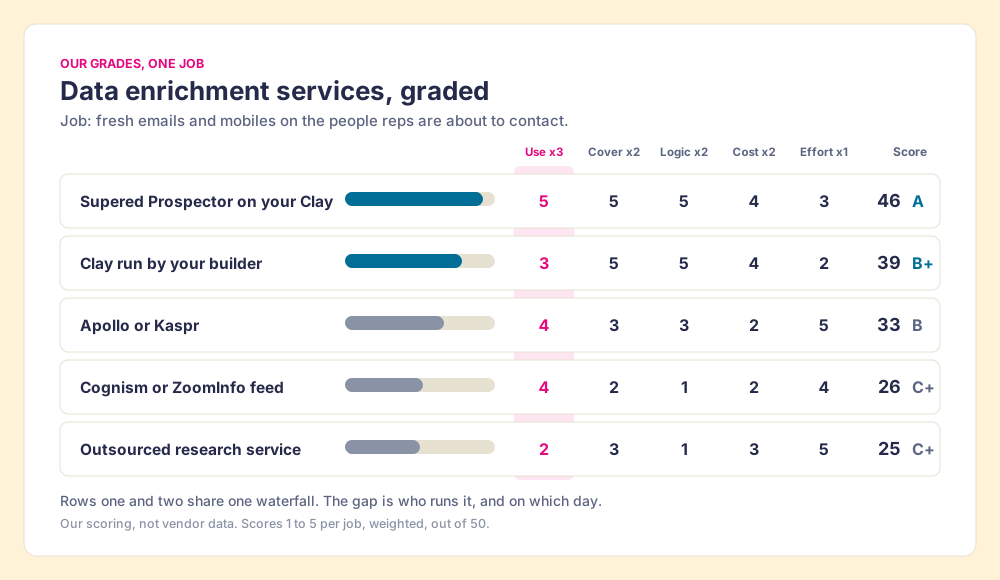
The per-job scores, so you can argue with them:
| Option | Day of use (x3) | Coverage (x2) | Logic (x2) | Cost (x2) | Effort (x1) | Total |
|---|---|---|---|---|---|---|
| Prospector on your Clay | 5 | 5 | 5 | 4 | 3 | 46 |
| Clay run by your builder | 3 | 5 | 5 | 4 | 2 | 39 |
| Apollo or Kaspr | 4 | 3 | 3 | 2 | 5 | 33 |
| Cognism or ZoomInfo feed | 4 | 2 | 1 | 2 | 4 | 26 |
| Outsourced research service | 2 | 3 | 1 | 3 | 5 | 25 |
Two footnotes. Prospector’s coverage score is Clay’s coverage: Supered brings no database of its own, it brings Clay’s waterfall, which is every database, routed, and that is the reason we chose Clay as our only data provider. And the outsourced row earns an A in its own lane. For a fixed project with an end date, a team of researchers who read company websites by hand can fill fields no API returns, and your team builds nothing.
Why trust this page?
I founded RevPartners, a HubSpot partner that did only sales implementations; it sold roughly twice as much Sales Hub as any other partner and reached HubSpot’s Elite tier in 13 months. RevPartners is now a Walker Sands company and a Clay Elite Studio partner, so I have a stake in Clay doing well, and you should read the grades knowing it. Supered came out of that work and holds 4.9 out of 5 from 81 reviews on G2 and 5.0 from 122 reviews on the HubSpot App Marketplace (both checked October 1, 2026). We make Prospector, ranked first above for one job: a sales team already on Clay. Change the job and the order changes.
When is Supered Prospector the right data enrichment service?
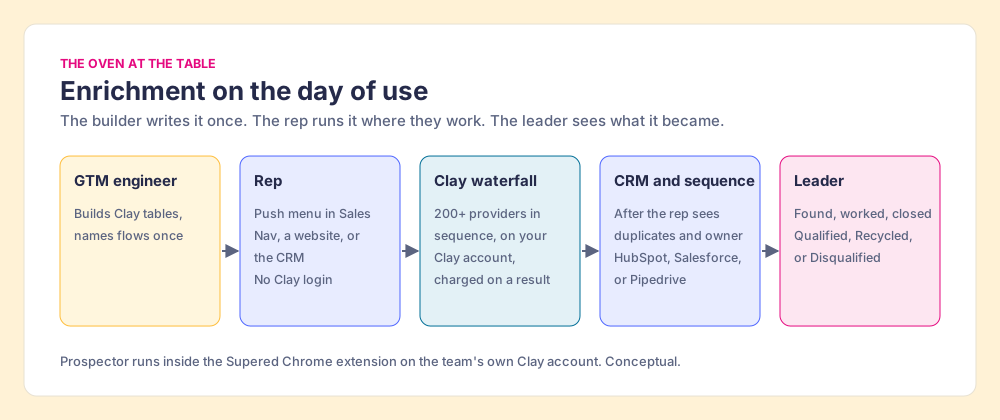
When you already pay for the oven and the reps cannot reach it. Clay plus Supered is the best way for a sales team to prospect: GTM engineers build in Clay, reps never open Clay. Prospector runs inside the Supered Chrome extension, on your own Clay account and your own credits, so the waterfall your builder tuned runs at the moment a rep needs a person, from the screen the rep already has open.
- Flows, built once. The GTM engineer names flows once. Each maps to a Clay table or function, such as person enrichment or a buying-committee lookup, and a destination, such as your sales engagement tool or the CRM on the account. Your logic stays yours: waterfalls, tiers, tags, and sequence variables.
- A Push menu where reps work. A rep in Sales Navigator, on a company website, or in a HubSpot, Salesforce or Pipedrive record picks a flow; the table runs and sends to the CRM and the sequence. Reps add Sales Navigator leads to a prospect list and push the list to a Clay table. Prospector works within LinkedIn’s terms and does not copy search results in bulk; the contact data comes from Clay’s waterfall on the customer’s Clay account.
- No duplicate work. Before pushing, the rep sees whether the person was prospected before and who owns the record.
- Found, worked, closed. The leader sees which lists were found, who is working theirs and who is not, and how each lead ended the way your process says: Qualified, Recycled or Disqualified. Prospector for sales leaders shows that view.
The money is small next to a data contract. Prospector is $45 per rep per month, billed annually, from one rep (Prospector). Ten reps come to $5,400 a year; with Clay Growth at $446 a month billed yearly ($5,352), the pair is $10,752, about a third of Vendr’s $33,500 median ZoomInfo contract. Skip the extra seats: get more out of the Clay you already pay for. Teams new to Clay can start from the Supered Clay template or bring their own tables.
Choose something else if you have no Clay account and no one to build in it, or if what you need is a data enrichment company that owns its database: Prospector does nothing without Clay, so start with a seat platform or hire a Clay agency first. Choose something else, too, if the job is a one-time migration cleanup; a research service will finish it without a single table. And if your contacts are donors, Blackbaud’s bureau is built for exactly that file.
How do the other data enrichment providers compare?
Fair to each, in its own lane, with the price we could see.
- Clay run by your builder. The same waterfall as row one, scheduled or triggered from the CRM. Clay University’s lessons show the controls: providers queried “in a specific order,” “usually starting with the most cost-effective,” with credits refunded “if a provider doesn’t return an email” (Clay University). Strong for keeping known records current. The rep with a new name on screen still asks the builder. The waterfall enrichment page covers the mechanism.
- Apollo. “Apollo data first, then lets 20+ partners fill in the rest,” with Waterfall Enrichment covering emails and phones (apollo.io/product/waterfall). $49, $79 or $119 a user a month on annual billing, 1 credit an email and 8 a phone (apollo.io/pricing, re-read October 2, 2026). The best one-login answer for a team with no builder.
- Kaspr. Part of Cognism since 2022, “Powered by 120+ verified data sources and providers,” with “200 million +” European B2B contacts (kaspr.io). Starter $49 and Business $79 a user a month on annual billing. Built for individual reps on LinkedIn; the Kaspr alternatives page grades it against its neighbors.
- Cognism. Phone-verified mobiles, DNC and TPS scrubbing across 15 lists, data generally kept inside the EEA (cognism.com/compliance). CRM Enrichment re-charges credits only “when key details change, like a job move.” Quote-only; Vendr’s median buyer pays $32,750 a year on 94 purchases (Vendr). The pick for an EMEA team whose counsel asks first.
- ZoomInfo. “500 million contacts” per its August 2026 results, about twice Apollo’s “240M contacts,” with scheduled and instant enrich into the CRM. Vendr’s median buyer pays $33,500 a year on 1,573 purchases (Vendr). The ZoomInfo pricing page breaks the contract down.
- Outsourced research shops. HabileData, SPAN Global Services and Datamatics combine software with people. HabileData says providers “price per record, with cost scaling by field count and verification depth.” The right buy for a project with an end date. The wrong buy for a sales floor that needs fresh records weekly.
Who owns the recipe when you buy a data enrichment solution?
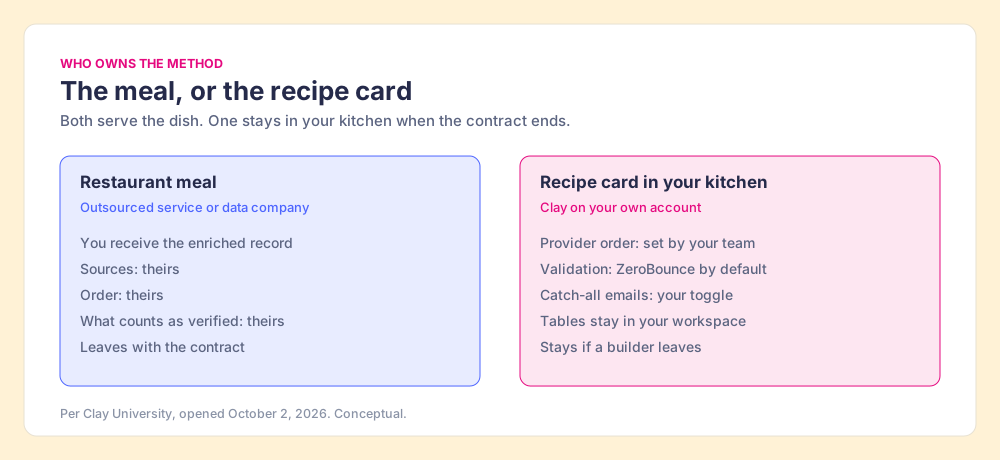
A restaurant meal and a recipe card can produce the same dish. Only one of them stays in your kitchen when the restaurant closes.
With an outsourced service or a data company, the matching logic is theirs: which sources they asked, in what order, what counted as verified. You receive the dish. With Clay on your own account, the recipe card is yours. Clay University says you can reorder providers “if you know a certain provider has better coverage for your ICP,” and its email waterfall validates with ZeroBounce by default, with a toggle to “Only mark Safe to Send emails as valid” that excludes catch-all addresses (Clay University). If the GTM engineer leaves, the tables stay in your workspace.
The recipe matters for one legal reason too. Where GDPR applies to a contact you did not collect from them directly, Article 14 obliges you to tell the person “from which source the personal data originate,” at the latest within one month or at your first communication (GDPR Art. 14). A file from a black box makes that sentence hard to write. Whichever route you take, get the source per field in writing.
What do data enrichment services cost?
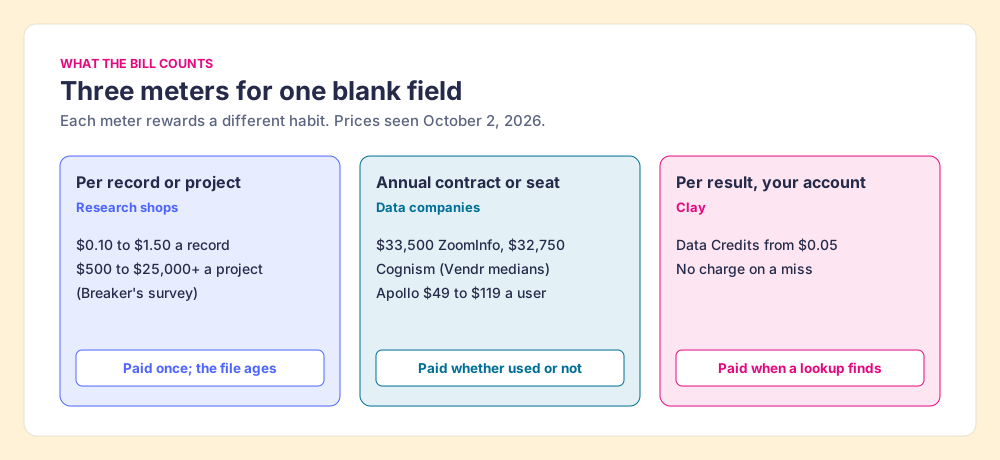
Three meters, and they reward different habits.
| Meter | Example | Price seen |
|---|---|---|
| Per record or per project | HabileData, SPAN, Datamatics | Quote-only; Breaker’s 2026 survey puts the market at $0.10 to $1.50 per record and $500 to $25,000+ per project |
| Annual contract or seat | ZoomInfo, Cognism, Apollo, Kaspr | Vendr medians $33,500 (ZoomInfo) and $32,750 (Cognism) a year; Apollo $49 to $119 and Kaspr $49 to $79 a user a month |
| Per result, on your account | Clay (plus Prospector for reps) | Data Credits from $0.05, nothing charged on a miss; Growth $446 a month billed yearly; Prospector $45 a rep a month |
Sources: Breaker’s guide to data enrichment services (its survey ranges), Vendr, and the vendors’ pricing pages, opened October 2, 2026.
The per-record price looks cheapest on the invoice, and the cost per usable record climbs for as long as the file sits. Forty thousand records at the low end of Breaker’s range is $4,000; at 2.1% a month, about 3,300 of them have gone stale by the end of the fourth month (our arithmetic, 0.979 to the fourth power). Paying per result at the moment of use skips the shelf entirely, which is why the meter and the delivery shape are one decision.
How do you evaluate data enrichment solutions?
Six questions, in the order they save money:
- The date of the accuracy claim. On which day was the figure measured, and on what sample? A delivery-day number tells you about the oven.
- The refresh cycle. How often does the data refresh, and what triggers it: a calendar, a job change, a CRM event, or a rep’s click? Apollo’s 90-day threshold is a sensible ceiling for active prospects.
- The source per field. Can the vendor name where each email and mobile came from? You may owe that answer to the person under GDPR Article 14.
- The charge on a miss. Do you pay when nothing comes back? Clay and FullEnrich say no; seat and contract models charge for access whether a field comes back or not.
- The landing spot. Does the result arrive as a file to import, a CRM field, or on the screen the rep has open? The CRM data enrichment page covers the second; the third is what the Clay Chrome extension guide compares.
- The recipe after you leave. If the contract ends, do the sources, order and rules stay with you?
One more check, outside the vendor’s control. HubSpot bars marketing email to contacts “purchased, rented, borrowed, or otherwise obtained from a third party list” (HubSpot KB). Enriching a record you have is a different act from buying one you do not, and some enrichment companies sell both. Know which you are buying.
Which data enrichment service should you choose?
Four ways forward, depending on where you stand.
- A one-time cleanup with an end date. Hire an outsourced research shop, get the source per field in writing, and use the file inside 90 days.
- No Clay, no builder, a team that wants one login. Apollo, or Kaspr for a Europe-heavy list, with its built-in waterfall. Re-check accuracy at day 90.
- One database kept current, compliance first. Cognism or ZoomInfo on an annual contract, with the CRM enrichment add-on doing the refreshing.
- Clay already paid for. Put the waterfall where the reps work and stop buying a second database: Prospector’s lane.
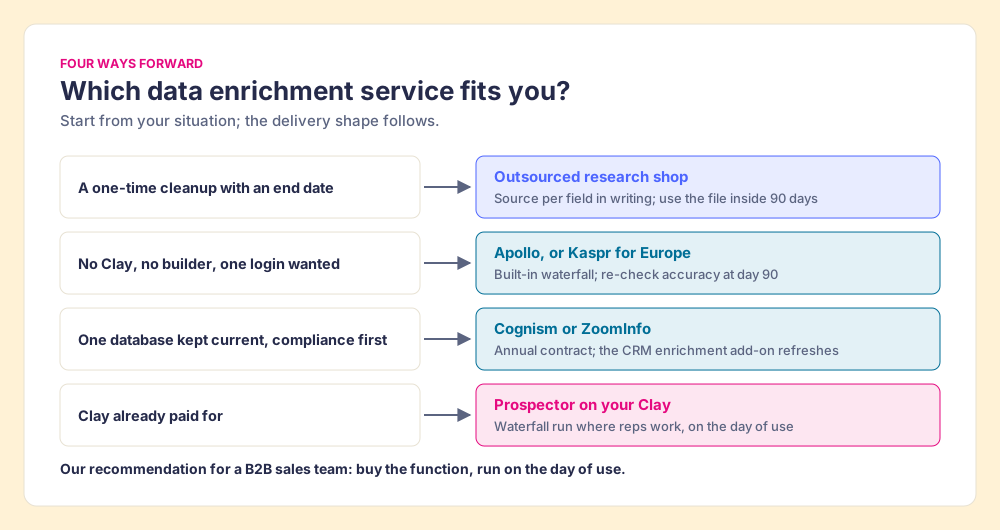
Our recommendation, for a B2B sales team: buy the function, run on the day of use. The evidence is on this page. The best accuracy claim in the market, 99.99%, falls to about 93.8% after 90 days on the shelf if 2.1% a month holds; the federal separations rate says people move about that fast; and a waterfall run on the day of use pays only for what it finds. If you have Clay, you have most of the answer already. The reps need a way to run it.
The VP with forty thousand contacts does not need a fresher loaf. She needs an oven her reps can reach. For the software side, read data enrichment tools; for the endpoints underneath, the data enrichment API guide; for the records most likely to have moved, job change tracking; and for how sourcing fits the rest of the sales process, sourcing with Supered.
Frequently asked questions
What are data enrichment services?+
How accurate are data enrichment services?+
What do data enrichment services cost?+
Should I outsource data enrichment or use a tool?+
Which data enrichment company is best for a sales team on Clay?+
What should I ask a data enrichment provider before signing?+
Your Clay waterfall, where reps already work.