Clay Agency: How to Pick One, and Who Runs the Tables After It Leaves
A Clay agency builds your tables, waterfalls and CRM sync. How to read Clay's partner tiers, what Clay agencies charge in 2026, eight questions to ask before you sign, and one more test for the contract: who runs the tables on day 31.
A Clay agency is a GTM consultancy that builds and runs workflows in Clay for a client: the tables, the waterfall across Clay's data vendors, the signals, the CRM sync, and often the outbound campaigns themselves.
The agency did good work. Fourteen tables, a waterfall tuned for your segment, a buying-committee lookup, a signal that fires when a target account posts a RevOps job, and a forty-minute Loom walking through all of it. Thirty-one days later the Loom has nine views, all of them from your RevOps lead, and she has become the list desk. Reps Slack her a LinkedIn URL. She runs the table. She pastes the result back. The build is excellent, and it runs through one pair of hands.
A Clay agency is a GTM consultancy that builds and runs workflows in Clay for a client: the tables, the waterfall across Clay’s data vendors, the signals, the CRM sync, and often the outbound campaigns themselves. They come in three kinds, and the right one depends on who will run the work after the contract ends:
- A full GTM systems partner. For a sales team that wants Clay wired into the CRM and the sales process, and someone to answer for both.
- A Clay-specialist consultancy. For a team with a strong in-house operator who will own the tables after handoff.
- An outbound execution shop. For a company that wants meetings booked and does not want to run Clay at all.
Most guides to picking among Clay agencies grade the build. This one grades the build and then asks the question that decides whether you got your money’s worth: on day 31, who presses run?
What is a Clay agency, and what do Clay’s partner tiers mean?
Clay keeps its own list. The Solutions Partner directory at clay.com/experts opens with “Grow faster with Clay solution partners” and promises “dedicated support from industry leading GTM and RevOps consultancies focused on product implementation and systems design.” On October 2, 2026 it listed 186 partners, sortable by tier and filterable by expertise, ICP, industry, language, pricing and minimum engagement. Those last two filters are worth using before you book a single call; they cut the list to agencies that work at your budget.
The supply is large because the job is new. Clay’s own post on reaching $100M in annual recurring revenue says GTM engineering “has now spawned thousands of open jobs, hundreds of agencies, and nearly seventy self-organized clubs around the world” (clay.com, December 8, 2025). Hundreds of agencies is a lot of choice and a lot of noise, which is why the tiers matter.
The directory sorts Clay experts into four tiers: Elite Studio, Studio, Advanced Artisan and Artisan. Elite Studio sits at the top. Clay does not publish the criteria for each tier on the directory page, and the third-party guides that rank Clay agencies describe them only in general terms. Rahul Bageria of Real Good GTM, whose agency guide was updated in August 2026, offers the most useful single line on what a tier can and cannot tell you: “The tier says nothing about whether the agency fits your stage, your budget, or whether you keep the Clay workspace afterward” (Real Good GTM).
A tier tells you Clay has watched the agency deliver. It does not tell you what happens on day 31. One more thing to check before you go further: if you searched “clay agency” hoping for the San Francisco UX and branding studio, that is a different company called Clay, at clay.global, and the rest of this page is about the GTM platform.
Which kind of Clay agency do you need?
Andrew van Rossenberg’s June 2026 roundup for Nebor splits the field into three shapes: outbound execution shops that send campaigns with Clay as the data layer, Clay-specialist consultancies that “build workflows and hand them to in-house teams,” and full GTM systems builders that cover outbound, inbound, signals and RevOps (Nebor). The split is right, and it is the first decision to make. Two more paths belong beside them, because the plain alternative to any Clay consultant is to hire or grow your own builder.
The grades below are ours, for one job: a B2B sales team that wants Clay’s output used by its own reps and wants to see whether it turns into pipeline. Change the job and the order changes.
| Criterion | Weight | What it rewards |
|---|---|---|
| Builds what your motion needs | x3 | Waterfalls, signals and tables fitted to your ICP and plays |
| You own it and can run it after | x3 | Workspace on your Clay account, documented, operable by your team |
| Reaches the reps | x2 | Output lands where reps work: the CRM, the sequence, the page they have open |
| Cost you can predict | x1 | Published pricing, clear scope, no surprise credit burn |
| Speed to the first live table | x1 | Weeks, not quarters |
Each option scores 1 to 5 on each criterion, weighted, out of 50. Bands: A 44+, A- 40 to 43, B+ 36 to 39, B 32 to 35, C 25 to 31.
| Rank | Option | Grade | Score | Best fit | CRM integration | Setup effort | Pricing seen | Why it ranks here |
|---|---|---|---|---|---|---|---|---|
| 1 | Full GTM systems partner | B+ | 39 | Teams that want Clay, CRM and process wired together | Native CRM sync built by the partner | Low for you | From $6,500 for RevOps and Clay engineering (Playbook Agency) | Builds the table and the CRM side the reps live in |
| 2 | Clay-specialist consultancy | B+ | 38 | Teams with a strong in-house operator | Usually via Clay’s CRM sync | Medium: someone must take the handoff | From $5,000 a month, quarterly (Workflows.io) | Deep Clay work; the handoff is yours to catch |
| 3 | In-house GTM engineer | B | 35 | Teams ready to own Clay for years | Whatever the hire builds | High: recruiting and ramp | Median $127,500 a year salary | Best ownership, slowest start |
| 4 | DIY with Clay University | C | 31 | A RevOps lead with time to learn | Clay’s CRM sync on Growth | High | Your Clay plan only | Cheapest, slowest, thinnest build |
| 5 | Outbound execution shop | C | 28 | Companies buying meetings, not a system | Often none on your side | Lowest | Outbound from $4,500 (Playbook Agency) | An A at booking meetings; your reps never touch the tables |
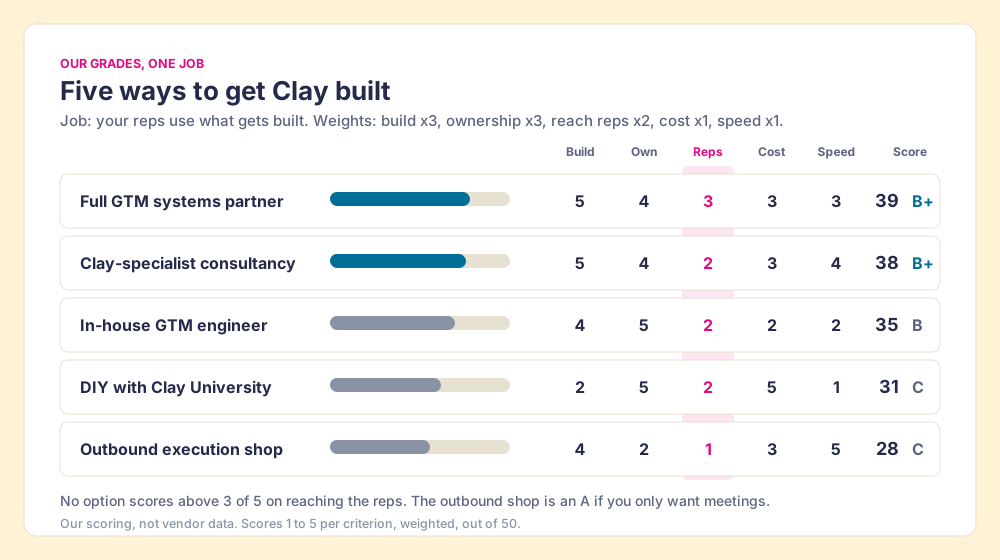
Read the table across the “reaches the reps” column and a pattern shows. Nothing scores above a 3. The best agencies build superb tables, and the tables still live in Clay, where reps do not work. We come back to that gap below, because it is the cheapest one to close.
What does a Clay agency cost in 2026?
Most Clay agencies quote custom, so the published numbers are few. These are the ones we could find, each checked October 2, 2026:
- The GTM Engineering Company. A $4,000-a-month starter tier and a $6,000-a-month growth tier that adds “advanced Clay automation and full RevOps,” on its own blog (gtm-engineering.io).
- Workflows.io. “From $5,000 a month, quarterly commitment,” as listed by Real Good GTM.
- Spring Drive. “From around $5,000 a month up to $30,000+ for particular projects,” as listed by Real Good GTM.
- The Playbook Agency. “Contact data from $1,000, outbound from $4,500, RevOps and Clay engineering from $6,500,” as listed by Real Good GTM.
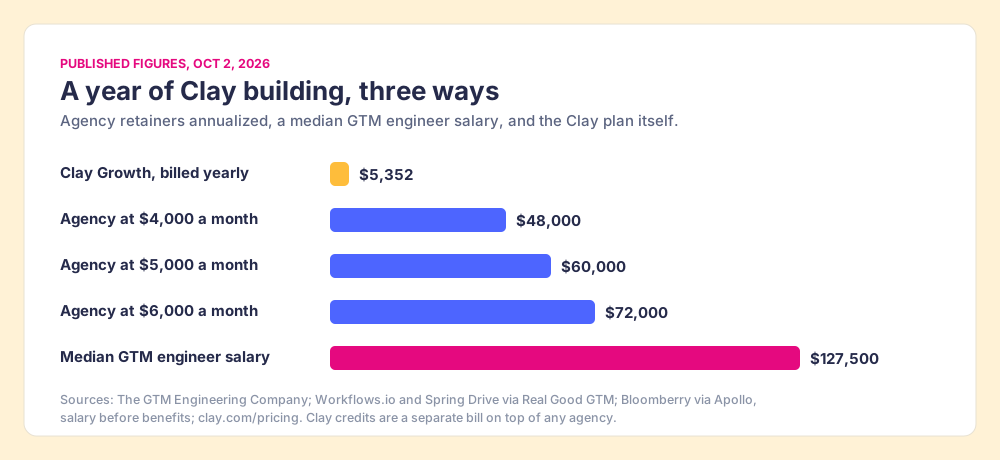
So the going rate for a Clay partner sits near $5,000 a month, or about $60,000 a year. Set that against the hire. Apollo’s February 2026 compensation guide cites a Bloomberry analysis of 1,000 GTM engineering job postings that put the median salary at $127,500 a year, before benefits (Apollo). An agency costs about half the salary on sticker, ships in weeks, and leaves. The hire costs more, ramps slower, and stays.
Neither number includes Clay. The agency builds in your workspace and spends your credits. Clay’s pricing page on October 2, 2026 showed Growth, the plan that carries CRM auto-sync, at $446 a month billed yearly, which is $5,352 a year (clay.com/pricing).
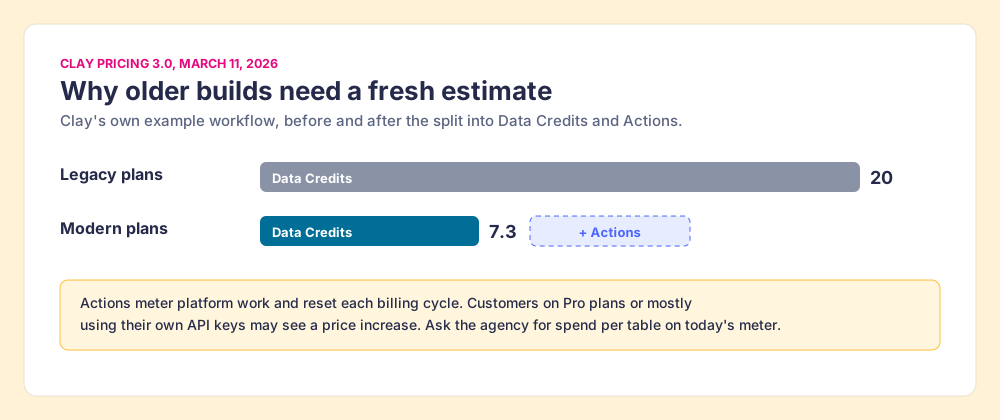
One cost hides inside older builds. On March 11, 2026 Clay split its credits into Data Credits and Actions, and its announcement gives an example workflow that “costs 7.3 Data Credits on modern plans, compared to 20 Data Credits on legacy plans” (clay.com). The same post warns that customers “who predominantly use their own API keys or are on Pro plans may see a price increase.” A table an agency built in 2025 was costed under the old meter. Ask any Clay consultant whether your tables have been re-costed under Pricing 3.0, and which ones spend Actions you did not budget for.
Why do Clay builds stall after the agency leaves?
An agency is a kitchen fitter. You hire them to build a restaurant kitchen, and they do it beautifully: the right burners for your menu, knives sharpened, the walk-in stocked from two hundred suppliers on one account. Then they hand over the keys. The trouble is the floor plan. The cooks do not work in that kitchen. They work across the street, in the LinkedIn room, the Sales Navigator room, the company-website room and the CRM room, and they phone their orders in to the one person who holds a key. She cooks every dish herself. The kitchen is excellent, and it serves a few plates an hour.
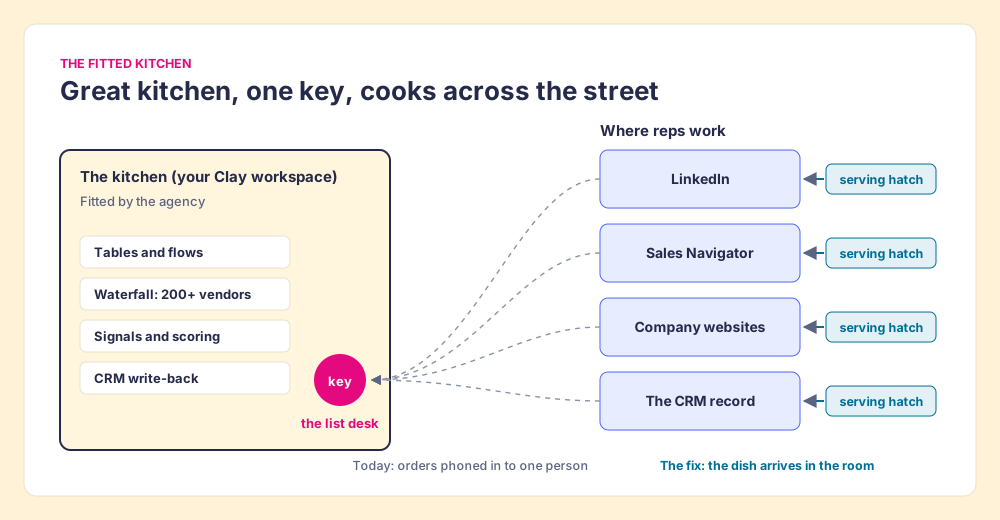
The numbers behind the floor plan are plain. The Bridge Group’s 2025 SDR report, covering 351 B2B companies, puts the median SDR at 112 activities a day: 44 phone, 41 email, 19 LinkedIn and 8 text or other (Bridge Group). None of the 112 happens in a Clay table. Clay knows it; its Clay for Sales page asks teams to “Keep reps selling instead of switching tools to find contacts, fix data, or research accounts” (clay.com/clay-for-sales). And Nebor’s roundup reports that Clay implementations without a named owner “end up shelved within six months.”
The list desk is a system failure, not a people failure. The reps are not lazy for phoning orders in; the build gave them no other door. The GTM engineer is not slow; she is one person serving a sales floor. The agency did not do bad work; it built what the statement of work described, and the statement of work stopped at the kitchen wall.
The comparison stops being true in one useful place. A kitchen stays the same after the fitter leaves. A Clay build does not: providers change, prices move (see Pricing 3.0 above), and a buying-committee table fitted to last year’s titles drifts. So the handoff has two jobs: a person who maintains the tables, and a door for the people who run them. An agency can deliver the first. The second needs a surface in the rep’s rooms, and no agency ships one on its own.
What should you ask a Clay agency before you sign?
Eight questions, in the order they protect you. The first four are about the build, the last four about what happens after it.
- Tier, verified. Is the agency listed at clay.com/experts, and at which tier? A tier claimed on the agency’s own site and missing from Clay’s directory is a red flag Real Good GTM calls out by name.
- A named builder. Who builds your tables, and are they on the account for the whole engagement? A partner badge belongs to the firm; your tables are built by a person.
- The workspace and the credits. Do the tables live in your Clay workspace, on your Clay account, spending your credits? If the agency runs them in its own workspace, you are renting, and the work leaves with them.
- Re-costing under Pricing 3.0. Has the agency costed each table in Data Credits and Actions, and does it build for the modern plans? Ask for the expected monthly spend per table.
- CRM write-back rules. What does a table write to HubSpot, Salesforce or Pipedrive, under which owner, and how does it avoid duplicates? Bad write-back creates more cleanup than no write-back.
- A handoff your team can run. What documentation, training and support come at the end, and who on your side is the named owner? “A build you cannot operate is a dependency,” in Real Good GTM’s words.
- The rep’s button. How will a rep run a table from where they work, without a Clay login and without messaging the builder? If reps still have to ask RevOps, you have bought a list desk.
- The leader’s view. How will you see which lists were found, which were worked, and which closed? The build is the investment, and those lists are its return.
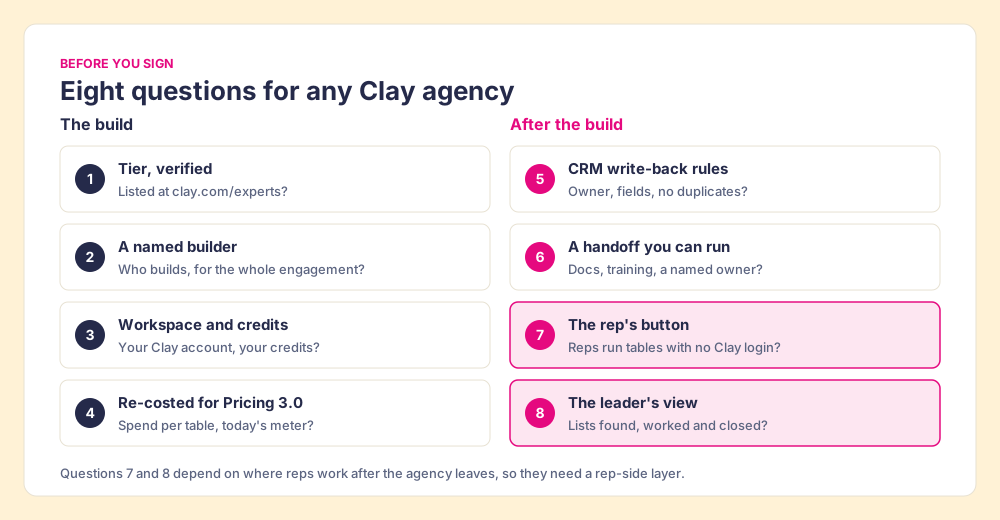
Good Clay consultants answer the first six without blinking, and Real Good GTM’s guide already presses on the tier and the ownership questions. The last two are harder for an agency to promise, because they depend on where reps work after the agency has gone. They need a rep-side layer.
Why trust this page?
I founded RevPartners, a HubSpot partner that did only sales implementations; it sold roughly twice as much Sales Hub as any other partner and reached HubSpot’s Elite tier in 13 months. It is now a Walker Sands company (Walker Sands, June 2026) and a Clay Elite Studio partner, listed on Clay’s directory, so I have a horse in the agency race and you should weigh the page with that in mind. The table above grades agency types, never a named agency. Supered came out of that agency work and holds 4.9 out of 5 from 81 reviews on G2 and 5.0 from 122 reviews on the HubSpot App Marketplace (both checked October 1, 2026). We make Prospector, which appears in the next section. It is not an agency and is not ranked as one.
Where does Supered Prospector fit with a Clay agency?
Prospector is the serving hatch. Clay plus Supered is the best way for a sales team to prospect: GTM engineers build in Clay, reps never open Clay. Prospector runs inside the Supered Chrome extension, on your own Clay account and your own credits, so whatever your agency or your builder put in Clay becomes something a rep runs from where they already work. It does not bring its own database. It brings Clay’s waterfall across 200+ vendors (clay.com, October 2, 2026), routed through the tables your builder wrote, and we chose Clay as our only data provider for that reason.
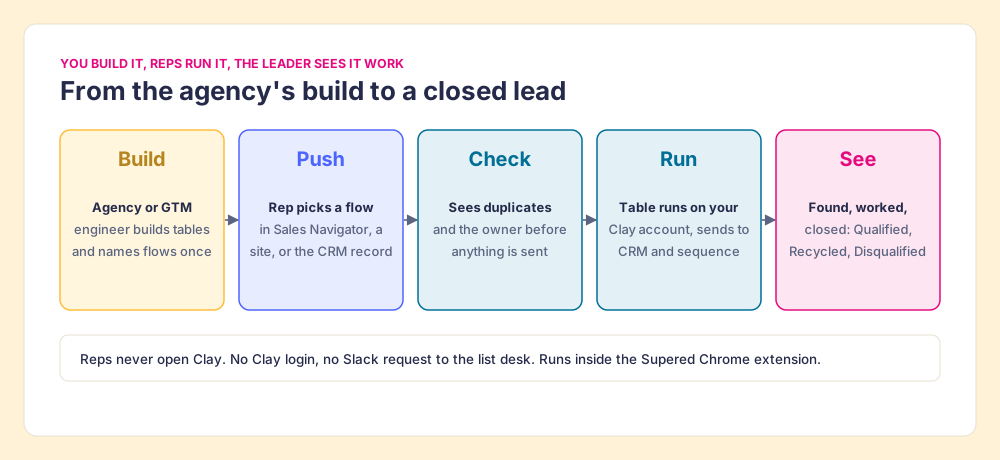
How the pieces fit, from the agency’s build to a closed lead:
- Flows, built once. Your GTM engineer, or your agency, names flows once. Each flow maps to a Clay table or function, such as person enrichment or a buying-committee lookup, and a destination, such as your sales engagement tool or the CRM on the account. Your logic stays yours: waterfalls, tiers, tags, and sequence variables.
- A Push menu for reps. A rep in Sales Navigator, on a company website, or in a HubSpot, Salesforce or Pipedrive record picks the flow from a Push menu. The table runs, then sends to the CRM and the sequence. Reps add Sales Navigator leads to a prospect list and push the list to a Clay table. Prospector works within LinkedIn’s terms and does not copy search results in bulk; the contact data comes from Clay’s waterfall on the customer’s Clay account.
- The plays an agency builds for. Research an account and pull the buying committee you defined; new logos, where the rep picks the campaign on any lead; expansion, the rest of the team at a customer; job changers, a past champion and their new team; stalled deals, the economic buyer and two peers before the forecast call.
- No duplicate work. Before pushing, the rep sees whether the person was prospected before and who owns the record.
- Found, worked, closed. The leader sees which lists were found, who is working theirs and who is not, and how each lead ended the way your process says: Qualified, Recycled or Disqualified. Prospector for sales leaders shows the leader’s side.
- A start for teams without a build. Use the Supered Clay template, or bring your own tables.
The money is small next to the build. Prospector is $45 per rep per month, billed annually, from one rep (Prospector). Ten reps come to $5,400 a year, under a tenth of a $60,000 agency year, and the leader’s view is how a team shows the Clay spend was worth growing. Skip the extra seats: reps who can run the tables stop asking for a separate database login to build their own lists.
Choose something else if you have no Clay account yet: Prospector runs on Clay and does nothing without it, so the agency (or a hire) comes first, and Clay’s own “GTM engineers build on Clay” says why. Choose something else, too, if you hired an outbound shop to book meetings and your reps never prospect themselves; there is nothing for them to push. If your reps work all day in an AI chat, Clay MCP is the closer fit. And if the only goal is to sync agency-built lists into the CRM overnight, Clay’s CRM auto-sync on Growth does that without a rep-side layer.
How should you choose a Clay agency?
Four ways forward, depending on where you stand.
- No Clay, no builder. Hire a full GTM systems partner or a Clay-specialist consultancy for the first build, and write workspace ownership into the contract. Plan the hire or the internal owner before the engagement ends.
- Clay and a strong operator. A Clay-specialist consultancy to build the hard tables fast, with the handoff going to your operator. Ask for re-costing under Pricing 3.0 on anything already built.
- Clay, tables, and a list desk. You do not need another agency. You need a door for the reps. Put the tables in a Push menu and let the builder build again.
- Meetings wanted, no sales team prospecting. An outbound execution shop is the right buy. Grade it on meetings held and pipeline, and ignore the rest of this page.
Our recommendation, grounded in what the page has shown. Pick a Clay agency for the build, using the directory’s tier as the floor and the eight questions as the test, and pay the roughly $5,000 a month the market charges for good work. Then refuse to let the statement of work stop at the kitchen wall. Bridge Group’s median rep makes 112 touches a day and none of them in Clay, so the tables pay back only when reps can run them where they work, and you can see what those runs became.
The RevOps lead in the first paragraph did nothing wrong. She held the only key. For the role your agency is standing in for, read what a GTM engineer does and what GTM engineers earn; for what the agency should build first, see Clay workflows and Clay templates; for wiring the output into the CRM, see the Clay HubSpot integration and the Clay Salesforce integration; for the rep-side options compared, see the Clay Chrome extension guide; and for how sourcing fits the rest of the sales process, see sourcing with Supered.
Frequently asked questions
What is a Clay agency?+
How much does a Clay agency cost?+
What do Clay's partner tiers mean?+
Should I hire a Clay agency or a GTM engineer?+
Who owns the Clay workspace after the agency leaves?+
How do sales reps use the tables a Clay agency builds?+
Your process, running itself.