Command of the Message: The Framework Is the Easy Part
Force Management's Command of the Message standardizes how every rep frames value.
Why a value framework written down is not a value framework delivered, and how to close the gap between the deck and the conversation.
Command of the Message is Force Management's value-based sales methodology for being audible-ready to define your solutions to customer problems in a way that differentiates you and earns a premium, built on one shared value framework the whole team uses.
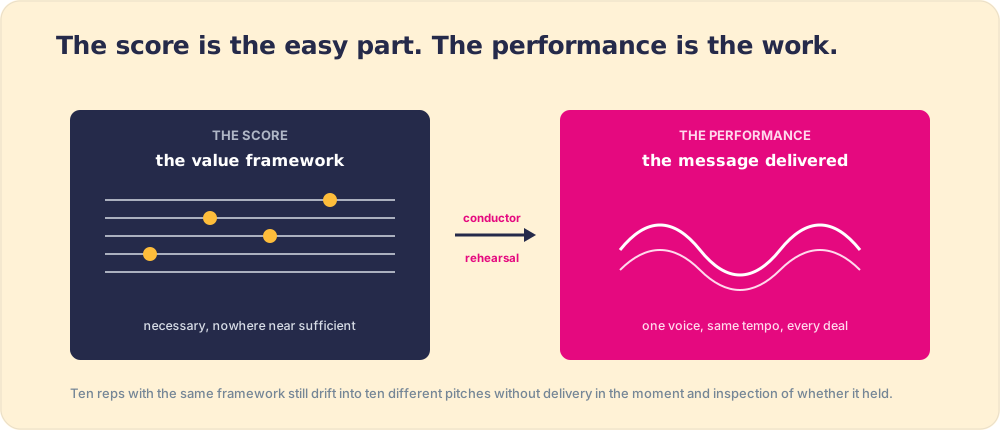
Hand ten musicians the same sheet of music and you do not get a symphony. You get ten people playing the same notes at ten slightly different tempos, in keys that drift, with none of them listening to the rest. The score is necessary. It is nowhere near sufficient. What turns the page of notes into music is a conductor, a tempo the whole orchestra holds, and the daily, unglamorous rehearsal where someone listens and says, again, slower, you are rushing the bridge. The score is the easy part. The performance is the work.
This is the truth about Command of the Message, and it is the part the framework’s own advocates tend to rush past. The methodology gives a revenue team a beautiful score: one shared way to articulate value, so every rep tells the same story about why a buyer should change. That score is genuinely worth having. But messaging consistency is a behavior problem, not a deck problem. A value framework written down is not a value framework delivered, and the message only moves the number when every rep performs it the same way, in the moment of the conversation, while someone is listening for whether they did. Knowledge is solved here. Behavior is the open problem.
What is Command of the Message?
Command of the Message is Force Management’s value-based sales methodology that standardizes how every rep articulates value, so the whole team tells the same story about why the buyer should act. Force Management’s own definition of having it is sharper: “being audible-ready to define your solutions to customer problems in a way that differentiates you from your competitors and allows you to charge a premium for your products and services” (Force Management).
Audible-ready is a football word. A quarterback who calls an audible looks at the defense, sees the play in the huddle will not work, and changes it at the line. He can do that only because he knows the playbook cold. Force Management means the same of the rep: “flexible in front of the customer, ready to respond and adapt, based on what the customer communicates about their genuine business need.” Command of the Message is a messaging framework first and a sales motion second, and that order is the point. You cannot improvise well on a story you never learned.
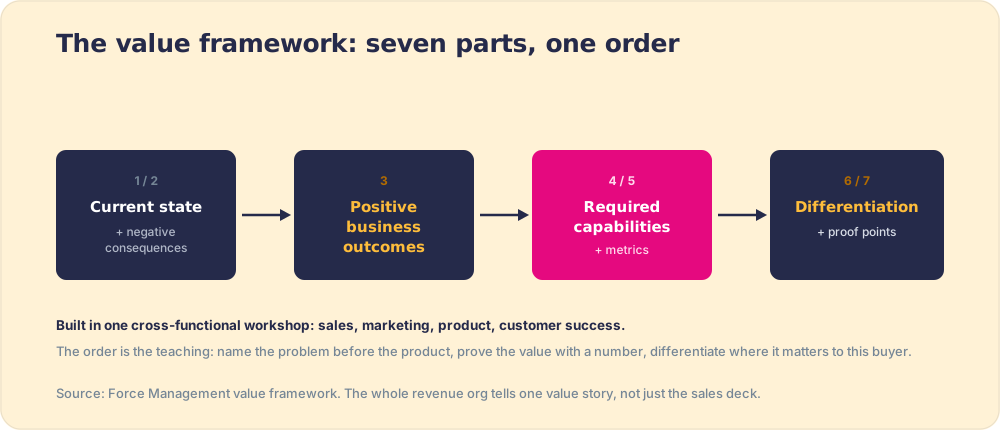
The engine underneath it is the value framework, built not by sales alone but in a cross-functional workshop with marketing, product, and customer success in the room. The Command of the Message framework moves from the buyer’s problem to the proof in a set order.
- Before scenario and negative consequences. Where the buyer is now and what staying there costs them, named in the buyer’s own terms.
- Positive business outcomes. The after scenario, stated as a measurable result rather than a wish.
- Required capabilities. What the buyer would need to be able to do to get from here to there, framed before any product is mentioned.
- Metrics. The numbers that prove the outcome was reached, so value is a figure, not an adjective.
- Differentiators and proof points. What sets you apart in a way that matters to this buyer, and the evidence that makes it credible.
This is value framework sales done with discipline. If gap selling is about diagnosing the distance between current and future state, Command of the Message is about how the whole team narrates that distance in one voice, with differentiation and proof built in. It pairs naturally with the qualification methodologies, which is why Force Management licenses both it and MEDDIC; you can read where it sits among the others in our field guide to sales methodologies.
What goes in a Command of the Message value framework template?
The value framework is where the methodology stops being a slogan and becomes something a rep can use on a call. Force Management’s own writing uses a consistent vocabulary for its parts, and a template that keeps that vocabulary lets your reps, managers, and any Force Management-trained hire speak the same language.
- Before scenario. The buyer’s current state, described the way they would describe it to their boss. Force Management’s clients adopt terms like “Before Scenario” and “Positive Business Outcomes” as operating vocabulary in “sales meetings, deal reviews, or CRM fields” (Force Management).
- Negative consequences. The cost of standing still. Force Management frames the question directly: “What are the negative consequences of the buyer not acting on that business pain?” (Force Management).
- Positive business outcomes. The after scenario. Command of the Message positive business outcomes (PBOs) are “the tangible benefits that result from a buyer implementing your solutions” (Force Management).
- Required capabilities. “The specific requirements that are necessary to achieve your prospect’s PBOs.” Force Management treats these as the buyer’s decision criteria, which is why they matter so much: whoever shapes them shapes the evaluation.
- Metrics. How the customer “will measure success” after they buy, kept simple and tied to business impact.
- Differentiators. How you do it differently, judged by the buyer. Force Management’s test: “it’s only differentiated if your customers view it as a highly differentiated solution” (Force Management).
- Proof points. Named customers, results, and testimonials that make the claim defensible, and that force a competitor to prove theirs.
- Discovery and trap-setting questions. Discovery questions surface the before scenario and its cost. Trap-setting questions “help you steer a discovery session toward your differentiators. We call them ‘trap setting’ because they trap your competition” (Force Management).
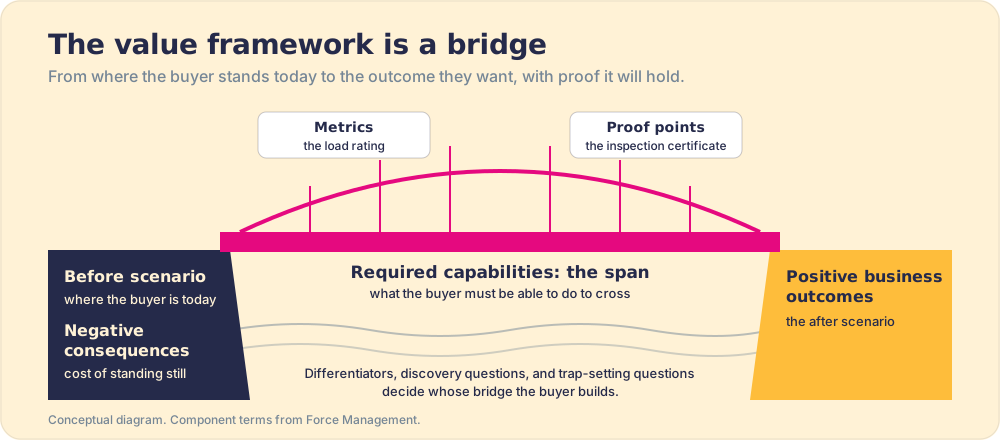
Think of the finished framework as a bridge. The before scenario is the near bank, where the buyer stands today. Positive business outcomes are the far bank. Required capabilities are the span that has to exist for anyone to cross, metrics are the load rating stamped on it, and proof points are the inspection certificate showing that other buyers crossed and the bridge held. Differentiators decide whose bridge gets built. A rep who pitches features is selling steel beams to someone who wants to reach the other side.
Here is a Command of the Message template you can copy into a doc, a spreadsheet, or your CRM. Build one block per buyer problem (or per persona, if one problem looks different to a CFO than to a VP of Sales).
COMMAND OF THE MESSAGE VALUE FRAMEWORK (one block per buyer problem)

Buyer / persona:
Before scenario (today, in the buyer's own words):
Negative consequences (cost of not acting; put a number on it):
Positive business outcomes (the after scenario, measurable):
Required capabilities (what the buyer must be able to do to get there):
Metrics (how they will measure success: baseline and target):
Differentiators (how we do it differently, in ways this buyer values):
Proof points (customer, result, and where the evidence lives):
Discovery questions (to surface the before scenario and its cost):
Trap-setting questions (to define required capabilities around our differentiators):
Four rules keep the filled-in template useful:
- Won deals as the source. Fill the blocks from deals you won and the words those buyers used, not from the product sheet. Your best reps already run this conversation; the template captures their version.
- A number in every metric. A metric without a baseline and a target is an adjective in disguise.
- Named proof. A proof point with no customer name, result, or link is a claim, and buyers can tell the difference.
- Questions tied to capabilities. Every trap-setting question should point at one required capability you can meet and a competitor struggles to, or it is only a question.
Who is Force Management, and how does Command of the Message fit with MEDDICC?
Force Management is a B2B sales consultancy in Charlotte, North Carolina, founded in 2003 by John Kaplan and Grant Wilson (Force Management). It created and licenses Command of the Message, and it is one of the best-known teachers of MEDDICC, the qualification framework that grew out of the Parametric Technology Corporation (PTC) sales team in the 1990s. Kaplan was on that team.
The two frameworks answer different questions. Force Management describes MEDDICC as “a litmus test for gauging the strength of a sales opportunity and a GPS for navigating the sales cycle” (Force Management FAQ). Command of the Message tells the rep what to say once they know where they stand. Kaplan’s own picture is the clearest one available: “You can’t fix your deals or solve your forecasting issues without having both the x-ray to identify gaps and the treatment so you can fix them. That treatment is prescribed by your sales methodology” (Force Management). The same article says MEDDIC’s “power multiplies when paired with a strong selling methodology like Command of the Message.”
MEDDICC is the x-ray. Command of the Message is the treatment plan. An x-ray with no treatment is an expensive photograph of a problem, and a treatment with no x-ray is a guess.
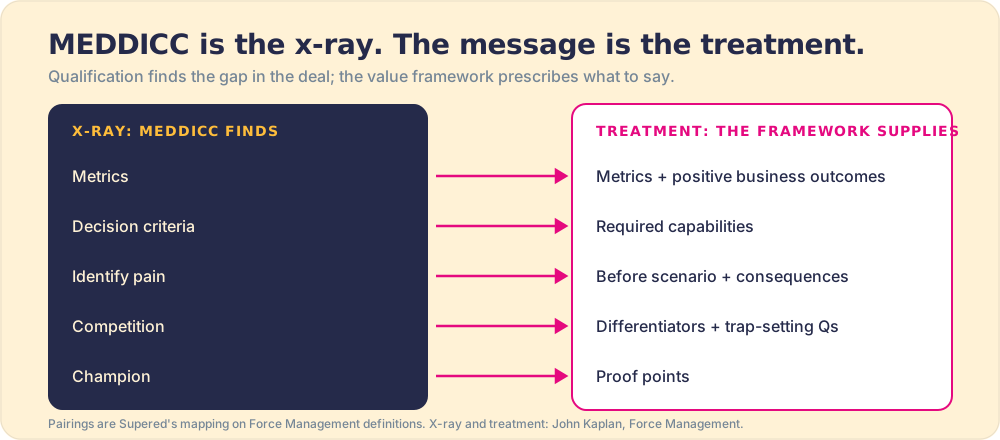
The pairing is tight enough that you can map the letters to the framework, which is how we would run the two together:
- Metrics to metrics and positive business outcomes. MEDDICC asks whether the buyer has quantified the value; the framework supplies the outcomes and the numbers to quantify.
- Decision criteria to required capabilities. Force Management itself treats required capabilities as decision criteria, so the trap-setting questions are how a rep helps write them.
- Identify pain to the before scenario and negative consequences. The pain MEDDICC wants confirmed is the before scenario, priced.
- Competition to differentiators. The second C in MEDDICC names the rival; the differentiators and trap-setting questions are how you beat them.
- Champion to proof points. A champion has to sell internally when you are not in the room, and proof points are what they carry into that meeting.
Intercom is one public example of a team that ran both. Its case study with Force Management quotes the company: “We implemented Force Management’s Command of the Message and MEDDPICC” (Force Management). If you are building the qualification side, start with our MEDDPICC field guide and the history in the MEDDIC sales process.
Why does messaging consistency matter so much?
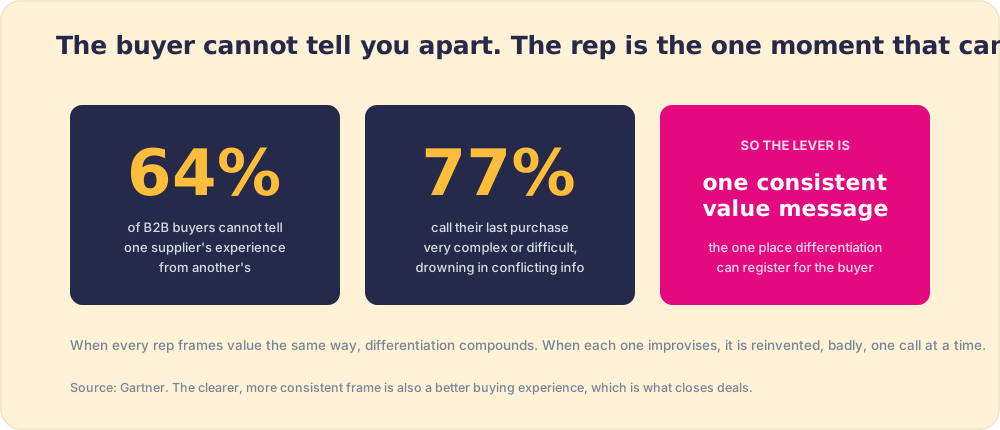
Because the buyer cannot tell you apart, and the rep is often the only thing that can. Gartner found that 64 percent of B2B customers cannot distinguish one supplier’s digital experience from another’s (Gartner). To the buyer, the websites blur, the feature lists rhyme, and the demos look interchangeable. The one moment where differentiation can register is the conversation with a person who can frame why this problem, for this buyer, is worth solving now and worth solving with you. If that person improvises a different story than the rep on the next deal, the differentiation never compounds. It is reinvented, badly, one call at a time.
The buyer is already drowning. Gartner’s research found that 77 percent of B2B buyers described their most recent purchase as very complex or difficult, with managing information from conflicting sources as the top obstacle (Gartner, via CSO Update 2019). A consistent value message is not a marketing nicety in that environment. It is what makes the buyer’s job possible, which is the deeper reason it wins: a clear, repeatable frame is a better buying experience, and the better experience is what closes the deal in a market where buyers dislike buying. Command of the Message is right to insist on it.
Suppose a buyer talks to two of your reps across a six-week evaluation, as most committee buys involve. The first frames the whole conversation on the cost of their current state and a metric they can take to their CFO. The second, a month later, opens with a feature tour and a discount. The buyer has now heard two different companies. They cannot weigh a value story against a price pitch, so they default to the only axis both reps gave them, which is price, and your differentiation evaporates. Gartner found that 69 percent of B2B buyers, in a survey of 632 of them, report inconsistencies between what a supplier’s website says and what its sellers say (Gartner), and inconsistency between two of your own sellers is the same wound from a closer range. The value framework exists to close exactly this gap. It only does so if both reps run it.
Why doesn’t writing the framework fix it?
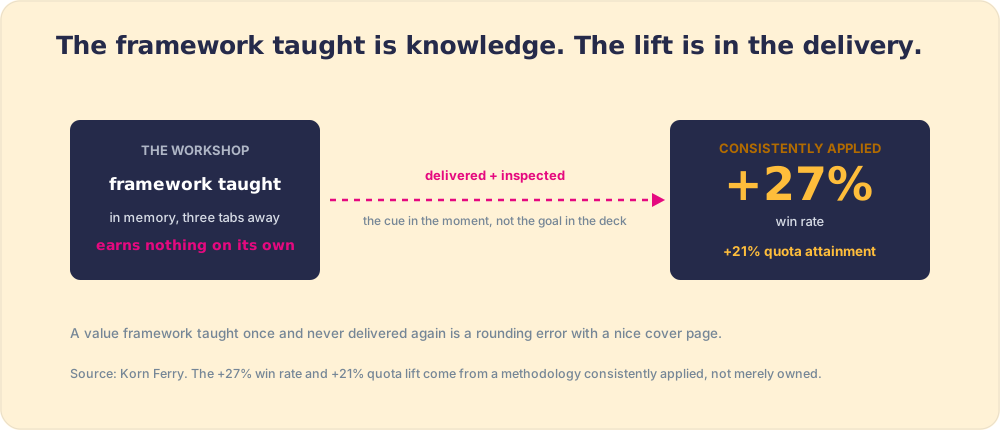
Because a framework is a piece of knowledge, and knowledge was never the bottleneck. Any rep can read the value framework. Any rep can nod along in the workshop, pass the certification, and quote the current-state-to-outcome arc back to you on demand. None of that tells you whether, on Tuesday’s call with a real buyer under real pressure, they framed the conversation on value or slid back into a feature tour because the demo was right there and the framework was three tabs away. Knowing the message is not delivering the message, and the distance between the two is where the methodology silently leaks its value.
This is the same execution gap that swallows every methodology, and the research is blunt about how much rides on closing it. Korn Ferry found that organizations with a dynamic, consistently applied sales methodology see win rates 27 percent higher and quota attainment 21 percent higher than those with a random or informal one (Korn Ferry). Read that carefully. The lift comes from consistently applied. The framework existing earns you nothing; the framework being run by every rep on every deal earns you the 27 points. A value framework that is taught once and never delivered again is, in revenue terms, a rounding error with a nice cover page.
There is a behavioral reason the deck-to-conversation gap is so wide, and it has a name. Peter Gollwitzer’s work on implementation intentions showed that people are far more likely to act on a goal when the action is tied to a specific cue (when situation X arises, I will do Y) than when they merely hold the goal in mind (Gollwitzer, 1999). A rep who “knows the value framework” is holding a goal. A rep who gets the right current-state question surfaced the instant they open the deal is being handed the cue. The framework lives in memory, where it competes with quota anxiety and a hundred other tabs; the cue lives in the flow of work, where the behavior happens. Methodologies that depend on memory lose to the moment, every time.
How do you make Command of the Message stick across a team?
Treat the message as a performance to be delivered and inspected, not a document to be distributed. The conductor analogy holds all the way down: the score (the value framework) has to be in front of the player at the moment of playing, and someone has to be listening for whether the tempo held. Two things turn a messaging framework from a deck into a habit.
- Delivery in the moment. The value framework, the current-state questions, the differentiation, the proof points, have to reach the rep while they are prepping the call or writing the email, not in a quarterly refresher they half-remember. A message that is not in front of the rep when the conversation happens is a message that will be improvised.
- Inspection of the delivery. A manager has to be able to see whether a given deal was framed on value or reverted to a feature pitch under pressure. You can only expect what you inspect, and an unchecked methodology is a suggestion. The win is automating that inspection so the manager’s time goes to coaching the rep who is drifting, not auditing the ones who are fine.
This is the lever our own data points to hardest. The State of Sales Enablement 2026 found that teams who consistently inspect deals against a defined process hit quota at 6.3 times the rate of teams that rarely do, the single largest factor we measured. For Command of the Message, that means the value frame cannot be an optional good habit a rep summons from memory. It has to be surfaced in the flow of work and inspected deal by deal, the way sales process adoption only happens when the process reaches the rep where they work. When non-adherence shows up, the cause is almost never a lazy rep; it is a framework that lived too far from the moment of the work and a delivery no manager checked. That is a system to fix, not a person to blame.
What we recommend
Two paths sit underneath this, and only one of them turns a value framework into a number. You can treat Command of the Message as a content project: run the workshop, build the beautiful framework, distribute the deck, certify the team, and trust that knowing the message means delivering it. Or you can treat it as a behavior project: build the same framework, then put your real effort into getting it delivered in the moment of every conversation and inspected so you can see whether it was.
We recommend the second, and the evidence is not subtle. Gartner says the buyer cannot tell you apart and finds buying overwhelming, so the consistent value frame is the one place you can differentiate, which is why the framework is worth building at all. Korn Ferry says the win-rate lift comes from a methodology consistently applied, not merely owned, so the framework on its own buys you nothing. Gollwitzer says behavior follows the cue in the moment, not the goal in memory, so the message has to reach the rep where the work is. And our own data says the inspected process outperforms the uninspected one by 6.3 times. Those four point the same way: the framework is the easy part, and the delivery is the deal.
So build the score, by all means. Then go be the conductor. For where this fits among the other frameworks, read our guide to sales methodologies; for the qualification discipline Force Management pairs with it, the MEDDPICC field guide; for stronger ways to deliver the value frame back to the buyer, sales pitch examples; for an older framework that maps the same complex buying committee, Miller Heiman’s Strategic Selling; and for how it all ladders into one runnable system, the sales playbook guide.
Frequently asked questions
What does command of the message mean?+
What is Command of the Message?+
What is in a Command of the Message value framework?+
How is Command of the Message different from MEDDIC?+
Who is Force Management?+
What goes in a Command of the Message value framework template?+
Does Command of the Message improve win rates?+
How do you make Command of the Message stick across a team?+
Your process, running itself.