Sales Methodologies: Which One Wins, and Why It Is Not the One You Pick
There are dozens of sales methodologies and, studied head to head, they mostly tie. The history, how the major ones differ, why the methodology is not the lever, and how to choose and run one.
A sales methodology is a defined approach to how a rep works inside the sales process, how they qualify, question, uncover need, and advance a deal. MEDDIC, SPIN, and Challenger are methodologies; the process is where the deal is, the methodology is how the rep works once they are there. Studied honestly, the major ones mostly tie, and adherence, not the choice, predicts results.
If you have ever argued about diets, you already understand the sales methodology market. In 2018, Stanford ran the argument to ground: the DIETFITS trial put 609 people on a healthy low-fat or a healthy low-carbohydrate diet for a year and found no significant difference in weight loss between them. The two camps had spent a decade certain the other was wrong, and the trial handed both a tie. What separated the people who lost weight from those who did not was adherence, whether they stuck to the plan, not which plan they were handed. Sales methodologies work the same way. There are dozens, each sold as the answer, each with a book, a certification, and a consultant who will install it, and when you study them honestly they mostly tie. The variable that predicts results is whether your reps run the one you chose, consistently, on real deals.
That claim deserves the discomfort it causes, because a great deal of money rides on the opposite belief. A sales leader under pressure to fix the number reaches, understandably, for a new methodology, the way a frustrated dieter reaches for a new diet, and the reach feels like action. This guide argues that the reach is usually misplaced. It covers the major methodologies and how they genuinely differ, goes deep on what each one teaches a rep to do at the desk, and then spends its real energy on the part that moves the number: choosing one that fits, and getting it run. The methodology is the diet. Adherence is the result, and the rest of this page is the case for why.
Where did sales methodologies come from?
From two eras, and knowing which era a methodology comes from tells you how much to trust it. The first was the intuition era, roughly the 1960s through the 1980s, when the frameworks codified what good sellers seemed to do, built from observation and a charismatic founder's experience rather than from controlled study. BANT, a qualification checklist (Budget, Authority, Need, Timeline), came out of IBM in the 1960s. David Sandler built his system in 1967 after a career in which he had, by his own account, grown sick of the chase. Solution Selling, formalized by Michael Bosworth, emerged in the late 1980s as software grew complex enough that buyers needed a diagnosis before a pitch. These were genuine advances on the hard-close, pitch-first selling that preceded them, and they share a parentage worth noticing: each was one practitioner's hard-won pattern, written down. Useful, but unfalsifiable.
The second was the research era, and it is the one worth taking seriously, because it replaced the founder's intuition with data large enough to be checked. Neil Rackham and his team at Huthwaite studied 35,000 sales calls across 10,000 reps over twelve years before publishing SPIN Selling in 1988, the largest empirical study of selling ever run. Its central finding, that questions which build the buyer's own sense of the problem outperform pitching and pressure, has held up for three decades and reversed the conventional wisdom of its day. In 2011 the team behind The Challenger Sale analyzed roughly 6,000 reps and found that the highest performers in complex sales were not the relationship-builders everyone assumed but "Challengers" who teach the buyer something new, the largest single profile among star performers. Two rigorous studies, twenty-three years apart, and they did not contradict each other so much as describe two halves of the same skilled seller: one who draws the problem out of the buyer, and one who brings a sharper view of it to them.
The lineage matters because the field keeps repackaging the same handful of findings under new acronyms, and a leader who knows the family tree stops paying twice for the same idea. Read the modern methodologies against the two eras and most of them turn out to be recombinations: a qualification spine (the BANT and MEDDIC lineage), a questioning engine (the SPIN lineage), and an insight-led reframe (the Challenger lineage), mixed in different proportions and sold under a fresh name. Gap Selling, which we will come to, is essentially Solution Selling's diagnosis discipline sharpened with a quantified before-and-after. The convictions barely move across forty years. What moves is the cover.
There is a deeper pattern under the repackaging worth naming, because it is the seed of this guide's whole argument. The research era did not only produce better methodologies; it produced a finding the methodology vendors have spent thirty years declining to dwell on. Rackham's own data, gathered to validate a method, kept pointing past the method to the rep's consistency in running it. The most reliable predictor in his numbers was never which technique a seller preferred but how disciplined they were about the investigating work, call after call. The same shadow falls across the Challenger research: the profile mattered, but the authors were blunt that the profile only paid off where the organization built the surrounding system to coach and sustain it. Two landmark studies, set out to crown a method, and both kept circling back to execution. The field heard "we found the better method" and sold that. The more durable sentence was "we found that doing the method consistently is what separates the winners," and it is the sentence the rest of this page is built on.
If that sounds like an abstract claim, medicine ran the cleaner version of the experiment, and it is worth holding onto because it is the master proof behind everything below. In 2009 a team led by Atul Gawande published in the New England Journal of Medicine the result of giving eight hospitals around the world a nineteen-item surgical safety checklist. The items were not new knowledge; every surgeon already knew to confirm the patient, mark the site, give the antibiotic on time. The checklist simply made the known steps get done, every case, by making them inspected. Inpatient deaths fell from 1.5 percent to 0.8 percent and major complications from 11 percent to 7 percent. Same surgeons, same operating rooms, same medical knowledge. The only thing that changed was that a known process now reliably got run. A sales methodology is a checklist for a conversation, and the surgical study is the cleanest evidence on record that the lever was never the knowledge in the checklist. It was the adherence the checklist enforced.
Methodology vs process: what is the difference?
This is the confusion that sells the most unnecessary methodology licenses. A sales process is where a deal is on its path, the shared stages a whole team walks and a manager inspects. A methodology is how a rep works inside those stages: the questions they ask in discovery, the way they qualify, how they handle the economic buyer. The process is the road; the methodology is how you drive each stretch of it. You build the process first, then choose a methodology that fits how your winners already sell, never the reverse, because a methodology with no process to live inside is a workshop everyone forgets by the next live call.
The order is not arbitrary, and getting it backward is the single most common structural mistake in sales operations. A process gives a methodology somewhere to live: a stage is the slot into which a rep's SPIN questions or MEDDIC qualifiers fit, and the manager inspecting that stage is the only mechanism that ever makes the methodology stick. Buy the methodology first, with no process underneath, and there is no slot, no inspection point, and no way to tell whether a rep ran it. You have handed the team a driving technique and no road to drive it on, so each rep improvises a route, and the expensive certification evaporates within a quarter. This is why the line "we adopted Challenger last year and saw nothing" is so common: the company bought a how with no where to anchor it. The deeper treatment of building the road is the sales process guide, and the practical point here is the sequence, process first, methodology second, adherence always.
How do the major sales methodologies differ?
Less than their marketing suggests, but the differences that exist map to what kind of sale you run.
| Methodology | Core move | Based on | Best when |
|---|---|---|---|
| SPIN | Question sequence that builds the buyer's sense of the problem | Rackham, 35,000 calls (1988) | Consultative, discovery-heavy sales |
| MEDDIC / MEDDPICC | Qualify the deal against metrics, economic buyer, criteria, champion | PTC sales team, 1990s | Complex, multi-stakeholder enterprise deals |
| Challenger | Teach the buyer something new, tailor, take control | CEB, 6,000 reps (2011) | Buyers who self-educate and need reframing |
| Solution Selling | Diagnose the problem, then prescribe | Bosworth, late 1980s | Products that solve a defined pain |
| Sandler | Mutual qualification, no pressure, disqualify early | David Sandler, 1967 | Teams burning time on deals that never close |
| Gap Selling | Sell the gap between current and desired state | Keenan, 2018 | Reps who pitch features before finding pain |
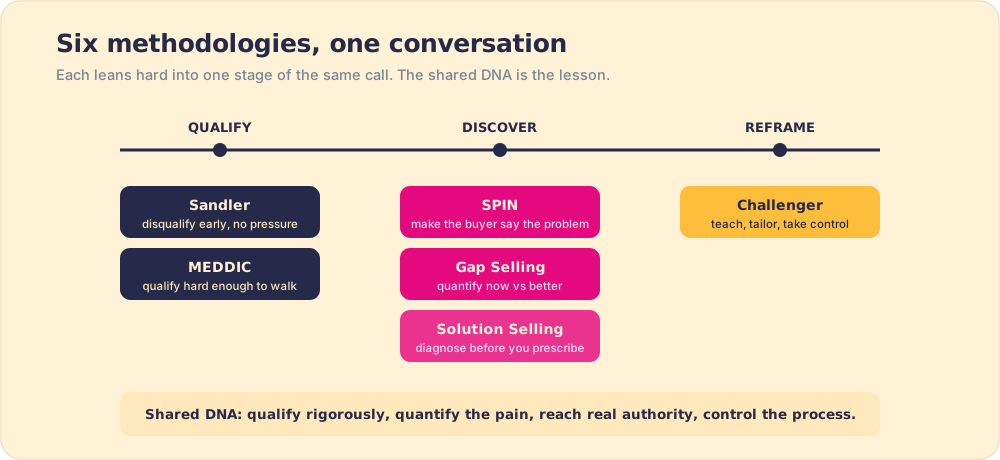
Read across them and the shared DNA is unmistakable: qualify rigorously, quantify the pain in the buyer's words, reach real authority, and control the process. The acronyms differ; the convictions barely do. The differences that survive that comparison are differences of emphasis, which stage each one leans into hardest, and that is what the next section makes concrete, because "they mostly tie" is not the same as "they are interchangeable." A diet that tells you what to eat is not the same instrument as one that tells you when, even if both leave you the same weight a year on.
What does each methodology teach a rep to do?
Here is where the marketing falls away and the craft shows. A methodology earns its place not by its acronym but by the specific move it drills into a rep's hands, the thing they do differently on a live call because they were trained in it. Below is each major methodology reduced to that move, with the evidence behind it, the founder in their own words where it sharpens the point, and a worked example of the move on a real call. The pattern to watch for is the one the history predicts: each leans hard into one stage of the same conversation.
SPIN Selling: make the buyer say the problem out loud
SPIN teaches a rep to run discovery as a deliberate question sequence rather than a fact-finding interview, moving through four kinds of question in order: Situation (the buyer's current setup), Problem (where it hurts), Implication (what that pain costs if it continues), and Need-payoff (what solving it would be worth). The engine of the method is the Implication question, because it is the one that grows a mild complaint into a problem worth paying to solve, in the buyer's own words rather than the rep's. Rackham's data put the weight precisely here: as he wrote, "Success in the larger sale depends, more than anything else, on how the Investigating stage of the call is handled." The rep's job is not to pitch the solution but to ask the questions that make the buyer articulate the cost of inaction, so the buyer arrives at the need on their own.
Rackham's most uncomfortable finding for the sales-training industry of 1988 was about what reps should stop doing. His research showed that classic high-pressure closing techniques, the assumptive close, the alternative close, the techniques every sales course of the era taught, reduced the likelihood of a sale in large, complex deals, and left the buyers who did purchase less satisfied. The bigger the deal, the more a pat closing maneuver read as manipulation and cost the rep trust. The same logic explains the method's signature diagnostic for a stalled call, in Rackham's words: "If you're getting a lot of objections early in the call, it probably means that instead of asking questions, you've been prematurely offering solutions and capabilities." A flood of objections is not a buyer being difficult; it is a rep who pitched before they questioned.
The data behind that reversal is sharper than the slogan. In one strand of the work Rackham's team surveyed thirty-eight reps on whether they favored or opposed classic closing techniques, then matched the answer to performance, as recounted in the SPIN summaries of the research: the reps with an unfavorable view of hard closing hit 104 percent of their annual quota, against 83 percent for the reps who believed in closing maneuvers. The technique a generation of sales managers drilled hardest correlated with missing the number. That is the kind of finding that only a 35,000-call study could produce and only an industry heavily invested in the opposite could ignore, and ignore it the industry largely did, which is its own small proof of this guide's thesis: the field prefers a new method to an inconvenient finding about the old one.
The move in practice: a rep selling logistics software hears "our shipping is a bit slow sometimes." A pre-SPIN rep launches into the speed features. A SPIN rep asks an Implication question instead, "when a shipment runs late, what does that do to the customer relationship, and how often does it cost you a reorder?" The buyer, working it out aloud, lands on a number that dwarfs the software's price, and now the rep is not selling a feature but solving a problem the buyer sized for themselves. The depth on this is in SPIN selling.
MEDDIC and MEDDPICC: qualify hard enough to walk away
MEDDIC, born on the PTC sales floor in the 1990s, teaches a rep what they must know about a deal before they trust it: Metrics (the quantified value at stake), Economic buyer (the person who controls the budget), Decision criteria, Decision process, Identify pain, and Champion (an internal advocate who sells when the rep is not in the room). MEDDPICC adds Paper process (the procurement and legal path) and Competition. It is a qualification discipline, not a conversational one: it does not tell a rep what to say, it tells them what to verify, and its real product is the courage to disqualify a deal that fails the test rather than carry it in the forecast for two quarters out of hope.
The trap is the one the related deep dive names directly: installing the acronym changes nothing. A team can add eight MEDDPICC fields to the CRM, require them, and watch reps fill them with plausible guesses that clear validation, producing a pipeline that looks rigorously qualified and is not. The qualifier only works when the rep genuinely earns each letter on the call, which is a behavior, not a field. The move in practice: a rep is told a deal is "looking good, the VP loves us." A MEDDIC rep treats that as unqualified until they can name the economic buyer (often not the enthusiastic VP), point to a written decision criterion they map to, and identify a champion willing to advocate internally. More than once that test reveals the loved-by-the-VP deal has no budget owner engaged at all, and the rep stops spending time on it. The full treatment is in MEDDIC and MEDDPICC.
Challenger: lead with an insight that reframes the problem
Challenger, from CEB's study of roughly 6,000 reps, teaches three moves, defined by the authors as the ability to teach the customer something new about their own business, tailor that insight to the specific stakeholder, and take control of the conversation, including the money. The headline finding reversed a generation of relationship-selling orthodoxy. Matthew Dixon and Brent Adamson put it in one line on the book's first pages: "The best salespeople don't just build relationships with customers. They challenge them." The top performers in complex sales were not the likable relationship-builders the prevailing wisdom assumed but the reps willing to challenge a customer's thinking with a commercial insight the customer had not considered. Where SPIN draws the problem out of the buyer, Challenger brings a sharper problem to them, which is why it fits the modern, self-educated buyer who arrives already believing they understand their situation.
One caution the authors made and most adopters skip: the Challenger profile was the largest single group among star performers, but it was not a magic personality you hire and forget. CEB found the profile paid off only inside an organization that supplied the commercial insight to teach, coached the tailoring, and backed the rep's willingness to take control. A rep told to "be more challenging" with no insight to deliver is not a Challenger; they are an argumentative vendor, and the buyer feels the difference immediately. That dependency, the method only works wrapped in a system that feeds and sustains it, is the same dependency the surgical checklist exposed and the same one the adherence argument turns on. The profile is the knowledge. The surrounding system is what gets it run.
The move in practice: a buyer asks for a quote on the exact configuration they have decided they need. A relationship rep delivers the quote and competes on price. A Challenger rep teaches first, "most teams who buy this configuration discover within six months that the real constraint was upstream, in onboarding, not in the tool, and the data shows it," reframing the purchase before quoting it. Done well, this is generous and earns trust; done badly, it is a rep arguing with a customer. The line between the two is the "tailor" discipline, and it is covered in the Challenger sale.
Solution Selling and consultative selling: diagnose before you prescribe
Solution Selling, from Michael Bosworth in the late 1980s, teaches the oldest and most durable discipline in the field: do not present a solution until you have diagnosed the problem, the way a doctor who prescribes before examining is committing malpractice. The rep's job is to uncover a "latent pain" the buyer has not fully named, develop it into an admitted need, and only then map the product to it. Consultative selling is the broader family this belongs to, the posture of advisor rather than vendor. The methodologies that followed mostly sharpened this core: SPIN gave the diagnosis a question structure, Gap Selling gave it a quantified before-and-after. The move in practice is restraint: when a buyer says "tell me about your product," the consultative rep answers with a question about the buyer's situation instead, because a product described against a vague need sounds like every competitor, and a product mapped to a diagnosed pain sounds inevitable. The detail is in consultative selling.
Sandler: disqualify early, and let the buyer convince themselves
Sandler, built by David Sandler in 1967, teaches a rep to invert the traditional power dynamic of a sale: rather than chasing and pitching, the rep qualifies the buyer as rigorously as the buyer qualifies the product, and walks away early from deals that will not close. Sandler famously described the system he wanted by imagining the call running itself. In his own words: "Prospects would deliver the presentations themselves. They would raise the stalls and objections, and they would resolve them. They would qualify themselves financially. They would close the sale. And finally, they would thank me for calling on them!" The method's machinery, the up-front contract that sets expectations for a meeting, the "reversing" technique of answering a question with a question, all serves that aim: get the buyer doing the work of the sale, so the ones who are not serious remove themselves before the rep has sunk weeks into them.
The move in practice: a prospect says "send me a proposal and I'll review it with the team." A traditional rep, grateful for the engagement, sends it and waits. A Sandler rep sets an up-front contract instead, "happy to, and so I do not waste your time, can we agree that after you review it you will tell me yes or no rather than going silent?" The reps who hate this move misread it as confrontational; run with genuine warmth, it is a kindness, because it spares both sides the slow fade of a deal that was never real. The fuller picture is in the Sandler methodology.
Gap Selling: quantify the distance between now and better
Gap Selling, from Keenan in 2018, is the most recent of the major methodologies and the sharpest articulation of the diagnosis discipline: it teaches a rep to define, in numbers, the buyer's current state and their desired future state, and to sell the gap between the two. The product is never the point; the size of the gap is, because that gap is the only thing that justifies the price and the disruption of change. Keenan's central warning cuts at lazy discovery: "Never sell to need. If you only solve the problem your buyer thinks they have instead of the one they really have, you haven't helped them at all." The discipline is to dig past the stated problem to the real one, quantify both states, and let the arithmetic of the gap carry the sale.
The move in practice: a buyer says they need a better reporting tool. A Gap Selling rep does not quote a reporting tool. They establish the current state in numbers (six hours a week per manager assembling reports by hand, decisions made on week-old data) and the desired future state (real-time data, those hours returned to coaching), then size the gap in dollars and risk. The reporting tool now sells itself against a quantified loss, not a vague wish. The depth is in gap selling, and the whole field is ranked in the sales methodologies overview.
Set the six side by side and the family resemblance is the lesson. SPIN and Gap Selling are both diagnosis engines, one through questions, one through quantified states. MEDDIC and Sandler are both qualification disciplines, one a checklist, one a posture. Challenger and consultative selling are both about the rep's stance toward the buyer's thinking. None of them is wrong, and none of them is magic. Each is a trained move that helps a competent rep do one part of the same conversation better, which is precisely why the choice between them matters far less than whether the chosen move gets made on the call.
Which sales methodology is best?
The honest answer is the diet answer: the one you will run. Because the major methodologies tie when studied fairly, the choice that matters is fit, not brand. Match the methodology to how your winners already sell and to the complexity of your sale: a transactional, high-volume motion does not need MEDDPICC's eight qualifiers, and a seven-figure enterprise deal is not served by a four-letter checklist. Pick the one your best reps would recognize as a description of what they already do, because a methodology that names your winners' instinct gets adopted, and one that fights it gets resented. Then stop shopping, because the next ten percent of performance is not in a different acronym. It is in adherence.
The DIETFITS trial repays a closer look, because the detail is what makes the analogy bite rather than charm. Stanford randomized 609 adults to a healthy low-fat or a healthy low-carbohydrate diet, taught both groups hard for a year through twenty-two instructional sessions, and weighed the result. Both arms lost about the same amount, roughly twelve pounds on average, with no significant difference between the diets. The investigators had also pre-registered two hypotheses they expected to win: that a person's genotype, or their baseline insulin response, would predict which diet suited them. Both failed. Neither the gene pattern nor the insulin profile picked the better diet for an individual. The thing everyone wanted, a rule that matched the plan to the person, did not exist in the data. What did separate the people who lost the most from the people who lost the least, within both diets, was how completely they followed the plan they were given.
Christopher Gardner, the study's lead investigator, has spent forty years running trials like it, and his summary of the whole body of work is the line to keep. As he told Levels in reviewing what the research adds up to, the goal is to find "the highest-quality version of an eating pattern you can actually stick to long-term." Stick-to-it-ness, not the macronutrient theory, is the active ingredient. Swap "eating pattern" for "sales methodology" and "long-term" for "on real deals" and you have the whole argument of this guide, handed to us by a nutrition scientist who never sold software in his life. The convergence is the strongest thing we can show: an independent field, studying an unrelated behavior with far larger samples and a randomized design, found exactly the pattern our own pipeline data finds. When two unconnected disciplines arrive at the same law, it is usually a law.
Notice how strong the pull is in the other direction, because naming the pull is how you resist it. The DIETFITS result was published in a major journal in 2018, and the diet industry did not shrink; it kept selling the next certain plan, because a person who has failed on one diet is the most willing buyer of the next. The sales methodology market runs on the same engine. A leader whose number came in soft has a powerful incentive to believe the fix is a new framework, because that belief is hopeful and the alternative, that the team simply did not run the framework it had, feels like an indictment. The DIETFITS finding is the kinder truth and the more useful one: the failure was rarely in the plan, so the cure is rarely a new plan.
Does the choice of methodology not matter at all?
Here the honest objection deserves its full force, because the strong version of "it does not matter which one" is wrong, and pretending otherwise would cost us the reader's trust. You might say: surely a four-letter qualification checklist is genuinely the wrong instrument for a seven-figure enterprise deal with a buying committee of ten, and a heavy eight-qualifier framework is genuinely overkill for a self-serve renewal. That is true. Fit matters. The DIETFITS analogy can be pushed too far, and an honest guide marks where the picture stops being true: the trial compared two sensible diets, and its lesson is not that all eating is equivalent, only that among reasonable plans, adherence dominates. It did not put a sensible diet against a diet of nothing but soda. So no, the methodologies are not interchangeable in the way "they tie" can be misheard to mean. A grossly mismatched methodology, the soda diet of sales, will underperform a well-matched one even at equal adherence.
Grant all of that, and the argument still holds, for a precise reason: the fit decision is a one-time, low-difficulty choice, and the adherence decision is a permanent, high-difficulty one. Picking a methodology that suits your sale is not hard; an hour with your two best reps and an honest look at where your deals die gets you a defensible answer, as the next section lays out. What is hard, and what stays hard every week forever, is getting the chosen method run on the deals in front of the team. So the practical weight sits overwhelmingly on adherence not because fit is irrelevant but because fit is the easy 10 percent and adherence is the punishing 90, and a leader's attention is the scarce resource being misallocated when it goes to re-shopping the easy part.
Sales has run its own version of the DIETFITS experiment, and it points the same way. CSO Insights, the research arm now inside Korn Ferry, has tracked sales-process maturity against win rates for years, sorting companies into those with a "random" process (informal, left to each rep), a formal one, a "dynamic" one (documented and adapted and reinforced in practice), and so on. Their finding, reported via the enablement maturity research, is that companies running a dynamic, reinforced process win roughly 35 percent more often than companies running a random one. The jump comes not from a cleverer methodology but from one that is documented, inspected, and sustained, which is to say, adhered to. That is the sales-data twin of the diet finding and the surgical checklist: the same population of methods, the difference made by whether the method gets run. Three independent bodies of evidence, nutrition science, surgical medicine, and sales research, converging on one law is about as much proof as a soft science ever offers.
Does the methodology change for a transactional or an inbound sale?
It changes how heavy a methodology you can afford, which is the practical edge case most "best methodology" advice ignores. The weight of a framework has to match the weight of the deal, and the two ends of the spectrum want almost opposite things from a methodology.
At the transactional end, a short cycle, a single buyer, a price low enough to decide in one or two conversations, the binding constraint is rep time per deal, and a heavy qualification framework becomes pure friction. A rep working forty small deals a month cannot run MEDDPICC's eight qualifiers on each without grinding the motion to a halt, and the qualifiers earn nothing on a deal with no buying committee and no procurement gauntlet to navigate. Here a light qualification spine like BANT (Budget, Authority, Need, Timeline) does the real work: a fast read on whether this buyer can and will buy, so the rep spends their scarce minutes on the deals that can close and disqualifies the rest early, which is the same instinct Sandler formalized. The methodology's job at this end is speed and triage, not depth.
At the enterprise end, a six- or seven-figure deal, a buying committee, a cycle measured in quarters, the economics invert. Now the cost of carrying an unqualified deal for two quarters dwarfs the cost of the qualification work, so the heavy frameworks earn their weight: MEDDPICC's paper-process and competition letters exist precisely because enterprise deals die in procurement and to incumbents, and the diagnosis disciplines (SPIN, Gap Selling) earn their hours because there is real money riding on getting the problem sized correctly across many stakeholders. The methodology's job at this end is rigor and multi-threading, and a light checklist that served the transactional motion would leave the enterprise rep blind to the risks that kill the deal. The fuller treatment of qualifying itself is in lead qualification.
Inbound versus outbound shifts the emphasis differently, and it is the shift that AI is now accelerating. An inbound buyer has self-educated and arrived with a formed view, often a request for a specific configuration, which is exactly the buyer the Challenger move was built for: a pure draw-it-out method underperforms because the buyer is not a blank slate, so the rep earns the deal by teaching them something their own research missed and reframing the purchase before quoting it. An outbound motion, where the rep created the conversation and the buyer has not yet admitted a problem, leans the other way, toward the diagnosis engines that build the buyer's own sense of the problem from a standing start (SPIN's implication questions, Gap Selling's quantified current state). Same six methodologies, weighted to the buyer's starting position. None of this changes the law underneath: whichever weighting you pick, the number moves only if the team runs it.
How do you choose a methodology, and what mistakes trap teams?
Choosing well is mostly a matter of refusing the wrong reasons, because the wrong reasons are seductive and the right one is dull. The right one: pick the methodology that matches the sale you run and the move your winners already make, then stop. The full diagnostic is short.
- Sale complexity. A transactional, high-volume motion with a single buyer and a short cycle does not need MEDDPICC's eight qualifiers, which exist to manage a six-figure deal with a buying committee of ten. Match the weight of the framework to the weight of the deal, or the framework becomes overhead reps route around.
- Your winners' instinct. Sit with your two best reps and watch what they do that the strugglers skip. If your winners win by sizing the cost of the problem, you are already a SPIN or Gap Selling team and should name that, not impose Challenger on top of it. The methodology that names your winners' existing move gets adopted; the one that fights it gets resented.
- Where deals die. If deals die in no-decision, you have a qualification or a conviction problem and want Sandler's discipline or Challenger's reframe. If they die after the demo, you have a discovery problem and want SPIN or Gap Selling upstream. Choose for the stage that leaks, not the stage that is fashionable.
- Buyer self-education. The more your buyers arrive already researched and opinionated, the more a pure draw-it-out method underperforms a teach-them-something method, which is the structural case for Challenger in 2026 covered below.
The mistakes are more instructive than the criteria, because teams rarely fail by picking the technically wrong framework; they fail by misusing whichever one they pick. Four traps account for most of the damage.
- Methodology mistaken for process. The most expensive error: licensing MEDDIC or Challenger and believing the company now has a sales process. It does not. It has a way for reps to work inside stages that still need to be defined and inspected. A methodology is how a rep drives; the process is the road, and buying a better driving technique does not build the road. This is why you choose the process first, as the sales process guide argues at length.
- The re-platform reflex. Results disappoint, so leadership swaps the methodology, the way a frustrated dieter swaps diets, and the swap itself becomes the work, eating the quarter in retraining while the real variable, adherence, goes untouched. Each new acronym arrives with fresh energy and the same fate as the last.
- The aspirational pick. Choosing the methodology leadership wishes the team ran rather than the one the winners run on won deals, so no rep recognizes a real deal in it, and unrecognizable methods get the adoption all unrecognizable things get, which is none.
- The everything-at-once rollout. Teaching qualification, questioning, and reframing in the same two-day workshop, so reps leave with three half-learned frameworks and a system that delivers none of them at the moment a live deal needs it. Layer methodologies deliberately, one per stage, or do not layer them at all.
Read down both lists and the same shape appears that runs through every sales failure: the convenient act (buy the framework, swap the framework, mandate the field) substitutes for the hard one (get reps to make the move on a live call). The craft of choosing a methodology is refusing that substitution, which is the same craft as running one.
Why do methodology rollouts fail?
Because they are taught and then abandoned, which is the same failure that haunts every sales initiative. A methodology gets rolled out in a two-day workshop, certified with a quiz, and printed on a poster, and then the rep opens a real deal weeks later with none of it in front of them and reverts to habit. Knowing a methodology is not running it. Our research found the shape of this everywhere: 89 percent of teams had a defined process, 36 percent saw it followed, and the methodology layered on top inherits the same gap.
The reason runs deeper than discipline, and it is worth understanding, because a leader who blames lazy reps will keep reaching for the wrong fix. This is the knowing-doing gap that Stanford's Jeffrey Pfeffer and Robert Sutton named in 2000: organizations rarely fail from a lack of knowledge, they fail because the knowledge never converts into action. A methodology learned in a workshop is a goal held in memory, and goals are weak predictors of behavior under pressure. The psychologist Peter Gollwitzer spent his career on this gap and found that intentions become actions far more reliably when they are reformulated as implementation intentions, if-then cues that bind a specific situation to a specific response ("if the buyer raises price before value is established, then I ask what the cost of inaction is"). Gollwitzer and Sheeran's meta-analysis of 94 studies found this if-then structure produced a medium-to-large lift in follow-through, an effect size of d=0.65. A methodology taught as a set of principles is written in the form the brain executes worst; the same methodology delivered as a situational trigger at the moment its situation arises is written in the form the brain executes best. The forgetting curve does the rest: most of a workshop's content is gone within days, so the prompt has to arrive when the deal needs it, not when the calendar scheduled the training.
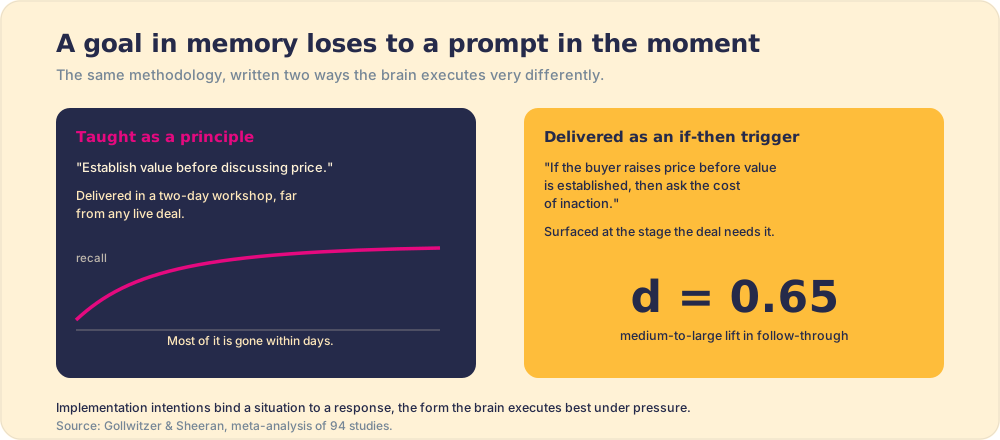
The rollouts that stick, then, do three things the workshop cannot. They deliver the methodology in the flow of work, at the stage where it applies, with the right MEDDIC qualifier or SPIN question surfaced the moment the rep needs it. They measure whether it was used, deal by deal, because a methodology no one inspects is a methodology no one runs. And they treat non-adherence as a system failure rather than a people failure, fixing the delivery and the friction rather than exhorting the rep. That delivery problem is the subject of the sales playbook guide, and the gap itself is mapped in the sales execution gap.
What does AI change about sales methodologies?
It makes the methodology cheap to teach and cheap to practice, which sharpens the point that teaching was never the constraint. AI roleplay tools now drill any methodology on demand, letting a rep run twenty practice discovery calls in an afternoon, and AI can score a recorded call against the MEDDIC qualifiers or the SPIN question sequence automatically, telling a manager which letters a rep earned on the call rather than which they claimed. That removes the last excuse for low adherence on the knowledge side, and it moves the live question from "does the rep know the methodology" to "did the rep, or increasingly the AI agent acting in the deal, make the move on the call."
AI also shifts which methodology earns its place, because it changes the buyer as much as the rep. Gartner finds B2B buyers now spend only about 17 percent of the journey meeting with all potential suppliers combined, and any single rep gets a sliver of that, roughly 5 to 6 percent of the buyer's time. AI research assistants are compressing the rep's window further still: in a June 2025 survey Gartner found that 61 percent of B2B buyers now prefer a rep-free buying experience, so the buyer arrives later, more researched, and more opinionated than ever. A method built purely to draw the problem out of a blank-slate buyer underperforms when the buyer is not a blank slate, which is the structural case for the Challenger move of teaching them something their own research missed. The other modern force is buyer indecision: the Jolt Effect's analysis of 2.5 million sales conversations found that 40 to 60 percent of lost deals end in no-decision rather than to a competitor, and of those, 56 percent stalled from the buyer's fear of making a mistake rather than a preference for the status quo. That rewards methodologies that help a hesitant buyer commit over those that only qualify them out, and it is a move no current methodology drills well, which is the open frontier in the field right now.
The defense is the same one you apply to a rep, applied now to the model: a methodology advances a deal only on a genuine buyer commitment, whether a human or an AI proposes the advance, and you must be able to inspect whether the AI, like the rep, ran the methodology or gamed the activity. The methodologies themselves do not change; a well-run SPIN call is a well-run SPIN call whether a person or a model helps shape it. Which one earns its place, and whether anyone, human or machine, runs it, is what moves.
The recommendation
The path forward comes down to a verdict, stated plainly, because a guide that explains a problem and then trails off has not done its job. You have three options. You can keep shopping for the methodology that finally works, which the DIETFITS evidence says will keep failing you the same way the last one did. You can pick one and mandate it through CRM fields and a quiz, which produces compliance and a clean-looking pipeline that still hides the truth. Or you can pick one that fits your sale and names what your winners already do, then put your real effort into getting it run. We recommend the third without hesitation, because every piece of evidence on this page points the same direction: the methodologies tie, adherence is the variable, and the variable is fixable by design rather than by exhortation.
Concretely, that means three commitments. Pick the one methodology that fits the complexity of your sale and the instinct of your best reps, and stop the quarterly re-platforming that eats the gain. Deliver it in the flow of work, at the stage where it applies, written as a situational trigger rather than a principle to remember, because the behavioral science says a goal held in memory loses to a prompt delivered in the moment. And measure whether reps run it, deal by deal, treating non-adherence as a delivery failure to fix rather than a discipline failure to scold. The methodology is the diet; consistency is the result. That run-it layer, the right move surfaced in the moment inside HubSpot and Salesforce with adherence measured, is the job we built Supered for, so the methodology you chose becomes the motion your team runs instead of the workshop they attended.
Read the methodologies in depth: the full overview, SPIN, MEDDIC, MEDDPICC, Challenger, gap selling, Sandler, consultative selling, and the process they run inside in the sales process guide.
Sales methodologies FAQ
What is a sales methodology?+
What are the main sales methodologies?+
Which sales methodology is best?+
What is the difference between a sales methodology and a sales process?+
Why do sales methodology rollouts fail?+
What is the difference between SPIN and Challenger?+
Is MEDDIC a sales methodology or a qualification framework?+
Can you use more than one sales methodology at once?+
Does the choice of sales methodology matter at all, or only adherence?+
What is the best sales methodology for a small or transactional sales team?+
How does AI change which sales methodology you should use?+
Stop re-platforming acronyms.