AI Sales Outreach: When Everyone Has the Volume, Volume Stops Working
AI made sales outreach free to produce, so everyone produced more, and reply rates collapsed. A 1970 Nobel idea, the market for lemons, explains why, and where the edge moved.
AI sales outreach is the use of AI to generate and send prospecting messages at scale, and because it made volume nearly free, volume stopped being an edge; reply rates have collapsed, and the advantage moved to relevance and the follow-through behavior AI cannot fake.
For about two years, AI sales outreach looked like free money. A rep who once wrote forty cold emails a day could now generate four hundred, each one auto-personalized with a scrape of the prospect’s LinkedIn, fired off by a sequence tool while the rep did something else. The math seemed unbeatable: ten times the volume at a fraction of the effort. Then a strange thing happened. The same tool reached every team at once, the inbox filled with the same kind of message, and the reply rate fell through the floor. The thing that made outreach cheap also made it stop working.
That is the story worth telling honestly, because most AI outreach pitches are still selling the 2023 dream. AI sales outreach is the use of AI to generate and send prospecting messages at scale, and because it made volume nearly free, volume stopped being an edge; reply rates have collapsed, and the advantage moved to relevance and the follow-through behavior AI cannot fake. The tool did exactly what it promised. The promise was the problem, and an economist could have warned you in advance.
What is AI sales outreach, and what did it change?
It is AI pointed at prospecting: AI cold email that generates the message, AI outreach tools that build the sequence and personalize at scale from prospect data, and AI sales prospecting that sends without a human in the loop. What it changed is the economics of volume. When producing a thousand tailored-looking messages costs almost nothing, every team does it, and a thing everyone can do is no longer an advantage. It is the table everyone is now sitting at, which means the edge has to come from somewhere else.
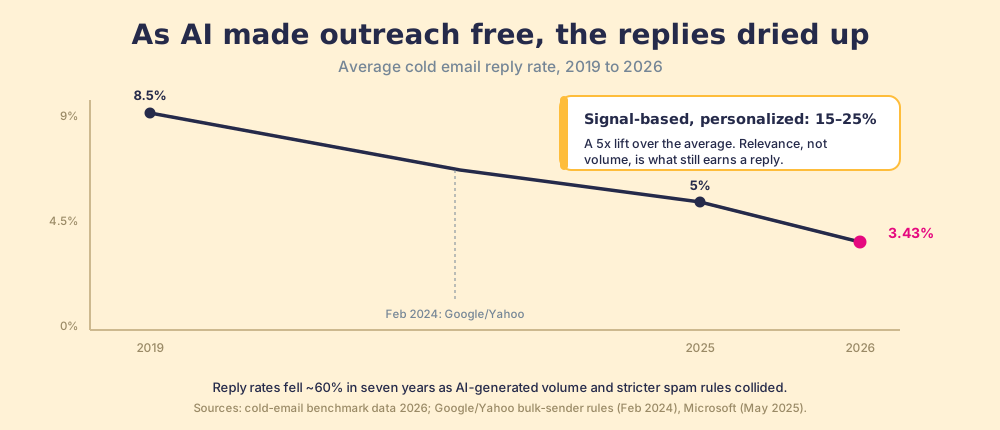
The numbers are blunt about what happened next. Average cold email reply rates fell to about 3.43% in 2026, down from 8.5% in 2019, a drop of roughly 60% in seven years (cold email benchmark data, 2026). The fall steepened exactly as AI-generated outreach went mainstream. More messages, fewer replies, which is the precise opposite of what the volume pitch promised.
Why is AI outreach making reply rates worse?
Two forces hit at once, and they compounded.
- Saturation. When a buyer’s inbox holds thirty near-identical AI-written pitches, the rational response is to ignore the whole genre, and they do. AI gave your team volume and gave every other team the same volume, so the marginal message lands in a more crowded, more cynical inbox than the one before it.
- The gatekeepers. In February 2024, Google and Yahoo began enforcing strict rules on bulk senders: authentication, one-click unsubscribe, and a hard spam-rate ceiling of 0.3%, with Microsoft following in May 2025 (on the 2024 sender rules). High-volume, low-engagement sending is now punished with the spam folder.
So the volume strategy gets hit from both sides: buyers tune it out, and the mailbox providers bury it. But “saturation” is a description, not an explanation. To see why this was inevitable, and what to do about it, you need the theory underneath.
The theory that explains it: a costly signal went free
Cold outreach was never about the words. It was about a signal. When a rep sent a researched, tailored email, the effort itself carried a message the text did not: someone spent real time on me, so they are probably a serious vendor with something relevant, not a spammer blasting a list. The buyer could not directly observe the sender’s quality, so they read the effort as a proxy for it. This is exactly the mechanism Michael Spence won a Nobel Prize for describing in 1973: in a market with hidden quality, informed parties communicate through a costly signal, one that is expensive enough that low-quality senders cannot afford to fake it. A college degree signals ability in his original example; a hand-researched email signaled seriousness in ours. The signal works only as long as it is costly, because the cost is what sorts the serious from the rest. Economists call that clean sort a separating equilibrium.
AI removed the cost, and the sort collapsed. When a “personalized” email takes one prompt and zero effort, the spammer’s message and the serious vendor’s message become indistinguishable, because effort no longer separates them. The high-effort-looking email is now something anyone can send, which means the signal that used to mean “serious” means nothing. The market moves from a separating equilibrium to a pooling one, where good and bad look the same, and then it does what George Akerlof showed any such market does. In his 1970 paper The Market for Lemons, Akerlof proved that when buyers cannot tell quality apart, they rationally assume the average is low, discount everything accordingly, and the good sellers, unwilling to be priced as junk, withdraw, which lowers the average again (Akerlof, Quarterly Journal of Economics, 1970). The market degrades toward breakdown. A buyer deleting every cold email unread is not being lazy. They are doing precisely what Akerlof’s theory predicts a rational actor does in a market flooded with indistinguishable lemons.
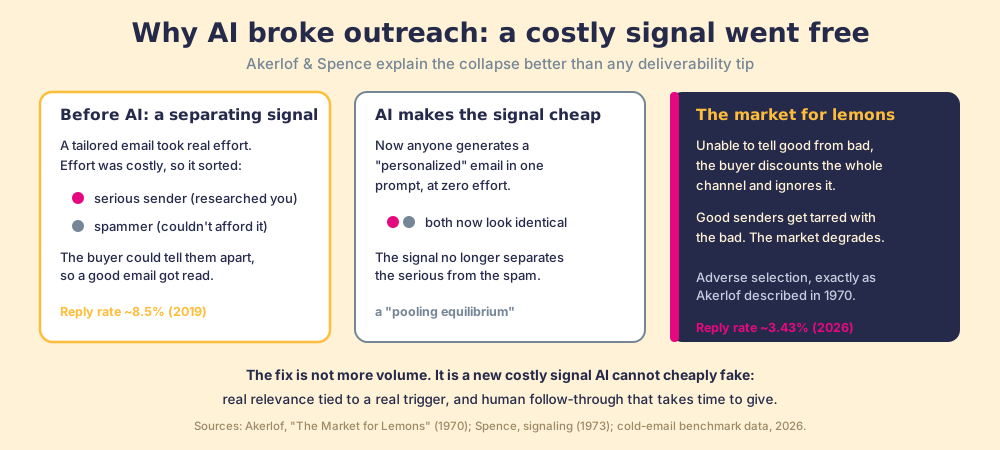
This is where we part company with the most aggressive pitch in the category, and it is worth doing by name. The vendors selling “AI personalization at scale” are promising to help you send the costly-looking signal at no cost, to everyone. Signaling theory says that is self-defeating by construction: a signal everyone can send for free is not a signal at all, it is noise, and scaling it faster only pollutes the channel you are trying to win. The harder a tool works to make cheap outreach look expensive, the faster it burns down the same inbox it is firing into. You cannot scale your way out of a lemons market by producing more lemons.
Where did the edge in outreach move?
To a new costly signal, one AI cannot fake cheaply, which is the only thing that restores the sort. The same datasets that show the average collapsing show a top tier thriving: signal-based, genuinely personalized campaigns still post 15 to 25% reply rates, a 5x lift over the average. The reason is precisely the signaling logic. A message that demonstrates real knowledge of the buyer’s specific situation, tied to a real trigger they would recognize, is expensive to produce because it requires genuine relevance and timing, the things a model cannot manufacture from a scrape. And human follow-through, a disciplined, well-timed sequence of touches that a person stands behind, is costly in the one currency AI has not made free: attention over time. Both re-establish a signal a spammer cannot cheaply counterfeit, which is what gets the reply.
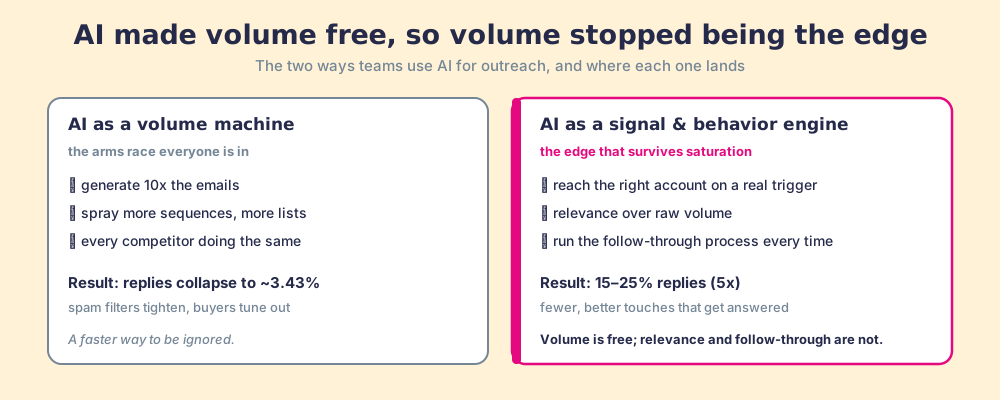
Notice what the winning version is made of. AI does the part it is good at, finding the signal and saving the rep hours, and the human supplies the part AI cannot fake: judgment about relevance and the discipline to follow through, every time, the same way. That second half is a behavior problem, not a content problem, which is why outreach lives or dies on whether reps run a consistent process rather than on how many messages the tool can spit out. It is the same lesson that runs under every AI-in-sales question, traced in full in generative AI for sales: AI amplifies the process you have, and a flood of generated outreach with no disciplined follow-through only amplifies the noise.
What we recommend
Stop buying AI outreach to send more, and start using it to send a signal a spammer cannot afford. The volume play is over; the data has called it, and Akerlof called it fifty years before the data did. So split the job the way the winners do. Let AI take the parts it does cheaply and well, surfacing the right accounts on real triggers, drafting a tailored first pass, clearing the admin around the sequence. Then put the reclaimed time into the two things that still carry a credible signal: relevance a human verifies against a real trigger, and a follow-through process run with discipline on every prospect that matters.
We recommend judging any AI outreach tool by a single question rewritten in signaling terms: does it help you produce a cheap signal at scale, or a costly one with reach? If the pitch is “personalization at scale,” it is selling you a faster way to add lemons to a lemon market. The teams winning in a saturated inbox are not the ones with the most messages. They are the ones whose AI sharpens a signal a competitor cannot counterfeit and whose reps reliably run the process behind it, which is the part no tool can do for you and the part that decides whether the outreach was worth sending at all.
From here: the mechanism in generative AI for sales, the assistant that helps run it in AI sales assistant, the full tool field in the best AI sales tools, the cadence engines in sales engagement platforms, and the follow-through discipline underneath in sales process adoption.
Frequently asked questions
What is AI sales outreach?+
Does AI cold email still work in 2026?+
Why are AI outreach reply rates dropping?+
How should you use AI for sales outreach?+
Your process, running itself.