Seismic Pricing in 2026: The Quote, the Hidden Costs, and the Merger Problem
A clear-eyed look at Seismic pricing in 2026: the quote-based model, the real contract numbers buyers pay, the costs the quote leaves out, and why the Highspot merger changes the math at renewal.
Seismic pricing is quote-based with no public list price: contracts are sold per named user, and Vendr's dataset of 411 purchases puts the median at 31,950 dollars a year inside a reported band of 9,000 to 178,390.
Ask a tailor what a suit costs and he will reach for a measuring tape. Ask Seismic what its platform costs and you get the same answer in software form: a discovery call, a scoping conversation, and a quote cut to your measurements. There is no price on the website, no tier grid, no calculator. That opacity is normal for enterprise software, and it is not the interesting part.
Seismic pricing is quote-based with no public list price: contracts are sold per named user, and Vendr’s dataset of 411 purchases puts the median at 31,950 dollars a year inside a reported band of 9,000 to 178,390 (Vendr marketplace data, updated February 2026). Hold that band. It runs almost twenty to one from floor to ceiling, and where you land inside it was always negotiable, because for a decade every Seismic buyer held the same card: Highspot. On August 18, 2026, that card was torn up, when the two companies completed their merger. The interesting question about Seismic pricing in 2026 is no longer what the quote says. It is what your bargaining position is worth now that the rival you used to quote against sits on the same cap table.
| Seismic pricing at a glance (2026) | The reported reality |
|---|---|
| Pricing model | Per named user, quote only, annual contracts |
| Public list price | None published |
| Median contract | $31,950 / yr (Vendr, 411 purchases, Feb 2026) |
| Reported band | $9,000 to $178,390 / yr (Vendr) |
| 10 to 50 users | $30,000 to $100,000 / yr (Vendr) |
| 50 to 200 users | $100,000 to $300,000 / yr (Vendr) |
| 200+ users | $300,000+, global deals past $1,000,000 (Vendr) |
| Implementation | $10,000 to $150,000+, quoted separately (Vendr) |
| Renewal escalator | 3 to 7 percent annually unless renegotiated (Vendr) |
How much does Seismic cost in 2026?
Every figure below is a reported range from procurement data, because no list price exists to cite.
- The model. Seismic sells per named user, annually, by quote. The core product is Seismic Enablement (content management, delivery, engagement tracking, CRM integration); Seismic Learning, Content Automation, and advanced analytics are separate add-on modules (Vendr).
- The median and the band. Across roughly 411 reported purchases, Vendr shows a median contract of 31,950 dollars a year, a floor near 9,000, a ceiling near 178,390, and average negotiated savings around 15 percent.
- The deployment bands. Vendr’s data sorts by size: 10 to 50 users typically pay 30,000 to 100,000 dollars a year for core Enablement; 50 to 200 users with a module or two pay 100,000 to 300,000; enterprise rollouts of 200+ users start above 300,000, and some global deals reach 500,000 to 1,000,000 or more.
- The second opinion. Spendflo’s procurement guide (March 2025) pegs typical Seismic contracts between 20,000 and 120,000 dollars and cites a base figure of 32 dollars per user (Spendflo). The two datasets overlap where it matters: five figures for most buyers, six for the big ones.
- The multi-year lever. Vendr reports that 2-year terms run 10 to 20 percent below annual pricing and 3-year terms 15 to 25 percent below, in exchange for the lock-in.
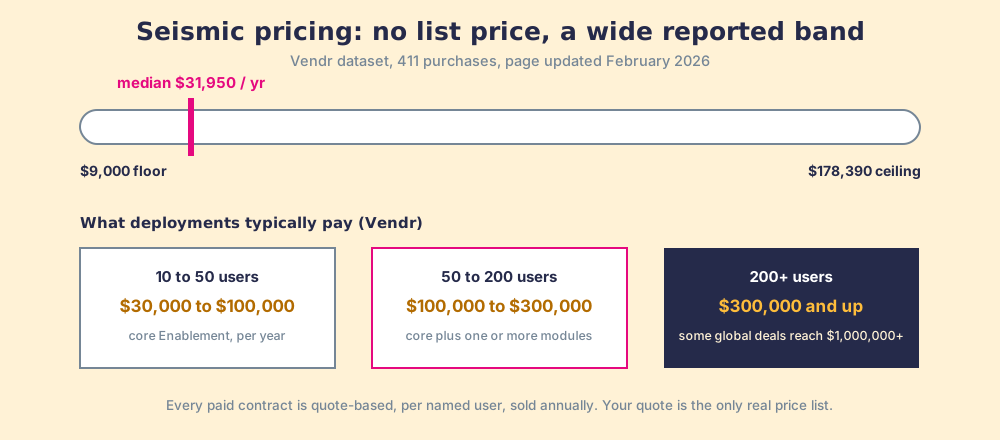
Notice where the median sits inside that band: low, far from the middle. Most Seismic buyers pay closer to the floor than the ceiling, and the six-figure deals that stretch the band are enterprise contracts stacking multiple modules across hundreds of seats. Your quote will be determined by three dials, in order of force: named user count, module count, and how convincingly you were shopping elsewhere. The third dial is the one this post is really about.
What does Seismic pricing leave off the quote?
The subscription line is the visible cost. Four more arrive after it, and Vendr’s transaction data prices three of them.
- Implementation and professional services. Quoted separately in Vendr’s data. Vendr puts the range at 10,000 to 30,000 dollars for small deployments (10 to 50 users), 30,000 to 75,000 for mid-market (50 to 200 users), and 75,000 to 150,000 or more for enterprise rollouts with content migration, custom integrations, and global workflows.
- Add-on modules. Seismic Learning, Content Automation, and advanced analytics are each priced separately, and Vendr reports they can raise total contract value by 20 to 50 percent. Buyers who bundle at signing get better rates than buyers who add mid-contract.
- The renewal escalator. Renewal contracts typically carry a 3 to 7 percent annual increase unless renegotiated, and Vendr’s data shows buyers who renegotiate (starting 90 to 120 days before expiration) often hold pricing flat while auto-renewers absorb the increase.
- Time. G2 buyer data reported in Flowla’s pricing guide puts average onboarding at about 4 months and average time to ROI at about 17 months. A platform you start paying for in January and start profiting from the following summer has a real carrying cost, even before you count the admin who runs it.
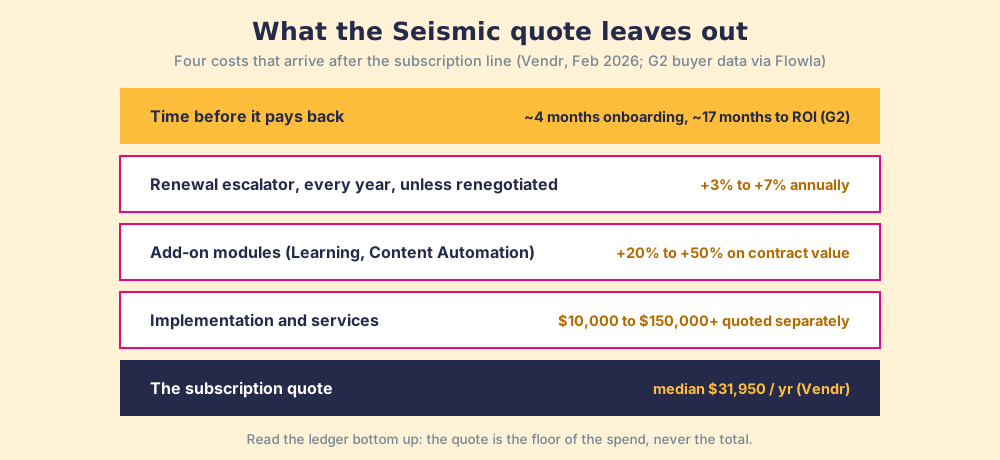
Read the ledger from the bottom and the pattern is plain. A 32,000 dollar quote for a 60-seat team becomes a 60,000 to 100,000 dollar first-year spend once services and a module land, and the escalator compounds from there. None of this is unusual for enterprise software, and none of it is a scandal. It is simply the difference between a quote and a total Seismic Enablement cost, and the buyer who budgets the quote alone will be back in front of finance before the renewal.
How does the Highspot merger change Seismic pricing?
Here is the part the older pricing pages cannot tell you, because they were written before February.
On February 12, 2026, Highspot and Seismic signed a definitive merger agreement, and on August 18, 2026 it closed. The combined company operates under the Seismic name, led by Seismic CEO Rob Tarkoff, with Highspot founder Robert Wahbe on the board, in a deal valued above 6 billion dollars (GeekWire, Highspot). We covered the deal itself in our Highspot and Seismic merger breakdown. What matters here is narrower: what it does to the price. And the answer changed on the day it closed, because the leverage this section describes is no longer theoretical.
An enterprise software negotiation works like an auction run in reverse. The vendor names a number, and the only force that pulls the number down is the paddle in your other hand, the rival bid you can credibly walk to. For a decade, Seismic and Highspot were each other’s paddle. Vendr’s negotiation guidance says so in as many words: buyers who evaluate competitive alternatives, Highspot first among them, commonly land 15 to 30 percent below list, and buyers with strong positions (competitive bids, large seat counts, quarter-end timing) have reached 30 to 40 percent (Vendr). The discount was never generosity. It was the paddle.
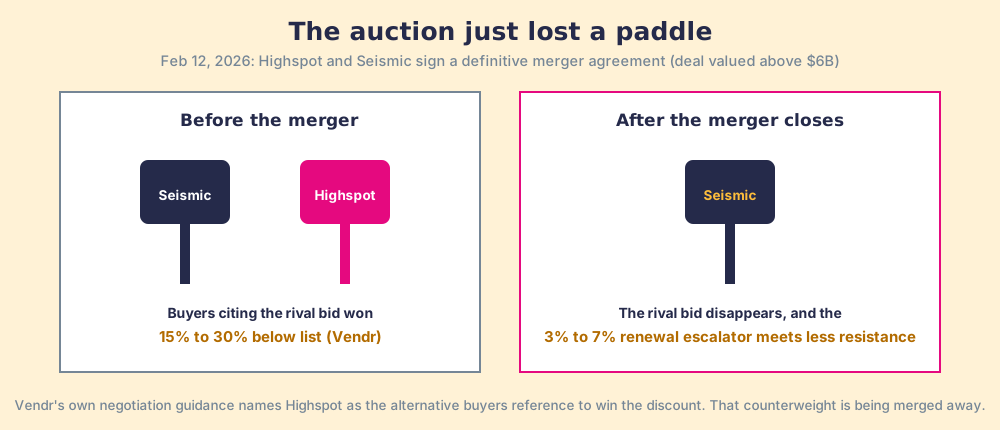
Now that the deal has closed, the two largest enablement vendors share one roadmap and one sales floor. Showpad, Mindtickle, and Allego remain real alternatives (we graded the whole field in Seismic alternatives, which is also where to look if you searched for Seismic pricing 2026 and want the escape routes, and compared the two merger partners head to head in Highspot vs Seismic). But the alternative Seismic’s own sales team feared most is becoming Seismic. The 3 to 7 percent renewal escalator does not need to grow a single point for your costs to rise; it only needs less resistance, and consolidation is how resistance gets bought.
So the closed merger produces one concrete instruction for anyone mid-contract: rebuild the leverage you just lost, before your next renewal rather than during it. Negotiate a cap on the annual escalator. Lock module pricing at today’s rates rather than adding later. Open the renewal conversation 90 to 120 days early, the window Vendr’s data ties to flat renewals. And bring a genuinely independent alternative to the table, because the paddle you used to row with is now sitting in the same boat.
Who should pay Seismic’s price, and who should not?
A fair verdict, because the platform earns its keep in a specific building.
- Large enterprise content operations. Pay it. A team managing tens of thousands of assets across regions, with compliance review and a dedicated enablement staff, is the buyer Seismic was built for, and the 100,000 to 300,000 dollar band buys automation and governance that a lighter tool cannot fake.
- Regulated industries. Pay it, for the same reason. Financial services and insurance teams that must prove which version of which document reached which client get real value from the content controls the quote covers.
- Mid-market teams of 20 to 60 reps. Think again. The implementation lift (4 months of onboarding, 17 to ROI, per G2 data via Flowla) and a 60,000 dollar first-year total are out of proportion to a content library a few hundred assets deep. The best sales enablement tools roundup covers the lighter field.
- Teams whose real problem is what reps do. Do not pay it, because you would be buying the wrong instrument. A content platform can prove an asset was opened. It cannot prove the process was followed, and that gap is the next section.
What happens to the spend when reps do not use what it delivers?
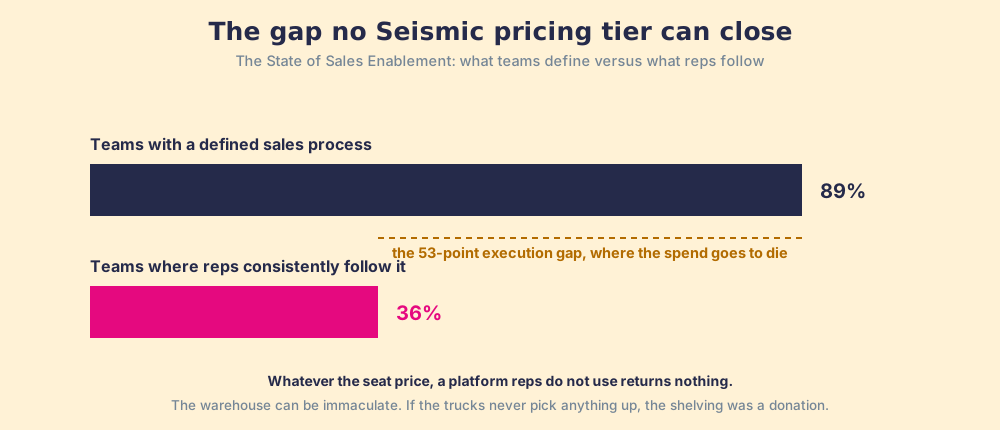
Picture the warehouse Seismic builds you, because it is a genuinely good warehouse. Every asset shelved and labeled, findable in seconds, with sensors reporting which boxes get taken down. Now watch the loading dock. If the trucks never pick anything up, if the sellers out on their routes keep working from whatever was in the cab, the warehouse returns nothing, and the sensors will faithfully report the silence. The shelving was a donation.
That is the finding our own research keeps returning. The State of Sales Enablement found that 89 percent of teams have a defined sales process while only 36 percent of reps consistently follow it, a 53-point gap between what the organization built and what the field runs. Every dollar in this post, the 31,950 median, the 150,000 implementation, the escalator, sits on the wrong side of that gap until a rep changes what they do while the work is in motion. The quote prices the shelving. Nothing on it prices the follow-through.
This is where Supered enters, once, because it does the job the warehouse cannot. Supered is the Business Logic Layer: it puts the next step of your process in front of the rep in the moment of the work, inside HubSpot, Salesforce, Gong, Gmail, wherever the work is happening, and then measures whether the process was followed, deal by deal. It does not store your content library better than Seismic does. It closes the 53-point gap the library cannot see.
The recap, for the buyer holding a Seismic quote:
- The price. Quote-based, per named user, median 31,950 dollars a year across 411 reported purchases, in a band from 9,000 to 178,390 (Vendr, Feb 2026).
- The total. Add 10,000 to 150,000 or more for implementation, 20 to 50 percent for modules, and a 3 to 7 percent annual escalator; budget the full ledger.
- The clock. About 4 months to onboard and about 17 months to ROI (G2 data via Flowla), so the first year runs at a loss by design.
- The merger. Signed February 12, 2026 and closed August 18, 2026; your strongest discount lever (the Highspot rival bid, worth 15 to 30 percent per Vendr) is gone, so cap your escalator and lock module pricing at the next renewal and bring a genuinely independent alternative rather than the former rival. If the close is what put you in market, we graded the field in Highspot alternatives.
- The gap. 89 percent of teams define a process, 36 percent of reps follow it, and no content tier at any price closes that.
- The pattern. Quote-only pricing is the category norm, and the newer wrinkle is metered AI: Gong pricing added a per-seat credit pool in June 2026, so ask any enablement vendor what its AI processing costs before you sign.
What we recommend
Three paths, and a clear verdict. If you are enterprise-scale with a heavy content operation, buy Seismic, negotiate hard before the merger closes, and cap the escalator in writing. If you are mid-market and the quote made you flinch, the flinch is data; the graded field in Seismic alternatives will serve you better than a discount. And in either case, spend the first dollar on the 53-point gap, because a process reps follow returns more than a library reps admire, and every dataset in this post says the money goes missing inside that 53-point gap. If the gap is your problem, book a demo and we will show you what the Business Logic Layer looks like on your own process.
Frequently asked questions
How much does Seismic cost in 2026?+
Does Seismic publish its pricing?+
What does Seismic implementation cost?+
How does the Highspot merger affect Seismic pricing?+
Is Seismic worth the price?+
Your process, running itself.