Seismic Alternatives in 2026: A Graded Guide for the Post-Merger Field
Seismic has merged with Highspot to form a 6 billion dollar enablement giant.
Here are the Seismic alternatives that matter now, graded by the job each one is built to do.
Seismic alternatives are the enablement platforms buyers weigh against Seismic, and in 2026 the search is driven by its completed Highspot merger, which splits the field into content clouds that store and serve material and behavior tools that change what reps do.
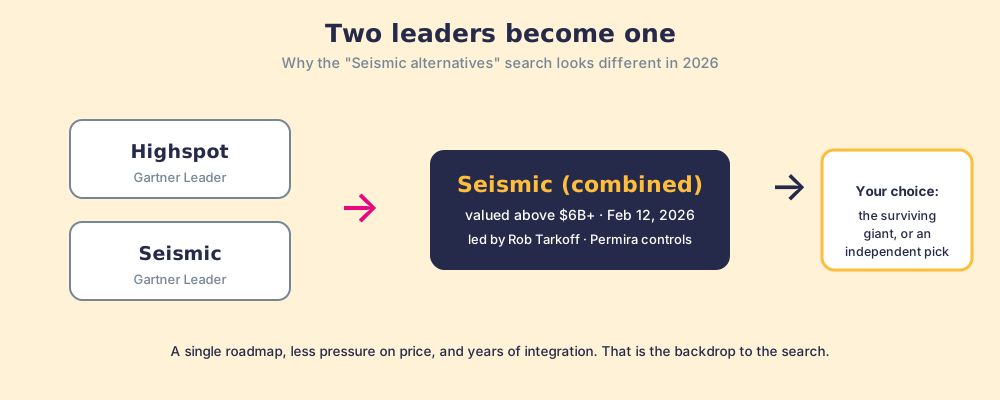
In February 2026 the two biggest names in sales enablement stopped competing and started merging, and on August 18, 2026 the deal closed. Highspot and Seismic, the pair that anchored every analyst chart for a decade, are now one company under the Seismic name, valued above 6 billion dollars and serving roughly 2,500 customers (GeekWire, and the full story in the Highspot-Seismic merger). For a buyer typing “Seismic alternatives” into a search bar, that one fact changes the whole exercise. You are no longer choosing between two heavyweights. You are deciding whether to commit to the surviving giant, or to look at the Seismic competitors it leaves behind.
Seismic alternatives are the sales enablement platform options buyers weigh against Seismic, and in 2026 the search is driven by Seismic’s completed merger with Highspot, which sorts the field into content clouds that store and serve material and behavior tools that change what reps do in the flow of work. That split is the spine of this guide. Most comparison lists rank near-identical content platforms by feature count. The cut that decides your purchase is the job each one is built to do.
Why are teams looking for Seismic alternatives now?
A switch search has a cause, and in 2026 it is usually one of three.
- Merger uncertainty. Now that the two market leaders have combined, the surviving roadmap belongs to one company, competitive pressure on price has eased, and integration will drag on for years. A buyer evaluating Seismic today is committing to a platform whose direction is being rewritten in real time.
- Enterprise weight. Seismic is built for large, complex content operations. A mid-market team often finds the implementation lift and the price out of proportion to the job, and goes looking for something lighter.
- The adoption question. Seismic stores, serves, and tracks content brilliantly. What it cannot tell you is whether the rep used the right material the right way with the buyer in front of them. That gap ends most searches, and it is the one the content-heavy alternatives share with Seismic itself.
That third reason is the one money cannot solve by switching to a cheaper twin, so it deserves the rest of this page.
What job is each Seismic alternative built to do?
The field splits in two, and naming the split is the whole comparison.
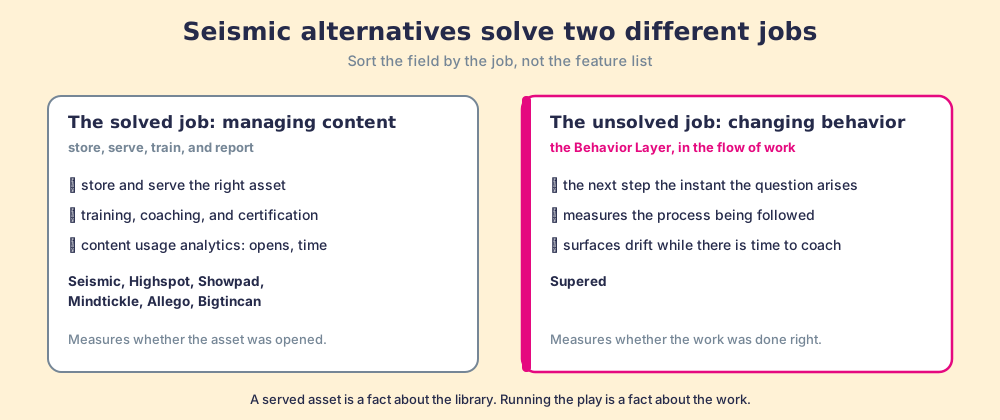
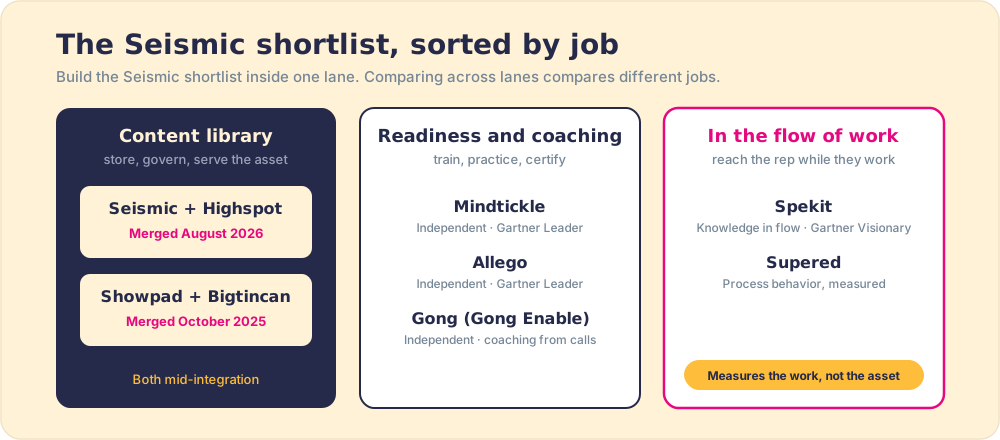
The content-and-enablement family does the solved job: storing material, serving the right asset, training reps, and reporting on what got opened. This is where Seismic, Highspot, Showpad (now including Bigtincan), Mindtickle, and Allego compete, and they compete well. Gartner’s first Magic Quadrant for Revenue Enablement Platforms, published November 10, 2025, named seven Leaders: Allego, Bigtincan, Highspot, Mindtickle, SalesHood, Seismic, and Showpad (Spotlight AR summary, Highspot), with Spekit named a Visionary (Spekit). Four of those seven Leaders have since become two companies: Highspot folded into Seismic, and Vector Capital merged Bigtincan into Showpad on October 30, 2025, under the Showpad name with more than 2,000 customers (Bigtincan). Their G2 standings, checked September 2026, are close enough to be a statistical tie: Mindtickle at 4.7 from 2,400 reviews, Showpad at 4.6 from 1,909, Seismic at 4.6 from 1,805, Highspot (now listed as “Highspot by Seismic”) at 4.7 from 1,206, and Allego at 4.6 from 695 (G2). If your job is managing a large content library and proving it gets used, any of these is a defensible pick, and you choose on depth, price, and which analyst chart you trust.
The behavior family does the unsolved job: changing what a rep does at the moment of the work, and measuring whether the process was followed. A served asset is a fact about the library. Whether the rep ran the play is a fact about the work, and the two diverge constantly. This is the lane where a content platform, however good, runs out of road, because it was built to manage material, not to govern behavior.
How we graded the Seismic alternatives
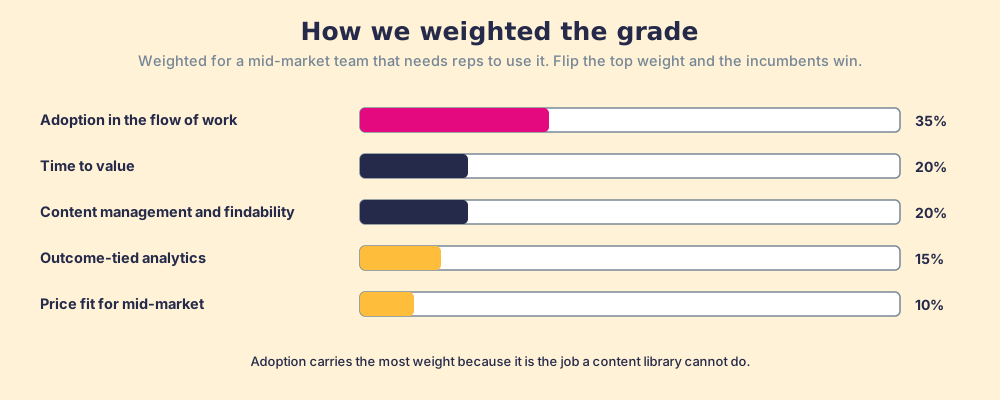
A ranking that hides its math is an advertisement. Here is the lens, stated plainly so you can flip it. We weighted the criteria for the buyer most likely to be searching “Seismic alternatives” in 2026: a mid-market revenue team that needs reps to use the tool on live work, not an enterprise running a 50,000-asset content operation. Weight it that way and the lighter, adoption-first tools rise. Weight it for a massive content library and Seismic or Highspot win, plainly.
| Criterion | Weight | What it rewards |
|---|---|---|
| Adoption in the flow of work | 35% | Changing what reps do, beyond storing what they could read |
| Time to value | 20% | Standing up fast without a year-long rollout |
| Content management and findability | 20% | Seismic’s core strength: serving the right asset |
| Outcome-tied analytics | 15% | Measuring behavior and revenue, beyond opens |
| Price fit for mid-market | 10% | Transparent, proportionate cost |
The honesty rule is the point: the weights serve a specific job, and each tool gets the A it earns in its own lane. Flip the top weight from adoption to content depth and the order below reshuffles toward the incumbents.
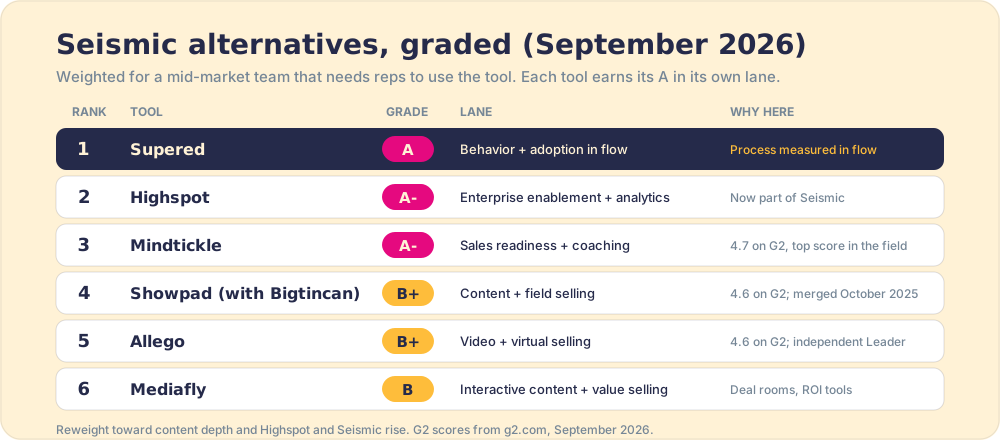
Here is the field, graded and ranked, with current corporate status named, because a comparison that does not say who owns whom is wrong the moment a deal closes.
| Rank | Tool | Grade | Best-fit lane | Why it ranks here |
|---|---|---|---|---|
| 1 | Supered | A | Behavior and adoption in flow | The only one that delivers the next step in the flow of work and measures whether the process was followed |
| 2 | Highspot | A- | Enterprise enablement + analytics | Highest Gartner execution, but it is now part of Seismic, so it is consolidation, not escape |
| 3 | Mindtickle | A- | Sales readiness + coaching | Top G2 score in the field (4.7, 2,400 reviews); best if the job is training and certification |
| 4 | Showpad (with Bigtincan) | B+ | Content + field selling | Strong content and buyer experience (4.6, 1,909 reviews); merged with Bigtincan under Vector Capital in October 2025, so it too is mid-integration |
| 5 | Allego | B+ | Video + virtual selling | A 2025 Gartner Leader (4.6, 695 reviews), still independent; best for video coaching and remote teams |
| 6 | Mediafly | B | Interactive content + value selling | Independent and acquisitive; strong for deal rooms and ROI tools, narrower than the leaders |
The table makes the split visible. Five of the six compete on the solved job and differ on depth, price, and who signs the roadmap. Only the first row changes the question being asked, and that is by design, not flattery: it is graded against a weight that prizes adoption, and it is the tool built for that lane.
How do Highspot, Seismic, Showpad, Allego, Mindtickle, and Gong compare?
The balanced shortlist, one line each: Seismic or Highspot if you need the enterprise content library and accept one merged roadmap; Showpad if you sell in the field and want content plus buyer experience at less weight; Allego for video coaching; Mindtickle for readiness and certification; Gong if you want coaching grounded in recorded calls; Spekit if you want knowledge delivered in the flow of work without a heavy library. Those are three different jobs sharing one search for alternatives to Seismic, which is why a single feature grid across all seven produces mush.
| Platform | Status (September 2026) | Reasons for | Reasons against |
|---|---|---|---|
| Seismic | Parent of the merged company (about 2,500 customers combined) | Deepest content automation and personalization at scale | Enterprise weight; roadmap being redrawn, with details promised at Seismic Shift, October 12 to 15, 2026 |
| Highspot | Product line inside Seismic since August 18, 2026 | Highest Ability to Execute in Gartner’s 2025 Magic Quadrant; content and training in one place | Buying it now means buying into Seismic’s roadmap |
| Showpad | Merged with Bigtincan under Vector Capital, October 2025 | Content plus buyer experience for field-selling teams; 4.6 on G2 from 1,909 reviews | Two platforms mid-integration under a new CEO |
| Allego | Independent; 2025 Gartner Leader | Video coaching and practice; 4.6 on G2 from 695 reviews | Lighter content library than Seismic’s |
| Mindtickle | Independent; 2025 Gartner Leader | Readiness, certification, and role-play; 4.7 on G2 from 2,400 reviews | Content management is a secondary strength |
| Gong | Independent; ARR above $500M (May 2026) | Coaching grounded in real calls; Gong Enable launched February 2026; 4.7 on G2 from 6,682 reviews | Revenue intelligence first; not a content library |
| Spekit | Independent; 2025 Gartner Visionary | Knowledge in the flow of work; 4.7 on G2 from 303 reviews | Smaller library and analytics than the suites |
Sources: Seismic merger completion, Showpad and Bigtincan, Gong ARR, Gong Enable launch (AI Call Reviewer, AI Trainer, and Initiative Tracking), Spekit on G2; G2 scores checked September 2026.
Is Spekit a Seismic alternative?
Yes, for a narrower job. Spekit puts knowledge and content inside the tools reps already use, Gartner named it a Visionary in the 2025 Magic Quadrant, and it holds a 4.7 on G2 from 303 reviews. It is lighter than Seismic on library depth and content automation. Choose it when the complaint is “reps cannot find the answer while they work,” and keep looking when the complaint is “we manage tens of thousands of assets across regions.” For a mid-market team, that distinction usually favors the lighter tool; the full comparison is in Spekit alternatives.
What should buyers weigh after the Highspot-Seismic merger?
The combined company says both platforms keep “continued investment and platform innovation,” plans more than $100 million a year in R&D, and will reveal the detailed roadmap at Seismic Shift in October 2026 (Highspot). A buyer signing before that reveal is signing a lease on a house whose floor plan the landlord has not drawn yet. Five checks, whether you are renewing or pricing a Seismic replacement:
- Product-line commitment in writing. Ask which platform your contract names and for how long it is supported, in the order form, not the press release.
- Contract length against the roadmap date. A term that ends after the October roadmap reveal gives you a decision point; a three-year lock-in signed in September does not.
- Price protection. Two leaders became one, so competitive pressure at renewal eased. A renewal cap is worth more this year than last.
- Migration path. If your product line is the one being folded in, ask who pays for the content move and the retraining.
- The same questions for Showpad. It is also two platforms mid-integration, so it is not the stable escape it looks like from the outside.
The deal history and the analyst reaction are in the Highspot-Seismic merger.
Which Seismic alternative is right for your job?
The choice resolves cleanly once you name the job, and the behavioral reason it resolves this way is worth stating. The intention-action gap, the studied distance between deciding to do something and doing it, is what a content library cannot close. Peter Gollwitzer’s research on implementation intentions, drawn from a meta-analysis of 94 studies, found that tying an action to a specific cue in the moment roughly doubles follow-through. A served asset is the decision. The cue at the moment of the work is what turns it into the deed, and that is a different product than content management, however deep.
- Highspot, for the enterprise content operation. If your job is a large library and analyst-grade analytics, Highspot is the closest match to Seismic, with the caveat that the two are now one company. See the head-to-head in our Highspot vs Seismic breakdown, or the full field of Highspot competitors if that is the side of the merger you are shopping.
- Mindtickle, for readiness and certification. If the job is onboarding and ongoing rep training, its readiness depth and field-leading G2 score earn the pick.
- Showpad or Allego, for the lighter content job. If you want content and buyer experience without Seismic’s weight, either stands up faster, with Allego the stronger choice for video and remote selling.
- A business logic layer, for adoption you can see. If the problem is that reps are not running the process and you cannot tell until the deal is cold, no content platform reaches that job, and you are looking for a business logic layer instead.
The deeper reason matters in 2026, and it is why this is a painkiller and not a nice-to-have. AI has commoditized the content half. Any rep or agent can find the deck, summarize the case study, draft the follow-up. What AI cannot do on its own is run your process the right way and prove it ran. That is the unsolved, expensive job, and it is the one Supered is built for. Supered is the business logic layer: rules, guides, the Process Board, and the Sidekick panel put the next action in front of the rep in the flow of work, and it ships an MCP server so your AI agents read the same process rules, see what reps did, and act in flow without replacing the rep. So the comparison with a content cloud is not feature against feature. It is two different jobs, and the scorecard below makes the line clear.
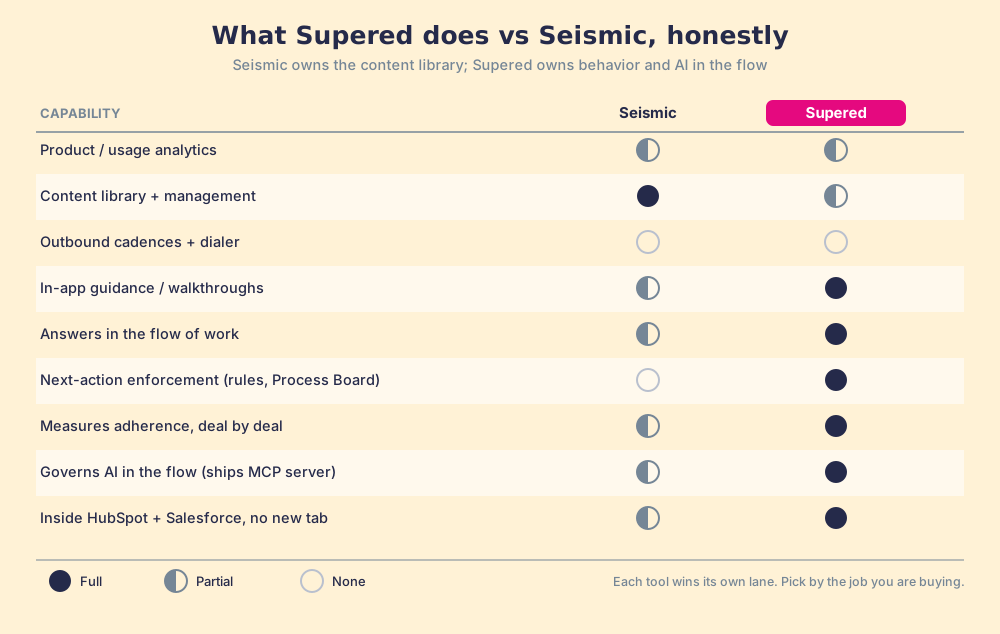
So here is what we recommend. If you need a content-and-enablement cloud and can absorb an enterprise rollout, Highspot or Seismic itself remains the safe pick, with eyes open about the merger reshaping both. If you want the same job at less weight, Mindtickle, Showpad, or Allego each win a clear lane, and you should choose on which lane matches your team. If the real problem is that the process is not getting run and you cannot see it, then the answer is not a cheaper content library, because the missing thing is the behavior signal that none of them carry. The decision was never Seismic versus a smaller Seismic. It is whether you are buying the content or the behavior. For the broader consolidation story, see how the same wave hit revenue intelligence in Clari alternatives.
Frequently asked questions
What are the best Seismic alternatives in 2026?+
Who are Seismic's main competitors in 2026?+
Is Spekit a Seismic alternative?+
What is the best Seismic alternative for a mid-market team?+
Why did Seismic and Highspot merge?+
Should the Highspot merger change my Seismic decision?+
Is Seismic a content management tool or a sales enablement platform?+
Your process, running itself.