What Is Outbound Sales? The Seller Picks the Buyer, and Deal Size Decides If It Pays
Outbound sales means the seller chooses the buyer and makes first contact. Inbound vs outbound sales in one table, the roles, the 2025 Bridge Group economics, and when outbound pays.
Outbound sales is selling in which the seller chooses the buyer and makes first contact, by phone, email, LinkedIn, or mail, before that buyer has asked to hear from anyone.
Outbound sales is selling in which the seller chooses the buyer and makes first contact, by phone, email, LinkedIn, or mail, before that buyer has asked to hear from anyone. Inbound runs the other way: the buyer chooses you. Most definitions stop at the channel, and the channel is the least interesting part. Three things decide whether outbound pays, and the rest of this guide takes them in order:
- The choosing. Outbound starts with a list someone decided on. Who picks the names, and why, sets the reply rate before the first email is written.
- The roles. Outbound split selling into a relay: one rep books the meeting, another runs the deal, and a third person increasingly builds the data machinery behind both.
- The math. The Bridge Group’s 2025 SDR report shows pipeline per SDR rising a third since 2022 while meetings fell, because deals got bigger. Outbound has become a deal-size business, and the arithmetic below shows where it stops paying.
What is outbound sales?
There are two ways to catch a fish. You can set a net off your own dock and see what swims in, or you can put on a mask, look through the water, pick one fish, and throw. Inbound sales is the net. Outbound sales is the spear. The net catches whatever comes by, and the fish chose to come. The spear catches only what you aimed at, and the aiming is most of the skill.
Salesforce, which ranks first for the question, defines outbound sales as “the process by which a seller initiates contact with a potential customer. This typically happens through cold calling or emailing” (Salesforce, updated August 28, 2026). Kaspr’s version is “making the first move” (Kaspr, updated December 16, 2024). Both are correct about the first move. They describe the throw, and leave out the aim.
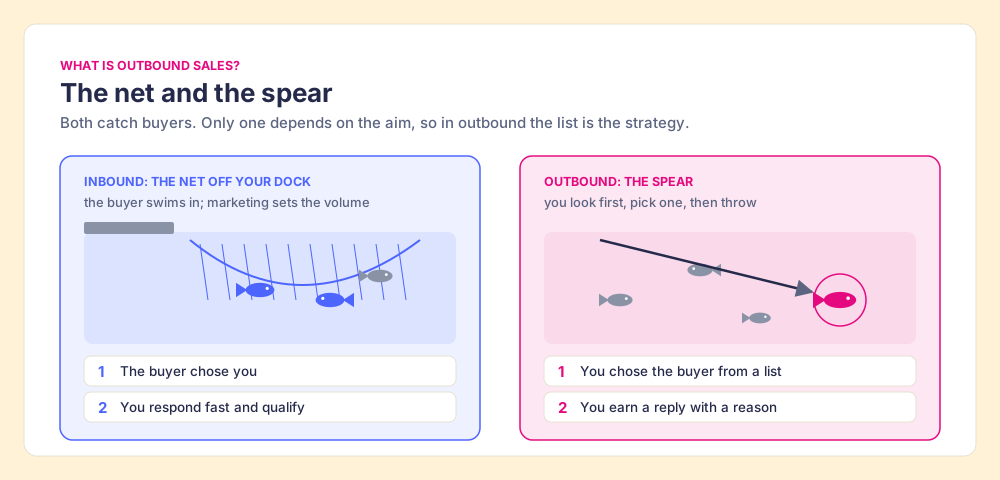
So the outbound sales meaning worth carrying around is short: the seller chooses. The channels that follow (the call, the email, the LinkedIn message, the handwritten note) is a way of throwing. A sharp throw at the wrong fish catches nothing, and a clumsy throw at the right one sometimes lands. A rep who picks twelve accounts with a reason to buy this month and a rep who loads four hundred rows into a sequencer are both doing outbound sales. They are not doing the same job.
Like any picture, the spear has an edge. A fish does not mind being speared by mistake; a buyer resents being contacted for no reason, and remembers the company that did it. Outbound’s reputation problem starts there, and so does its fix.
Inbound vs outbound sales: what is the difference?
Inbound vs outbound sales splits on who moves first, and the other differences follow from that one fact:
| Inbound sales | Outbound sales | |
|---|---|---|
| Who moves first | The buyer: a demo form, a trial, a call, a chat | The seller: a call, email, LinkedIn message, or letter |
| Who chose whom | The buyer chose you | You chose the buyer |
| What sets the volume | Marketing spend, content, brand, word of mouth | Rep headcount and the size and quality of the list |
| What the buyer already knows | Usually a lot; they researched before raising a hand | Often nothing about you |
| First job of the rep | Respond fast and qualify | Earn the first reply with a reason to talk |
| Main failure | Slow follow-up and unqualified leads | Irrelevant outreach to the wrong people |
| Typical roles | Inbound SDR, AE | Outbound SDR or BDR, full-cycle AE |
| Control over timing | Low: the market decides when buyers arrive | High: you decide who hears from you, and when |
Read down the outbound column and the trade is plain. Outbound buys control. You decide which accounts, which people, and which week, which is why a team that has to fill a gap in pipeline by a set date reaches for it. Inbound buys warmth. The buyer arrives already curious, but on their own clock.
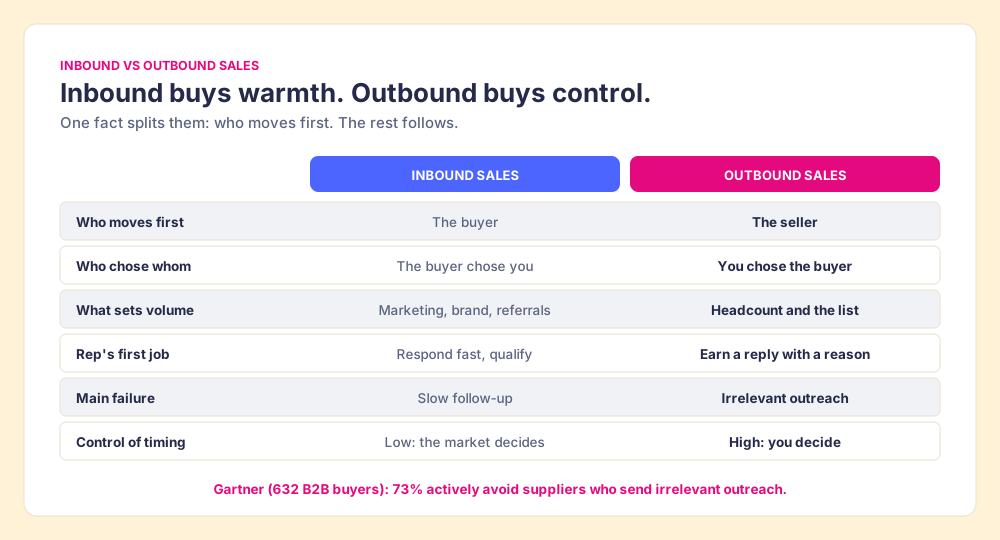
Outbound vs inbound sales arguments usually end with “do both,” and Kaspr says so too: “either approach alone is rarely the complete answer.” True, and it leaves the budget call unmade. What settles the mix is how much outbound your deal size can pay for, which the economics section below works out.
The buyer’s side explains why the outbound column’s main failure matters so much. Gartner’s survey of 632 B2B buyers found that “61% of B2B buyers prefer an overall rep-free buying experience” and “73% of B2B buyers actively avoid suppliers who send irrelevant outreach” (Gartner, June 25, 2025). Robert Blaisdell, a VP Analyst in Gartner’s sales practice, put it flatly: “Bad prospecting actively damages relationships with potential customers.” An inbound lead who ignores a slow reply costs you one deal. An outbound email to the wrong person can cost you the account, for years.
Who does outbound sales? The roles
Outbound used to be a job every salesperson did alone, start to finish. The modern split traces to Aaron Ross at Salesforce in the early 2000s, whose Predictable Revenue model separated prospecting from closing and gave each a specialist (Predictable Revenue summary). The result is a relay race. One runner carries the baton off the blocks, hands it over cleanly, and a second runner takes it to the tape. A dropped handoff loses the race no matter how fast either leg ran.
- Sales development rep (SDR). Books first meetings, often from both inbound leads and outbound lists. The detail is in what an SDR does.
- Business development rep (BDR). Usually the outbound-only version of the SDR; some companies use the titles the other way round, which BDR vs SDR sorts out.
- Account executive (AE). Takes the meeting and runs the deal to close. Full-cycle AEs also prospect for their own pipeline, which is outbound with no handoff at all.
- Sales leader. Sets the territory, the list rules, and the quota, and reviews which lists turn into pipeline.
- RevOps or the GTM engineer. Builds the data machinery: the enrichment, the routing, the tables. Clay says it coined “GTM engineer” in 2023 and that “about 100 GTME job listings go live every month” (Clay); our GTM engineer explainer covers the role.
The Bridge Group’s 2025 SDR report, covering 351 B2B companies, gives the shape of the relay: a median of 1 SDR for every 2.4 AEs, 82% of companies aligning SDRs to AE territories (up from 56% in 2018), and 6.4 SDRs per first-line leader (Bridge Group, February 6, 2025). It also logged “AI SDRs” as a category for the first time, at 1% of respondents. The AI SDR guide covers what those tools do; at 1% of respondents, they barely register in the data yet.
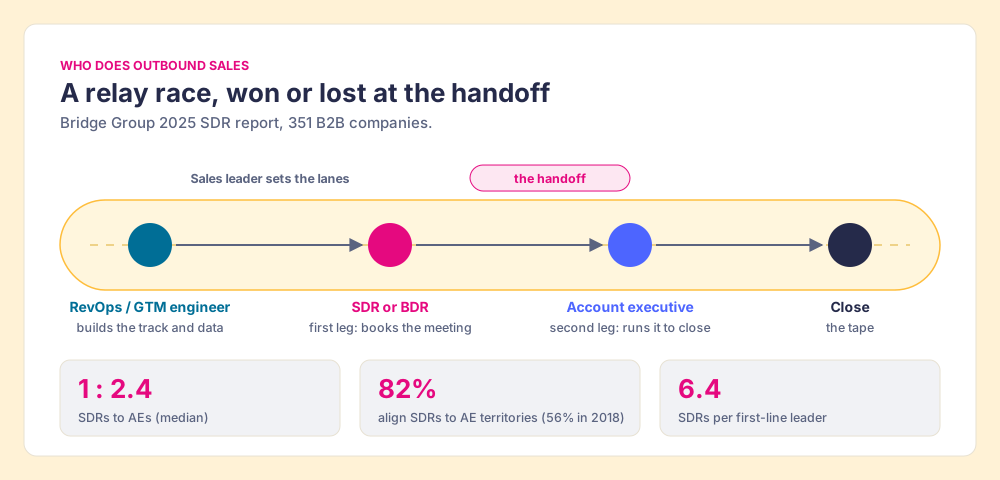
The territory alignment figure matters more than it looks. Going from 56% to 82% in seven years means four in five companies now want the SDR who books the meeting and the AE who takes it to share accounts, so the baton passes between people who know each other.
What does outbound sales cost, and what does it return?
Outbound sales is easy to price because its main cost is a salary, and the Bridge Group publishes the salary. The 2025 medians, from the same 351-company sample:
- The pay. $80,000 on-target earnings, split $55,000 base and $25,000 variable.
- The day. 112 activities: 44 phone, 41 email, 19 LinkedIn, 8 text or other, producing 4.1 quality conversations a day. Phone-heavy teams log 56 dials and 4.6 quality conversations; email-heavy teams 28 dials and 3.4.
- The month. A quota of 10 held meetings, and a median of 6 converted to a first-stage opportunity. Held meetings are down 40% since 2018 and conversions down 43%.
- The year. $3.78M of pipeline per SDR, up from $2.83M in 2022, with the report’s own caveat: “Pipeline figures represent raw pipeline generated, not forecast or closed-won revenue.”
- The seat. 3.0 months to ramp, 1.9 years average tenure, 40% annual attrition, and 60% of SDRs at quota, the lowest in the study’s history.
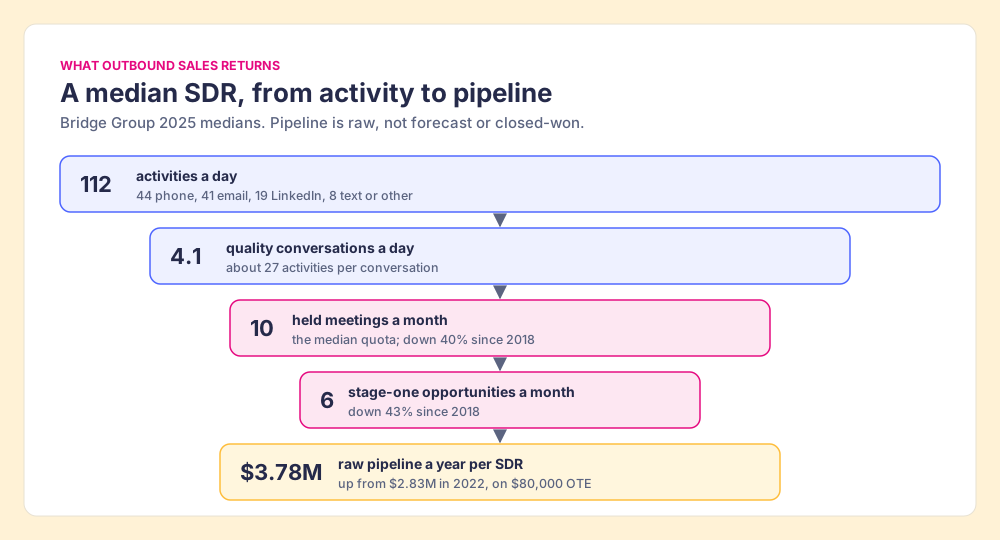
Neither the Salesforce page nor the Kaspr page carries the next finding. Pipeline per SDR went up by a third while meetings went down. Those two facts can both be true only if each meeting got bigger, and the report says so: the rise reflects higher deal sizes, $44,000 in 2024 against $27,000 in 2022, “rather than more meetings.” SDRs did not book more meetings; each meeting carried a bigger deal.
That turns outbound into a ferry with a fixed fare. Divide the median SDR’s $80,000 of pay by the 72 opportunities a year that 6 a month adds up to, and each opportunity costs about $1,111 in SDR pay alone, before tools, data, management, or the AE’s time. The fare is the same whatever is in the car:
| Average deal size | SDR pay per opportunity | Share of one deal |
|---|---|---|
| $50,000 (the report’s median company ASP) | $1,111 | 2.2% |
| $44,000 (2024) | $1,111 | 2.5% |
| $27,000 (2022) | $1,111 | 4.1% |
| $10,000 (example) | $1,111 | 11.1% |
| $5,000 (example) | $1,111 | 22.2% |
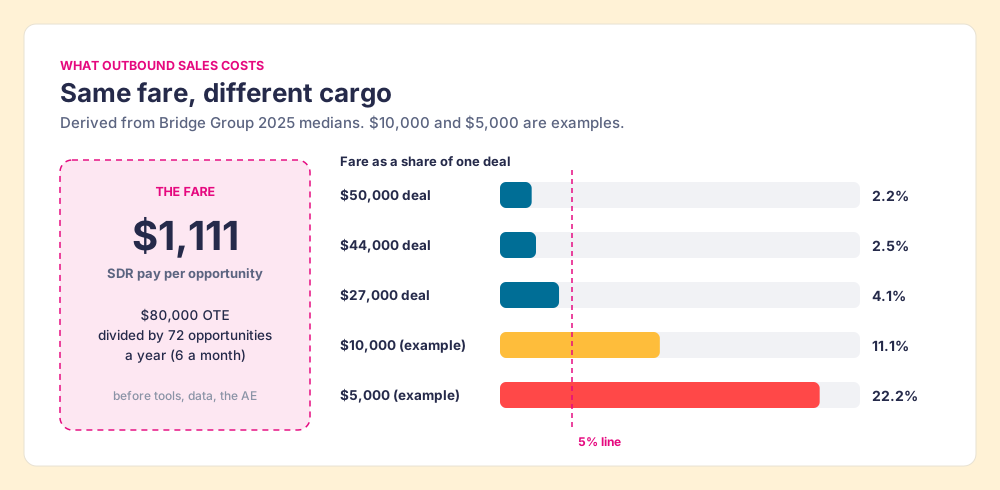
Two cautions about the ferry. It uses medians and pay only, so a real cost per opportunity is higher. And it divides by opportunities, not wins; once you apply your own win rate, the fare per closed deal multiplies. Neither caution changes the shape. At a $50,000 deal the fare is noise. At $5,000 it eats a fifth of the deal before anyone wins anything, and outbound with a dedicated SDR stops making sense. Small deals still get outbound, but from a full-cycle rep or a founder, where there is no separate salary to cover.
I would not approve an SDR hire without asking for the average deal size first. The tenure numbers say why the margin matters: a seat that turns over at 40% a year and spends 3 of every 22.8 months ramping pays its fare on fewer productive months than the org chart suggests.
When does outbound sales work?
Put the ferry, the buyer data, and the reply-rate data side by side and outbound works when five conditions hold. Two or three missing is a warning; all five missing is an inbound business.
- A deal big enough to pay the fare. At the Bridge Group medians, the SDR’s pay per opportunity is under 5% of the deal from about $25,000 up. Below $10,000 it passes 11% and climbs fast.
- A market you can name. Outbound needs a list of specific accounts and people. If you cannot write your ideal customer profile as one sentence with disqualifiers (what an ICP is), there is nothing to aim at.
- A reason to call this month. A new leader, a funding round, a hiring spree. Gong found “a 2.1x higher success rate for salespeople who state their reason for calling” (Gong, March 4, 2026); our cold calling tips go further.
- A list narrow enough to be relevant. Instantly’s data across its 2025 senders put the average cold email reply rate at 3.43% and the top 10% above 10.7%, and found “58% of all replies are generated from step one” (Instantly, January 12, 2026). That is about 34 replies per 1,000 emails against 107, and most of them decided by the first message, which is decided by the list. Instantly sells email software, so read it as directional; from the buyer’s side, Gartner found 73% avoid suppliers who send irrelevant outreach.
- Reps who can stay long enough. With 40% attrition and 3.0 months of ramp, a team that cannot keep a seat filled for more than a year spends much of its outbound budget on ramp.
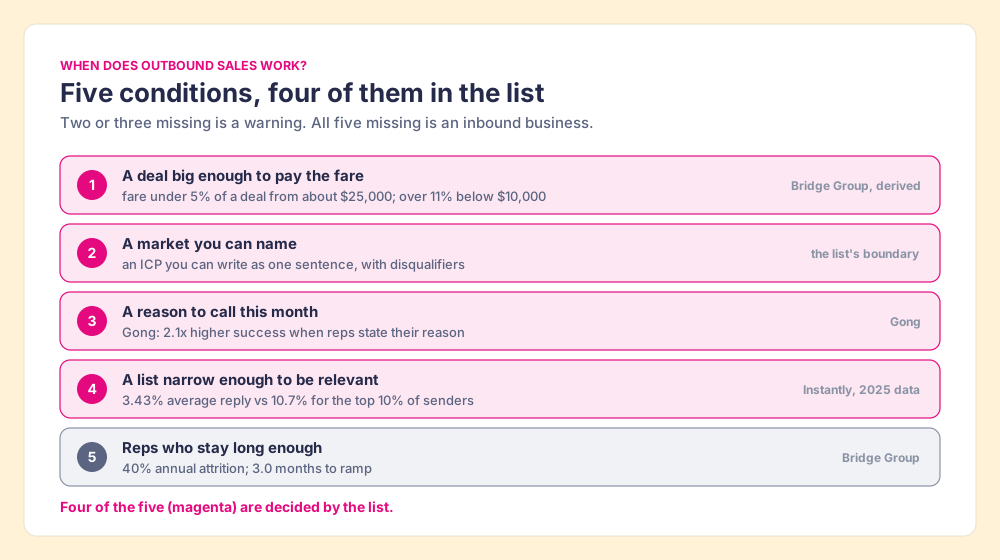
Four of the five live in the list. Deal size depends on which accounts you pick, the market is the list’s boundary, the reason to call is why a name made the list this week, and relevance is the list’s quality. Outbound is a list business with a phone attached. For the tool stack and the step-by-step motion, the companion guide is outbound lead generation, and the list itself has its own guide in how to build a lead list reps work.
Where do rep-built lists fit in outbound sales?
The spear works best in the hand of the person throwing it. A list Ops pulls from a database for four hundred reps is a net cast from someone else’s boat; a list the rep builds, account by account, with a reason for each name, is aimed. The catch has always been time: a rep who finds the right person on LinkedIn still has to find a verified email and phone, check the CRM, and type the record in, and that afternoon of tabs is why reps get handed lists instead.
Supered Prospector closes that gap for teams that already run Clay. It runs inside the Supered Chrome extension, on your team’s own Clay account, with no Clay login for reps.
- The rep’s own starting point. A LinkedIn profile, a Sales Navigator list, a company’s website, or a HubSpot, Salesforce, or Pipedrive record.
- The CRM check first. On the profile, the rep sees the matching CRM record and whether the person was already worked in the past, before a duplicate goes out.
- The waterfall in one click. The rep runs the team’s Clay table; Clay’s waterfall across 200+ providers asks source after source until one returns the verified email and phone.
- The buying committee, tuned. Reps pull the committee at an account by the titles, departments, and seniority the team sets, and can push a whole list into any custom Clay workflow the GTM engineer built.
- One click to the CRM. Ops sets the field mapping once; the person lands in HubSpot, Salesforce, or Pipedrive, ready for the sequence.
- The list after it ships. The team’s process applies to worked prospects, so a leader sees which rep-built lists were worked and which closed, and coaches from the lists that convert.
Supered does not bring its own database. It brings Clay’s waterfall, which is every database, routed, and that is why we chose Clay as our only data provider. Clay governs the data. Supered governs the motion. On LinkedIn, Prospector works within LinkedIn’s terms and does not copy search results in bulk; the contact data comes from Clay’s waterfall on your own Clay account. The full rep loop is on the sourcing use case, and the wider motion is in the sales prospecting guide.
Prospector is $45 per rep per month, billed annually, from one rep, on top of your Clay plan; Clay’s Growth plan starts at $446 a month billed annually, $495 billed monthly (Clay pricing, checked October 2, 2026).
Choose something else if:
- No Clay account. Prospector needs one. A single-database tool is the simpler start for a team without Clay.
- An inbound-only business. If your deals sit under the ferry line and buyers come to you, put the money into response speed instead.
- AI-written outreach. Prospector does not draft or send emails; it hands a verified person to your CRM and sequencer.
Why trust this guide?
Before Supered I started RevPartners, a HubSpot partner that did only sales implementations, sold roughly twice as much Sales Hub as any other partner, and reached HubSpot’s Elite tier in 13 months. We ran RevOps as a service for clients, which meant building and judging outbound motions from the fractional-CRO seat. Supered is the #1 sales enablement app on the HubSpot marketplace, rated 5.0 from 122 reviews there and 4.9 out of 5 from 81 reviews on G2 (checked October 1, 2026). The disclosure: we make Prospector, and it appears above for teams with Clay.
What we recommend
The evidence lines up behind one sentence: outbound sales pays when the deal is big enough and the list is narrow enough. The Bridge Group shows the pipeline gains of the last three years came from bigger deals, not more meetings. The ferry arithmetic shows a $1,111 fare that a $50,000 deal barely notices and a $5,000 deal cannot carry. And Gartner and Instantly agree from opposite ends that relevance decides the reply: 73% of buyers avoid irrelevant outreach, and the top senders get roughly three times the average reply rate.
- Deals above about $25,000. Fund outbound, align SDRs to AE territories, and spend the effort on the list before the cadence.
- Deals between about $10,000 and $25,000. Run outbound from full-cycle reps on narrow, signal-led lists, and add an SDR only once the fare clears 5%.
- Deals under $10,000. Lead with inbound and response speed; keep outbound for named, high-fit accounts.
- The list builder. Let the rep who will work the list build it, with the contact data fetched days before the first touch.
If you run Clay, Prospector is the shortest route to that last line. Next, read outbound lead generation for the tool stack and the step-by-step motion, then the sales prospecting process for what happens after the first reply.
Frequently asked questions
What is the difference between inbound and outbound sales?+
Is outbound sales the same as cold calling?+
What is an example of outbound sales?+
What is an outbound sales job?+
Does outbound sales still work in 2026?+
Do I need Clay to use Supered Prospector for outbound sales?+
Your Clay waterfall, where reps already work.