What Is Enablement? One Job, Pointed at Seven Different Teams
Enablement means getting people what they need to do a job well at the moment they need it. Sales, revenue, customer, GTM, and partner enablement are the same job aimed at different people, and they fail the same way.
Enablement is the work of giving people the content, tools, training, and process support to do a job well at the moment they need it, so that the right action becomes the easy one.
In business, enablement means making sure people have what they need to do their job well, at the moment they need it: the content, the tools, the training, and the process support. Ask what is enablement and the standard answers are lists of things handed over. The confusion clears up once you notice the dictionary gives “enable” two meanings, and that the 53-point execution gap in our own research sits between them.
Merriam-Webster defines enable first as “to provide with the means or opportunity,” and a line later as “to make possible, practical, or easy” (Merriam-Webster). The first sense is a delivery. The second is a result. You can provide someone with the means to do a job and leave it every bit as hard as it was before. Gartner’s working definition of sales enablement sits squarely in the first sense: “the process of providing the sales organization with the information, content and tools that help sellers sell more effectively” (Gartner). Providing. The rest of this page argues for the second sense, because that is the one the numbers reward.
A note on other meanings, since the search results mix them. In addiction studies, an “enabler” is someone who props up a harmful habit, and in social care “enablement” means supporting a person to do things for themselves. Neither is the business sense covered here.
What does enablement mean, in plain terms?
Start in an operating room. The surgeon holds out a hand without looking up, and a clamp lands in it. The scrub nurse did not perform the operation, did not write the textbook, and did not stock the supply room down the hall. What the nurse did was put the right instrument in the right hand at the moment the hand opened. Enablement at its best looks like that.
Now look at the other two ways a hospital helps its surgeons. The supply room holds every instrument anyone could want, sorted and labeled, and the surgeon would have to leave the table to fetch one. The lecture hall taught the technique years earlier, and the surgeon has to remember it under the lights. Both are necessary. Neither is enough. A hospital that stocked the shelves and ran the lectures, and then sent surgeons in alone, would have provided the means and made nothing easier.
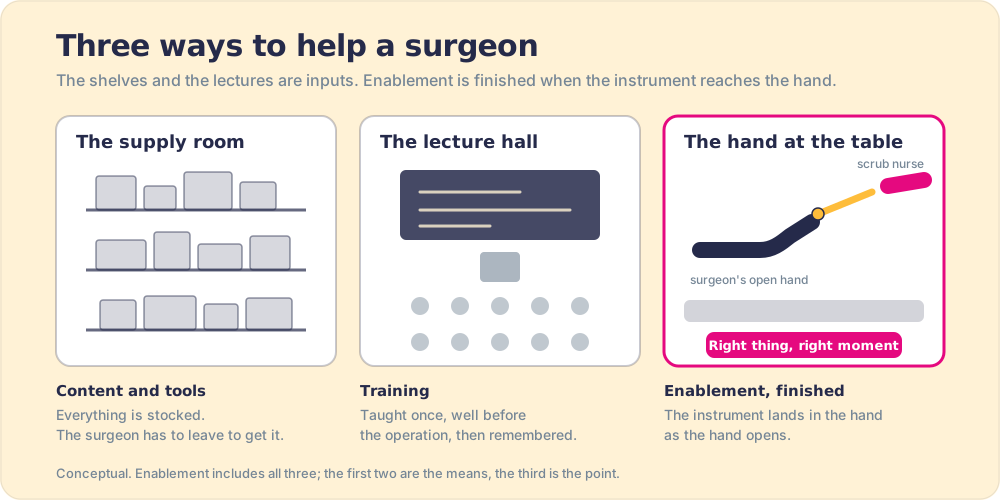
Translate that to a company and the enablement definition has five working parts. Each is a real piece of the job, and each can be done well while the job as a whole still fails.
- Content. The decks, talk tracks, case studies, and answers people use in front of a buyer or customer.
- Tools. The systems the work runs through, usually the CRM plus whatever sits around it.
- Training. The courses, certifications, and practice that build knowledge and skill.
- Process support. The written standard for how the work gets done, turned into playbooks, checklists, and in-the-moment guidance.
- Coaching and measurement. The feedback loop that shows whether the standard was run and helps the person get better at running it.
Gartner’s own seller research puts a number on why the second sense matters. It found that 83 percent of sellers experience high or medium “drag,” the friction that makes work feel harder than it should, and that low-drag sellers reach quota attainment at 1.7 times the rate of high-drag sellers (Gartner). Drag is what enablement exists to remove.
What are the types of enablement?
The types of enablement are the same job aimed at different people. What changes from one to the next is who is being made able and which moment in their work matters most. Here is a short answer for each, with a deeper read where we have one.
- Sales enablement. Making sellers able to run the right step at each point in a deal, from first call to signature. It is the original branch and the one the others borrowed from. The full treatment is in what sales enablement is, and the long-cycle, many-stakeholder version is in B2B sales enablement.
- Revenue enablement. The same work stretched across marketing, sales, and customer success so the handoffs between them hold. Gartner gave the category its own Magic Quadrant in November 2025 (Highspot). Whether a wider name produces a wider result is the subject of revenue enablement.
- GTM enablement. Enablement for every go-to-market role at once, and most visibly for launches, when a new product or price has to reach sellers, marketers, and support staff at the same time. See GTM enablement.
- Customer enablement. Making a customer’s own people able to get the value they paid for, through onboarding, education, and guidance inside the product. The academy is the easy half, as customer enablement explains.
- Partner enablement. Equipping resellers, agencies, and implementation partners to sell and deliver your product inside customer environments you do not control.
- Marketing enablement. A term with two meanings: marketing’s work to equip sales, and the work of equipping marketers themselves with tools, data, and process.
- Product and technical enablement. Teaching field teams, sales engineers, and support staff how the product works and how to demo, configure, and troubleshoot it, which matters most in the weeks after a release.
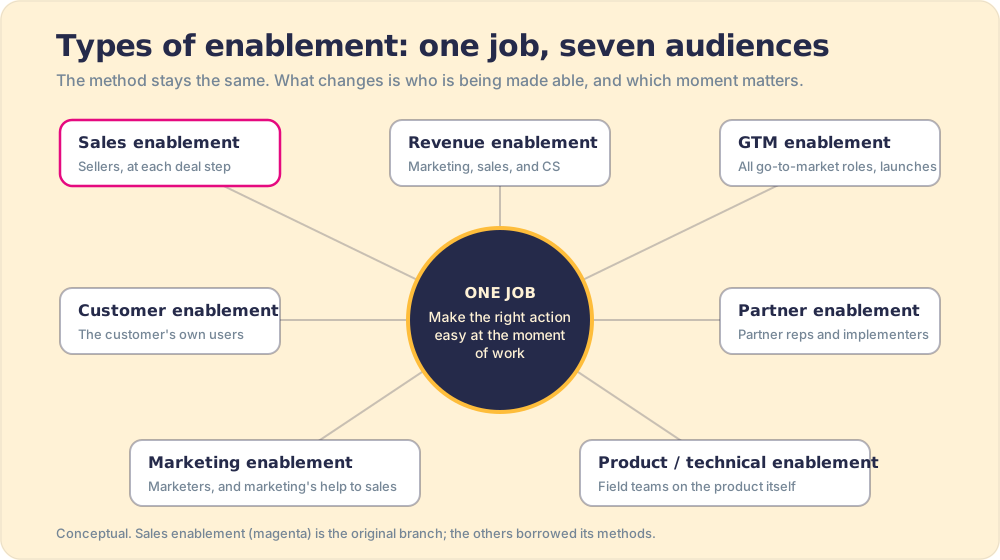
The shared job has a useful side effect. A lesson learned in one type transfers to the others almost intact. A customer enablement team that watches its academy completions climb while product usage stays flat is looking at the same pattern as a sales enablement team whose certification rates climb while win rates hold still. Same shelves, same lecture hall, same empty space beside the table.
What does an enablement team do?
An enablement team owns the path between “we decided how this work should be done” and “the work is done that way.” In practice that breaks into a handful of recurring jobs.
- Onboarding and ramp. Getting new hires from their first day to independent, productive work.
- Content and messaging. Building the material people use with buyers or customers, and retiring it when it goes stale.
- Training and certification. Teaching skills and checking that they stuck.
- Process and playbooks. Turning the way the best people already work into a standard others can follow.
- Tools, with operations. Choosing and configuring the systems, usually in partnership with RevOps.
- Coaching support. Giving managers the signal and the material to coach from.
- Measurement. Showing whether any of the above changed what people did and what the business got.
The trap sits in how teams organize around that list. Forrester found that more than 75 percent of sales enablement leaders call the end-user experience critical, yet more than one-third still structure their teams around deliverables and offerings, not the reps they serve (Forrester, Jennifer Bullock, 2020). A team built around deliverables measures itself by what it ships. The supply room gets fuller. The hand at the table stays empty. The role-level version of this argument is in the sales enablement manager.
Who does enablement report to?
Sales and revenue enablement belongs with the leader who owns the number the enablement is meant to move, which for a sales team means the sales leader or revenue operations. Forrester’s July 2025 research makes the case directly: enablement teams in high-performing sales organizations are 75 percent more likely to report to sales or operations leadership, and the firm argues that enablement has outgrown its marketing and HR origins (Forrester, 2025).
The reasoning is simple once you see it. The reporting line sets what the team gets praised for. Under marketing, the easy praise goes to assets. Under HR or learning, it goes to course completions. Under the sales leader, the praise goes to whether reps ran the play and the deals moved. By the same logic, customer enablement belongs under customer success and partner enablement under the channel leader: each should follow the number its audience owns.
How is enablement measured?
Forrester’s framework for revenue enablement metrics sorts measurement into four categories: “the activity, quality, adoption, and impact of revenue enablement initiatives” (Forrester, November 2025). Think of them as the rungs of a ladder, climbed in order.
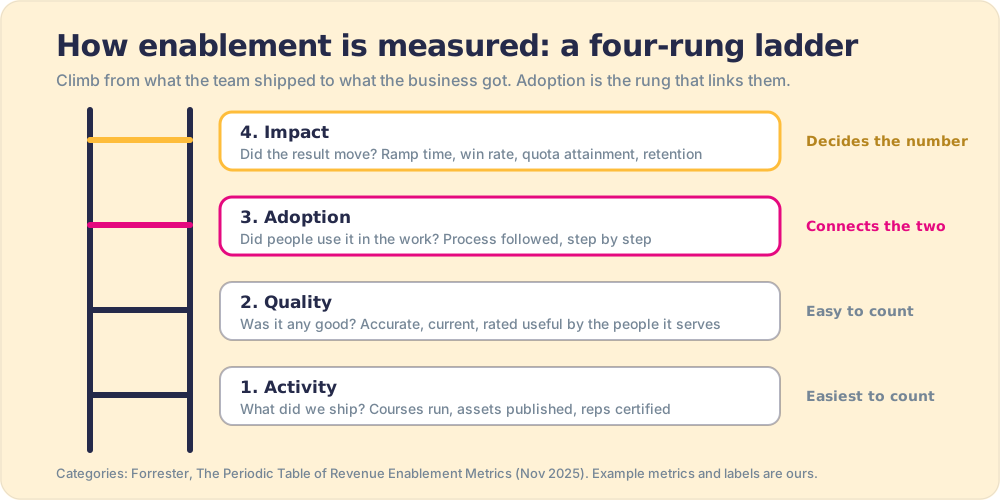
| Rung | The question it answers | Example metrics |
|---|---|---|
| Activity | What did we ship? | Courses delivered, assets published, reps certified |
| Quality | Was it any good? | Accuracy, freshness, usefulness ratings |
| Adoption | Did people use it in the work? | Process steps completed, guidance used during live work |
| Impact | Did the result move? | Ramp time, win rate, quota attainment, retention |
Adoption is the rung to instrument first, because it is the only one that shows the help reached the hand. It is also where inspection lives. In our own research, the teams that inspected process adherence most closely hit quota at 6.3 times the rate of the least-inspected teams (The State of Sales Enablement 2026). Inspection gives managers something true to coach from. For a fuller metric set, see sales enablement KPIs.
What is the difference between enablement and training?
Training is one of the parts; enablement is the whole machine. A training session transfers knowledge and skill at one point in time. Enablement is responsible for whether that knowledge shows up later, in the work, when the person is busy and the buyer is waiting.
Memory is the reason the two come apart. Hermann Ebbinghaus measured his own forgetting in the 1880s, and Jaap Murre and Joeri Dros replicated the experiment in 2015. In their replication, one day after learning a list, only about 25 percent of the learning effort was still “saved”; the rest had to be relearned (Murre and Dros, PLoS ONE, 2015). Those were lists of nonsense syllables, and a sales methodology has more meaning to hold on to, but the direction is plain. I have run enough HubSpot training sessions to see the same curve from the front of the room:
From the field
If you teach somebody something, they won’t actually do what you teach them. They will ask you to do it for them, because they’re gonna run out of time.
The full comparison is in sales enablement vs sales training.
Why does enablement that stops at content fail?
Because handing over the material does not finish the job. Our 2026 survey of 198 sales leaders found that 89 percent have a defined sales process and 36 percent see it followed as designed, a 53-point gap (The State of Sales Enablement 2026). Those teams did the first sense of “enable.” They wrote the process, trained on it, and stocked the shelves. The drop happens after the handoff, between knowing the process and running it with a deal open and three other things demanding attention.
The same survey shows where the drop is smallest. Teams whose process lives inside the CRM workflow hit quota at 49 percent; teams whose process lives in a doc, wiki, or LMS hit quota at 15 percent.
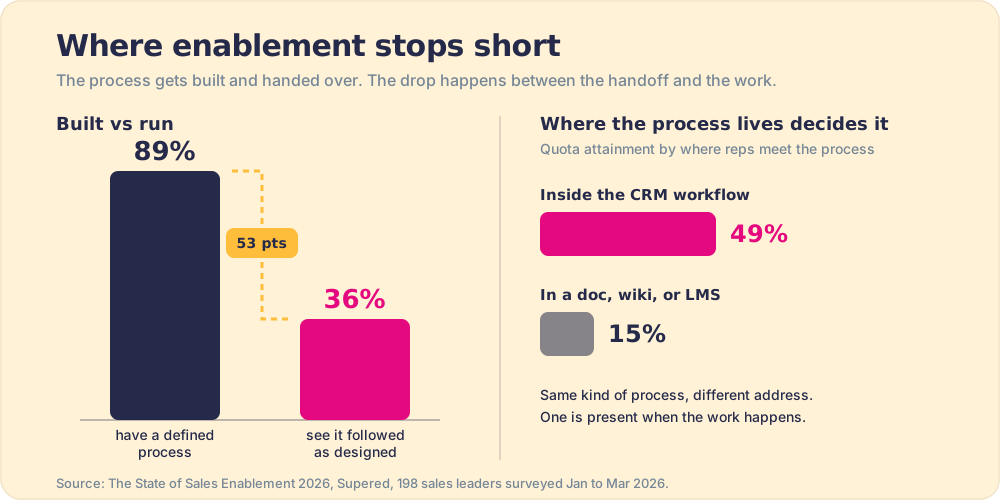
It would be easy to read that gap as a people problem and reach for accountability speeches. The evidence points the other way. The same reps, given the same process, run it far more often when it sits in front of them during the work than when it sits in a folder. That is a system result. When people skip the process, the fix belongs to the system that asked them to go find it.
How should you run enablement, whatever the type?
Run it for the second dictionary sense, making the right action easy in the moment of work, and grade it on adoption before you claim impact. When I explain it on calls, I put it in four steps:
From the field
Number one, we must expect. You must collect the expectations… We then equip. It must be in the moment, where people are, when they need it. They never have to search for it. The expectation or the answer to the question must always immediately be provided. Number three, those expectations must be measured, and it must be real time… And then fourth, there’s reinforcement.
A content function graded on what ships leaves the 53-point gap where it found it, and a training function graded on completions loses most of what it taught to the forgetting curve. Where the process lives decides the rest: 49 percent quota attainment when it sits inside the CRM workflow, 15 percent when it sits in a doc, wiki, or LMS. So name the handful of moments that decide results for the people you serve, put the content and the guidance inside the tools where those moments happen, report to the leader who owns the number, and inspect adoption so managers can coach from facts. The supply room and the lecture hall still stock the tray. The job is finished at the table.
From here: the seller-specific version in what sales enablement is, the cross-team version in revenue enablement, and the customer-facing version in customer enablement.
Frequently asked questions
What is enablement?+
What does enablement mean in business?+
What are the types of enablement?+
What does an enablement team do?+
Who does enablement report to?+
How do you measure enablement?+
What is the difference between enablement and training?+
Your process, running itself.