B2B Sales Enablement: Stock the Camp Before the Deal Climbs to It
B2B deals run for months and pass through many hands, so enablement delivered at kickoff has faded by the time the security review or procurement call arrives. Here is how to stock each stage of the climb instead.
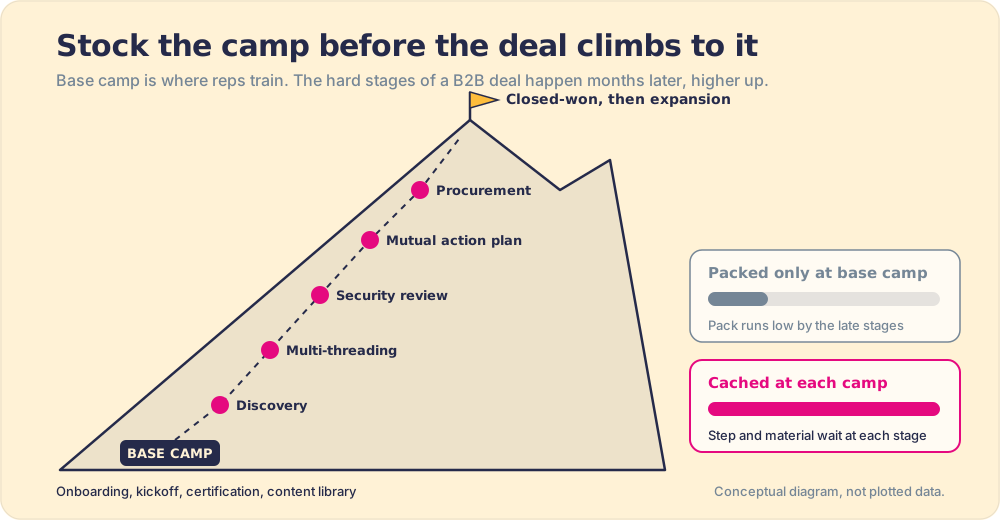
B2B sales enablement is the work of equipping the people who touch a business-to-business deal to run the right step at each stage of a long, many-person purchase, and it works when the guidance reaches the rep at the stage it applies instead of months earlier in training.
An account executive sat through a strong session on security reviews at the sales kickoff. The enablement lead brought in a sales engineer, walked through the standard questionnaire, and showed where the SOC 2 report lives. The AE took notes. Then she opened a new deal, ran discovery, found a second stakeholder, built a business case, and five months after the kickoff a long security questionnaire landed in her inbox from someone at the buyer she had never met. She did not remember the session. She searched the shared drive, found an old version of the answers, and sent it.
B2B sales enablement breaks in exactly this spot. The training was good. It arrived at the wrong altitude.
B2B sales enablement is the work of equipping the people who touch a business-to-business deal to run the right step at each stage of a long, many-person purchase. The top-ranking guides define it by its inputs (content, training, tools, sales and marketing alignment), and those inputs are real. What they leave out is time. A B2B deal runs for months and passes through many hands, so enablement delivered at kickoff has faded before the deal reaches the stage where it matters. It has to reach the rep at the stage it applies. Our own survey data says that is the largest single lever: teams whose process lives inside the CRM workflow hit quota at 49%, teams whose process lives in docs, wikis, or an LMS at 15% (State of Sales Enablement 2026).
What is B2B sales enablement, and what makes it different?
Gartner defines sales enablement as “the process of providing the sales organization with the information, content and tools that help sellers sell more effectively” (Gartner). That definition holds for any sale. What changes in B2B is the shape of the purchase the seller walks into, and four features do most of the work.
- A buying group. Gartner’s 2025 survey of 632 B2B buyers found buying groups “ranging from five to 16 people across as many as four functions,” and that 74% of buyer teams show unhealthy conflict during the decision (Gartner, May 2025). The rep is selling to a committee that disagrees with itself.
- Little seller time. Gartner’s buying research finds buyers spend about 17% of their total purchase time meeting with potential suppliers, all of them combined (Gartner). Split across a three-vendor shortlist, your reps get something near 6% of the buyer’s attention. Each meeting has to count.
- A long, staged cycle. Discovery, technical evaluation, security review, business case, legal, procurement. Each stage has its own failure mode and its own specialist on the buyer’s side.
- Several sellers on one deal. An SDR books it, an AE runs it, a sales engineer handles the technical review, a customer success manager inherits it, and in a partner-led motion an agency or reseller may carry part of it.
With so little time in front of the buyer, the way a team runs its meetings becomes part of what it sells. I put it to a partner agency this way:
From the field
Your job in the sales process is to just be more organized and feel more deliberate than all of the competitors. That’s your job.
B2C enablement prepares a rep for one conversation. B2B enablement prepares a team for a months-long campaign with a divided group, and that second job carries a problem the first barely has.
Why does B2B enablement fade before the deal needs it?
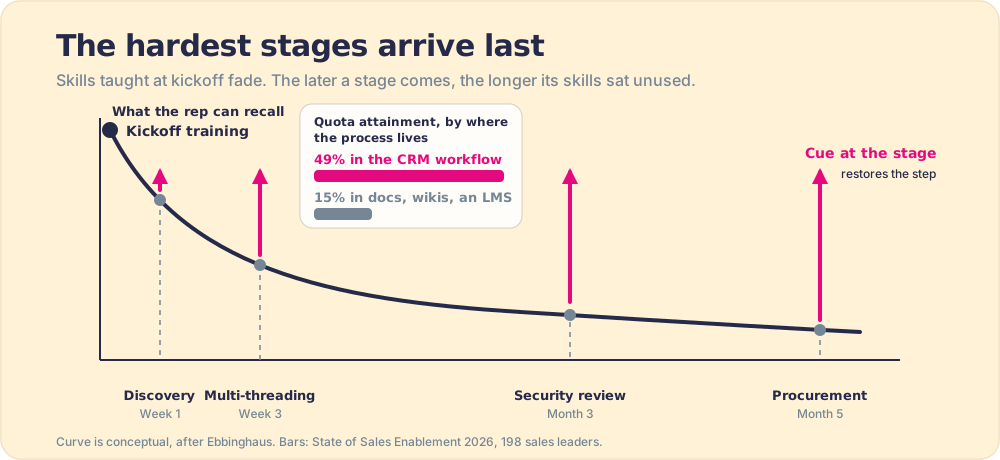
Memory has a half-life. Hermann Ebbinghaus measured it in the 1880s, and the summary line still holds: people “tend to halve their memory of newly learned knowledge in a matter of days or weeks unless they consciously review the learned material” (forgetting curve). The same body of research has a detail that matters more for B2B than for anyone else. The best time for a single review is roughly 10% to 20% of the way toward the moment the information will be needed. Learning is timed against use.
Lay a B2B deal next to that curve. The AE learns objection handling, multi-threading, the security process, and procurement tactics in onboarding or at a kickoff. Then she uses discovery skills in week one, multi-threading in week three, the security process in month three, and the procurement tactics in month five. Each skill decays on its own clock, and the late-stage skills decay longest before anyone calls on them. The deal reaches the hardest part of the climb with the least in the pack.
A mountain expedition solves this problem with logistics. Climbers on a big peak do not haul every tank of oxygen and every meal up from base camp on their backs. Teams stock a line of camps up the route in advance, so the supplies are sitting at the altitude where the body needs them. Base camp is where you train and acclimatize. The camps are where you survive. The standard B2B enablement program pours everything into base camp (onboarding, the kickoff, the certification, the content library) and sends reps up the mountain with a heavy pack that gets lighter every week.
A mountain is the same every season, and your process changes. That makes caching more useful, not less: a note cached at the security-review camp can be updated in one place when the SOC 2 report renews, while a slide from last year’s kickoff lives on in forty reps’ memories exactly as it was taught.
The evidence lines up with the picture. In our 2026 survey of 198 sales leaders, 89% said they have a defined sales process and 36% said reps follow it as designed, a 53-point gap. The variable that best separated high performers from the rest was where the process lived: 49% quota attainment when it sat in the CRM workflow, 15% when it sat in a doc, a wiki, an LMS, or a recorded video (State of Sales Enablement 2026). Two sources that never met, an 1880s memory experiment and a 2026 survey, point the same way. Knowledge delivered away from the moment of use fades, and in B2B the moment of use can be five months away.
Which moments in a B2B deal need enablement, stage by stage?
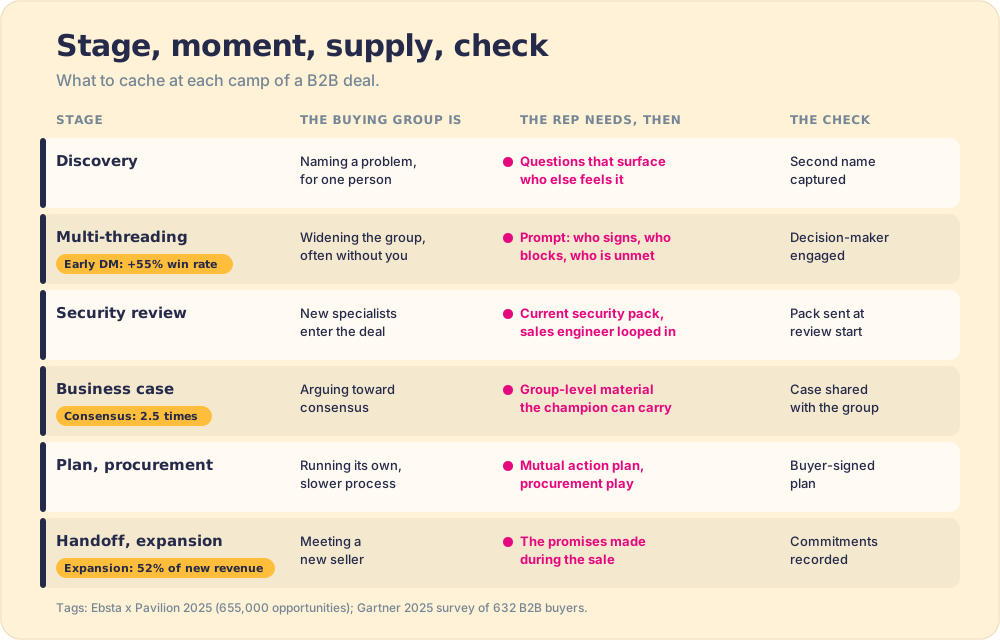
Sales enablement for B2B gets concrete at the stage level. Take your deal stages and ask, for each one, what the buying group is doing and what the rep has to do in response. You end up with a short list of moments, and each moment deserves its own cached supply: a step, a piece of content, and a check that it happened.
- The first meeting and discovery. The buyer is naming a problem, usually for one person’s reasons. The rep needs the discovery questions that surface who else feels the problem, and a required field that captures the second name before the deal can advance.
- Multi-threading. The buyer is widening the group, often without telling you. Ebsta and Pavilion’s 2025 benchmark of 655,000 opportunities found early decision-maker involvement lifts win rates by 55% (Ebsta x Pavilion 2025). The rep needs a prompt at stage two that asks who signs, who blocks, and who has not been met yet.
- The technical and security review. A security analyst and an IT architect enter the deal, people the AE has not spoken to. The rep needs the current security pack, the sales engineer looped in automatically, and the questionnaire workflow, all at the moment the review starts.
- Consensus and the business case. The group is arguing. Gartner found buying groups that reach consensus are 2.5 times more likely to report a high-quality deal, and that content tailored to the group raised consensus by 20% while content tailored to individuals had a 59% negative impact on it (Gartner, May 2025). The rep needs group-level material and help the champion can carry into rooms you are not in. Building that material is the work of buyer enablement.
- The mutual plan, legal, and procurement. The buyer has a process of their own, and it is slower than yours. The rep needs a mutual action plan with owners on both sides, co-signed before the proposal, plus the procurement playbook for the buyer’s size and industry.
- The handoff and expansion. The deal closes and a new seller takes over. Ebsta and Pavilion found customer expansion now accounts for 52% of new revenue (Ebsta x Pavilion 2025), so the handoff is the start of the next sale. The CSM needs the promises made during the sale, recorded where she will look.
Each of those moments is a trigger, and a trigger with a written response is a sales play. The practical version of a B2B sales enablement strategy is a map from stage to moment to play, delivered when the trigger fires.
Why is B2B sales enablement a relay race?
A B2C sale is usually one runner. A B2B deal is a relay. The SDR runs the first leg, hands to the AE, who pulls in a sales engineer for the technical leg, maybe a partner for implementation scoping, and then hands the account to customer success. The baton is the context: what the buyer said hurts, who signs, what was promised on price, which security concession legal approved.
In a relay, the exchange zone is the one stretch where two runners have to do something together at speed, and a clean leg means nothing if the baton hits the track. B2B deals fail the same way. The SDR’s discovery notes live in a sequence tool the AE never opens. The sales engineer’s answers to the security review sit in an email thread. The discount rationale is in a Slack DM. Then the CSM runs the kickoff call and asks the buyer questions they answered four months ago, and the buyer, who was promised a smooth handover, feels the drop.
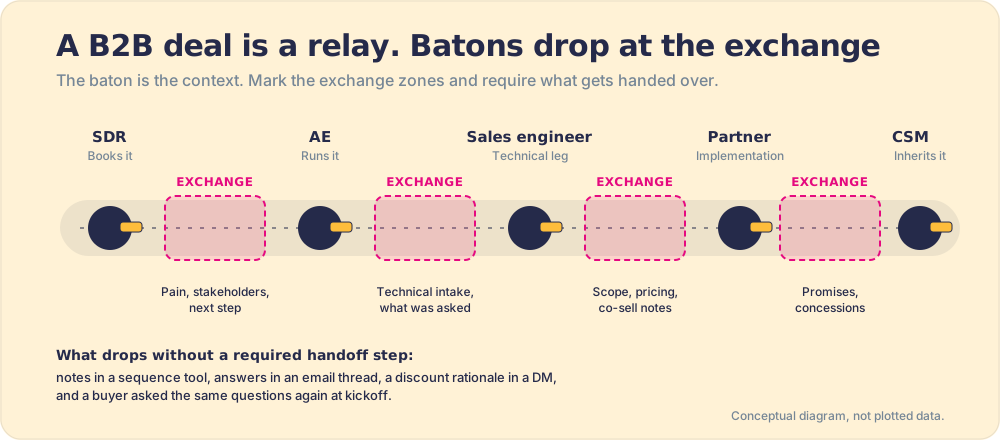
So B2B enablement covers more people than the AE. It covers every runner, and it pays special attention to the exchange zones:
- The SDR-to-AE handoff. Required fields for pain, stakeholders, and next step before the meeting can be accepted, so the AE starts with the baton in hand.
- The AE-to-sales-engineer handoff. A technical intake the AE completes before the SE joins, so the buyer does not repeat discovery to a second person.
- The partner exchange. Channel and agency partners co-selling or implementing need the same guidance inside the CRM they work in.
- The close-to-CS handoff. The commitments made during the sale, written into the record before the deal can move to closed-won.
A RevOps manager at an e-commerce services agency described this problem to me on a demo call, and I played her situation back to her like this:
From the field
As we’ve sold more, we’ve also perhaps lost some of the integrity of what is required in the upfront sales, in order to have a good handoff afterwards to your services or CS team.
The fix for a dropped baton is rarely a better runner. It is a marked exchange zone and a rule about what gets handed over. When reps skip a handoff step, the cause is almost always friction or a missing check. That is a system to repair, and it says little about the rep.
What does B2B sales enablement look like on a small team?
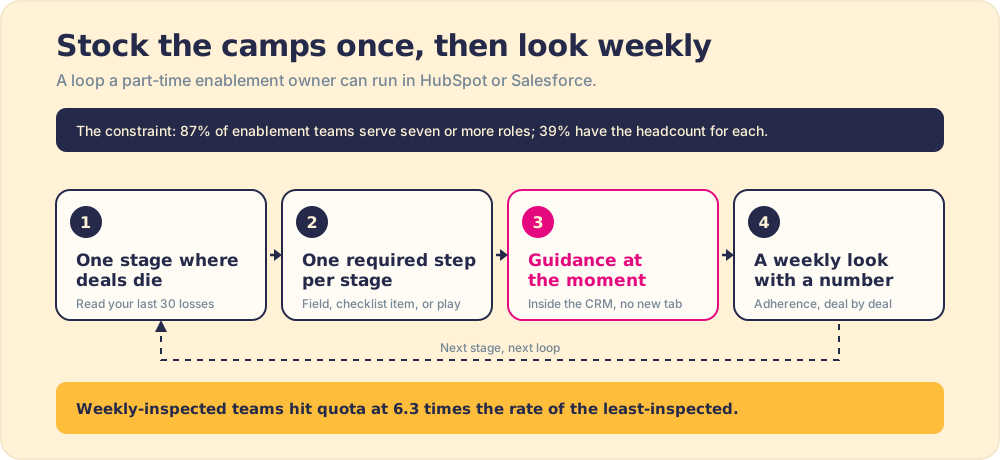
The top-ranking guides on B2B enablement assume a department. The mid-market and SMB reality is different. SBI’s 2025 research on enablement teams found 87% are expected to serve seven or more commercial roles while only 39% have the headcount to staff each role, and a modest four-person team runs a median of $585,000 a year (SBI, February 2025). A 15-rep company selling to other businesses does not have that budget. Enablement belongs to the sales manager, the RevOps lead, or the founder, on top of a full job, in HubSpot or Salesforce.
That constraint points to the same answer the forgetting curve does. A part-time owner cannot run a training calendar, maintain a content library, and chase adoption across a six-month cycle. What a part-time owner can do is stock the camps once and let the CRM carry the supplies up the mountain. A workable order for a small team:
- One stage where deals die. Pull your last 30 losses and find the stage where most stalled. For many B2B teams it is the gap between a good demo and a second stakeholder.
- One required step per stage. A field, a checklist item, or a play that must be done before the stage can change. Keep it to one or two. Reps skip lists of twelve.
- Guidance at the moment. The talk track, the security pack, or the mutual plan template shown when the rep enters the stage, inside the CRM they already use. No new tab and no new login.
- A weekly look. Review adherence to those steps deal by deal once a week with a real number. In our survey, teams inspected weekly against a defined process hit quota at 6.3 times the rate of the least-inspected teams (State of Sales Enablement 2026).
- Your best rep’s motion as the source. The steps worth caching are the ones your top performer already runs. Write theirs down; skip the consultant’s template.
This is also where the full B2B sales process and your B2B sales playbook stop being documents and start being the route itself: the stages are the camps, and the plays are what you leave at each one.
How do you measure B2B sales enablement?
Stage by stage, with the behavior first and the outcome second. Course completions tell you what happened at base camp. The measures that matter tell you whether the rep ran the step at the camp.
| Stage | Behavior to track | Outcome it should move |
|---|---|---|
| Discovery | Second stakeholder named before stage advance | Stage 1 to 2 conversion |
| Multi-threading | Decision-maker engaged before demo | Win rate |
| Security review | Current pack sent, SE assigned at review start | Days in technical stage |
| Business case and plan | Buyer-signed mutual action plan before proposal | Slip rate on close dates |
| Procurement | Procurement play run for the buyer’s segment | Cycle length, discount depth |
| Handoff | Sale commitments recorded before closed-won | Time to value, expansion revenue |
Track seller activity and the buyer’s position together. A logged step shows the process ran; the buyer’s response (a signature, a second meeting accepted, a security sign-off) shows the deal moved. You need both to trust a stage.
Where should a B2B team start?
Put one required step and the material for it at each stage of your deal, inside the CRM, and check adherence every week. Keep a lean onboarding program as the place reps learn the route, and do not ask it to carry them up the mountain.
The evidence above makes the case. Ebbinghaus found new knowledge halves in days or weeks, the hardest B2B stages arrive last, and in our survey the teams whose process lived in the CRM workflow hit quota at 49% against 15% for teams whose process lived in docs, wikis, or an LMS. Skipping it has a cost you already met in the first paragraph: an AE, five months after a good kickoff session, sending an old version of the security answers because nothing at that stage told her where the current ones were.
On a small team, “stocked” has a plain meaning. When I showed an ops lead how the rep side works, I described it like this:
From the field
There is no confusion. There’s no having them in multiple places. You just come here, you click play, and you make sure it’s at zero. And everybody owns a role.
Content platforms and course libraries still have a job at base camp, and a larger team with people to run them may want one. If you are weighing tools, our sales enablement software guide compares them against this test.
Supered is one way to stock the camps. It surfaces the step and the guidance inside HubSpot and Salesforce as the rep reaches each stage, and it measures whether the step got run, so a part-time enablement owner can see adherence without chasing it.
If you want the buyer’s side of the same climb, read buyer enablement next. It covers the material your champion carries into the rooms you never get to enter.
Frequently asked questions
What is B2B sales enablement?+
How is B2B sales enablement different from B2C sales enablement?+
What should a B2B sales enablement strategy include?+
Who owns B2B sales enablement at a small company?+
How do you measure B2B sales enablement?+
What is B2B enablement for partners and channel sellers?+
Your process, running itself.