Sales Enablement vs Sales Training: The Event and the System
Sales training is an event that puts knowledge in a rep's head. Sales enablement is the system that makes the behavior show up in deals, and training is one of its inputs. How they differ on scope, owners, metrics, tools, and budget, and how to run them together.
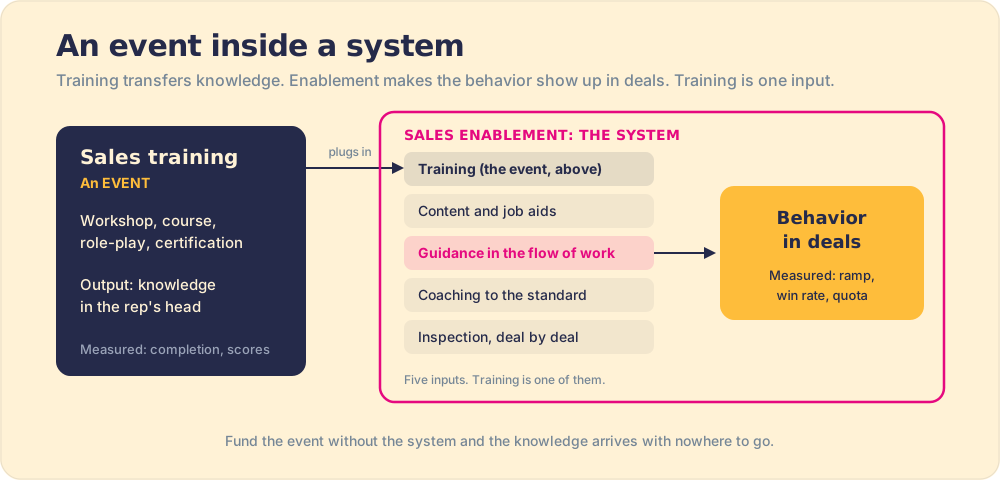
Sales enablement vs sales training is the difference between an event and a system: sales training transfers knowledge and skill in a workshop or course, while sales enablement is the system that makes the trained behavior show up in deals, with training as one of its inputs.
A new rep spends her second week in a conference room learning the discovery framework. She role-plays it twice, passes the certification, and a completion badge appears next to her name in the LMS. Five weeks later she is on her fourth discovery call of the day, the buyer mentions a budget freeze, and she does what she did at her last company: skips ahead to the demo.
The training worked, by its own measure. The badge is still there. The behavior never reached the deal.
That scene is the cleanest way into sales enablement vs sales training. Sales training is an event: a workshop, a course, a certification that moves knowledge into a rep’s head. Sales enablement is the system that makes the trained behavior show up in deals, weeks and months later, when a buyer says something inconvenient. Training is one input to that system. The two often get drawn as peers. They are nested, one inside the other, and the difference between sales training and sales enablement is which one is on the hook for the day after the workshop ends.
What is sales training?
Sales training is the structured transfer of knowledge and skill to sellers. It covers product knowledge, a sales methodology, discovery and negotiation technique, and the tools a rep uses. It happens in a bounded window: a bootcamp, a quarterly workshop, a self-paced course, a role-play session with a certification at the end.
The Sales Enablement Collective, whose page sits near the top of the results for this question, defines it as “teaching sales skills and strategies to your sales team,” through “workshops, coaching sessions, and training days with the aim of upskilling your reps” (Sales Enablement Collective). It captures the shape: training has a start date, an end date, and an attendance list.
Companies spend heavily on this. Training magazine’s 2025 industry report put U.S. training expenditures at $102.8 billion, about $874 per learner, with employees averaging 40 hours of training a year (Training magazine). The money buys a real good. A rep who has never heard of a mutual action plan cannot run one, and no prompt will teach her the whole idea mid-call. Training is how new capability enters a team. We cover how to design programs that hold up in sales training programs.
What is sales enablement?
Sales enablement is the system that makes the right behavior happen in deals, on the tenth call and the hundredth as reliably as the first. It includes training, and it adds the parts that carry training forward in time: content and job aids reps use mid-deal, guidance that appears in the flow of work, coaching against a standard, and inspection of whether the rep ran the play. We walk through the full discipline in what is sales enablement.
The Collective’s definition of enablement leans on inputs: “creating sales content, providing resources, and implementing sales technology.” We agree with the list and would judge it somewhere else. Content, resources, and tools are what enablement spends. Its output is behavior in deals, and it should be judged there.
Sales enablement vs sales training: what is the difference?
Set them side by side and the difference between sales training and sales enablement shows up in every row.
| Dimension | Sales training | Sales enablement |
|---|---|---|
| Shape | An event with a start and an end | A system that runs continuously |
| Core question | Does the rep know how? | Does the rep do it, deal after deal? |
| Scope | Skills, product, methodology | Training plus content, in-flow guidance, coaching, inspection |
| Typical owner | Trainer or learning team | Enablement lead, with managers and RevOps |
| Output | Knowledge in the rep’s head | Behavior in deals |
| Primary metrics | Completion, assessment scores, satisfaction | Behavior adoption, ramp time, win rate, quota attainment |
| Main tool | LMS | Enablement platform or in-CRM guidance |
| Failure mode | Reps never learned it | Reps learned it and do not run it |
The driving test makes the split easy to see. Driving lessons are training: a few weeks with an instructor, a test, a license. Lessons matter: a driver who never learned to reverse-park will not pick it up from a road sign. But the reason you stop at a particular junction ten years later has little to do with the lessons. A sign stands at the junction, lines are painted on the road, and a camera watches the speed limit. The road carries the behavior. The lessons got you onto it.
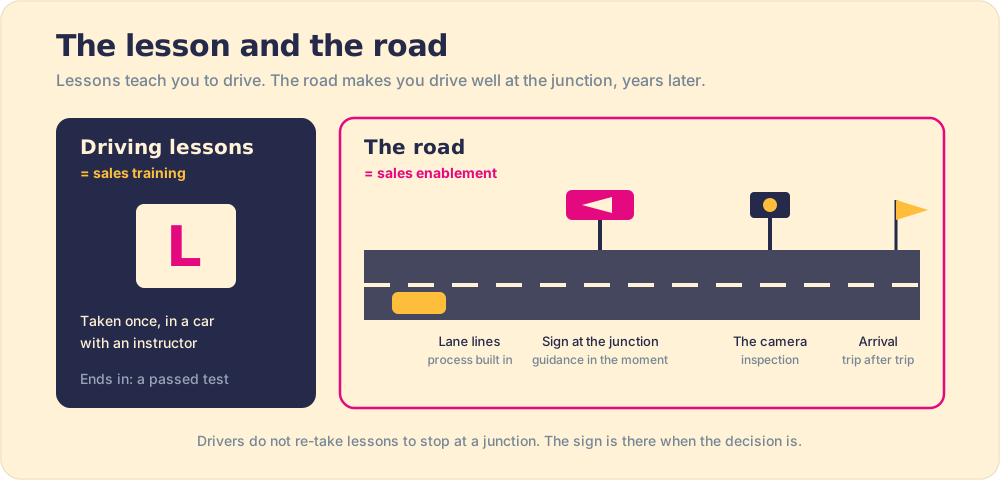
A road has a government behind the camera, though, and a sales team has managers whose time is scarce. So the inspection half of enablement has to be cheap enough to run on every deal, or it does not run.
Why doesn’t sales training alone change what reps do?
Because memory fades between the workshop and the moment of use, and because using a skill on the job depends on what surrounds the training more than on the training itself. I have watched it happen on my own teams:
From the field
I’ve trained people, I’ve documented this stuff, I’ve reminded them, and it still doesn’t stick.
Two bodies of research show why, from different angles.
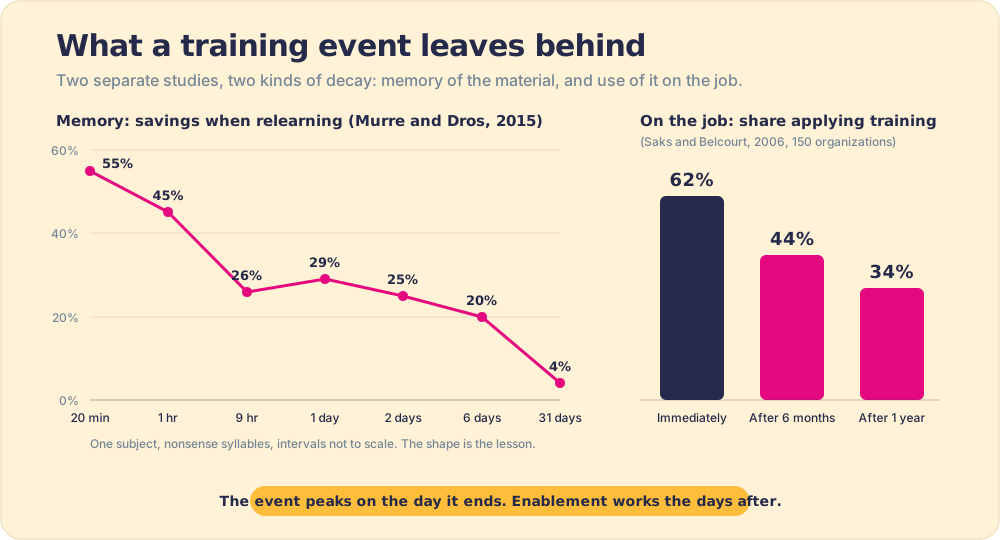
- Memory decays on a curve. In 2015 Jaap Murre and Joeri Dros replicated Hermann Ebbinghaus’s 1880 forgetting experiment and found results “similar to Ebbinghaus’ original data” (Murre and Dros, PLOS ONE). They measured savings, the share of the original learning effort you skip when you relearn something. Savings stood at 55% after 20 minutes, 45% after an hour, 29% after a day, 20% after six days, and 4% after 31 days. The study used one subject and nonsense syllables, so the exact figures will not carry over to a sales methodology. The shape is the lesson: the steepest loss comes in the first day, and a month later most of the effort has to be spent again.
- Transfer decays too. Alan Saks and Monica Belcourt surveyed training professionals at 150 organizations, who estimated that 62% of employees apply training on the job immediately, 44% after six months, and 34% after one year (Saks and Belcourt, Human Resource Management). Their sharper finding: organizations were more likely to use transfer activities during training than before or after it, yet the activities before and after were more strongly related to whether people used what they learned.
That second finding is the case for enablement in a sentence. The session is where companies spend. The days after are where transfer is won or lost. Enablement is the name for owning the days after.
The mechanism has a name in behavioral science. Peter Gollwitzer and Paschal Sheeran’s meta-analysis found that if-then plans (“if the buyer mentions a budget freeze, then I ask what changed”) had a medium-to-large effect on goal attainment, d = .65, across 94 independent tests (Gollwitzer and Sheeran, 2006). A cue tied to a situation beats a general intention. Training can teach the if-then. Enablement puts the cue in the situation.
None of this is a rep problem. The rep in the opening scene did not forget because she was careless. She forgot because the framework lived in a course she took five weeks earlier, and the call gave her four seconds to decide. When reps skip a trained step, the system around the training failed them.
How do you measure sales training vs sales enablement?
Use the Kirkpatrick model, the standard four-level frame for evaluating training, and the split draws itself. Level 1 is reaction, level 2 is learning, level 3 is behavior, level 4 is results. Kirkpatrick Partners define level 3 as “the degree to which the target audience performs the critical behaviors in its environment and is supported in and accountable for its performance,” and name job aids, manager check-ins, and observations as part of the support package (Kirkpatrick Partners). That support package is enablement, described by the people who wrote the training-evaluation standard.
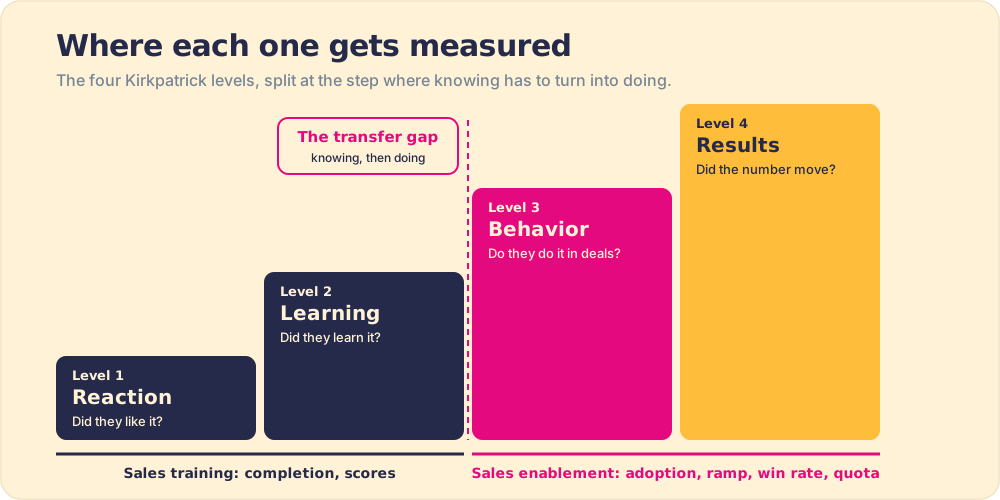
- Sales training metrics. Completion rate, assessment and certification scores, time to certification, and learner satisfaction. They answer whether the knowledge landed. We go deeper on which ones earn their place in sales training metrics.
- Sales enablement metrics. Behavior adoption (the share of deals where the trained step shows up), ramp time for new reps, win rate, and quota attainment. They answer whether the knowledge did anything.
A program can post full completion while win rate stays flat. Keep the completion number; it tells you the input arrived. It cannot tell you the output happened.
What tools and budget does each one need?
The tools follow the split between event and system, and buying the wrong one for the job spends enablement money on training.
- LMS. Hosts courses, runs certifications, tracks completion. Right for the training event. It sits outside the rep’s working day, so it reaches the rep when they choose to open it.
- Enablement platform. Holds content, plays, and guidance, and reports on usage. Right for the content half of enablement, and useful to the degree reps open it mid-deal.
- In-CRM guidance. Puts the next step, the talk track, and the required field in front of the rep inside the CRM record they already have open, and records whether they ran it. Right for the behavior half of enablement.
Where the process lives is one of the largest variables we have measured. In our survey of 198 sales leaders, teams whose process was built into the CRM workflow hit quota at 49%, against 15% for teams whose process lived in documents, wikis, or an LMS (State of Sales Enablement 2026). Same process, different address. For a side-by-side of training platforms, see our sales training software guide.
On budget, the practical rule for mid-market teams is to fund training for new capability and fund the system for consistency. If the line goes to courses and leaves the days after unfunded, the Saks and Belcourt numbers describe what you will get back.
When do you need sales training, and when do you need enablement?
Ask one question about the gap you are trying to close: can the rep do it in a role-play?
- A skill the team has never had. New product, new methodology, new segment, a first-time manager. The rep cannot do it in a role-play. That is a training problem, and training is the right first spend.
- A skill the team has and does not use. Reps can recite the discovery questions and skip them on calls. More training repeats an event whose effect you have already watched fade. That is an enablement problem.
- A skill that decays under pressure. Reps run the process in easy deals and drop it in late-stage, high-stakes ones. That calls for guidance at the moment and inspection afterward, which is enablement.
- A new hire. Both, in order: training for the foundation, then the system so the foundation shows up by the fourth call of the day.
The diagnostic decides the budget line; our advice on designing the training itself lives in sales training best practices.
How do sales training and sales enablement work together?
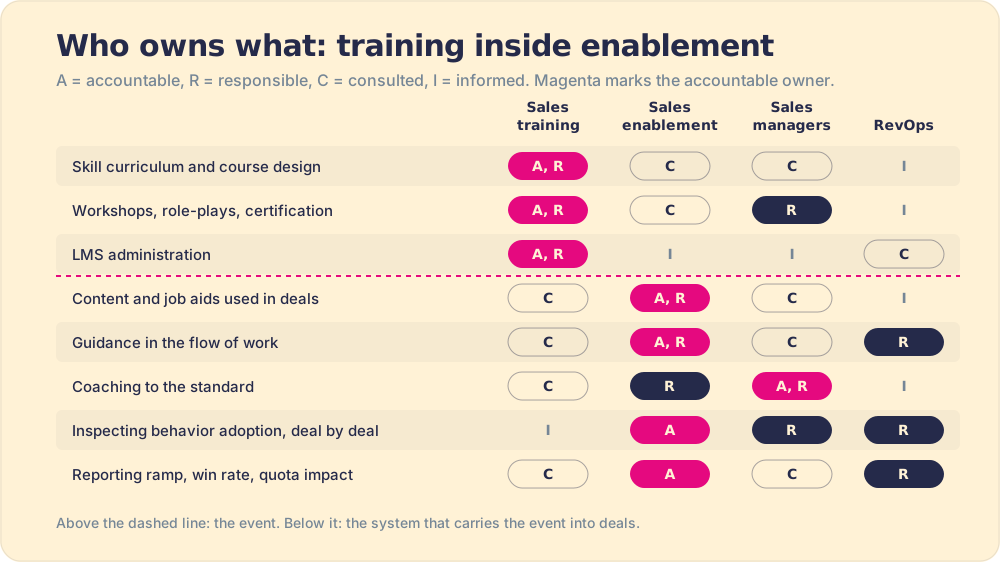
Treat training as a subsystem of enablement with its own owner, and assign every hand-off on purpose. The RACI below is the split we recommend (R = responsible, A = accountable, C = consulted, I = informed).
| Work | Sales training | Sales enablement | Sales managers | RevOps |
|---|---|---|---|---|
| Skill curriculum and course design | A, R | C | C | I |
| Workshops, role-plays, certification | A, R | C | R | I |
| LMS administration | A, R | I | I | C |
| Content and job aids used in deals | C | A, R | C | I |
| Guidance in the flow of work | C | A, R | C | R |
| Coaching to the standard | C | R | A, R | I |
| Inspecting behavior adoption, deal by deal | I | A | R | R |
| Reporting ramp, win rate, quota impact | C | A | C | R |
Two design choices carry the weight.
- Managers own coaching. Coaching is the bridge from the workshop to the call, and it belongs with the person who watches the calls. The Sales Enablement Collective reports that teams coaching more than two hours a week hit a 56% win rate, against 43% with minimal coaching (Sales Enablement Collective). We cover how to make that hour count in sales coaching.
- Enablement owns inspection. You can only expect what you inspect. In our survey, teams that consistently inspect deals against a defined process hit quota at 6.3 times the rate of teams that rarely do (State of Sales Enablement 2026). Inspection is also how training gets better: the deals show which trained step reps skip, and that becomes the next curriculum.
Manual inspection eats the hours managers would spend coaching, which is why the inspection half has to be automated wherever it can be. Supered is one way to do that. It puts the process in front of the rep in the flow of work inside HubSpot and Salesforce and records whether each step ran, which we call the Behavior Layer.
So should you fund sales training or sales enablement first?
Put your training program inside enablement, under one owner accountable for Kirkpatrick levels three and four: whether the trained behavior shows up in deals, and what it does to ramp, win rate, and quota.
Training still earns its budget whenever the team faces a skill it has never had; skip it and there is nothing for the system to carry. But the research above is plain about what an event leaves behind. Murre and Dros measured savings at 4% after 31 days, Saks and Belcourt’s training professionals estimated on-the-job use falling from 62% to 34% within a year, and in our survey teams whose process lived in documents, wikis, or an LMS hit quota at 15% against 49% for teams with it built into the CRM workflow. The price of funding the event alone is the rep from the opening: certified in week two, skipping to the demo in week seven.
Keep training’s own scorecard for completion and certification. Judge the whole system on the four jobs I walk buyers through on demo calls:
From the field
You must collect the expectations, you must equip them where they are, you must measure them against those expectations, and then you must reinforce that over time.
This post is one of three on where enablement’s edges sit. Sales enablement vs sales operations draws the line between the system reps run on and the behavior itself, and sales enablement vs product marketing follows a launch message from the deck to the deal. The data behind the 49% and the 6.3x lives in the State of Sales Enablement.
Frequently asked questions
What is the difference between sales training and sales enablement?+
Is sales training part of sales enablement?+
Who owns sales training vs sales enablement?+
How do you measure sales training vs sales enablement?+
Do I need an LMS if I have a sales enablement platform?+
When should a company invest in sales training instead of sales enablement?+
Your process, running itself.